El SEO técnico es la capa de infraestructura que sustenta todo lo demás que haces en las búsquedas. El contenido brillante, los backlinks fuertes y la segmentación perfecta de palabras clave no rinden al máximo cuando la base técnica está rota. Y según los datos de auditoría de sitios más completos disponibles en 2026, El 72% de los sitios web tienen páginas lentas., El 95.2% tiene problemas de redireccionamiento., El 59.5% tiene etiquetas H1 faltantes, y El 80.4% tiene atributos alt de imagen faltantesEstos no son casos excepcionales en sitios web mal mantenidos, sino la norma estadística en toda la web.
La ironía del SEO técnico en 2026 es que los estándares son más altos que nunca (los umbrales de Core Web Vitals de Google, la transición de FID a INP, el papel ampliado de los datos estructurados en Funciones de búsqueda generadas por IA), mientras que la mayoría de los sitios web siguen fallando en aspectos básicos que deberían haber corregido hace años. Esta brecha entre lo que Google exige y lo que la mayoría de los sitios ofrecen representa la oportunidad clave en el SEO técnico actual.
El estado del SEO técnico en 2026: Las cifras más destacadas
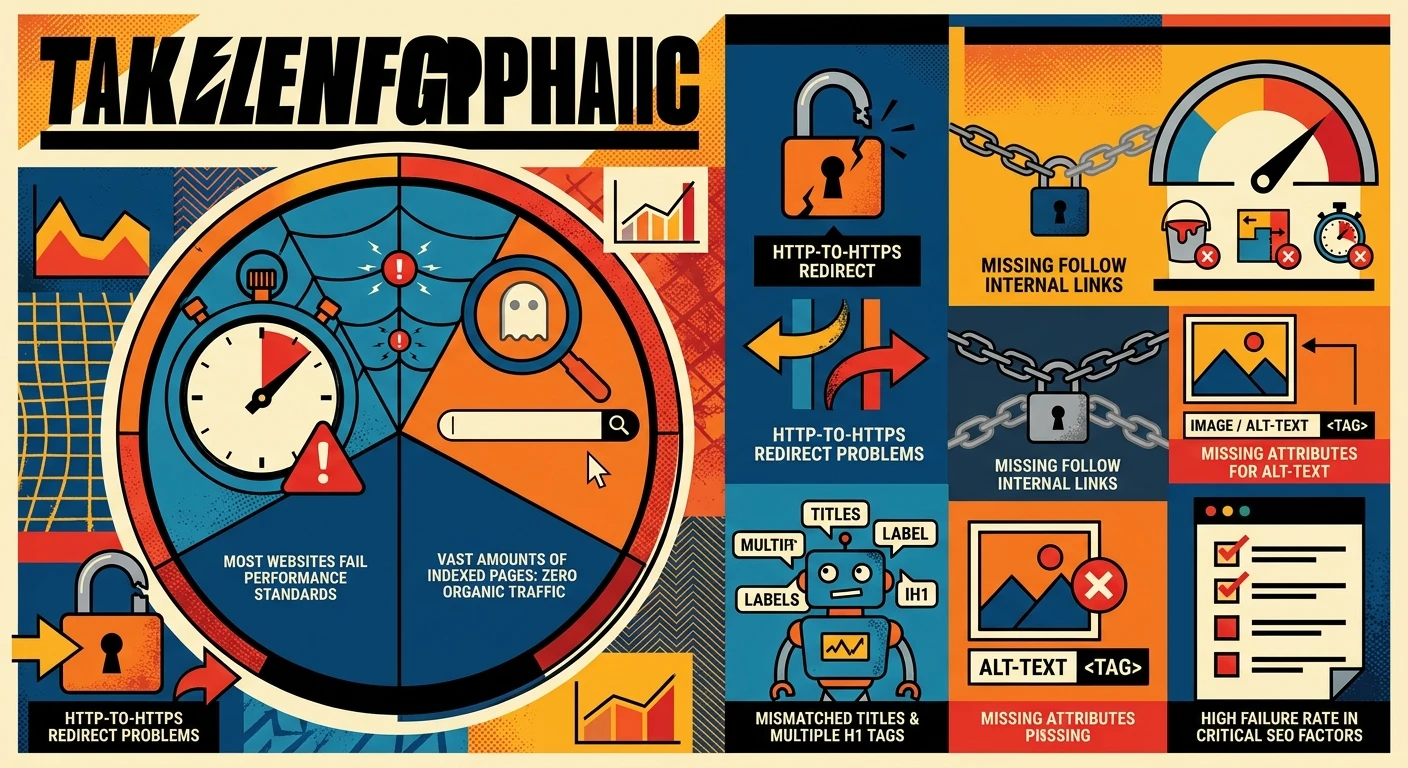
Antes de profundizar en categorías específicas, estas estadísticas generales establecen el panorama general:
72% de sitios web Las páginas son lentas y no cumplen con los estándares de rendimiento de Google.
96.55% de todas las páginas indexadas recepción cero tráfico orgánico desde Google
Solo el 33% de los sitios web superar el umbral de Core Web Vitals de Google
72% de sitios web fallar al menos en un factor técnico crítico de SEO
95.2% de sitios web tienen problemas de redireccionamiento 3XX
88% de sitios web tienen problemas de redirección de HTTP a HTTPS
80.4% de sitios web tienen atributos alt faltantes
59.5% de los sitios tienen etiquetas H1 faltantes
51.3% de los sitios tienen múltiples etiquetas H1 (un problema conflictivo con lo anterior)
66.2% de los sitios tener al menos una página con un solo enlace interno "seguir"
68.5% de los sitios tienen títulos de página y SERP que no coinciden
Los datos revelan una realidad innegable: la mayoría de los sitios web en internet presentan problemas técnicos de SEO significativos y solucionables que limitan directamente su visibilidad orgánica. Para cualquier profesional del SEO, esto resulta a la vez alarmante y esclarecedor: la auditoría técnica de SEO no es un lujo, sino una labor de remediación esencial.
Estadísticas de rastreo e indexación
Googlebot solo puede clasificar lo que puede rastrear e indexar. Los problemas de rastreo e indexación son los fallos técnicos de SEO más fundamentales, ya que impiden que el contenido se tenga en cuenta para la clasificación.
Estadísticas de indexación:
96.55% Todas las páginas no reciben tráfico de búsqueda de Google: la asombrosa magnitud del contenido desperdiciado.
Sólo 1.94% De todas las páginas, entre 1 y 10 reciben visitas orgánicas mensuales.
Sólo 1.74% de las páginas recién publicadas alcanzan el top 10 de Google en un año
Google mantiene un índice web de aproximadamente 400 mil millones de documentos
15% de todas las búsquedas de Google nunca se han realizado antes
Problemas de eficiencia del rastreo:
Problema | Predominio |
Cadenas de redireccionamiento 3XX | 95.2% de sitios web |
Problemas de redirección de HTTP a HTTPS | 88% de sitios web |
Páginas que enlazan a URL de redireccionamiento | 62.7% de los sitios |
Páginas huérfanas (un enlace interno) | 66.2% de los sitios |
Problemas con las etiquetas canónicas (comercio electrónico) | 53% de los sitios de comercio electrónico |
Los enlaces rotos | 62.4% de los sitios de comercio electrónico |
Errores de Hreflang (de los usuarios) | Más del 67% de los sitios lo utilizan. |
Problemas de contenido duplicado | 38.78% de sitios de alta visibilidad |
92% de los sitios con peor rendimiento |
El presupuesto de rastreo es un recurso limitado, especialmente para grandes sitios de comercio electrónico. Cada cadena de redireccionamiento, cada página huérfana y cada enlace roto desperdician presupuesto de rastreo que podría destinarse a contenido que realmente se desea indexar. La prevalencia del 95.2 % de problemas de redireccionamiento es particularmente significativa: significa que la limpieza de cadenas de redireccionamiento es una oportunidad de SEO técnico casi universal.
Indicadores básicos de rendimiento web: El estándar de rendimiento que la mayoría de los sitios aún no alcanzan
Las métricas Core Web Vitals (CWV) de Google son el marco técnico principal para medir la experiencia de usuario en las páginas web. Son a la vez un indicador de posicionamiento y un indicador de la calidad general del sitio, y la mayoría de los sitios aún no las cumplen.
Tasas de aprobación del CWV (2026):
Métrico | Tasa de aprobación en escritorio | Tasa de aprobación móvil |
LCP (Bueno: <2.5 s) | 58% | 43% |
INP (Bueno: <200 ms) | 78% | 65% |
CLS (Bueno: <0.1) | 78% | 74% |
Los tres combinados | 63% | 42% |
Sólo 33% de todos los sitios web superan el umbral de Core Web Vitals según el estudio de Ahrefs. Según el Web Almanac 2025, solo 48% de páginas móviles y 56% de las páginas de escritorio Superar las tres métricas. El rendimiento móvil sigue siendo el principal desafío, y a la vez la principal oportunidad.
INP (Interacción con la siguiente pintura) Actualmente, la métrica de Core Web Vitals que más falla es la que más falla, tras haber reemplazado a FID (First Input Delay) en marzo de 2024. INP mide la rapidez con la que una página responde a la interacción del usuario, una métrica más completa y exigente que su predecesora. Esta transición ha generado una nueva oleada de fallos en CWV en sitios que antes los superaban.
Tasas de aprobación de CWV por plataforma CMS (móvil):
CMS | Tasa de aprobación de CWV (móvil) |
Shopify | 64% |
Next.js | 58% |
Squarespace | 56% |
Wix | 49% |
WordPress | 38% |
Joomla | 31% |
Magento | 28% |
WordPress potencia aproximadamente 43% de la web aún solo 38% de los sitios de WordPress Supera las tres métricas principales de rendimiento web en dispositivos móviles. La tasa de éxito de Magento, del 28 %, es la más baja entre las principales plataformas de comercio electrónico, lo cual es significativo dado su uso por parte de grandes minoristas. La diferencia entre Shopify (64 %) y Magento (28 %) es de 36 puntos porcentuales, atribuible exclusivamente a la arquitectura de la plataforma y a la optimización del rendimiento predeterminada.
Problemas técnicos en la página: Los problemas más comunes
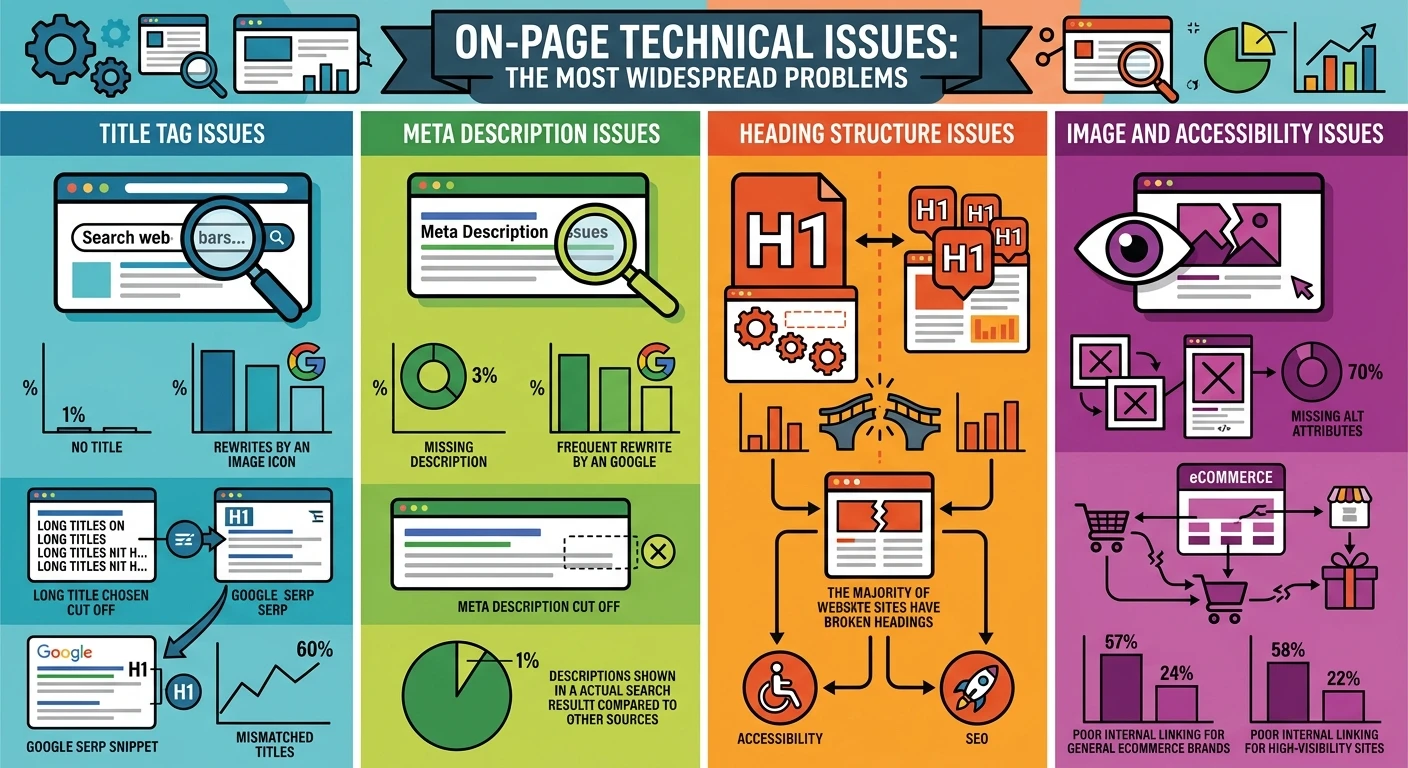
Problemas con la etiqueta de título:
7.4% Muchas de las páginas mejor posicionadas no tienen etiqueta de título.
Google reescribe las etiquetas de título 76% del tiempo (datos del primer trimestre de 2025)
Google es 57% más de probabilidades reescribir las etiquetas de título que son demasiado largas
Cuando Google ignora tu etiqueta de título, utiliza la etiqueta H1. 50.76% del tiempo
68.5% Los sitios tienen títulos de página y títulos de SERP que no coinciden.
Problemas con la meta descripción:
25% Las páginas mejor posicionadas no tienen meta descripción.
Google reescribe las meta descripciones. 62.78% del tiempo
40.61% Las páginas tienen meta descripciones que se truncan en los resultados de búsqueda.
Google solo muestra meta descripciones en los resultados. 37.22% del tiempo
Problemas de estructura de encabezados:
59.5% Los sitios tienen etiquetas H1 faltantes
51.3% Los sitios tienen múltiples etiquetas H1
La combinación de estos dos problemas provoca que la estructura de encabezados esté dañada en la mayoría de los sitios web, lo que perjudica tanto las señales SEO como la accesibilidad.
Problemas de imagen y accesibilidad:
80.4% Los sitios web tienen atributos alt faltantes
53.1% Las páginas de inicio tienen texto alternativo faltante para las imágenes.
La falta de atributos alt afecta tanto al SEO (indexación de imágenes de Google) como a la accesibilidad (usuarios de lectores de pantalla).
86% Las marcas de comercio electrónico carecen de enlaces internos optimizados.
Incluso 41% Los sitios de comercio electrónico de alta visibilidad tienen enlaces internos deficientes.
Estadísticas de enlaces internos
El enlazado interno es una de las prácticas de SEO técnico más impactantes y, a la vez, más descuidadas:
66.2% Los sitios tienen páginas con un solo enlace interno de seguimiento.
86% Las marcas de comercio electrónico tienen estructuras de enlaces internos subóptimas.
Las URL con un mayor número de variaciones de texto de anclaje de los enlaces internos son altamente correlacionado con un mayor tráfico orgánico
Las páginas con al menos un enlace interno de texto de anclaje de coincidencia exacta tenían 5 veces más tráfico que páginas sin
62.7% Los sitios enlazan a URL de redireccionamiento desde enlaces internos, desperdiciando PageRank.
Los datos de enlaces internos revelan una gran oportunidad perdida. Corregir la arquitectura de enlaces internos, especialmente en sitios de comercio electrónico con miles de páginas de productos, suele ser una de las intervenciones de SEO técnico con mayor retorno de la inversión.
Estadísticas de enlaces entrantes y salud de los enlaces
66.5% Todos los enlaces creados en los últimos nueve años ya no funcionan (enlaces rotos).
73.6% de dominios tienen enlaces recíprocos
43.7% Las páginas mejor posicionadas tienen algunos enlaces recíprocos.
10.6% Todos los backlinks son nofollow.
Las páginas mejor clasificadas obtienen nuevos backlinks seguidos de dominios de referencia a un ritmo de +5–14.5% mensual
La mayoría de las páginas mejor clasificadas también se encuentran entre las 10 primeras durante casi Otras 1,000 palabras clave
Hay un fuerte correlación positiva entre el número de dominios de referencia y el tráfico de búsqueda
Estadísticas de esquemas y datos estructurados
El marcado de esquema es una implementación técnica de gran impacto que la mayoría de los sitios web aún omiten o implementan incorrectamente:
Páginas con esquema logran 20-40 % más CTR
Se obtienen resultados excelentes 82% más CTR que los fragmentos estándar
Los sitios web con esquema reciben 4 veces más fragmentos enriquecidos que los sitios sin
El esquema del producto ofrece 4.2 veces más Visibilidad en Google Shopping
Las descripciones generales de IA de Google utilizan datos estructurados como un fuente principal
Schema.org ahora incluye Más de 800 tipos de esquema
Los fragmentos destacados de Google aparecen para 30.9% de consultas desde la posición #1
Inteligencia artificial y SEO técnico: la intersección emergente
La integración de la IA en los productos de búsqueda de Google ha creado nuevos requisitos técnicos de SEO que no existían hace 18 meses:
74% Todo el contenido web nuevo publicado ahora contiene contenido generado por IA.
Las descripciones generales de IA están asociadas con un 34.5% reducción de clics para páginas que aparecen en los resultados de búsqueda
Cuentas de YouTube para el 23.3% de citas en Google AI Overviews: el dominio más citado
Wikipedia aparece en el 18.4% Descripción general de la IA citas
48% Los principales sitios web de noticias ahora bloquean los rastreadores de OpenAI.
24% Bloquear el rastreador de IA de Google
El contenido citado por IA es un 25.7 % más reciente. En promedio, las páginas que se posicionan orgánicamente —las señales de frescura se están volviendo más importantes—.
El bloqueo de los rastreadores de IA por parte de las principales editoriales crea un panorama técnico fragmentado donde las diferentes decisiones técnicas sobre robots.txt y los permisos de los rastreadores afectan ahora a la visibilidad en múltiples superficies de búsqueda impulsadas por IA simultáneamente.
Preguntas Frecuentes
Los cinco problemas técnicos de SEO más comunes en 2026 son la lentitud de carga de la página (72.3 % de los sitios), los problemas de redireccionamiento 3XX (95.2 %), la falta de etiquetas H1 (59.5 %), la falta de atributos alt (80.4 %) y un enlazado interno deficiente (66.2 %). Solucionar estos problemas principales mejoraría significativamente la visibilidad orgánica de la mayoría de los sitios web.
Solo el 33 % de todos los sitios web superan el umbral de Core Web Vitals, y en dispositivos móviles, solo el 42 % de los orígenes superan las tres métricas. INP es ahora la métrica que más falla tras la sustitución de FID en marzo de 2024.
Los problemas de redireccionamiento afectan al 95.2 % de los sitios web, y cada redireccionamiento en cadena diluye la transmisión de PageRank y desperdicia el presupuesto de rastreo. El problema se agrava por el hecho de que el 62.7 % de los sitios también tienen enlaces internos que apuntan a URL de redireccionamiento en lugar de a las URL de destino final.
Sí, aunque el esquema no influye directamente en el posicionamiento, las páginas con marcado alcanzan tasas de clics entre un 20 % y un 40 % superiores, y los resultados enriquecidos logran un CTR un 82 % mayor que los fragmentos estándar. El esquema también es cada vez más importante para la visibilidad en las Resúmenes de IA de Google, que utilizan datos estructurados como fuente principal.
Sí, las páginas con enlaces internos de texto ancla que coinciden exactamente reciben cinco veces más tráfico que las que no los tienen. A pesar de esto, el 86 % de las marcas de comercio electrónico tienen estructuras de enlaces internos subóptimas y el 66.2 % de los sitios tienen páginas con un solo enlace interno "follow", lo que convierte al enlazado interno en una de las mejoras técnicas de SEO con mayor retorno de la inversión.