Ogni millisecondo che il tuo sito web impiega a caricarsi è un millisecondo in cui un potenziale cliente riconsidera se vuole fare affari con te. Può sembrare un'affermazione esagerata finché non si vedono i numeri, e allora sembra un eufemismo.
Nel 2026, la velocità di caricamento delle pagine non è più una preoccupazione "tecnica" che vive silenziosamente nel backlog. È una priorità assoluta. fattore di reddito, una variabile di ranking di ricerca e, sempre più spesso, la prima vera impressione che il tuo marchio dà a qualsiasi visitatore. Con il traffico mobile che ora rappresenta più del 62% di tutte le visite web globali e Google che ha inasprito i requisiti Core Web Vitals con il suo Aggiornamento dell'algoritmo principale di marzo 2026Ignorare il divario tra un sito veloce e uno lento non è mai stato così costoso.
Questo articolo raccoglie le statistiche più importanti e aggiornate sulla velocità di caricamento delle pagine web per il 2026, dai benchmark sui tempi di caricamento e i dati sulla frequenza di rimbalzo alle correlazioni con il posizionamento SEO e l'impatto reale sui ricavi. Che tu sia uno sviluppatore, un marketer o un imprenditore, questi numeri raccontano una storia che devi assolutamente conoscere.
Lo stato delle prestazioni web nel 2026: una panoramica
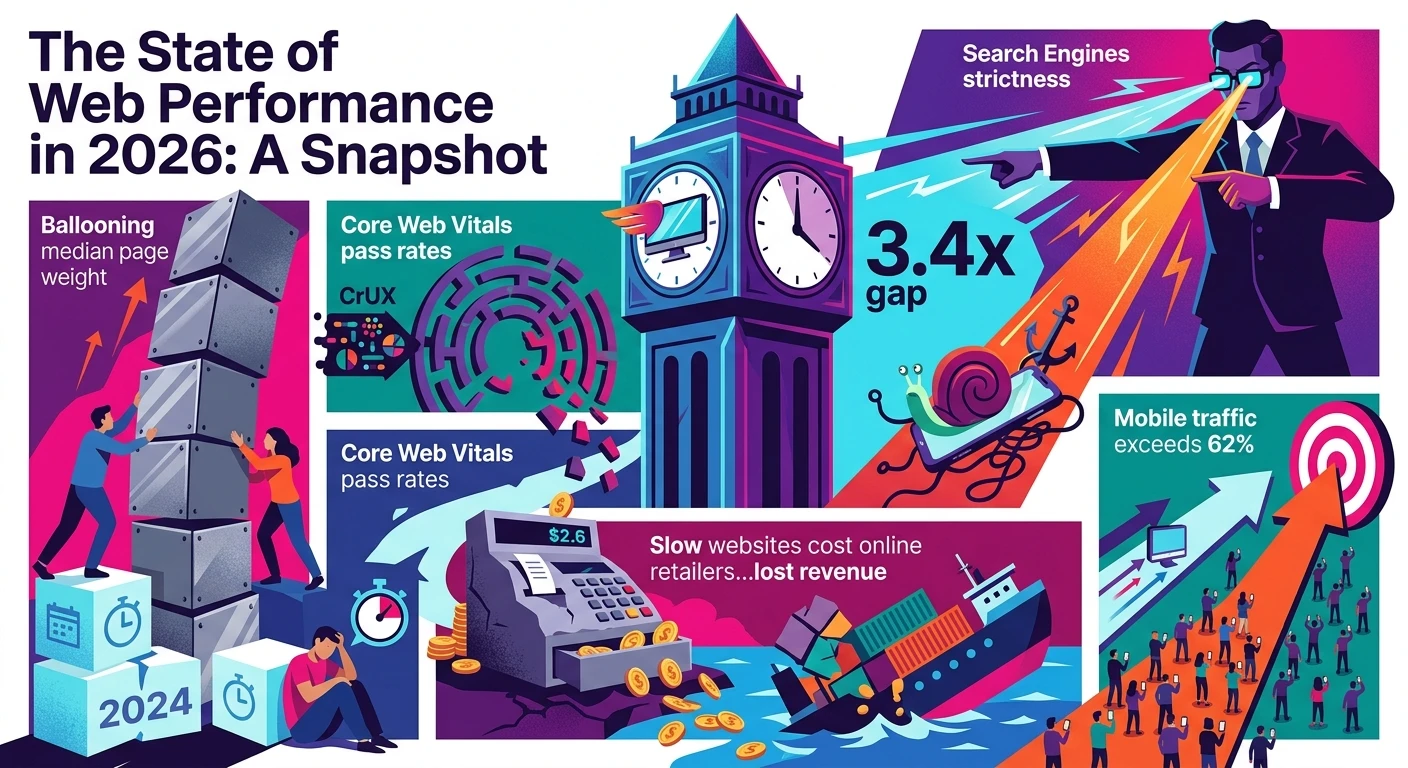
Prima di addentrarci nei dati più dettagliati, ecco a che punto si trova il web a metà del 2026:
Il sito web desktop medio si carica in 2.5 secondi, mentre il sito web mobile medio impiega un tempo sbalorditivo 8.6 secondi — un divario di 3.4 volte che continua a costare alle aziende miliardi.
Il traffico mobile supera Il 62% di tutte le visite web, tuttavia i tassi di superamento del Core Web Vitals su dispositivi mobili sono molto inferiori rispetto a quelli su computer desktop.
A soli 42% delle origini mobili and Il 63% delle origini desktop Secondo i dati di CrUX, il sistema supera tutti e tre i Core Web Vitals.
I siti web lenti costano ai rivenditori online una cifra stimata $ 2.6 miliardi in perdite di fatturato annuali.
Il peso medio della pagina è aumentato vertiginosamente 2.3 MB — in aumento del 12% rispetto al 2024 — mentre la pazienza degli utenti è solo diminuita.
La brutale ironia del 2026 è questa: le pagine web diventano sempre più pesanti, gli utenti sempre più impazienti e i motori di ricerca sempre più severi. Questa combinazione sta trasformando la velocità di caricamento delle pagine nel fattore determinante per la competitività del web moderno.
Parametri di riferimento per i tempi medi di caricamento: a che punto si trova il tuo sito?
Per capire se un sito web è veloce o lento, è necessario contestualizzarlo. I tempi di caricamento variano significativamente in base al tipo di dispositivo, alla velocità di connessione e alla posizione geografica. I seguenti benchmark, tratti dai dati di Google CrUX e HTTP Archive, forniscono proprio questo contesto.
Per dispositivo e tipo di connessione:
Tipo di connessione | Tempo medio di caricamento |
Banda larga in fibra ottica (oltre 100 Mbps) | 1.9 secondi |
Banda larga via cavo (50–100 Mbps) | 2.5 secondi |
Mobile 5G | 1.8 secondi |
Connessione 4G LTE | 4.7 secondi |
DSL (10–25 Mbps) | 5.2 secondi |
Connessione 3G | 12.4 secondi |
3G lento / mercati emergenti | 19.2 secondi |
Il divario prestazionale tra dispositivi mobili e desktop rappresenta la sfida cruciale per le prestazioni web nel 2026. Le pagine desktop beneficiano di processori più veloci, connessioni stabili e un minor numero di processi in background in competizione. Le pagine mobile, invece, devono fare i conti con hardware meno potente, condizioni di rete variabili e carichi di lavoro JavaScript più pesanti. Per la maggior parte delle aziende, la maggior parte del traffico proviene da dispositivi mobili, il che rende il tempo medio di caricamento di 8.6 secondi su mobile una vera e propria emergenza, non una semplice nota a piè di pagina.
Per geografia:
La dimensione geografica dei tempi di caricamento è spesso sottovalutata. Un utente in Corea del Sud potrebbe impiegare 3.1 secondi per caricare il tuo sito, mentre un utente nel Sud-est asiatico potrebbe attendere 9.7 secondi e un visitatore dell'Africa subsahariana potrebbe doverne aspettare 14.1. Se il tuo hosting è disponibile solo negli Stati Uniti, i visitatori europei subiranno un ritardo aggiuntivo di 200-400 ms, mentre i visitatori dell'Asia-Pacifico ne subiranno 400-700 ms in più, semplicemente perché il tuo server si trova nel continente sbagliato.
Aspettative degli utenti nel 2026: la pazienza sta per finire.
I dati sulle aspettative degli utenti nei confronti dei siti web sono sorprendentemente coerenti. Anni di ricerca e migliaia di studi hanno dimostrato che la tolleranza umana verso le pagine a caricamento lento è rimasta pressoché invariata, e semmai l'influenza delle app native ultraveloci ha reso gli utenti ancora meno indulgenti.
47% degli utenti Aspettatevi che una pagina si carichi in due secondi o meno.
53% dei visitatori da dispositivi mobili Abbandonerò il sito se il caricamento richiede più di tre secondi.
40% di tutti gli utenti Il sistema abbandonerà il sistema se il caricamento di una pagina richiede più di tre secondi, indipendentemente dal dispositivo.
70% di consumatori affermano che la velocità di caricamento delle pagine influisce direttamente sulla loro decisione di acquistare da un sito web.
79% di acquirenti online Chi riscontra problemi di prestazioni afferma che non tornerà su quel sito.
80% degli utenti Secondo quanto riportato, un sito web che si carica lentamente è più frustrante di un sito web temporaneamente non disponibile, ovvero le persone preferiscono visualizzare una pagina di errore pulita piuttosto che rimanere bloccate a guardare un'icona di caricamento per cinque secondi.
Forse la statistica più significativa di tutte: quando un sito web si carica lentamente, circa Il 50% degli utenti aggiorna la pagina una volta, il 22% chiude completamente la scheda e il 14% naviga direttamente al sito di un concorrente.Quest'ultimo gruppo, ovvero il 14% di utenti che si rivolgono direttamente alla concorrenza, non rappresenta solo una visita persa, ma un vero e proprio regalo per chi si posiziona al secondo posto nella pagina dei risultati.
Uno studio di Ericsson ha rilevato che I livelli di stress aumentano del 33% quando il contenuto impiega più di sei secondi ad apparire sullo schermo. Le prestazioni web non sono solo un problema aziendale; sono, in un senso molto misurabile, un problema di salute pubblica.
Velocità di caricamento delle pagine e frequenza di rimbalzo: i numeri che dovrebbero tenervi svegli
La frequenza di rimbalzo è l'indicatore più chiaro e immediato di come gli utenti reagiscono alla velocità di caricamento delle pagine. La relazione è quasi perfettamente lineare: ogni secondo aggiuntivo di tempo di caricamento spinge un numero maggiore di utenti ad abbandonare il sito.
Tempo di caricamento | Frequenza di rimbalzo | Variazione rispetto alla linea di base di 1 secondo |
0–1 secondo | 26% | Linea di base |
1 – 3 secondi | 32-38% | da +23% a +46% |
1 – 5 secondi | 52% | + 100% |
1 – 10 secondi | 67% | + 158% |
10+ secondi | % 85 + | +227%+ |
Il dato più significativo emerso dall'analisi di Google su 900,000 landing page di annunci per dispositivi mobili è uno dei più citati in tutta la ricerca sulle prestazioni web: Man mano che il tempo di caricamento passa da 1 secondo a 3 secondi, la probabilità di un rimbalzo aumenta del 32%. Quando una pagina impiega 10 secondi a caricarsi, quella probabilità aumenta del 123%.
Per comprendere meglio il significato pratico di questi numeri: un sito che attualmente si carica in 5 secondi e attrae 100,000 visitatori al mese ne perde circa 50,000 prima ancora che visualizzino un singolo contenuto. Se anche solo il 2% di questi visitatori persi si convertisse in clienti, si tratterebbe di migliaia di opportunità mancate ogni singolo mese.
L'impatto delle pagine lente sul fatturato: calcolare i costi
La motivazione più convincente per investire nella velocità di caricamento delle pagine non risiede nel posizionamento sui motori di ricerca, nella frequenza di rimbalzo o nei punteggi di soddisfazione degli utenti. Riguarda il denaro. E nel 2026, la validità finanziaria dell'ottimizzazione delle prestazioni è più evidente che mai nella storia del marketing digitale.
Tasso di conversione in base al tempo di caricamento:
Tempo di caricamento | Tasso di conversione | Impatto sul fatturato (sito con un fatturato annuo di 10 milioni di dollari) |
0–1 secondo | ~40% (valore di base) | Massimo |
1 – 2 secondi | Da -3% a -7% | -$300 a -$700 all'anno |
2 – 3 secondi | Da -7% a -15% | Da -$700 a -$1.5 milioni all'anno |
3 – 5 secondi | Da -15% a -30% | -1.5 milioni di dollari a -3 milioni di dollari all'anno |
5 – 10 secondi | Da -30% a -50% | -3 milioni di dollari a -5 milioni di dollari all'anno |
10+ secondi | -50%+ | -5 milioni di dollari all'anno |
I singoli dati riportati in questa tabella meritano di essere letti con attenzione:
A Un ritardo di 1 secondo nel caricamento della pagina riduce le conversioni fino al 20%. e le visualizzazioni di pagina dell'11%. Per ogni 100 ms di latenza aggiuntiva, le conversioni diminuiscono di circa l'1%. Un miglioramento di 0.1 secondi nella velocità può aumentare le conversioni del 8.4% per i siti di vendita al dettaglio and 10.1% per i siti web di viaggi. I siti web che si caricano in un secondo generano Ricavi per utente 2.5 volte superiori rispetto ai siti che impiegano cinque secondi a caricarsi.
La BBC ha scoperto che il suo sito web perde Il 10% dei suoi visitatori per ogni secondo aggiuntivo del tempo di caricamento: una cifra straordinaria per un editore con miliardi di visualizzazioni di pagina mensili. Si stima che i siti di e-commerce lenti nel mercato statunitense perdano complessivamente 4.2 miliardi di dollari di fatturato annuo.
Forse la formulazione più semplice deriva dal caso studio di Amazon: Ogni 100 ms di latenza costa ad Amazon l'1% delle sue vendite. Quella singola scoperta, pubblicata nel 2009, ha dato il via al settore delle prestazioni web e rimane valida oggi come lo era allora.
Casi di studio reali: i miglioramenti in termini di velocità generano ricavi concreti.
Le statistiche di cui sopra acquistano un significato molto più concreto se applicate ad aziende reali, decisioni reali e risultati reali.
Vodafone È uno dei casi di successo in termini di velocità meglio documentati. Dopo aver migliorato del 31% il proprio Largest Contentful Paint, Vodafone ha registrato un aumento dell'8% delle vendite, un miglioramento del 15% nel tasso di conversione da lead a visita e un miglioramento dell'11% nel tasso di conversione da carrello a visita. L'intero intervento è stato un progetto di ottimizzazione mirato dei Core Web Vitals: nessuna riprogettazione, nessuna nuova funzionalità, solo tempi di caricamento più rapidi.
Scambia, una startup che vende telefoni ricondizionati, per anni ha dato priorità alle nuove funzionalità rispetto alle prestazioni. Quando le entrate da dispositivi mobili hanno iniziato a diminuire rispetto a quelle da desktop, hanno affrontato direttamente i Core Web Vitals. Il risultato: una riduzione del 23% del tempo medio di caricamento della pagina e un Aumento del 42% dei ricavi provenienti dai visitatori da dispositivi mobili..
Renault ha analizzato 10 milioni di visite sulle sue landing page, ha trovato una forte correlazione tra LCP e tasso di conversione e ha fissato l'obiettivo di portare LCP al di sotto di un secondo. Un miglioramento di un secondo di LCP ha portato a un Diminuzione del tasso di rimbalzo pari a 14 punti percentuali e Aumento delle conversioni del 13%..
Walmart hanno scoperto che ogni miglioramento di 100 ms nella velocità della pagina ha portato a un Aumento delle conversioni del 2%. e un aumento dell'1% del fatturato incrementale. Per un rivenditore che fattura miliardi, queste percentuali rappresentano cifre assolute enormi in termini assoluti.
Staples Ho rifattorizzato il CSS e il JavaScript per ridurre di un secondo il tempo di caricamento della homepage e ho visto un miglioramento delle conversioni di circa il 10%.
Mozilla Firefox ha ridotto il tempo medio di caricamento della pagina di 2.2 secondi e ha visto aumentare le conversioni di download del 15.4%.
Lo schema si ripete in ogni settore, per ogni dimensione aziendale e in ogni era del web moderno: le pagine più veloci generano maggiori profitti.
I principali indicatori web (Core Web Vitals) nel 2026: il framework di performance di Google spiegato.
Nel 2026, i Core Web Vitals di Google rimarranno il framework di riferimento per misurare e comunicare la velocità di caricamento delle pagine. Le tre metriche principali sono:
Vernice di contenuto più grande (LCP): Misura le prestazioni di caricamento, nello specifico il tempo necessario affinché l'elemento principale della pagina diventi visibile. La soglia "Buona" di Google è inferiore a 2.5 secondi.
Interazione con Next Paint (INP): Sostituito il First Input Delay (FID) nel marzo 2024. Misura la velocità con cui una pagina risponde alle interazioni dell'utente. La soglia "Buona" di Google è inferiore a 200 ms. INP è ora il metrica più frequentemente non riuscita in tutto il web.
Spostamento cumulativo del layout (CLS): Misura la stabilità visiva, ovvero quanto gli elementi della pagina si spostano inaspettatamente durante il caricamento. La soglia "Buona" di Google è inferiore a 0.1.
Tassi di superamento attuali del CWV (2026):
Metrico | Tasso di superamento desktop | Tasso di superamento mobile |
LCP (Buono: <2.5 s) | 58% | 43% |
INP (Buono: <200ms) | 78% | 65% |
CLS (Buono: <0.1) | 78% | 74% |
Tutti e tre insieme | 63% | 42% |
Secondo l'Almanacco Web 2025, Solo il 48% delle pagine per dispositivi mobili e il 56% delle pagine per desktop superano tutti e tre i Core Web Vitals — il che significa che più della metà del web non soddisfa tecnicamente gli standard di qualità di Google. Nel giugno 2025, il 67% dei siti web ha ottenuto un punteggio LCP rapido, mostrando progressi significativi, ma la metrica INP rimane l'ostacolo maggiore.
Tassi di superamento CWV per piattaforma CMS (mobile):
Piattaforma CMS | Tasso di superamento del CWV |
Shopify: | 64% |
Next.js | 58% |
Squarespace | 56% |
Wix | 49% |
WordPress | 38% |
Joomla | 31% |
Magento | 28% |
WordPress alimenta circa il 43% dell'intero web, eppure solo il 38% dei siti WordPress su dispositivi mobili soddisfa tutti e tre i Core Web Vitals. Questo divario rappresenta un'enorme opportunità, ma anche un enorme costo continuo, per i milioni di aziende che utilizzano la piattaforma.
Velocità di caricamento delle pagine e posizionamento SEO: la connessione diretta
Google ha ufficialmente confermato la velocità di caricamento delle pagine come fattore di ranking dal 2010. Nel 2018 è diventato un fattore esplicito per il ranking della ricerca mobile. Nel 2021, i Core Web Vitals sono entrati a far parte del segnale Page Experience. E con il Con l'aggiornamento principale di marzo 2026, Google ha aumentato l'importanza dei Core Web Vitals nei suoi algoritmi di ranking. in modo significativo.
I dati su come questo si riflette concretamente nei risultati dei motori di ricerca (SERP) sono illuminanti:
Il 91% delle pagine si posiziona al primo posto superare tutti e tre i Core Web Vitals.
A soli Il 47% delle pagine si posiziona nella seconda pagina superare tutti e tre i Core Web Vitals.
Il valore mediano di LCP delle pagine che si classificano nelle posizioni 1–3 è 1.8 secondi.
Il valore mediano di LCP delle pagine che si classificano nelle posizioni 20–30 è 4.2 secondi.
I siti con le migliori prestazioni CWV (Community Work Value) nel 10% superiore hanno una media 3.2-vantaggio in classifica oltre il 50% più povero.
Il 34% dei siti che hanno migliorato il proprio CWV ha registrato un miglioramento del posizionamento entro 28 giorni del miglioramento.
I siti che hanno corretto le metriche CWV non funzionanti hanno visto una media Aumento del 12% del traffico organico.
Stato CWV | Posizione media | CTR (Posizioni 1–3) | Indice di traffico organico |
Tutto CWV buono | 8.2 | 31.4% | 1.00 (valore di base) |
2 su 3 Buono | 11.1 | 24.7% | 0.78 |
1 su 3 Buono | 14.6 | 18.2% | 0.56 |
Tutti i CWV sono scarsi | 19.3 | 11.8% | 0.34 |
Il risultato è netto: un sito con tutti i CWV nella gamma "Buona" genera quasi 3 volte il traffico organico di un sito con tutti i CWV nella fascia "Scarsa" — anche mantenendo costanti tutti gli altri fattori di ranking. Non si tratta di un piccolo aggiustamento marginale. Si tratta di un vantaggio strutturale intrinseco all'architettura della tua visibilità nei risultati di ricerca.
Oltre al segnale di ranking diretto, la velocità influisce indirettamente sulla SEO attraverso metriche comportamentali. Le pagine più veloci producono tassi di abbandono inferiori e durate di sessione più lunghe, entrambi indicatori di qualità per i sistemi di Google. Le pagine che si caricano rapidamente vengono inoltre scansionate in modo più efficiente, poiché Googlebot opera entro un budget di scansione e ritorna più frequentemente sui siti più veloci.
Tassi di superamento del CWV per settore: chi vince e chi perde
La distribuzione delle prestazioni dei Core Web Vitals nei vari settori rivela una scomoda verità: i settori in cui la velocità è più importante per i ricavi sono spesso quelli con le prestazioni peggiori.
Industria | Tasso di superamento del CWV | LCP mediano |
Notizie e Media | 61% | 2.8 secondi |
Tecnologia / SaaS | 57% | 3.1 secondi |
Formazione | 53% | 3.4 secondi |
Settore Sanitario | 49% | 3.7 secondi |
Servizi finanziari | 46% | 3.9 secondi |
Servizi B2B | 44% | 4.1 secondi |
Immobiliare | 41% | 4.4 secondi |
eCommerce | 37% | 4.8 secondi |
Viaggi e ospitalità | 34% | 5.2 secondi |
Automotive | 31% | 5.6 secondi |
L'eCommerce, il settore con la relazione più diretta e quantificabile tra velocità e fatturato, si colloca quasi in fondo alla classifica delle prestazioni. Il LCP mediano dell'eCommerce di 4.8 secondi è quasi il doppio della soglia "Buono" di Google. Il fatturato annuo stimato perso a causa dei siti di eCommerce lenti nel solo mercato statunitense è $4.2 miliardi.
I settori dei viaggi e dell'automotive stanno registrando performance persino peggiori, il che è particolarmente sorprendente considerando che entrambi i settori dipendono fortemente da acquisti importanti e ponderati da parte degli utenti, che richiedono fiducia – e la fiducia è difficile da costruire quando una pagina impiega ancora cinque secondi a caricarsi.
Velocità mobile: il divario che ti costa di più
Se c'è un divario prestazionale che richiede un'attenzione prioritaria nel 2026, è quello della velocità su dispositivi mobili. I dispositivi mobili generano ormai oltre il 62% di tutto il traffico web, eppure i tempi di caricamento su mobile rimangono in media 3.4 volte più lenti rispetto ai computer desktop.
I dati sul comportamento degli utenti su dispositivi mobili sono particolarmente insidiosi:
Il 53% degli utenti di dispositivi mobili abbandona i siti che impiegano più di 3 secondi per caricarsi.
Le pagine mobili impiegano in media Tempo di caricamento superiore del 70.9% rispetto alle pagine desktop.
Nel 70% delle landing page per dispositivi mobili, ci vuole fino a 7 secondi per caricare completamente tutti i contenuti visivi nella parte superiore della pagina.
Quando il tempo di caricamento mobile aumenta da 1 secondo a 10 secondi, la probabilità di un bounce aumenta di 123%.
Circa il 28% degli utenti di dispositivi mobili non aspetta più di 5 secondi per il caricamento di un sito web.
Gli utenti di iPhone sono particolarmente impazienti: Il 64% degli utenti iOS Non aspetterò più di 3 secondi.
Quasi 3 utenti su 4 di dispositivi mobili hanno riscontrato problemi di caricamento lento dei siti web, il che lo rende una delle frustrazioni online più diffuse.
I siti mobili che si caricano in un secondo generano Ricavi per utente 2.5 volte superiori rispetto a quelli che impiegano cinque secondi.
La sfida delle prestazioni su dispositivi mobili è aggravata dal fatto che molte organizzazioni ottimizzano prima l'esperienza desktop e considerano i dispositivi mobili come secondari. Dato che la maggior parte degli utenti accede ai siti da dispositivi mobili e che i tassi di abbandono sono più elevati, questa priorità è errata.
Hosting, CDN e infrastruttura: le basi della velocità
L'infrastruttura di hosting determina il limite massimo delle prestazioni prima ancora che inizi qualsiasi ottimizzazione del front-end. Il Time to First Byte (TTFB), ovvero il ritardo tra la richiesta di una pagina da parte dell'utente e l'invio del primo byte della risposta da parte del server, è direttamente determinato dalla qualità dell'hosting e ha un impatto a cascata su ogni metrica successiva.
Confronto delle prestazioni di hosting (2026):
Provider di hosting / CDN | TTFB mediano | Tasso di superamento del CWV |
Vercel (bordo) | 120ms | 68% |
Pagine Cloudflare | 140ms | 65% |
Netlify (Edge) | 160ms | 62% |
AWS CloudFront + S3 | 180ms | 59% |
CDN di Google Cloud | 190ms | 57% |
Piattaforma per app DigitalOcean | 320ms | 48% |
VPS tradizionale | 450ms | 41% |
Hosting condiviso (GoDaddy/Bluehost) | 820ms | 29% |
La differenza di TTFB (Time To First Byte) di 6.8 volte tra piattaforme edge e hosting condiviso è una delle variabili di performance più significative e meno discusse del settore. Un sito su hosting condiviso ha un tasso di superamento della verifica CWV (Critical Work Vehicle) del 29%; lo stesso sito su una piattaforma edge potrebbe raggiungere il 65-68%. Non si tratta di un'ottimizzazione, ma di una decisione infrastrutturale.
Le Content Delivery Network (CDN) sono diventate uno standard per l'ottimizzazione delle prestazioni, con il 73% dei 10,000 siti web più visitati che ne utilizza una. L'adozione di una CDN può migliorare il LCP (Last-to-Content Performance) fino al 52% per i siti attualmente ospitati su server a origine singola. Con un investimento mensile di 20-50 dollari, una CDN può eliminare la penalizzazione dovuta alla latenza geografica, che costa ai visitatori internazionali dai 200 ai 700 ms per ogni caricamento di pagina.
Fattori tecnici che rallentano le pagine: cosa risolvere per primo
Comprendere cosa rallenta le pagine è il primo passo per risolvere il problema. I colpevoli più comuni sono ben noti:
Immagini rappresentano circa il 78% della dimensione totale di una pagina web. Una pagina web media contiene circa 21 immagini per un peso complessivo di 1.9 MB. Ridimensionare correttamente le immagini prima del caricamento può rendere il caricamento di una pagina circa 1.54 secondi più velocee circa il 10% delle pagine web potrebbe risparmiare 1 MB semplicemente comprimendo le proprie immagini.
Payload JavaScript sono cresciuti fino a una media di 468 KB e i problemi di prestazioni di JavaScript sono la causa principale dei punteggi INP scadenti. Gli script di terze parti ora rappresentano 34% del peso totale della pagina — reti pubblicitarie, widget di chat, tag di analisi e strumenti di test A/B, nel loro insieme, aggiungono secondi ai tempi di caricamento, contribuendo ben poco all'esperienza utente.
Risorse di blocco del rendering — grandi pacchetti CSS e font non differiti — ritardano il First Contentful Paint anche quando la risposta HTML è veloce. Ridurre il peso della pagina in modo olistico può migliorare il tempo di caricamento fino a 50%.
Tempo di risposta del server Il TTFB (Time To First Byte) è il valore di riferimento. Un TTFB lento di 820 ms (tipico dell'hosting condiviso) significa che il browser non può iniziare il rendering per quasi un secondo intero prima che qualsiasi contenuto venga caricato o elaborato.
Eventi di traffico di punta Colpiscono in modo sproporzionato l'e-commerce: circa il 50% degli utenti di e-commerce ha riscontrato rallentamenti del sito web durante i periodi di traffico elevato, come il Black Friday o i saldi natalizi.
Il ritorno sull'investimento (ROI) dell'ottimizzazione della velocità: perché è l'investimento con il rendimento più elevato.
L'ottimizzazione della velocità ha una caratteristica che la distingue da quasi ogni altro investimento di marketing digitale: migliora l'esperienza per Il 100% del tuo traffico esistente contemporaneamente, senza costi ricorrenti per visitatore.
ROI dell'ottimizzazione della velocità per tipologia di sito (2026):
Tipo di sito | Costo tipico dell'ottimizzazione | Guadagno di fatturato annuo | ROI del primo anno | Periodo di rimborso |
Commercio elettronico (fatturato di 10 milioni di dollari) | $ 10– $ 15 | $ 500– $ 1.5 milione | 3,300-10,000% | 1-2 settimane |
Commercio elettronico (fatturato di 1 milioni di dollari) | $ 5– $ 10 | $ 50– $ 150 | 500-1,500% | 2-4 settimane |
Lead generation | $ 5– $ 8 | $ 30– $ 80 | 375-1,000% | 3-6 settimane |
Prodotto SaaS | $ 8– $ 12 | $ 40– $ 120 | 333-1,000% | 4-8 settimane |
Contenuti/Media | $ 3– $ 6 | $ 15– $ 40 | 250-667% | 4-10 settimane |
La regola generale da seguire ai fini della valutazione aziendale è la seguente: Per ogni 10 milioni di dollari di fatturato annuo, un miglioramento di 100 ms nel tempo di caricamento genera circa 100 dollari di fatturato annuo aggiuntivo. Un sito con un fatturato annuo di 1 milione di dollari può aspettarsi un aumento di 10 dollari di entrate annuali per lo stesso miglioramento di 100 ms, il cui costo è una frazione di quello necessario per realizzarlo.
Nonostante questi rendimenti straordinari, solo circa Il 3% dei professionisti del marketing afferma che migliorare la velocità del sito web è la loro priorità principale.Questa è una delle discrepanze più evidenti in tutto il marketing digitale, nonché una delle più chiare opportunità competitive per chiunque sia disposto a darle la priorità.
Soglie dei parametri vitali del Web: cosa significa "buono" nel 2026
A titolo di riferimento pratico, ecco le attuali soglie di Google per "Buono", "Da migliorare" e "Scarso" per ciascun Core Web Vital:
Metrico | Buone | Ha bisogno di miglioramento | povero |
LCP (Più grande pittura contenta) | ≤ 2.5 s | 2.5 - 4.0 | > 4.0 secondi |
INP (Interazione con la vernice successiva) | ≤ 200 ms | 200 ms - 500 ms | > 500 ms |
CLS (Spostamento cumulativo del layout) | ≤ 0.1 | 0.1 - 0.25 | > 0.25 |
TTFB (tempo al primo byte) | ≤ 800 ms | 800 ms - 1800 ms | > 1800 ms |
FCP (Prima pittura contenta) | ≤ 1.8 s | 1.8 - 3.0 | > 3.0 secondi |
Guardando al futuro, si prevede che Google inasprirà queste soglie entro il 2028: la soglia LCP "Buona" potrebbe scendere a 2.0 secondi e quella INP a 150 ms. I siti che oggi superano a malapena i test potrebbero non superarli tra due anni se considerano le prestazioni come una soluzione una tantum anziché come una disciplina continua.
Verso dove si sta dirigendo la performance web: proiezioni 2026-2028
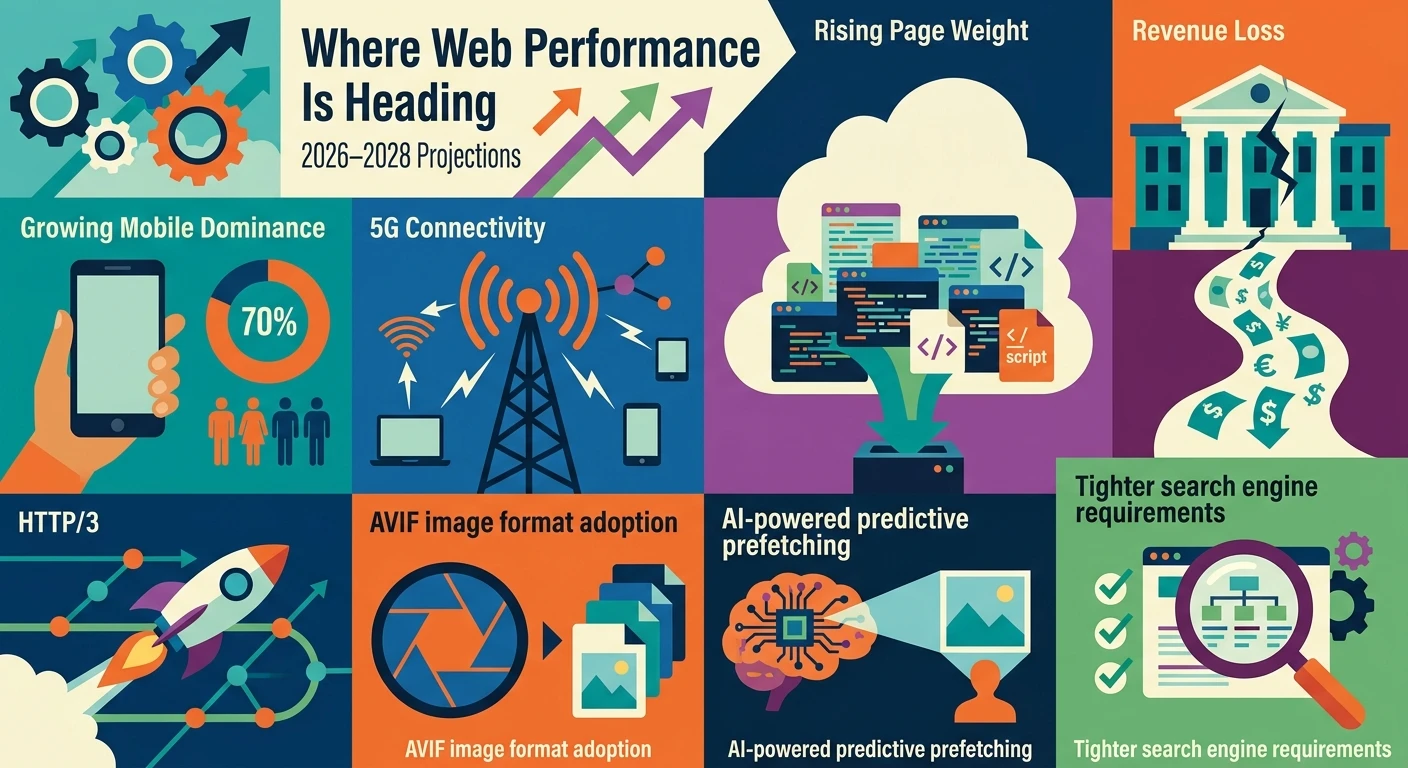
L'evoluzione delle prestazioni web nei prossimi due anni sarà plasmata da una serie di fattori convergenti: requisiti più stringenti per i motori di ricerca, la crescente diffusione dei dispositivi mobili, le aspettative sempre più elevate degli utenti e le nuove tecnologie infrastrutturali.
Si prevede che il traffico mobile raggiungerà Il 70% di tutte le visite al web entro il 2028.
Si prevede che il 5G raggiungerà Il 56% delle connessioni mobili a livello globale entro il 2028, il che innalzerà il livello minimo di prestazioni ma aumenterà anche le aspettative degli utenti.
Si prevede che il peso medio della pagina raggiungerà 3.1 MB entro il 2028, in aumento del 35% rispetto al 2026, grazie alla continua crescita dei framework JavaScript e degli script di terze parti.
Si stima che il fatturato annuo globale perso a causa delle lente prestazioni web raggiunga $ 18 miliardi entro 2028.
HTTP/3, attualmente supportato dal 31% dei siti web, riduce del 33% i tempi di configurazione della connessione e sarà adottato su scala più ampia.
Il formato immagine AVIF, attualmente adottato al 14%, offre file di dimensioni inferiori del 50% rispetto a WebP ed è in rapida crescita.
Il precaricamento predittivo basato sull'IA, che utilizza l'apprendimento automatico per caricare le pagine prima che un utente faccia clic, sta dimostrando Miglioramenti del 40% nella velocità percepita nelle prime implementazioni.
Si prevede che il peso di ranking CWV di Google aumentare di 3x rispetto ai livelli attuali entro il 2028.
La direzione è chiara: il web si sta facendo sempre più pesante e le aspettative degli utenti sempre più esigenti. Le aziende che considerano le prestazioni una priorità costante per il proprio prodotto rafforzeranno il proprio vantaggio competitivo. Quelle che le considerano un'operazione da svolgere una tantum si ritroveranno, anno dopo anno, a perdere terreno.
Parametri di riferimento pratici: qual è il target ideale per il tuo sito?
Sulla base dei dati del 2026, ecco gli obiettivi di performance che rappresentano l'eccellenza competitiva:
LCP: Meno di 2.5 secondi (obiettivo: meno di 1.8 secondi per eguagliare le pagine ai primi posti del ranking)
INP: Meno di 200 ms (obiettivo: meno di 100 ms per rientrare nel 25% dei migliori)
CLS: sotto 0.1
TTFB: Meno di 800 ms (obiettivo inferiore a 200 ms per i siti distribuiti in periferia)
FCP: Sotto 1.8 secondi
Peso totale della pagina: Meno di 1.5 MB (obiettivo: meno di 1 MB per dispositivi mobili)
Numero di richieste HTTP: Meno di 50 per caricamento di pagina (la mediana attuale è 87)
Payload JavaScript: Meno di 300 KB (la mediana attuale è di 468 KB)
Se il tuo sito impiega attualmente 3-5 secondi a caricarsi su dispositivi mobili e non supera due o tre Core Web Vitals, stai perdendo posizioni nel posizionamento organico, pagando un costo per acquisizione superiore al necessario e lasciando sul tavolo entrate derivanti dalle conversioni ogni singolo giorno. La buona notizia è che la strada da percorrere è ben tracciata: analizza il tuo TTFB e la configurazione dell'hosting, comprimi e ridimensiona le immagini, posticipa l'esecuzione di JavaScript non critico, elimina le risorse che bloccano il rendering e monitora con dati di utenti reali anziché con test di laboratorio sintetici.
Conclusione: la velocità non è una metrica tecnica, bensì una decisione aziendale.
Le statistiche sulla velocità di caricamento delle pagine per il 2026 convergono su un'unica, inequivocabile conclusione: il tempo di caricamento del tuo sito web è uno dei fattori più diretti a tua disposizione per migliorare il posizionamento nei motori di ricerca, il traffico e i ricavi. Ogni secondo che riduci nel tempo di caricamento è un secondo che guadagni in termini di minore frequenza di rimbalzo, conversioni più elevate, migliore visibilità sui motori di ricerca e maggiore fidelizzazione degli utenti.
I numeri sono sufficientemente specifici da poter essere utilizzati per costruire un business case in qualsiasi contesto. Un aumento dell'1% delle conversioni grazie a un miglioramento di 100 ms. Un aumento del 12% del traffico organico grazie alla correzione di errori nei Core Web Vitals. Un aumento del 42% dei ricavi da dispositivi mobili grazie a un miglioramento del 23% dei tempi di caricamento delle pagine. Non si tratta di proiezioni teoriche, bensì di risultati misurati da aziende reali, da Vodafone a Swappie fino a Renault.
Il fatto che solo il 3% dei marketer attualmente indichi la velocità come priorità principale non è un commento sull'importanza di questa metrica. È piuttosto una porta aperta per qualsiasi azienda disposta a varcarla.
DOMANDE FREQUENTI
Sì, Google utilizza ufficialmente i Core Web Vitals (LCP, INP e CLS) come segnali di ranking, e il loro peso è aumentato significativamente con l'aggiornamento principale di marzo 2026. I dati mostrano che il 91% delle pagine che si posizionano in prima posizione soddisfano tutti e tre i Core Web Vitals, rispetto a solo il 47% dei risultati in seconda posizione.
L'obiettivo è raggiungere un LCP inferiore a 2.5 secondi su desktop e inferiore a 3 secondi su dispositivi mobili come base, ma per competere ai primi posti nei risultati di ricerca, puntate a 1.8 secondi o meno. Il TTFB (Time To First Byte) dovrebbe rimanere al di sotto di 800 ms e il peso totale della pagina dovrebbe idealmente non superare 1.5 MB.
Per un sito che genera 10 milioni di dollari di fatturato annuo, ogni 100 ms di tempo di caricamento aggiuntivo si traducono in una perdita di circa 100 dollari di entrate all'anno. Un ritardo di un secondo riduce le conversioni fino al 20%, e i siti di e-commerce lenti nel mercato statunitense perdono complessivamente circa 4.2 miliardi di dollari di fatturato annuo.
Le pagine per dispositivi mobili si caricano in media il 70.9% più lentamente rispetto alle versioni desktop a causa dei processori meno potenti, delle connessioni di rete meno stabili e dei payload JavaScript più pesanti che sovraccaricano le CPU dei dispositivi mobili. I soli script di terze parti rappresentano il 34% del peso totale della pagina, aggravando ulteriormente il divario in assenza di una CDN o di una corretta gestione degli script.
Le soluzioni più efficaci consistono nel comprimere e ridimensionare le immagini, passare a un hosting più veloce o aggiungere una CDN e posticipare l'esecuzione di JavaScript non critici e script di terze parti. L'attivazione della cache del browser e la minimizzazione dei file CSS e JS possono ridurre complessivamente i tempi di caricamento di 1-3 secondi sulla maggior parte dei siti web.