Ecco un dato che ridefinisce l'intero dibattito sulla sicurezza informatica per il 2026: Nel 2025 il traffico generato dagli agenti di intelligenza artificiale è cresciuto del 7,851%. Non un modesto incremento. Non un rispettabile miglioramento trimestrale. Settemilaottocentocinquantuno per cento. In un solo anno.
Gli agenti di intelligenza artificiale – sistemi software autonomi in grado di navigare sul web, eseguire attività, accedere alle API, scrivere codice, inviare e-mail e prendere decisioni senza intervento umano – sono passati da promettente esperimento a realtà aziendale di uso comune quasi da un giorno all'altro. E come accade con ogni tecnologia che si diffonde così rapidamente, l'architettura di sicurezza non è riuscita a tenere il passo. Neanche lontanamente.
Oggi le organizzazioni stanno implementando agenti di intelligenza artificiale a una velocità record, pur ammettendo di non avere quasi idea di come proteggerli. La superficie di attacco è esplosa. Gli autori delle minacce si sono adattati. E le conseguenze finanziarie di un errore si misurano in decine di milioni di dollari per incidente.
Questa è quella storia, raccontata attraverso i numeri.
La portata dell'adozione degli agenti di intelligenza artificiale e la falla di sicurezza che ne è derivata
Quanto più velocemente si è diffusa la protezione
Prima di analizzare le minacce, è fondamentale comprendere la velocità di adozione che le ha generate. Il mercato degli agenti IA ha raggiunto $ 7.92 miliardi nel 2025 e si prevede che aumenterà a $ 236.03 miliardi entro 2034 — un tasso di crescita annuo composto di 45.82%Non si tratta di una tecnologia di nicchia. È una delle categorie di infrastrutture aziendali in più rapida crescita nella storia dell'informatica.
I dati relativi alle implementazioni lo confermano:
79% di organizzazioni segnalare un certo livello di IA agentica adozione a partire dal 2025
L'impresa media ora gestisce circa 37 agenti di intelligenza artificiale per organizzazione (in aumento rispetto a quasi zero solo 24 mesi fa)
96% di organizzazioni prevedono di espandere l'utilizzo dell'IA agentiva nel 2026
Le organizzazioni aziendali dominano l'attuale adozione dell'IA agentica a 25% di penetrazione — grazie a maggiori risorse tecniche e a budget dedicati all'IA
Ma ecco la statistica che fa venire il mal di stomaco a ogni CISO: Il divario tra il 79% di adozione e l'11% di sicurezza pronta per la produzione rappresenta la sfida decisiva del 2026. Quasi quattro aziende su cinque hanno implementato agenti di intelligenza artificiale in qualche forma. Appena una su dieci dispone di controlli di sicurezza sufficientemente maturi per proteggerli adeguatamente.
La crisi di prontezza operativa in cifre
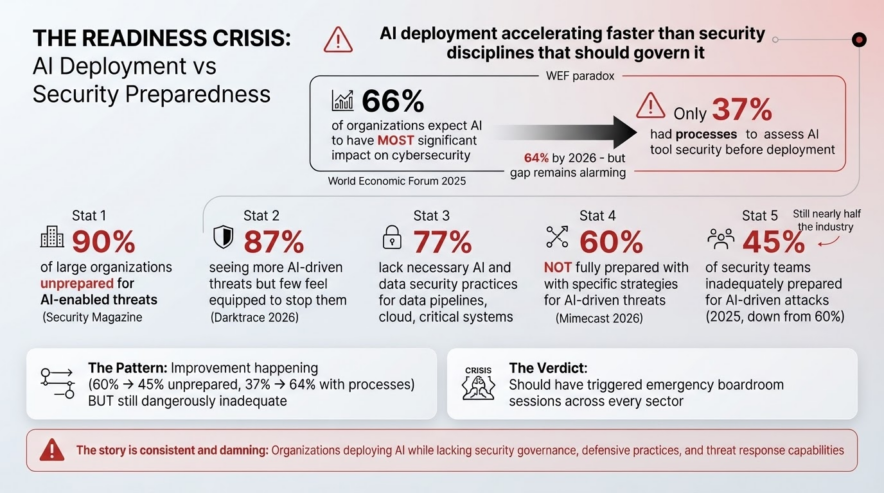
Il Forum economico mondiale Prospettive sulla sicurezza informatica globale 2025 ha emesso un verdetto che avrebbe dovuto innescare riunioni di emergenza nei consigli di amministrazione di tutti i settori: Il 66% delle organizzazioni prevede che l'intelligenza artificiale avrà l'impatto più significativo sulla sicurezza informatica. — eppure solo Il 37% aveva implementato processi per valutare la sicurezza degli strumenti di intelligenza artificiale prima della loro distribuzione. quello stesso anno. Entro il 2026, tale dato di valutazione è migliorato al 64%, ma il divario di fondo rimane allarmante.
Ulteriori statistiche sulla prontezza operativa dipingono un quadro altrettanto inquietante:
Il 90% delle grandi organizzazioni non è preparato per le minacce basate sull'intelligenza artificiale (Security Magazine)
Il 60% delle organizzazioni NON è completamente preparato con strategie specifiche per le minacce basate sull'intelligenza artificiale (Mimecast, 2026)
Il 77% delle organizzazioni non dispone delle necessarie pratiche di intelligenza artificiale e sicurezza dei dati. per difendere le pipeline di dati, l'infrastruttura cloud e i sistemi critici
45% dei team di sicurezza Nel 2025 hanno ammesso che le loro organizzazioni non erano adeguatamente preparate agli attacchi basati sull'intelligenza artificiale: in calo rispetto al 60% dell'anno precedente, ma pur sempre quasi la metà del settore.
Il 87% dei professionisti della sicurezza Si prevede che nel 2026 le minacce basate sull'intelligenza artificiale saranno più numerose, ma pochi si sentiranno in grado di contrastarle (Darktrace).
La storia che emerge da questi numeri è coerente e allarmante: la diffusione dell'intelligenza artificiale sta accelerando più rapidamente delle discipline di sicurezza che dovrebbero regolarla.
Il panorama delle minacce: cosa sta realmente attaccando gli agenti di intelligenza artificiale?
Iniezione rapida: l'arma numero uno
Se c'è una tipologia di attacco che definisce l'era della sicurezza degli agenti IA, è l'iniezione immediata, e il suo predominio nel panorama delle minacce è statisticamente innegabile.
L'iniezione tempestiva è classificata come LLM01 di OWASP, rendendola la vulnerabilità classificata n. 1 nella sicurezza dei modelli linguistici di grandi dimensioni. I tassi di successo degli attacchi variano da 50% a% 84 a seconda della configurazione del sistema, il che significa che, nel peggiore dei casi, gli aggressori hanno successo più spesso di quanto falliscano.
La portata dello sfruttamento nel mondo reale è sconvolgente:
In una competizione pubblica di red teaming contro agenti di IA schierati, i ricercatori hanno lanciato 1.8 milioni di tentativi di iniezione rapida — dimostrando la scala industriale a cui questo attacco può essere automatizzato
Gli agenti IA si muovono 16 volte più dati rispetto agli utenti umani, il che significa che un singolo agente compromesso crea un'esposizione che supera di gran lunga quella di un singolo account compromesso
L'iniezione indiretta di prompt, ovvero l'inserimento di istruzioni dannose nei contenuti web visualizzati dagli agenti di intelligenza artificiale, è stata documentata in incidenti reali fino a dicembre 2025, con aggressori che hanno aggirato i sistemi di recensione dei prodotti basati sull'IA.
L'attacco è elegante nella sua semplicità: invece di violare il sistema sottostante, gli aggressori violano il istruzioni fornite all'IA, inducendo il sistema a compiere azioni che i suoi operatori non avevano previsto: esfiltrare dati, aggirare i controlli di accesso o elevare i privilegi per conto dell'attaccante.
Mappa completa delle minacce: principali vettori di attacco degli agenti IA nel 2026
Vettore di minaccia | Gravità | Statistica chiave |
Iniezione immediata | critico | Tasso di successo degli attacchi: 50-84%; vulnerabilità LLM n. 1 secondo OWASP. |
Phishing con deepfake basato sull'intelligenza artificiale | critico | Aumento del 2,137% dei tentativi di frode deepfake in 3 anni |
Malware basato sull'intelligenza artificiale | Alto | Aumento dell'89% degli attacchi da parte di avversari che utilizzano l'intelligenza artificiale (CrowdStrike) |
IA ombra / Agenti non autorizzati | Alto | Classificata come la principale fonte di rischio aziendale; il 90% delle organizzazioni non è preparato. |
Attacchi di intelligenza artificiale alla catena di approvvigionamento | Alto | La principale minaccia secondo il rapporto "AI Threat Landscape Report 2026" di HiddenLayer. |
Avvelenamento dei dati | Media altezza | Vettore in crescita; mirato ai dati di addestramento e all'integrità del modello |
Furto/Estrazione di modelli | Medio | Rischio per la proprietà intellettuale derivante da domande avversarie |
Escalation dei privilegi dell'agente | critico | Agenti con accesso sovradimensionato sfruttati autonomamente |
L'esplosione dei deepfake merita una sezione a parte.
I numeri relativi ai deepfake generati dall'IA e utilizzati negli attacchi informatici sono così eclatanti da meritare un trattamento a parte. La quota di deepfake nei tentativi di frode globali è cresciuta da 0.1% in 2022 in 6.5% in 2025 - Un Aumento del 2,137% in soli tre anniLa clonazione vocale ormai non costa quasi nulla agli aggressori, e le frodi basate sull'identità sintetica, alimentate dai deepfake, sono diventate una delle categorie di attacchi in più rapida crescita nel settore dei servizi finanziari.
SentinelOne segnala un Aumento del 1,265% degli attacchi di phishing guidati dall'intelligenza artificiale generativa solo nell'ultimo anno
Gli attacchi basati sull'intelligenza artificiale, comprese le impersonificazioni deepfake, sono aumentati del 15% nell'ultimo anno secondo il rapporto sulle tendenze del phishing del 2026 di HoxHunt.
Il numero di professionisti della sicurezza informatica che dichiarano di essere meno preparati agli attacchi deepfake è aumentato 3% in 2024 in 21% in 2025 — un aumento di sette volte dell'impreparazione riconosciuta
Quanto costa realmente una violazione dei dati quando è coinvolta l'intelligenza artificiale?
Le conseguenze finanziarie si misurano ora in milioni per incidente.
Il rapporto IBM sul costo delle violazioni dei dati monitora i costi derivanti da tali violazioni da oltre vent'anni e l'edizione 2025 ha presentato risultati che ridefiniscono completamente il dibattito sugli investimenti nella sicurezza dell'IA.
$4.7 milioni è il costo medio di una violazione della sicurezza di un agente AI nel 2026 (Shattered.io ricerca sulla sicurezza degli agenti)
Il costo medio globale di una violazione dei dati di tutti i tipi ha raggiunto 4.44 milioni di dollari nel 2025, leggermente in calo rispetto ai 4.88 milioni di dollari del 2024, ma le violazioni che coinvolgono l'IA tendono ad aumentare significativamente
Violazioni che coinvolgono modelli o applicazioni di IA in media $ 5.08 milioni per incidente nel rapporto IBM del 2025 — un premio di circa 640,000 dollari rispetto al valore di riferimento
13% di organizzazioni violazioni segnalate che hanno coinvolto direttamente i loro modelli o applicazioni di intelligenza artificiale nel 2025
criticamente, Il 97% di queste organizzazioni non disponeva di controlli di accesso all'IA adeguati. al momento della violazione — il che significa che la violazione era prevenibile con una governance di base
Il rovescio della medaglia di questi dati è altrettanto importante: le organizzazioni che utilizzano l'IA difensivamente nelle operazioni di sicurezza si osservano risultati nettamente migliori.
Le organizzazioni con un'ampia intelligenza artificiale e automazione nella loro infrastruttura di sicurezza pagano 3.62 milioni di dollari per violazione in media, rispetto a $5.52 milioni per coloro che non hanno — un differenza di costo di 1.9 milioni di dollari
I team di sicurezza dotati di intelligenza artificiale rilevano e contengono le violazioni 51 giorni più veloce rispetto ai team senza l'ausilio dell'IA
Il costo nascosto: il tempo
Oltre alle perdite finanziarie dirette, la dimensione temporale degli attacchi basati sull'IA sta peggiorando a un ritmo allarmante. Il Global Threat Report 2026 di CrowdStrike ha rilevato che il tempo medio di interruzione della criminalità informatica, ovvero l'intervallo di tempo tra l'accesso iniziale di un aggressore e il suo spostamento laterale all'interno di una rete, ridotto a soli 29 minutiNel 2019, quel lasso di tempo si misurava in ore. Oggi, ai responsabili umani della risposta agli incidenti viene chiesto di essere più veloci degli attacchi automatizzati che operano alla velocità delle macchine, e stanno perdendo.
La reazione del mercato: dove confluiscono i capitali
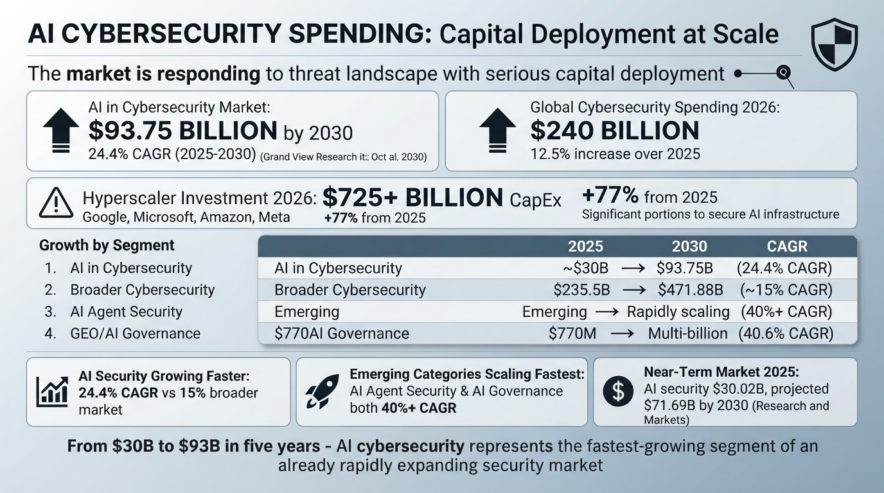
La spesa per la sicurezza informatica basata sull'intelligenza artificiale sta accelerando.
Il mercato sta reagendo al panorama delle minacce con ingenti investimenti di capitale. I dati sono impressionanti:
Si prevede che il mercato globale dell'IA nella sicurezza informatica crescerà a un ritmo CAGR del 24.4% dal 2025 al 2030, raggiungendo $ 93.75 miliardi entro 2030 (Ricerca Grand View)
Il mercato più ampio dell'IA nella sicurezza è stimato a $ 30.02 miliardi nel 2025, progettato per raggiungere $ 71.69 miliardi entro 2030 (Ricerca e Mercati)
Si prevede che la spesa globale per la sicurezza informatica nel complesso raggiungerà $ 240 miliardi nel 2026 Aumento del 12.5% rispetto al 2025 (Gartner)
I quattro maggiori hyperscaler (Google, Microsoft, Amazon, Meta) sono sulla buona strada per spendere oltre 725 miliardi di dollari di spese in conto capitale nel 2026 — in aumento del 77% rispetto al 2025 — con quote significative destinate a infrastrutture sicure per l'intelligenza artificiale.
Segmento di mercato | Valore 2025 | 2030 proiezione | CAGR |
AI nella cybersecurity | ~ $ 30 miliardi | $93.75 miliardi | 24.4% |
Mercato più ampio della sicurezza informatica | $235.5 miliardi | $471.88 miliardi | ~ 15% |
Sicurezza degli agenti IA (specifica) | Emerging | Scalabilità rapida | % 40 + |
Mercato della governance GEO/AI | $770 milioni | Multimiliardario | 40.6% |
Chi considera questa la sua priorità assoluta?
I dati sulla definizione delle priorità organizzative sono altrettanto rivelatori. Un sondaggio di Dark Reading del 2026 ha rilevato che Il 48% dei professionisti della sicurezza classifica l'IA agentiva come il principale vettore di attacco dell'anno — più di qualsiasi altra categoria di minacce, inclusi ransomware, attacchi alla catena di approvvigionamento e intrusioni da parte di stati nazionali. Nel frattempo:
Il 92% dei professionisti della sicurezza esprimere preoccupazione per i rischi per la sicurezza degli agenti di intelligenza artificiale
Il 36% dei dirigenti della sicurezza e della tecnologia affermano che l'intelligenza artificiale sta superando le loro capacità di sicurezza (Accenture)
80% di organizzazioni sono preoccupati per le fughe di dati sensibili attraverso gli strumenti di intelligenza artificiale generativa (Mimecast)
48% di organizzazioni classificano l'IA agentiva come la principale minaccia alla sicurezza informatica nel 2026 (Lettura oscura)
I cinque rischi specifici che ogni azienda deve comprendere
Analisi della superficie di attacco agente
Comprensione perché Gli agenti di intelligenza artificiale creano una superficie di attacco talmente estesa che è necessario esaminare cosa li differenzia strutturalmente dai software tradizionali.
Rischio n. 1: Azione autonoma senza supervisione umana
Gli agenti di intelligenza artificiale compiono azioni – inviare email, navigare su siti web, eseguire codice, chiamare API – senza l'intervento umano in ogni fase. Un agente compromesso può causare danni significativi prima che qualcuno si accorga di qualcosa di anomalo. In questo contesto, il dato relativo al tempo di inattività di 29 minuti assume una connotazione catastrofica.
Rischio n. 2: Privilegi eccessivi per impostazione predefinita
La maggior parte delle organizzazioni implementa agenti di intelligenza artificiale con diritti di accesso eccessivi perché è più semplice concedere autorizzazioni generiche che definire con precisione i limiti di autorità di ciascun agente. Ciò significa che un singolo agente compromesso spesso ha accesso a molte più risorse di quelle effettivamente necessarie, amplificando la portata di qualsiasi attacco riuscito.
Rischio n. 3: la vulnerabilità della catena di approvvigionamento
Gli agenti di intelligenza artificiale dipendono da strumenti esterni, plugin, API e fonti di dati. Gli aggressori che compromettono qualsiasi componente di questa catena, che si tratti di un plugin di terze parti, di un database esterno o persino di una pagina web visitata dall'agente, possono potenzialmente dirottare il comportamento dell'agente senza mai intervenire sul sistema centrale. Il rapporto "AI Threat Landscape Report 2026" di HiddenLayer elenca gli attacchi alla catena di fornitura come una delle cinque principali minacce specifiche per l'IA.
Rischio n. 4: Proliferazione dell'IA ombra
I dipendenti di diverse organizzazioni stanno implementando i propri agenti e strumenti di intelligenza artificiale senza alcuna competenza in ambito IT o di sicurezza. Questo fenomeno di "IA ombra" fa sì che le organizzazioni si trovino spesso con sistemi di IA che operano sui loro dati, si connettono ai loro sistemi e agiscono per loro conto, il tutto completamente al di fuori dei framework di governance della sicurezza. Si prevede che questo rimarrà uno dei principali rischi aziendali fino al 2026 e oltre.
Rischio n. 5: Esfiltrazione di dati alla velocità della macchina
Poiché gli agenti IA trasferiscono 16 volte più dati rispetto agli utenti umani in periodi di tempo equivalenti, un attacco di esfiltrazione di dati tramite un agente compromesso non appare come un lento e sospetto rivolo. Sembra una normale attività dell'agente, finché il danno non è già fatto.
Il manuale difensivo: cosa dicono i dati che funziona davvero
Costruire una sicurezza adeguata alla minaccia
La buona notizia – e si tratta davvero di una buona notizia – è che le organizzazioni che adottano un approccio strutturato alla sicurezza degli agenti di intelligenza artificiale stanno ottenendo risultati misurabili. I dati sui risultati in termini di difesa sono incoraggianti per coloro che sono disposti a investire in modo adeguato.
Organizzazioni con programmi di sicurezza AI maturi contenenti violazioni 51 giorni più veloce ea 1.9 milioni di dollari di costi in meno per incidente
L'implementazione di un'architettura zero-trust per gli agenti di intelligenza artificiale riduce drasticamente il rischio di movimenti laterali.
Gli agenti IA autonomi gestiranno fino a Il 90% del triage di sicurezza di routine entro la fine del 2026 — il che significa che l'IA è anche uno degli strumenti di difesa più potenti disponibili
Il quadro strategico difensivo su cui la maggior parte dei leader della sicurezza sta convergendo si basa su diversi pilastri fondamentali:
Principio del minimo privilegio per gli agentiOgni agente di intelligenza artificiale dovrebbe avere esattamente l'accesso di cui ha bisogno e niente di più. Sembra ovvio, eppure quasi nessuno lo applica rigorosamente fin dal primo giorno.
Monitoraggio continuo del comportamento dell'agenteIl monitoraggio della sicurezza tradizionale è stato progettato per i modelli di comportamento umano. Il monitoraggio tramite agenti di intelligenza artificiale richiede nuovi strumenti creati specificamente per la velocità e il volume dell'attività degli agenti.
Indurimento a iniezione rapidaLivelli di sanificazione dell'input, isolamento del contesto e convalida dell'output che trattano ogni input esterno come potenzialmente ostile.
Distinta base per l'intelligenza artificiale (AI-BOM)Catalogare ogni agente, modello, dipendenza e fonte di dati dell'IA, proprio come le organizzazioni mantengono le distinte base del software per le applicazioni tradizionali.
Punti di controllo con intervento umano: Per azioni ad alto rischio (transazioni finanziarie, cancellazione di dati, comunicazioni esterne), che richiedono una conferma umana prima dell'esecuzione da parte dell'agente, indipendentemente da quanto l'azione appaia di routine.
Riepilogo statistico: tutto ciò che conta a colpo d'occhio
Sicurezza degli agenti basati sull'IA: dati chiave per il 2026
Categoria | statistico | Fonte |
Crescita del traffico degli agenti di IA | 7,851% in 2025 | Sicurezza UMANA |
Dimensioni del mercato degli agenti di intelligenza artificiale (2025) | $7.92 miliardi | Ricerca di mercato |
Dimensioni del mercato degli agenti di intelligenza artificiale (2034) | $236.03 miliardi | Ricerca di mercato |
Organizzazioni con agenti di intelligenza artificiale | 79% | Sondaggi multipli |
Organizzazioni pronte per la sicurezza | Circa l'11% pronto per la produzione | Digitale Applicato |
Principale minaccia legata all'IA | IA agentica: il 48% dei professionisti | Lettura oscura |
Costo medio di violazione di un agente IA | $4.7 milioni | |
Risparmio sui costi grazie alla sicurezza basata sull'intelligenza artificiale. | 1.9 milioni di dollari per violazione | IBM2025 |
Rilevamento più rapido grazie alle difese basate sull'intelligenza artificiale. | 51 giorni | IBM2025 |
Tasso di successo rapido dell'iniezione | 50-84% | OWASP / Vectra |
Aumento delle frodi legate ai deepfake (3 anni) | 2,137% | sumsub |
Aumento del phishing tramite intelligenza artificiale | 1,265% su base annua | Sentinella Uno |
Le organizzazioni non sono preparate alle minacce dell'intelligenza artificiale. | 90% delle grandi organizzazioni | Rivista sulla sicurezza |
Mercato della sicurezza informatica (2026) | $240 miliardi | Gartner |
L'intelligenza artificiale nel mercato della sicurezza informatica (2030) | $93.75 miliardi | Grand View Research |
tempo di reazione dell'attaccante di CrowdStrike | 29 minuti | CrowdStrike 2026 |
Conclusione
La finestra di opportunità per agire è ristretta e si sta chiudendo
La crisi di sicurezza degli agenti di intelligenza artificiale non è un problema futuro. Non è un problema che emergerà quando la tecnologia sarà un po' più matura. È un'emergenza immediata, un allarme generale che coinvolge il consiglio di amministrazione e alla quale la maggior parte delle organizzazioni sta rispondendo troppo lentamente.
La matematica è inequivocabile: Il 79% delle organizzazioni ha implementato agenti di intelligenza artificiale. Il 90% delle grandi organizzazioni non è preparato agli attacchi basati sull'IA. Il 48% dei professionisti della sicurezza afferma che l'IA agentiva rappresenta la minaccia numero 1 per il 2026. Il costo medio di una violazione è di 4.7 milioni di dollari. Gli attaccanti hanno a disposizione solo 29 minuti per reagire prima che il danno sia fatto.
Le organizzazioni che usciranno indenni da quest'era saranno quelle che considereranno la sicurezza degli agenti di intelligenza artificiale non come un semplice elemento da aggiungere alla lista di controllo IT, ma come un rischio aziendale fondamentale, che richiede investimenti dedicati, una chiara definizione delle responsabilità, un monitoraggio continuo e la stessa serietà strategica riservata al rischio finanziario o alla conformità normativa.
L'orologio non ticchetta. Alla velocità della macchina, sta già contando alla rovescia.
DOMANDE FREQUENTI
Gli studi dimostrano che oltre il 70% delle implementazioni di intelligenza artificiale presenta vulnerabilità critiche che potrebbero esporre dati aziendali sensibili, e gli attacchi informatici contro i sistemi di IA sono aumentati di oltre il 300% negli ultimi anni. Inoltre, la maggior parte delle organizzazioni dichiara di non disporre delle competenze interne necessarie per proteggere adeguatamente i propri agenti di IA dalle minacce emergenti.
Gli agenti di intelligenza artificiale sono altamente vulnerabili agli attacchi di prompt injection, con i ricercatori di sicurezza che sono riusciti a manipolare il comportamento degli agenti fino al 97% dei sistemi testati utilizzando tecniche di base. Questi attacchi possono indurre gli agenti di intelligenza artificiale a divulgare dati riservati, eseguire azioni non autorizzate o aggirare completamente i protocolli di sicurezza.
Molte aziende si concentrano sui vantaggi in termini di produttività offerti dagli agenti di intelligenza artificiale, trascurando però l'ampliamento della superficie di attacco che questi creano, soprattutto quando agli agenti viene concesso l'accesso a database interni, API e strumenti di comunicazione. La mancanza di framework di sicurezza standardizzati per l'IA fa sì che la maggior parte delle organizzazioni operi senza parametri di riferimento adeguati per la protezione.
Sì, gli agenti di intelligenza artificiale compromessi sono già stati collegati a ingenti perdite finanziarie, con alcuni incidenti che hanno comportato transazioni non autorizzate, violazioni di dati e sanzioni normative per milioni di dollari. Il rischio finanziario è aggravato dalla natura autonoma degli agenti di intelligenza artificiale, che possono agire rapidamente prima che la supervisione umana possa intervenire.
Assolutamente sì, i criminali informatici prendono sempre più di mira le piccole imprese perché tendono ad adottare rapidamente strumenti di intelligenza artificiale senza investire altrettanto nelle misure di sicurezza. Le ricerche indicano che le PMI sono responsabili di una quota sproporzionata di incidenti di sicurezza legati all'IA a causa delle risorse IT limitate e di pratiche di audit di sicurezza insufficienti.