AI content creation promised something amazing: just click a button and get an article instantly. But the reality?
Most AI-written content lacks personality, authority, and strategy, making it hard to rank on Google or engage real readers.
Google now prioritizes helpful, people-first content and evaluates websites using E-E-A-T: Experience, Expertise, Authoritativeness, Trustworthiness. This means that simply letting AI write for you is not enough.
The real winners in SEO are teams who use AI smartly as an assistant—for research, structure, and ideas—then refine it with a human touch.
Humanize AI Content: Why Humanizing AI Content Is Essential for Business
- AI content is everywhere. According to the Similarweb 2025 report, AI platforms grew 76% in monthly visits and generated over 1 billion referral visits in June 2025.
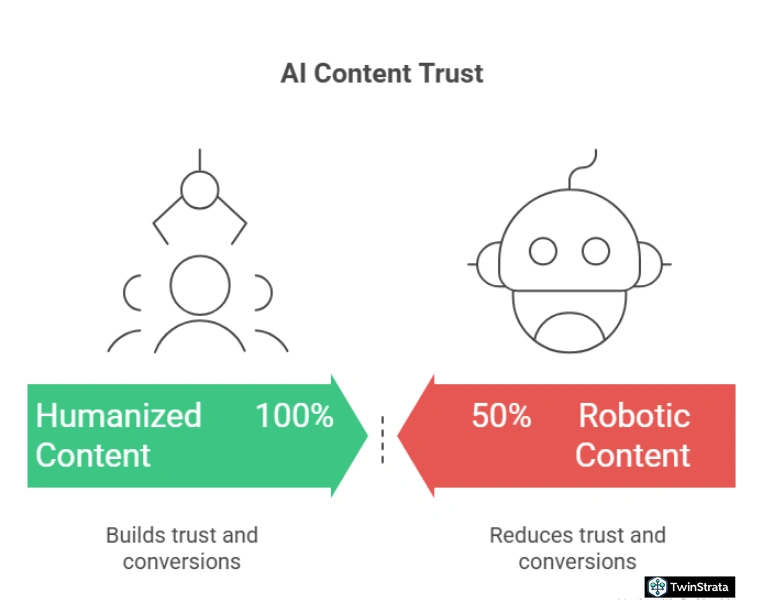
- Robotic, generic AI content can hurt trust and conversions. A Raptive study shows that content that seems AI-made can reduce consumer trust by 50% and lower willingness to pay a premium by 14%.
- Humanized content—authentic, expert, and empathetic—performs better, wins shares, and converts visitors into customers.
Bottom line: If your content feels human, it satisfies both readers and search engines.
Also read about: YMYL Content Guidelines: Google Search Quality Updates
Where AI Excels vs. Where It Fails
Strengths of AI:
- Research speed: Quickly summarizes public information and finds sources.
- Analysis: Identifies keyword opportunities and gaps in competitor content.
- Structure: Creates logical outlines and frameworks.
Limitations of AI:
- Average tone: AI sounds polite but bland; it rarely matches your brand voice.
- Lacks nuance: AI can summarize, but it struggles with original insights or complex arguments.
- Empathy gap: AI cannot evoke real emotion or connect naturally with readers.
- Factual errors: AI may give wrong information—humans must verify all claims.
10 Techniques to Humanize AI Content
- Define Your Brand Voice
- Create a clear tone guide (friendly, professional, witty, etc.).
- Use prompts that match your voice.
- Rewrite AI drafts line by line to match your brand.
- Craft a Strong Introduction
- Replace AI intros with stories, stats, or provocative questions.
- Example: “90% of pages get no Google traffic. Here’s why your SEO may fail.”
- Use a Narrative Structure
- Apply PAS (Problem → Agitate → Solution).
- Include real case studies for credibility.
- Write with Empathy
- Address the reader directly: “you,” not “users.”
- Acknowledge challenges and provide practical solutions.
- Add Proprietary Insights
- Share your own experiments, survey data, or case studies.
- Example: “Pages with short videos converted 40% better than text-only pages.”
- Fact-Check Thoroughly
- Verify statistics and claims.
- Standardize terminology and make content readable.
- Format for Scanners
- Use subheadings, bullets, and short paragraphs.
- Link to related content internally.
- Include Nuance and Counterarguments
- Highlight limitations and alternate approaches.
- Offer guidance for different contexts and team sizes.
- Encourage Engagement
- Ask questions and invite reader feedback.
- Example CTA: “What’s your biggest AI content challenge: voice, verification, or speed?”
- Show Authorship and Authority
- Include bylines, credentials, and process notes.
- Use schema markup to highlight authorship and expertise.
Conclusion: Human + AI = Best Results
The best SEO teams leverage AI for speed and analysis but rely on humans for trust, empathy, and creativity. By humanizing AI content, you produce material that:
- Ranks well in search engines
- Connects with real readers
- Reflects your brand’s expertise
- Supports business goals
More News To Read: