Anthropic confirmed this week that Claude will start embedding invisible watermarks into every piece of text it generates. If you use Claude to help draft blog posts, this directly affects you, here’s what’s actually changing.
What’s Happening
Starting August 2, 2026, new Claude models weave an imperceptible signal directly into the words they generate. You won’t see it. It doesn’t change the meaning, tone, or readability of the text. But it’s there, and it can be detected later.
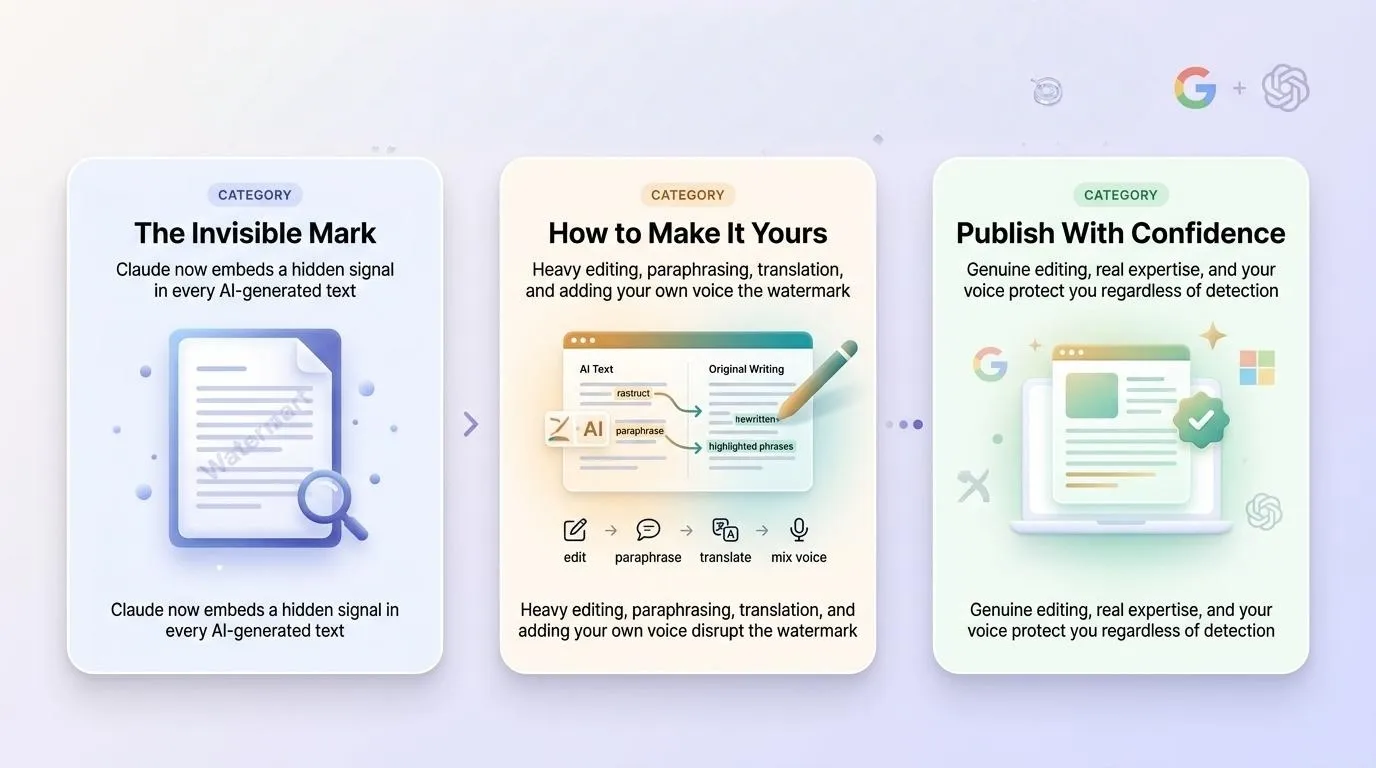
Anthropic made this move to comply with the EU AI Act’s Article 50, a regulation requiring AI companies to mark generated content so it can be identified as machine-made. The company applied the watermark globally, not just for EU users, so this affects bloggers everywhere, regardless of where you’re writing from.
Does This Mean My Blog Content Gets “Flagged”?
Not automatically, and not in a way that blocks publishing. The watermark is a detectable signal, not a filter or a warning label attached to your content. Nobody scanning your blog will see a visible tag saying “AI-written.” The mark only shows up if someone runs your text through a specific detection tool.
That said, it’s worth being realistic: if you’re publishing content drafted heavily by Claude without disclosure, and a platform or reader later runs a detection check, the mark will likely still be there, especially on longer, lightly-edited passages.
What Breaks the Watermark
According to reporting on Anthropic’s own documentation, the signal can weaken or disappear if the text is:
Heavily edited or rewritten
Paraphrased significantly
Translated into another language
Mixed extensively with your own writing
Very short (a sentence or two may not carry enough signal to detect reliably)
In other words, if you’re using Claude as a drafting tool and then genuinely rewriting, restructuring, and adding your own voice on top, as most serious bloggers already do, the watermark’s practical relevance to your workflow shrinks considerably.
What This Means for Blogger Disclosure Practices
This is a good moment to revisit how transparent you are about AI assistance in your content. A few practical takeaways:
If you already disclose AI assistance: nothing changes for you. This is just Anthropic backing up what you’re already being upfront about.
If you don’t currently disclose: consider whether your content is genuinely transformed through your own editing, research, and voice, or whether it’s closer to a lightly-touched AI draft. The gap between those two matters more now that detection tools are becoming more available.
If you’re writing for platforms with AI-content policies: check those policies again. Detection capability improving industry-wide (Google’s SynthID has done something similar for a while, and OpenAI and Microsoft have also signed onto the same EU transparency code) means platforms may start relying on these signals more directly.
Youtube: Anthropic to watermark AI-generated text
Youtube: Claude Will Put Invisible Watermarks On AI Text And Images—And The Internet Isn’t Happy
X: https://www.threads.com/@cnn/post/Db7r0TCD1yt/video-anthropic-said-it-will-add-invisible-watermarks-to-text-generated-by-future/
The Bigger Picture
Anthropic isn’t acting alone here. Nearly 200 companies have signed onto the EU’s Code of Practice on Transparency of AI-Generated Content, including Google, Meta, Microsoft, and OpenAI. Google has watermarked AI images since 2023 and has extended similar tech to text. This is clearly becoming an industry norm, not a one-off Anthropic decision.
For bloggers, the practical advice stays the same as it’s always been: use AI tools to speed up research and drafting, but make sure what you publish reflects genuine editing, real expertise, and your own voice. That approach protects you regardless of what any watermark can or can’t detect.
Quick Links: