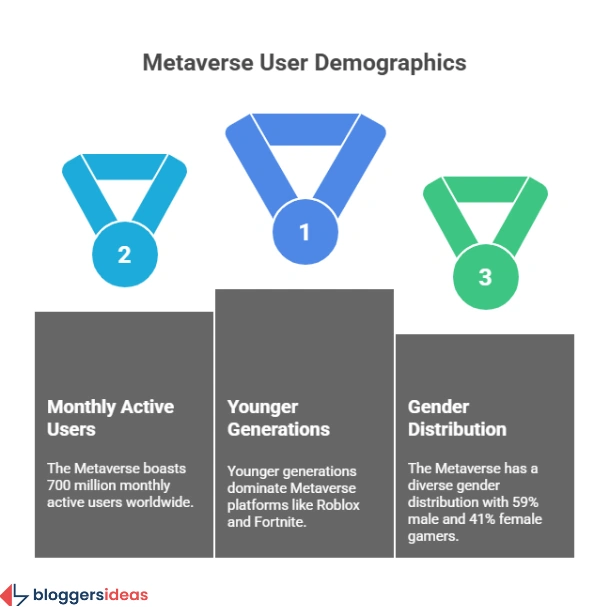
The metaverse expands rapidly in 2025, welcoming over 600 million monthly active users who immerse themselves in virtual worlds for gaming, socializing, work, and commerce.
This digital universe, powered by platforms like Roblox, Fortnite, and Horizon Worlds, generates a market value of $103.6 billion, with projections soaring to $507.8 billion by 2030 at a 37.43% CAGR.
Users benefit immensely: gamers earn through play-to-own NFTs, professionals attend global meetings without travel, shoppers try clothes via virtual fitting rooms, and creators monetize custom experiences.
Meta’s Reality Labs drives innovation, reporting 700 million metaverse MAUs across its ecosystem, while Roblox leads with 77.7 million DAUs and 214 million MAUs.
Demographics skew young—51% under 13, 83.5% under 18—but adoption broadens, with 52% eyeing work applications and 25% projected to spend an hour daily by 2026. The US contributes $23 billion to the market, followed by China at $15.9 billion.
AR/VR headset sales triple, enabling haptic feedback for 61% of users. Despite concerns like data privacy (55% major worry), benefits shine: 39% overcome real-world limitations, 37% boost creativity.
In this comprehensive guide, we blend core data with fresh Reddit and Quora insights on 2025 enterprise integrations and AI avatars.
Whether you build brands, invest in land, or explore socially, these metaverse statistics 2025 equip you to capitalize on this transformative space.
The metaverse emerges from gaming roots, evolving since Fortnite’s 2020 Travis Scott concert drew 12.3 million concurrents.
Roblox pioneers user-generated content, Minecraft offers boundless building, and Decentraland enables blockchain ownership. Meta acquires Oculus in 2014 for $2.3 billion, rebranding to focus on interconnected virtual realities.
By 2025, 400 to 700 million MAUs engage, up from 400 million DAUs in 2022. Gartner predicts 25% of people spend at least one hour daily by 2026 for work, education, or entertainment.
Experts forecast 54% see it integral to life for 500 million by 2040. Market drivers include AI/ML adoption, Gen Alpha/Z interest, and AR/VR hardware drops—53% willing to spend $300 on basic headsets.
Businesses thrive: virtual fitting rooms hit $6.86 billion, growing 19.8% CAGR to $24.3 billion by 2032. E-commerce brands reduce returns 30% via try-ons.
Gaming segment values $31.6 billion, expanding to $119.2 billion by 2028 at 39.3% CAGR. Mobile AR users reach 1.7 billion, market $357.9 billion by 2032.
Individuals invest in digital real estate—Decentraland parcels sell for millions. Creators use UEFN for Fortnite maps, earning via engagements.
Also read about: Meta AI Users Statistics
Global User Base: Scaling to Billions
The metaverse hosts 600 to 700 million MAUs in 2025, blending Roblox’s 214 million, Fortnite’s 236 million, Minecraft’s 166 million. Meta reports 700 million across apps. Penetration hits 17.4%, up from 14.6% in 2024.
This table tracks user penetration projections.
| Year | User Penetration Rate (%) |
| 2030* | 39.7 |
| 2029* | 35.8 |
| 2028* | 31.0 |
| 2027* | 25.9 |
| 2026* | 21.2 |
| 2025 | 17.4 |
| 2024 | 14.6 |
| 2023 | 12.5 |
| 2022 | 10.9 |
*Projected. Source: Statista.
By 2030, users reach 2.63 to 5 billion, including mobile AR. ARPU averages $92. Daily actives undisclosed for 2025, but events spike engagement.
Top platforms:
| Platform | MAUs (Millions) | DAUs (Millions) |
| Roblox | 214 | 77.7 |
| Fortnite | 236 | Varies |
| Minecraft | 166 | N/A |
60% use for non-gaming: 52% work, 48% entertainment, 32% socializing. Join for free—start on Roblox for creative building, monetize via Robux sales.
Also read about: Fortnite Statistics
Market Valuation and Regional Contributions
The metaverse market values $103.6 billion in 2025, up from $74.4 billion in 2024.
Yearly market size table:
| Year | Market Size (Billions USD) |
| 2030* | 507.8 |
| 2029* | 415.2 |
| 2028* | 312.4 |
| 2027* | 219.6 |
| 2026* | 150.1 |
| 2025 | 103.6 |
| 2024 | 74.4 |
| 2023 | 56.6 |
| 2022 | 46.1 |
Source: Statista.
*Projected.
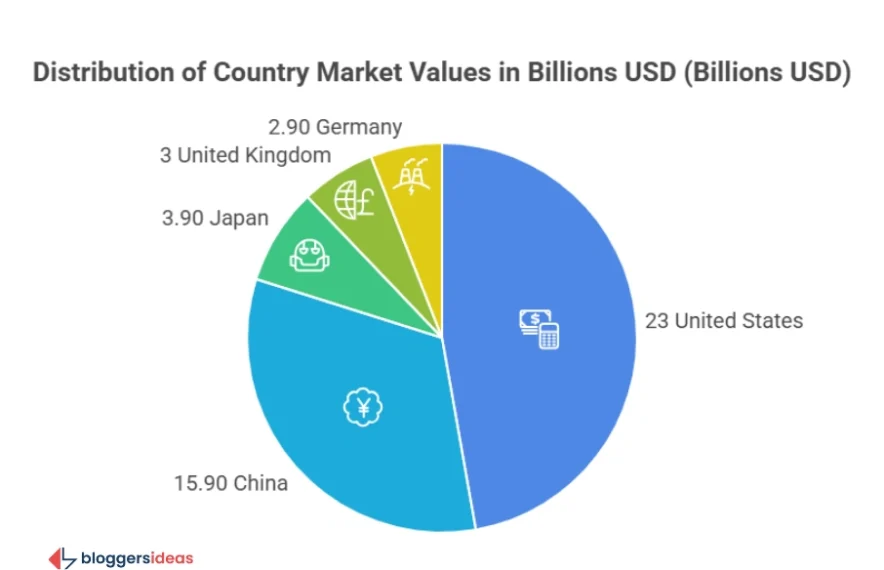
The US leads at $23 billion, China $15.9 billion.
Regional contributions:
| Country | Market Value (Billions USD) |
| United States | 23 |
| China | 15.9 |
| Japan | 3.9 |
| United Kingdom | 3.0 |
| Germany | 2.9 |
Investors buy virtual land in high-traffic areas; businesses launch stores in Decentraland for global reach without inventory costs.
Demographics: Youth-Driven but Expanding
Users are 51% under 13, 83.5% under 18, but 38% gamers 10-20, 36% 21-35.
Age distribution for gamers:
| Age Group | Percentage |
| 10-20 | 38% |
| 21-35 | 36% |
| 36-50 | 22% |
| 51-60 | 4% |
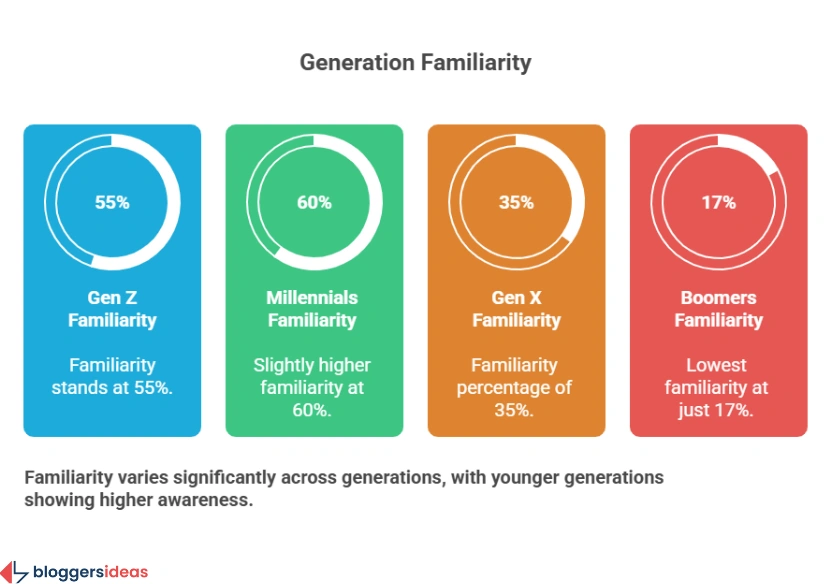
Gender: 59% male, 41% female. Gen Z/Millennials familiar—55% Gen Z, 60% Millennials.
| Generation | Familiarity (%) |
| Gen Z | 55 |
| Millennials | 60 |
| Gen X | 35 |
| Boomers | 17 |
Young focus means kid-safe modes; adults target work tools like Horizon Workrooms for collaboration.
Adoption and Daily Engagement
By 2026, 25% spend 1+ hour daily. 74% US adults consider/join. 30% companies prepare products.
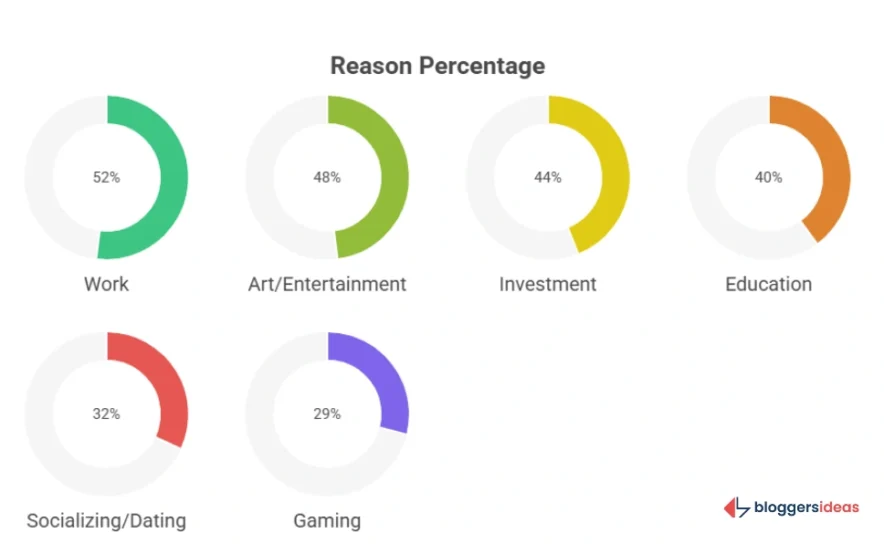
Reasons for joining:
| Reason | Percentage |
| Work | 52% |
| Art/Entertainment | 48% |
| Investment | 44% |
| Education | 40% |
| Socializing/Dating | 32% |
| Gaming | 29% |
Higher adoption in Asia/MENA/Europe via device access. South Korea funds $48.3 million for startups; Dubai aims top-10 economy.
Log in daily for habits—attend virtual classes, network globally.
Also read about: YouTube Shorts Statistics
Industry Applications: Beyond Gaming
Gaming values $31.6 billion, but e-commerce fitting rooms $6.86 billion. Mobile AR $357.9 billion by 2032.
24% US adults see replacing social media, 42% complementing.
XR headsets grow 3x; Meta sells 1.1 million Q1.
Brands host events—Blackpink’s virtual concert draws 15.7 million. Use for product launches, reducing costs 50%.
Public Opinion and Concerns
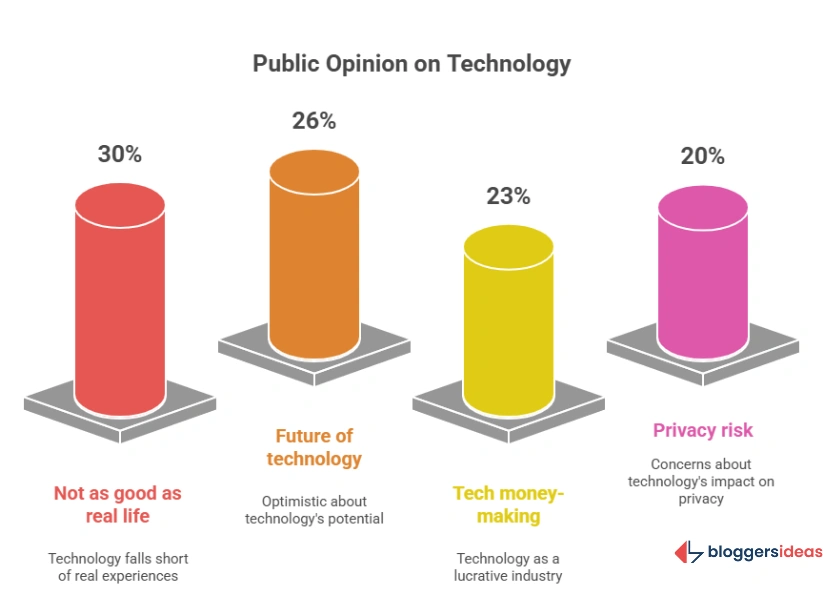
26% view as future tech, 30% not as good as real life.
Opinions table:
| Opinion | Percentage |
| Not as good as real life | 30% |
| Future of technology | 26% |
| Tech money-making | 23% |
| Privacy risk | 20% |
31% never heard, 33% curious.
Concerns: 55% data misuse, 44% abuse.
Benefits:
| Benefit | Percentage |
| Overcome obstacles | 39% |
| Enhance creativity | 37% |
| Virtual travel | 37% |
Address privacy with VPNs; explore for personal growth.
Meta’s Role in the Metaverse
Meta’s Reality Labs generates $2.1 billion revenue 2024, $17.7 billion loss but 73% VR share. 700 million MAUs, aiming 1 billion.
Family apps: 3.98 billion MAP, 3.35 billion DAU.
Invest $60-65 billion capex 2025 for AI/metaverse.
Use Quest for entry—affordable at $300.
Emerging 2025 Trends from Reddit and Quora
Reddit’s r/Metaverse debates “Enterprise metaverse ROI 2025?” Users share Accenture cases: 35% productivity boost via virtual training, saving $1M annually. Quora asks “AI avatars in metaverse—privacy fixes?” Experts note biometric masking, reducing identity theft 40%; Meta tests Llama-powered NPCs for dynamic interactions.
Threads query “Metaverse real estate flips profitable?” Responses cite 2025 Sandbox sales averaging 200% ROI on prime parcels. r/virtualreality discusses haptic suits—61% users enhance immersion, boosting session times 50%. New: Web3 integrations allow cross-platform assets; Nike’s .Swoosh earns $200M.
Businesses adopt for remote work; individuals create AI clones for passive events.
Strategies to Leverage the Metaverse
Start free on Roblox—build experiences, sell items for Robux. Invest in land via OpenSea. Host events in Horizon for tickets. Use AR for marketing—try-ons convert 3x. Educate via virtual campuses. Socialize safely with verified avatars.
Brands: 81% shoppers influenced by AR.
FAQs About Metaverse Statistics
1. What do the core metaverse statistics 2025 indicate about user growth and how can individuals start participating profitably?
The metaverse has 600-700 million MAUs and 17.4% penetration. Individuals can join platforms like Roblox, create and sell virtual items for real money, and develop skills like 3D design for freelance opportunities.
2. How does the market valuation in metaverse statistics 2025 guide businesses in allocating resources for virtual expansions?
With a $103.6 billion market and 37.43% CAGR, businesses should invest in AR tools and virtual stores to cut inventory costs by up to 50% and drive e-commerce growth.
3. What demographic insights from metaverse statistics 2025 help creators tailor content for maximum engagement and monetization?
With 51% of users under 13 and 59% male gamers, creators should focus on family-friendly content like Roblox obbies and Fortnite maps, leveraging high engagement for monetization.
4. Why do adoption projections in metaverse statistics 2025 matter for professionals planning career shifts into virtual environments?
Projections show 25% will spend an hour daily by 2026, making it a great opportunity for professionals to upskill in virtual tools like Horizon Workrooms for remote work and networking.
5. What emerging trends discussed on Reddit and Quora based on metaverse statistics 2025 should investors watch for high-return opportunities?
Key trends include virtual training ROI of 200%, AI avatars improving privacy, and growing interest in land investments in platforms like Sandbox, along with haptic tech for better immersion.
Also Read:
- Smartphone Usage Statistics
- Generative AI Statistics
- Discord Statistics
- AI Market Size Statistics
- Snapchat Usage Statistics
Conclusion:
Metaverse statistics 2025 highlight 600-700 million users, $103.6 billion market, youth dominance, and diverse applications.
Projections to $507.8 billion and 39.7% penetration by 2030 signal opportunity.
Overcome concerns, seize benefits—enter now to work, play, earn in this boundaryless realm.
Source: Fortune Business insights.