

On this page16 sections
- 01How Many People Play Fortnite in 2026?
- 02How Many Registered Fortnite Players Are There?
- 03What Was Fortnite’s Biggest Day?
- 04What Is Fortnite’s Peak Concurrent Player Count?
- 05How Much Money Does Fortnite Make?
- 06How Much Have Fortnite Creators Been Paid?
- 07How Much Time Do Players Spend on Creator Islands?
- 08How Popular Is Fortnite on Twitch and at Live Events?
- 09How Large Are Fortnite Esports Prize Pools?
- 10What Platforms Can People Use to Play Fortnite?
- 11How Has Fortnite Play Time Changed?
- 12What Challenges Show Up in the Latest Fortnite Statistics?
- 13What Is the Outlook for Fortnite?
- 14Pros & Cons: Fortnite Statistics
- 15FAQs: Fortnite Statistics
- 16Conclusion: Fortnite Statistics 2026 in Numbers
- Comments
Fortnite statistics this year start with one official figure: more than 75 million people use the game each month.
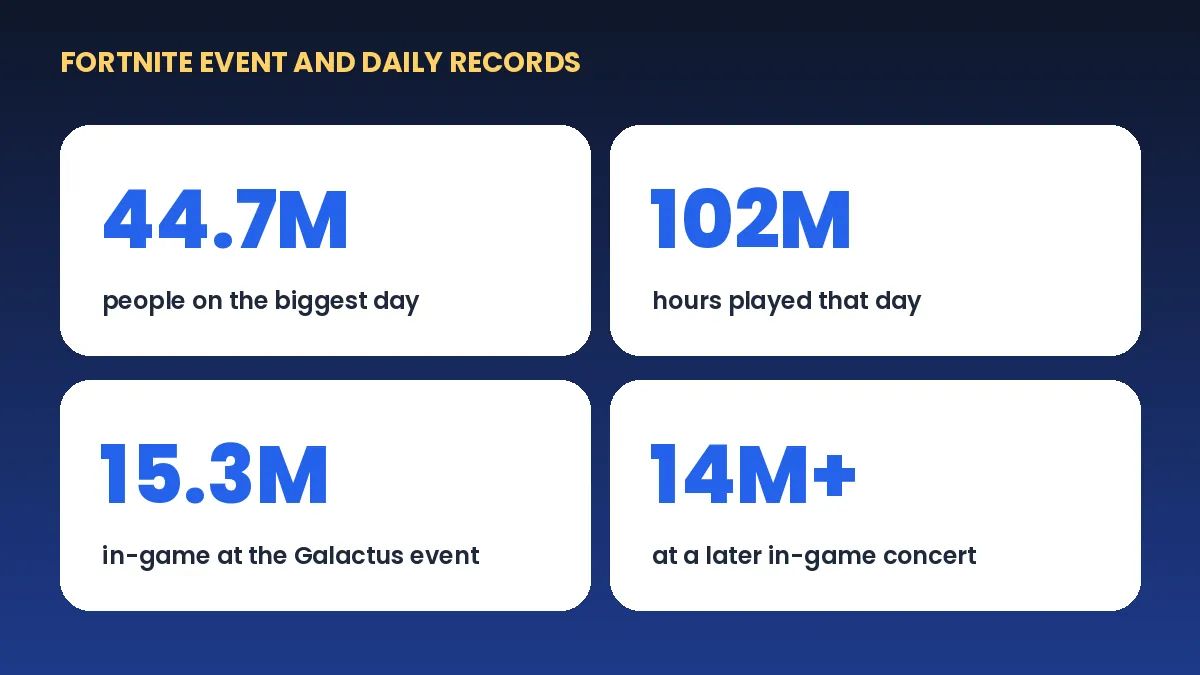
44.7 million people played on the biggest day, 15.3 million were in the game at once for a live event, and island creators have been paid over $1 billion.
This page covers monthly players, event peaks, revenue, creator pay, island play, streams, esports, platforms, play time and the outlook ahead.
Top Highlights
- More than 75 million people use Fortnite each month, the latest official monthly figure.
- Public filings later put registered players above 400 million, after Epic last announced 350 million.
- 44.7 million people played on the biggest day, for 102 million hours.
- A live event drew 15.3 million people in the game at once.
- A later in game concert drew more than 14 million people at once.
- Island creators have been paid over $1 billion, including $352 million in one year to 70,000 creators.
- 47% of player hours now go to creator built islands, up from 35% a year earlier.
- Fortnite statistics show this year’s championship series has a $10 million prize pool, up from $8 million last year.
How Many People Play Fortnite in 2026?
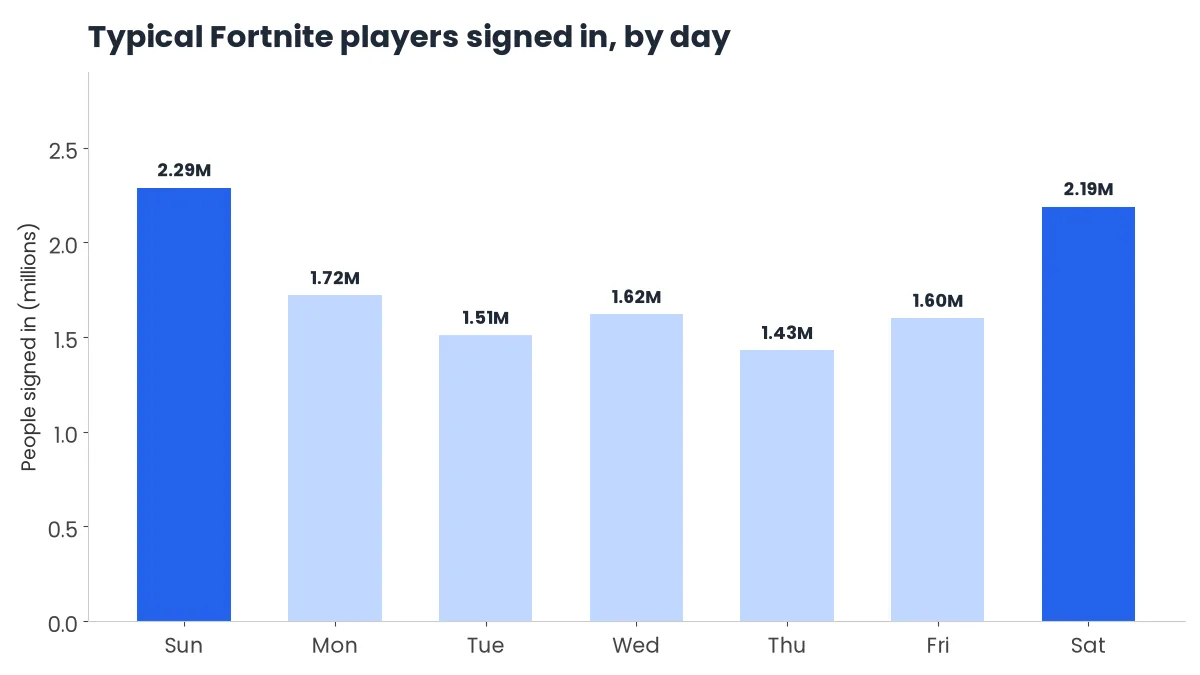
More than 75 million people use Fortnite each month. That is the latest monthly figure Epic has given, and it is the cleanest current size measure in these Fortnite statistics. It is not a live count of everyone online at once. On typical days, tracker totals put about 1.4 million to 2.3 million people signed in, with weekends at the top of that range.
What this means: treat 75 million as the monthly audience, and treat live totals as a smaller group that rises sharply when a big event lands.
How Many Registered Fortnite Players Are There?
Later public filings put registered Fortnite players above 400 million. Epic’s last direct announcement was 350 million registered players, more than six years ago, after earlier official totals of 125 million, 200 million and 250 million. A registered count includes every account ever created, so Fortnite statistics on accounts are a lifetime reach number, not a live player count.
| Milestone | Registered players |
|---|---|
| Later public filings | More than 400 million |
| Epic’s last announcement | 350 million |
| Third official total | 250 million |
| Second official total | 200 million |
| Early official total | 125 million |
What this means: use the monthly figure if you want to know who still plays, and use the registered total only as a lifetime reach number.
What Was Fortnite’s Biggest Day?
Fortnite’s biggest day brought in 44.7 million players, who logged 102 million hours. That daily total counts everyone who played at any point on the day the original map returned, not the number of people in the game at the same moment. The two figures get mixed up often in Fortnite statistics, but this remains the highest single day total Epic has announced.
What this means: if you see 44.7 million quoted as a live peak, it is the wrong reading of a daily record.
What Is Fortnite’s Peak Concurrent Player Count?
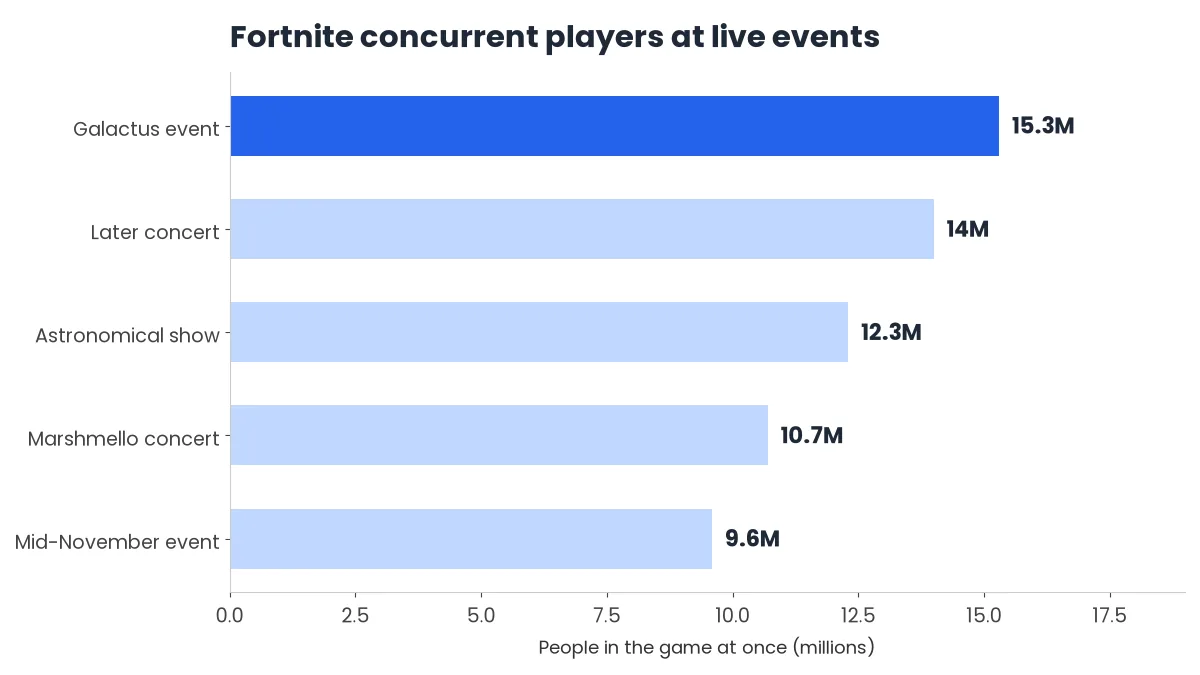
The highest live event count is 15.3 million people in the game at once. A later in game concert drew more than 14 million at the same moment. Astronomical’s first show reached 12.3 million, and the Marshmello concert reached 10.7 million. A mid November event this year peaked at about 9.6 million people in the game, with about 7.3 million in a match.
| Event | People in the game at once |
|---|---|
| Galactus live event | 15.3 million |
| Later in game concert | More than 14 million |
| First Astronomical show | 12.3 million |
| Marshmello concert | 10.7 million |
| Mid November event this year | About 9.6 million |
What this means: plan around event nights if you want the biggest rooms, because ordinary days sit far below these Fortnite statistics on peaks.
How Much Money Does Fortnite Make?
The last official Fortnite revenue figures were $5.48 billion and $3.71 billion in two early peak years. Epic has not published a Fortnite only revenue total since then, and it has not released a lifetime figure either. Estimates put the company’s revenue last year above $6 billion, with Fortnite as the main driver. Earlier this year, Epic also said it was spending more than it was making, so Fortnite statistics on current revenue should be treated as estimates, not a public ledger.
What this means: use the early official totals as the last hard numbers, and treat later annual figures as estimates rather than filings.
How Much Have Fortnite Creators Been Paid?
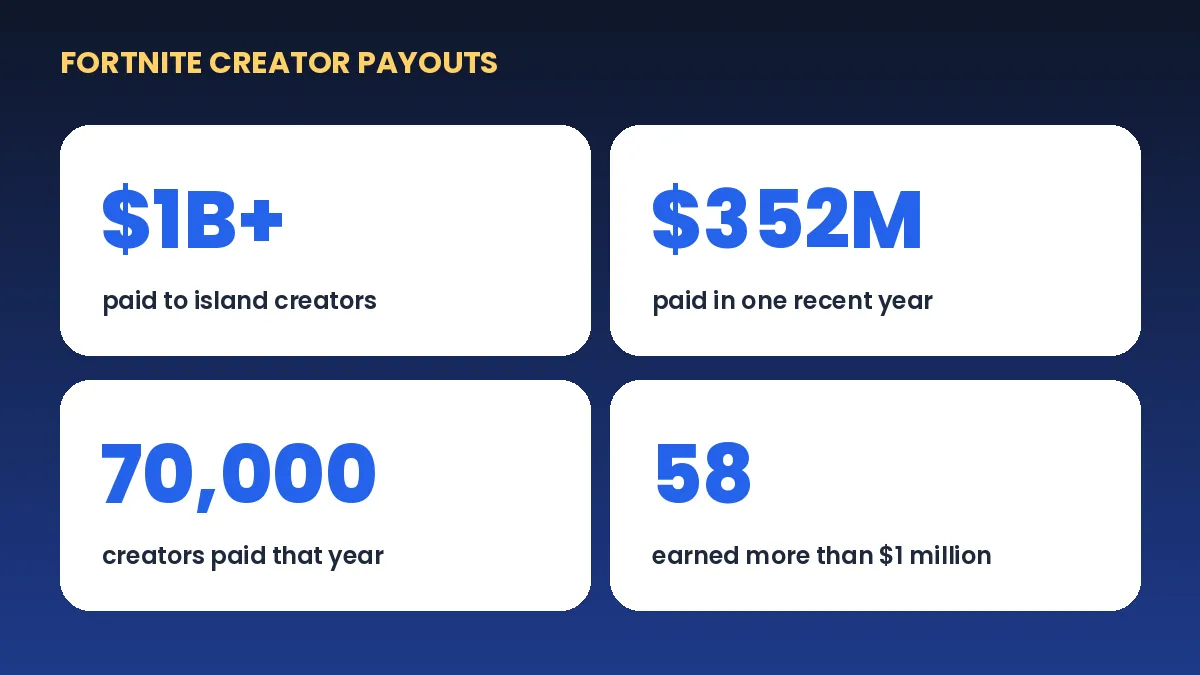
Island creators have been paid over $1 billion since the island editor launched. In one recent year, Epic paid $352 million to 70,000 creators, up from about 24,000 the year before. 58 of those creators earned more than $1 million, and 7 earned more than $10 million. Our creator economy statistics put that payout model in a wider context. These Fortnite statistics show creator pay is now central to how the game keeps people in new modes.
What this means: player made islands are no longer a side mode; they are a paid business with seven figure earners.
How Much Time Do Players Spend on Creator Islands?
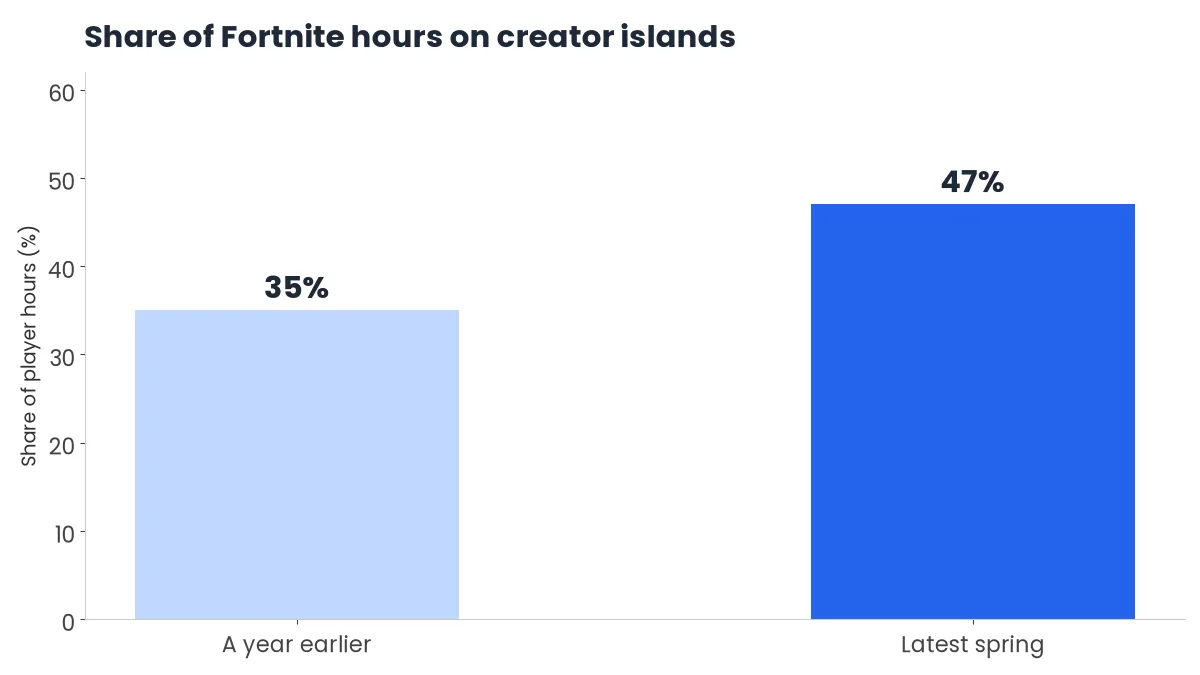
47% of player hours in the latest spring reading were spent on creator built islands, up from 35% a year earlier. Over 75% of in game transactions now happen outside Battle Royale. Battle Royale is still the front door for many players, but Fortnite statistics on time spent now show a growing share of hours and spending in islands built by other players.
What this means: if you create or advertise in Fortnite, island play now carries nearly half of all hours and most transactions.
How Popular Is Fortnite on Twitch and at Live Events?
People have watched Fortnite on Twitch for 361.2 million hours so far this year, at an average of about 45,800 viewers. In the last 30 days that average rose to 59,300 viewers, with 42.7 million hours watched and a peak of 346,600. Live events also pull extra viewers outside the game: about 3.4 million watched the Galactus event on Twitch and YouTube, and a later concert drew an estimated 3 million more on streams. For a wider view, see our Twitch statistics and live streaming statistics.
What this means: Fortnite is still a major streaming title, even if daily Twitch averages now sit far below the old event peaks.
How Large Are Fortnite Esports Prize Pools?
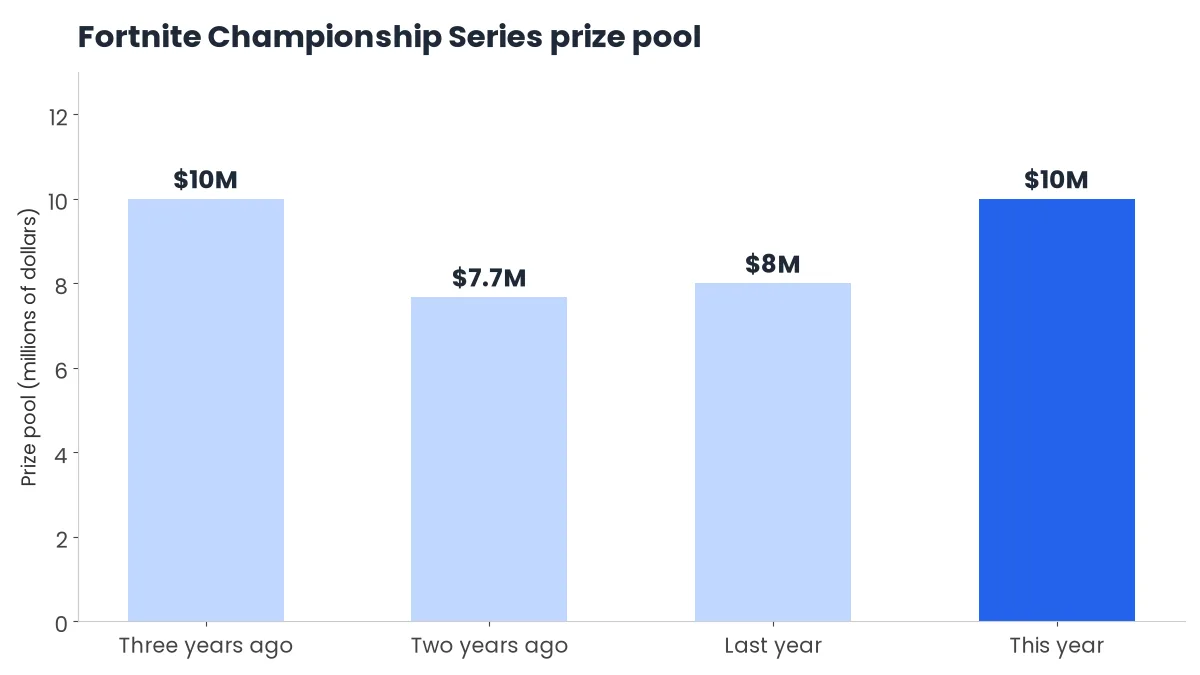
This year’s Fortnite Championship Series has a $10 million prize pool, up from $8 million last year. The year before that it was $7.7 million, and three years ago it was also $10 million. World Cup finals carried a $30 million prize pool, inside a $100 million competitive year, and the Global Championship this year had a $2 million prize pool. Our esports statistics show how that compares with other circuits.
| Period | Championship Series prize pool |
|---|---|
| This year | $10 million |
| Three years ago | $10 million |
| Last year | $8 million |
| Two years ago | $7.7 million |
What this means: prize money in these Fortnite statistics is still high, but it is now spread across a season.
What Platforms Can People Use to Play Fortnite?
Fortnite is back on major mobile stores after a long gap, and it still runs on PlayStation, Xbox, Nintendo Switch and PC. It returned to the US App Store last year and to the Google Play Store earlier this year. Cross play means those platforms share the same player pool, and our Xbox statistics cover one of the console sides of that mix.
What this means: Fortnite statistics on platforms now include phones again, but the mobile return is still a rebuild.
How Has Fortnite Play Time Changed?
Estimates for PlayStation and Xbox put average monthly play time at 15.4 hours last year, down from 29 hours three years earlier. The same estimates put peak monthly players on those consoles 28% lower than three years ago. That reading covers consoles only, not PC or mobile, but it lines up with Epic’s comment that engagement fell from last year.
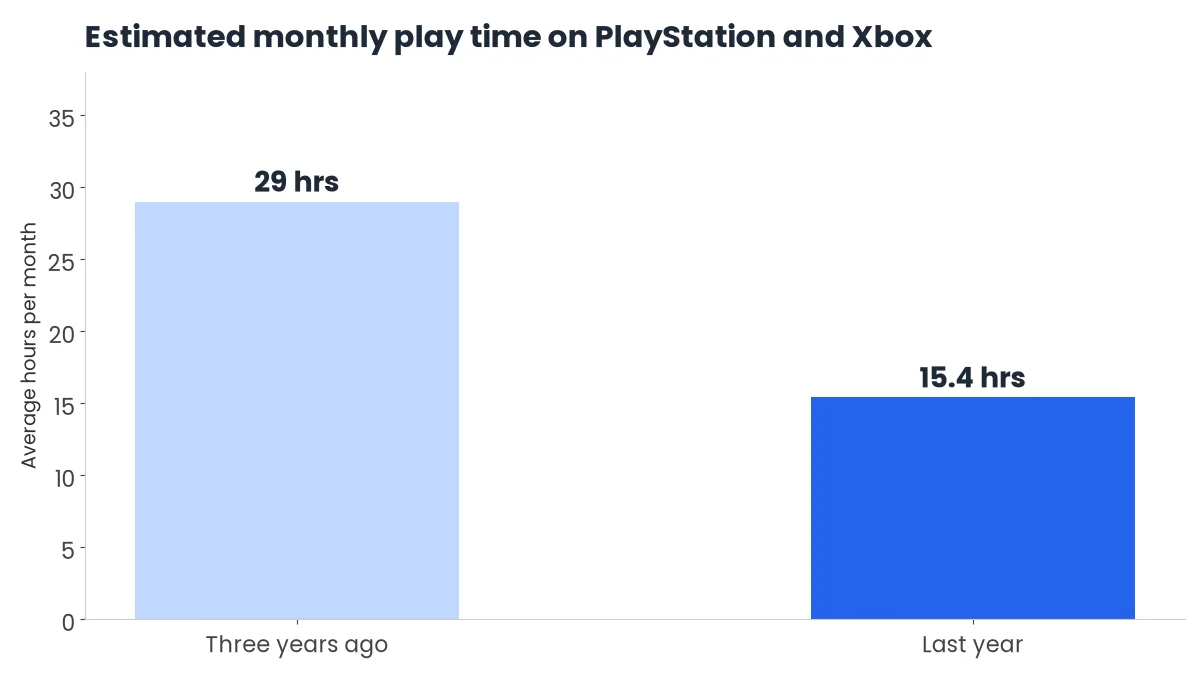
What this means: people still play, but the average console session calendar is thinner than it was at the last peak.
What Challenges Show Up in the Latest Fortnite Statistics?
Earlier this year, Epic cut more than 1,000 jobs after a downturn in Fortnite engagement, and it also reduced the V-Bucks in each pack. The $8.99 pack now holds 800 V-Bucks instead of 1,000, a 25% cut in coins for the same price. Larger packs were cut as well, the Battle Pass now costs 800 V-Bucks and pays back 800, and Fortnite Crew’s monthly grant fell from 1,000 to 800. Rocket Racing, Ballistic and Festival Battle Stage were also closed or set to close.
| Pack price | V-Bucks now | V-Bucks before |
|---|---|---|
| $89.99 | 12,500 | 13,500 |
| $36.99 | 4,500 | 5,000 |
| $22.99 | 2,400 | 2,800 |
| $8.99 | 800 | 1,000 |
What this means: prices went up and some modes closed after engagement slipped.
Did you know?
Over 75% of in game transactions now happen outside Battle Royale, and Fortnite statistics show more of that spending moving into player made islands. Our metaverse statistics look at how other virtual worlds handle that same shift.
What Is the Outlook for Fortnite?
Creator islands and the mobile return are the two clear growth bets in the latest Fortnite statistics. Island hours and payouts are already up, and this year’s championship series held a $10 million prize pool. Two years ago, Disney invested $1.5 billion to build a shared universe inside the game. For the other major game launch this month, see our GTA 6 statistics.
What this means: expect more weight on islands, mobile and partnerships, while everyday play time stays under pressure.
Pros & Cons: Fortnite Statistics
Pros
- More than 75 million people use Fortnite each month
- 44.7 million people played on the biggest day
- A live event drew 15.3 million people in the game at once
- Island creators have been paid over $1 billion
- 47% of player hours now go to creator built islands
- This year's championship series has a $10 million prize pool
Cons
- Engagement fell, and Epic cut more than 1,000 jobs earlier this year
- V-Bucks packs now give fewer coins for the same price
- Estimated console play time has fallen from 29 hours a month to 15.4 hours
Taken together, the Fortnite statistics above show a game that still reaches tens of millions of people each month and still sets event records, while play time and costs are under pressure. Use it for events, islands and competitive play, and budget for fewer V-Bucks in each pack.
Quick Links:
- GTA 6 Statistics 2026
- Esports Statistics 2026
- Twitch Statistics 2026
- Live Streaming Statistics 2026
- YouTube Statistics 2026
- Creator Economy Statistics 2026
- Xbox Statistics 2026
- AI Chatbot Statistics 2026
FAQs: Fortnite Statistics
Current Fortnite statistics put the latest official monthly figure at more than 75 million people. That is the cleanest current size measure, and it is not a live count of everyone online at once. On typical days, tracker totals put about 1.4 million to 2.3 million people signed in. A mid November event this year peaked at about 9.6 million people in the game at once.
Later public filings put registered Fortnite players above 400 million. Epic's last direct announcement was 350 million, more than six years ago, after earlier official totals of 125 million, 200 million and 250 million. No newer registered total has been published. A registered count includes every account ever created, so it is not the number of people who play now.
Fortnite's biggest day brought in 44.7 million players, who logged 102 million hours. That figure counts everyone who played at any point on the day the original map returned. It is a daily total, not a concurrent peak, and it remains the highest single day figure Epic has announced. Fortnite statistics should keep those two measures apart.
The highest live event count is 15.3 million people in the game at once. A later in game concert drew more than 14 million at the same moment, Astronomical's first show reached 12.3 million, and the Marshmello concert reached 10.7 million. A mid November event this year peaked at about 9.6 million.
The last official Fortnite revenue figures were $5.48 billion and $3.71 billion in two early peak years. Epic has not published a Fortnite only total since then, and it has not released a lifetime figure. Estimates put the company's revenue last year above $6 billion, with Fortnite as the main driver. Earlier this year, Epic also said it was spending more than it was making.
Island creators have been paid over $1 billion since the island editor launched. In one recent year, Epic paid $352 million to 70,000 creators, up from about 24,000 the year before. 58 of those creators earned more than $1 million, and 7 earned more than $10 million. These Fortnite statistics show creator payouts are now a core part of how the game shares revenue.
People have watched Fortnite on Twitch for 361.2 million hours so far this year, at an average of about 45,800 viewers. In the last 30 days that average rose to 59,300 viewers, with 42.7 million hours watched and a peak of 346,600. Fortnite statistics on live events also add millions of viewers on Twitch and YouTube.
This year's Fortnite Championship Series has a $10 million prize pool, up from $8 million last year and $7.7 million the year before. Three years ago the series was also $10 million. The first World Cup finals carried a $30 million prize pool, inside a $100 million competitive year. Fortnite statistics put the Global Championship prize pool this year at $2 million.
Fortnite statistics show a mixed picture, with monthly reach still in the tens of millions and creator islands now taking 47% of player hours. Creators have been paid over $1 billion. At the same time, estimated console play time has fallen, V-Bucks packs give fewer coins, and Epic cut more than 1,000 jobs.
Conclusion: Fortnite Statistics 2026 in Numbers
This year’s Fortnite statistics start with more than 75 million monthly players, 44.7 million people on the biggest day, and over $1 billion paid to island creators. The game still sets event records, including 15.3 million people in the game at once, and creator islands now take 47% of player hours. Engagement and play time have slipped, so the next chapter will lean on islands, mobile and live events.
Last updated

Affiliate disclosure: In full transparency – some of the links on our website are affiliate links, if you use them to make a purchase we will earn a commission at no additional cost for you (none whatsoever!).
Discussion
Join the conversation
No comments yet. Start the discussion with a question or your own experience.