Blogging remains a cornerstone of digital success in 2025, with over 600 million active blogs worldwide shaping how businesses, creators, and marketers connect with audiences.
As a reader eager to harness blogging’s potential, you gain from understanding the latest blogging statistics for 2025, which reveal not only the scale of this medium but also actionable strategies to boost traffic, leads, and engagement.
With 83% of internet users reading blogs monthly and businesses with blogs enjoying 55% more traffic, blogging offers a proven path to amplify your online presence.
This article dives deep into global trends, content formats, SEO tactics, and AI’s growing role, enriched with fresh insights from Quora and Reddit discussions where users share real-time concerns about AI-generated content and reader retention.
By exploring these statistics and strategies, you learn how to craft compelling posts, optimize for search engines, and build a loyal audience, turning your blog into a powerful tool for personal or business growth.
The State of Blogging in 2026: A Global Snapshot
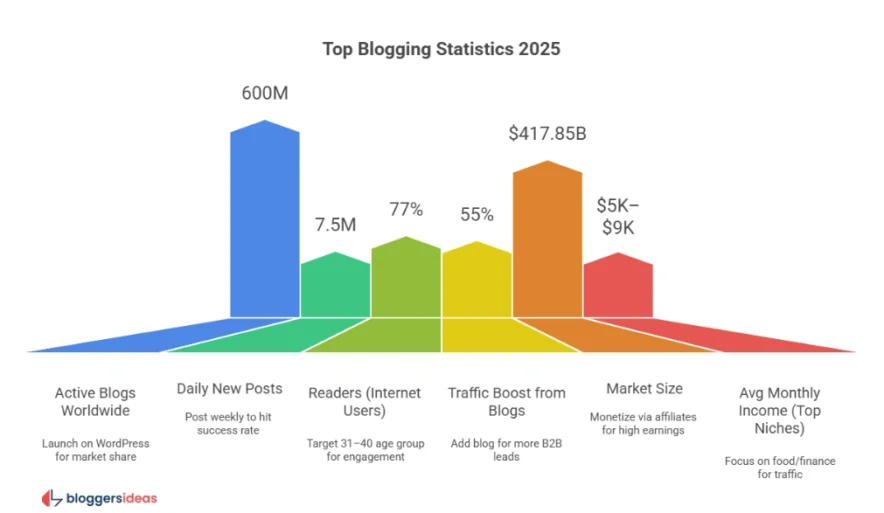
Blogging thrives as a dynamic platform in 2025, with over 600 million active blogs worldwide, including 60 million hosted on WordPress alone.
Each day, approximately 7.5 million new posts go live, reflecting the medium’s vibrancy. A staggering 83% of internet users, roughly 4.44 billion people, engage with blogs at least monthly, making them a critical channel for content consumption.
Businesses leverage this trend, as 76% of B2C marketers and 79% of B2B marketers use blogs to distribute content, ranking them second only to organic social media.
You capitalize on this by starting or refining your blog, ensuring it aligns with audience demands for fresh, relevant content.
The table below highlights key global blogging statistics for 2025:
| Metric | Statistic |
| Total Blogs Worldwide | Over 600 million |
| Daily Blog Posts Published | 7.5 million |
| Internet Users Reading Blogs Monthly | 83% (4.44 billion) |
| B2C Marketers Using Blogs | 76% |
| B2B Marketers Using Blogs | 79% |
| WordPress-Hosted Blogs | 60 million |
These figures show blogging’s massive reach, encouraging you to create consistent, high-quality content to tap into this engaged audience.
Also read about: WordPress Statistics
Benefits of Blogging: Driving Traffic and Leads
Blogging delivers measurable results for businesses and individuals alike. Websites with blogs boast 434% more indexed pages, enhancing their visibility on search engines like Google, which holds a 91.47% market share.
This increased indexing translates to a 55% traffic boost for businesses with blogs compared to those without.
Moreover, B2B companies with blogs generate 67% more leads, while marketers prioritizing blogging are 13 times more likely to achieve a positive return on investment (ROI).
For you, this means blogging isn’t just a creative outlet but a strategic tool to drive measurable growth.
The table below outlines the business benefits of blogging:
| Benefit | Statistic |
| Indexed Pages Increase | 434% more |
| Website Traffic Boost | 55% higher |
| B2B Lead Increase | 67% more |
| ROI Likelihood for Blog-Focused Marketers | 13x higher |
| Bloggers Reporting Strong Results | 26% |
You apply these insights by maintaining a blog to increase your site’s searchability, attract more visitors, and convert them into leads or customers.
Also read about: Autoblogging AI Coupon Code 2025: Get 55% Off Now ✅
Blogging Content: Crafting Posts That Engage and Convert
High-performing blog posts hinge on quality content that answers reader queries, uses clear headlines, and incorporates visuals.
The average blog post in 2025 spans 1,427 words, though 75% of readers prefer posts under 1,000 words for quick consumption.
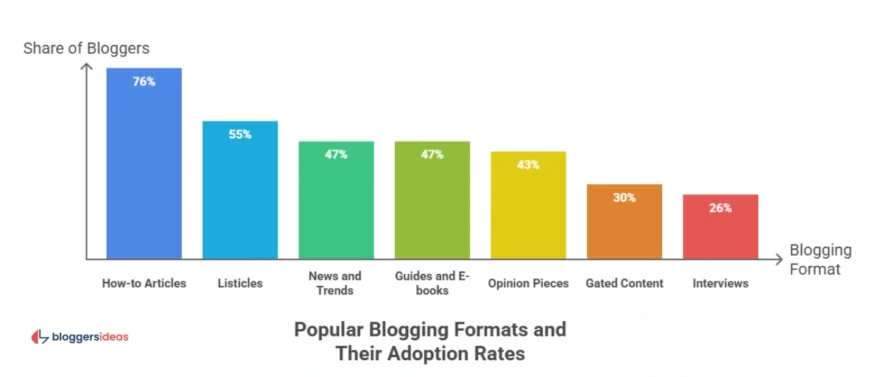
How-to articles dominate, with 76% of bloggers favoring this format, followed by listicles (55%) and news or trend updates (47%).
Readers spend just 52 seconds on average per post, so you grab attention with concise, scannable content and compelling visuals.
Posts with seven or more images earn 55% more backlinks, while those with videos generate 70% more organic traffic.
The table below shows the most popular blogging formats and their adoption rates:
| Blogging Format | Share of Bloggers |
| How-to Articles | 76% |
| Listicles | 55% |
| News and Trends | 47% |
| Guides and E-books | 47% |
| Opinion Pieces | 43% |
| Gated Content | 30% |
| Interviews | 26% |
| Infographics | 26% |
| Roundups | 23% |
| Webinars | 20% |
You enhance engagement by crafting how-to guides or listicles, embedding videos, and using at least two images every 150-300 words to keep readers hooked.
Blog Post Length and Reader Behavior:
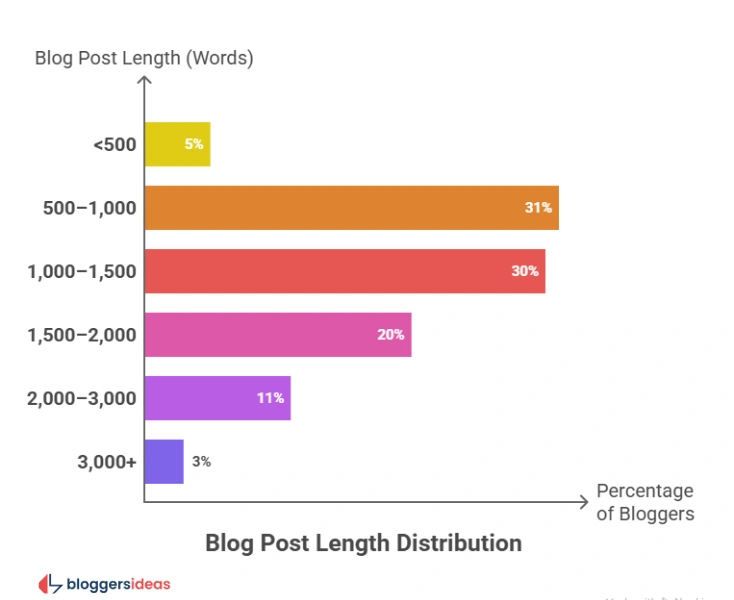
Blog post length significantly impacts engagement and SEO performance.
While the average post is 1,427 words, posts exceeding 2,450 words achieve the best conversion rates, ideal for in-depth guides or research pieces.
However, 73% of readers skim posts, and 23% read thoroughly, so you balance depth with readability. Posts over seven minutes long see engagement drop, as readers prefer quick, digestible content.
Headlines also matter: those with 6-13 words or question marks gain 23% more social shares, while H1 tags with seven or fewer words boost organic traffic by 36%.
The table below details reader behavior and content preferences:
| Metric | Statistic |
| Average Blog Post Length | 1,427 words |
| Preferred Post Length by Readers | Under 1,000 words (75%) |
| Skimming Readers | 73% |
| Thorough Readers | 23% |
| Engagement Drop Point | Over 7 minutes |
| Social Shares Increase with Question Mark Headlines | 23% |
| Organic Traffic Boost with Short H1 Tags | 36% |
You optimize by writing concise posts for broad appeal or longer, detailed ones for conversions, ensuring scannable formats with short headlines.
SEO Strategies: Boosting Blog Visibility
Search engine optimization (SEO) remains critical, as 68% of online experiences start with a search engine, and 71% of bloggers prioritize SEO to drive traffic.
Blogs with videos attract three times more inbound links, while businesses with blogs gain 97% more backlinks, enhancing Google rankings.
However, 91% of web pages receive zero organic traffic, underscoring the need for strategic optimization.
Updating old content ranks as the second-best SEO tactic after publishing new posts, with 74% of bloggers refreshing older articles to maintain relevance.
The table below highlights key SEO statistics for blogging:
| SEO Metric | Statistic |
| Bloggers Prioritizing SEO | 71% |
| Traffic Increase with Blogs | 55% |
| Backlink Increase with Blogs | 97% |
| Video Posts’ Inbound Link Boost | 3x |
| Pages with Zero Organic Traffic | 91% |
| Bloggers Updating Old Content | 74% |
You improve rankings by conducting keyword research with tools like Semrush or Ahrefs, incorporating videos, and regularly updating posts to reflect current trends.
AI Adoption in Blogging: Revolutionizing Content Creation
Artificial intelligence (AI) transforms blogging, with 65% of bloggers using AI tools at least occasionally. Common uses include generating ideas (43%), crafting headlines (29%), and creating outlines (28%).
AI-generated content grows 5% faster than human-written content, and blog posts cost $131 on average with AI versus $611 for human-written ones.
However, 97% of companies review AI content before publishing, ensuring quality. Recent Quora discussions reveal bloggers worry about AI content lacking authenticity, with users asking how to blend AI with human insights for unique posts.
Reddit threads in r/Blogging suggest using AI for drafting but editing heavily to maintain a personal voice.
The table below outlines AI adoption in blogging:
| AI Use Case | Percentage of Bloggers |
| Using AI Occasionally | 65% |
| Generating Ideas | 43% |
| Writing Headlines | 29% |
| Creating Outlines | 28% |
| Content Growth with AI | 5% faster |
| Cost of AI-Generated Post | $131 |
| Cost of Human-Written Post | $611 |
You leverage AI by using tools like ChatGPT for brainstorming, then refining outputs to reflect your unique perspective, addressing reader concerns about authenticity.
Blog Marketing: Amplifying Reach and Engagement
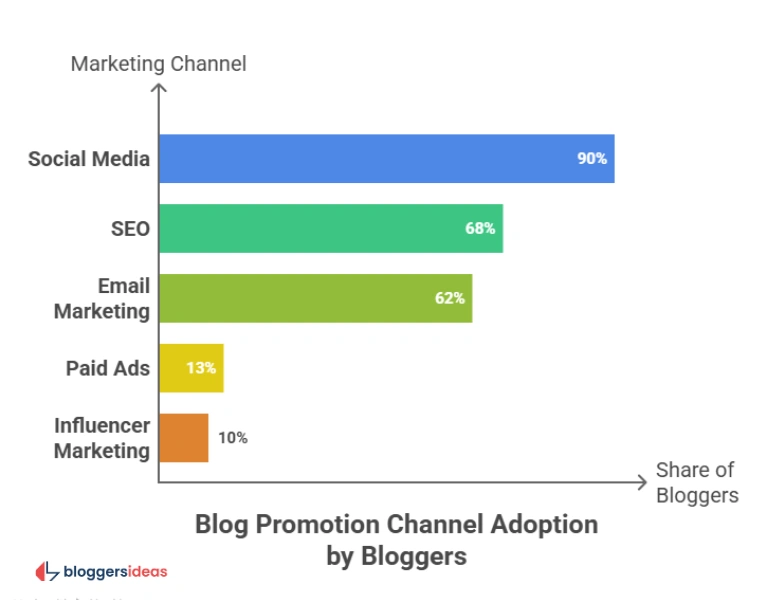
Effective blog promotion relies on diverse channels. Social media leads, with 90% of bloggers using it to drive traffic, followed by email marketing (62%) and SEO (68%).
Companies publishing 16 or more posts monthly generate 4.5 times more leads, and 70% of bloggers earning over $50,000 annually actively promote their blogs.
Influencer collaborations boost results, with 10% of bloggers partnering with influencers to expand reach.
On Reddit’s r/Marketing, users discuss the effectiveness of cross-posting blog snippets on Twitter and LinkedIn to drive clicks, while Quora users ask about balancing paid ads with organic promotion for cost efficiency.
The table below shows blog promotion channels and their adoption:
| Marketing Channel | Share of Bloggers |
| Social Media | 90% |
| SEO | 68% |
| Email Marketing | 62% |
| Paid Ads | 13% |
| Influencer Marketing | 10% |
You maximize reach by sharing posts on social platforms, building an email list, and exploring influencer partnerships to amplify your blog’s visibility.
WordPress: The Backbone of Blogging
WordPress powers over 478 million websites, including 60 million blogs, making it the leading platform for bloggers. Users publish 70 million new posts and 77 million comments monthly, reflecting its active community.
Blogs on WordPress appear in 120 languages, with English dominating at 71%. You benefit from WordPress’s flexibility by choosing it for easy customization and SEO plugins like Yoast to optimize content.
The table below breaks down WordPress blogging statistics:
| Metric | Statistic |
| Total WordPress Websites | 478 million |
| WordPress Blogs | 60 million |
| Monthly New Posts | 70 million |
| Monthly New Comments | 77 million |
| Top Language (English) | 71% |
You harness WordPress’s features by selecting SEO-friendly themes and regularly engaging with comments to build community.
Emerging Blogging Trends for 2025
Several trends shape blogging’s future, offering you opportunities to stay ahead. AI integration continues to rise, with 34% of companies using tools like ChatGPT for content creation and optimization.
Responsive infographics gain traction, as they engage the 73% of readers who skim posts, encouraging repeat visits. Social signals, such as traffic from social media, become critical, with experts predicting they’ll rival backlinks in SEO importance.
Personalization and branding also stand out, as readers trust branded blogs more in a crowded digital space.
Recent Reddit discussions in r/Blogging highlight concerns about AI content saturation, with users suggesting niche topics and original research to differentiate.
Quora users ask how often to post for optimal engagement, with answers favoring weekly updates for consistency.
The table below summarizes 2025 blogging trends:
| Trend | Description |
| AI Integration | 34% of companies use AI for content creation and optimization |
| Responsive Infographics | Engage skimming readers, increasing retention |
| Social Signals | Traffic from social media rivals backlinks in SEO impact |
| Personalization and Branding | Branded blogs build trust and stand out |
You adopt these trends by using AI for efficiency, incorporating infographics, and building a recognizable brand through consistent, niche-focused content.
Reader Behavior: Capturing and Retaining Attention
Readers’ short attention spans challenge bloggers, with the average visitor spending just 52 seconds on a post. Over 50% stop reading if they encounter issues like poor formatting or slow loading.
Posts with easy-to-read text perform better, with 33.45% of high-performing blogs rated “easy to read” versus 16.73% deemed “difficult.”
Including statistics (50% of bloggers do this) and contributor quotes (36%) boosts credibility. You retain readers by using clear headings, short paragraphs, and visuals to make content accessible and engaging.
The table below details reader behavior statistics:
| Behavior Metric | Statistic |
| Average Time Spent on Post | 52 seconds |
| Readers Stopping Due to Issues | Over 50% |
| Easy-to-Read Blogs’ Performance | 33.45% |
| Difficult-to-Read Blogs’ Performance | 16.73% |
| Bloggers Including Statistics | 50% |
| Bloggers Including Quotes | 36% |
You improve retention by prioritizing readability, using visuals, and addressing reader pain points directly in your content.
Practical Strategies to Benefit from Blogging
To maximize blogging’s potential, you track key performance indicators (KPIs) like overall traffic, top-viewed posts, and conversion rates.
Regularly analyze traffic sources to identify what drives visitors, with 33% of bloggers checking analytics three times weekly. Publish weekly or biweekly posts, as 47% of bloggers follow this schedule for consistent engagement.
Collaborate with influencers to tap into new audiences, and update old posts to maintain SEO relevance.
Recent Reddit threads in r/SEO emphasize creating “emotional SEO” content that resonates with readers’ needs, while Quora users suggest answering customer questions in posts to boost rankings. Y
ou implement these by focusing on reader-centric content, optimizing for long-tail keywords, and promoting across social platforms.
FAQs ABout Blogging Statistics
1. What is the average blog post length in 2025, and why does it matter?
The average blog post length in 2025 is 1,427 words, but 75% of readers prefer posts under 1,000 words for quick reading. Length matters because shorter posts suit skimming readers, while posts over 2,450 words drive higher conversions for in-depth topics, allowing you to tailor content to your audience’s needs.
2. How does AI impact blogging in 2025?
AI impacts blogging by streamlining content creation, with 65% of bloggers using tools like ChatGPT for ideas, headlines, and outlines. AI-generated posts cost $131 versus $611 for human-written ones, but blending AI with human editing ensures authenticity, addressing reader concerns about generic content.
3. What are the most effective blog formats for engagement?
How-to articles (76%) and listicles (55%) are the most effective formats, as they address reader queries directly and are easy to scan. Including videos and seven or more images boosts engagement by 70% and 55%, respectively, making these formats ideal for retaining attention.
4. How can bloggers improve SEO in 2025?
Bloggers improve SEO by conducting keyword research (85% use tools like Semrush), updating old content (74% do this), and incorporating videos for three times more inbound links. Focusing on long-tail keywords and answering customer questions in posts also enhances rankings.
5. Why are social signals important for blogging in 2025?
Social signals, or traffic from social media, are critical because they rival backlinks in SEO impact, with 90% of bloggers using social platforms to promote content. Strong social engagement signals relevance to search engines, boosting your blog’s visibility and reach.
Also Read:
- Android Usage Statistics
- Coupon Statistics
- Android Usage Statistics
- Content Marketing Statistics
- Live Streaming Statistics
Conclusion: Transform Your Blog into a Growth Engine
Blogging in 2025 offers unparalleled opportunities to connect with audiences, drive traffic, and generate leads.
With 600 million blogs worldwide, 83% of internet users reading them, and businesses seeing 55% more traffic, blogging remains a vital strategy.
By leveraging AI for efficiency, incorporating visuals, and prioritizing SEO, you create content that ranks higher and engages readers.
Trends like social signals and personalization help your blog stand out, while addressing reader concerns about authenticity ensures trust.
Start or refine your blog today, using these insights to build a loyal audience and achieve measurable success.
Source: Orbit Source Media, Worldometer