Google ran two major core updates in the first five months of 2026 and the SEO community is still assessing the damage. The March 2026 Core Update was the most volatile update in recent history by every major tracking tool’s measure. The May 2026 Core Update arrived just 43 days after March finished rolling out. And analysts are now predicting a June update before the dust has fully settled from May.
The February 2026 Discover Core Update marked a new chapter in Google’s efforts to make personalised surfaces more useful. The March 2026 Spam Update acted as a cleanup operation — its timing, just days before the core update, suggesting Google wanted to remove obvious spam before re-evaluating overall quality signals. medium
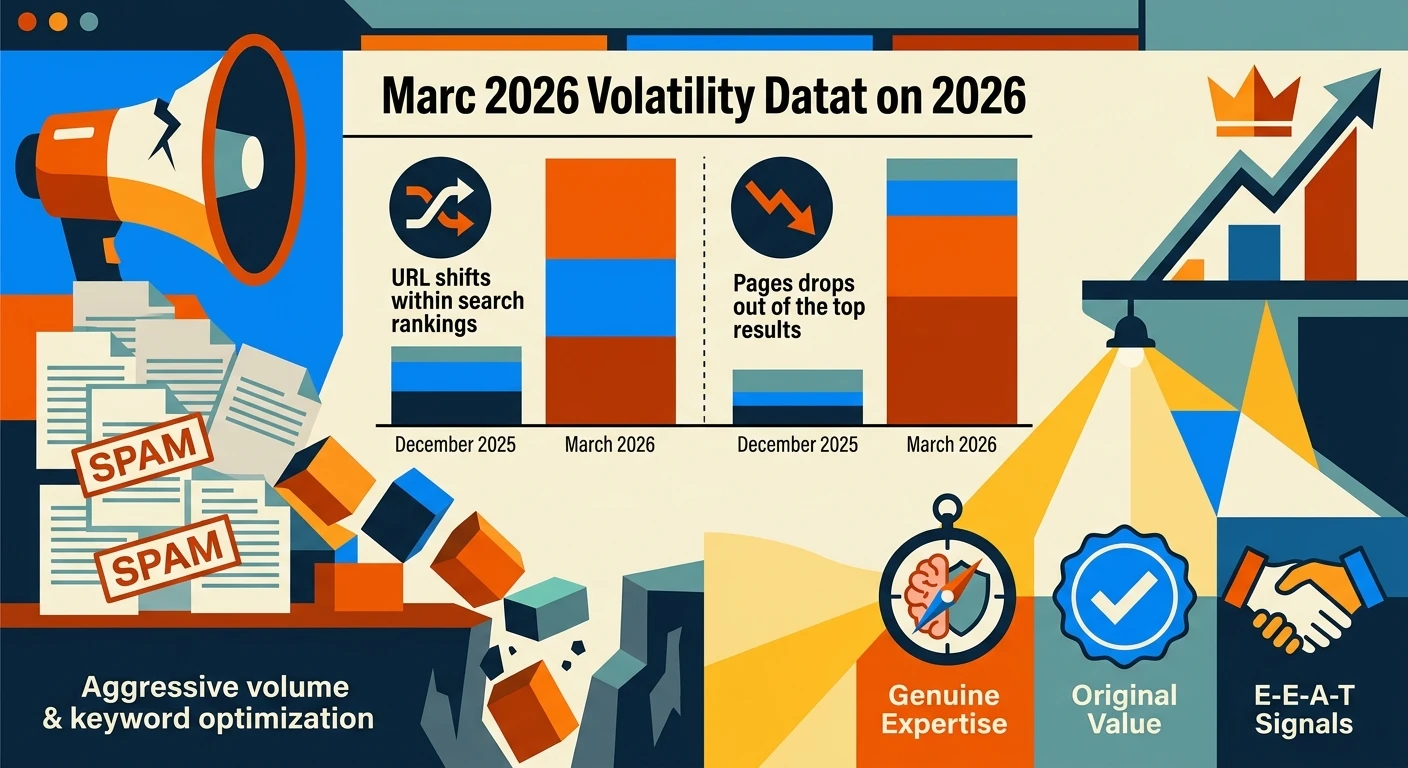
Fun Fact: During the March 2026 Core Update, nearly 80% of pages that ranked in positions 1 to 3 changed position. One in four pages in the top 10 fell completely out of the top 100. This is the highest positional volatility Google has produced in years. (SE Ranking data)
Google Core Update Statistics 2026: Top Picks
Nearly 80% of top results shifted during the March 2026 core update — significantly higher volatility compared to late 2025 updates. Google is increasingly emphasising content that provides real value over purely SEO-optimised material. medium
March 2026 saw 79.5% of URLs in top-three positions change compared to 66.8% in the December 2025 update. (SE Ranking)
In the top 10, 90.7% of URLs shifted during March 2026 compared to 83.1% in December. (SE Ranking)
The March 2026 core update is Google’s first broad core update of 2026, arriving two days after the fastest spam update in Google’s dashboard history. EEAT now applies across every content type, not just health, finance, and legal. MonsterClaw LLC
AI Overviews cut organic CTR by 61% on affected queries. Getting cited inside an AI Overview now earns 35% more clicks than holding a traditional top ranking below it. MonsterClaw LLC
Google described the March update as a regular update designed to better surface relevant, satisfying content. In practice, SEOs and site owners are seeing stronger emphasis on information gain — content that adds unique insights, original research, or fresh perspectives. Viacon
The May 2026 Core Update launched on May 21 with rollout taking up to two weeks to complete.
79.5% of top-3 URLs shifted during March — up from 66.8% in December 2025. (SE Ranking)
The Timeline of 2026 Google Algorithm Updates
Understanding the sequence matters because each update built on the previous one.
Date | Update | Duration | Primary Target |
February 2026 | Discover Core Update | ~2 weeks | Discover traffic for content sites |
March 24–25, 2026 | Spam Update | Under 20 hours | Scaled content abuse, spam networks |
March 27, 2026 | March Core Update | ~2 weeks | Content quality, EEAT, helpful content |
May 21, 2026 | May Core Update | Up to 2 weeks | Continuing quality signals |
June 2026 (predicted) | Potential Core Update | TBC | Topical coherence, content consolidation |
Date of the March 2026 Spam Update: March 24 to 25, 2026, completed in under 20 hours. The March 2026 Core Update launched two days later on March 27. medium
The speed of the spam update — under 20 hours — is remarkable. Previous spam updates took days to roll out. Google completing a major spam enforcement action in less than a day signals the level of automation now powering its content quality systems. Human review at this speed is not possible — these are AI-powered quality evaluations running at machine scale.
March 2026 Core Update — The Volatility Data
The March 2026 core update began rolling out on March 27, 2026 and may take up to two weeks to complete. It targets scaled content abuse, weak EEAT signals, and poor page experience. Brands that combine quality content, verified author expertise, and GEO-ready structure will recover. Those still optimising for rankings alone will fall further behind. MonsterClaw LLC
The volatility measurements from tracking tools were consistently alarming.
Metric | December 2025 | March 2026 | Change |
Top 3 URL shifts | 66.8% | 79.5% | +12.7pp |
Top 10 URL shifts | 83.1% | 90.7% | +7.6pp |
Pages dropping out of top 100 | ~18% | ~25% | +7pp |
For bloggers, the message is clear: the old publish-more-optimise-for-keywords playbook is no longer enough. The March 2026 update continues Google’s push toward higher-quality, people-first content while cracking down on low-value, spammy, and unoriginal material. Viacon
What this means for you: The March 2026 update did not create new rules. It enforced existing rules more aggressively using better AI-powered quality evaluation. If your content was already built around genuine expertise and original value, the update was either neutral or positive for your rankings. If your content strategy relied on volume and keyword optimisation without genuine depth, March 2026 was the bill arriving.
What Categories of Content Got Hit Hardest
The pattern across every credible post-March 2026 analysis is consistent.
Sites and content types most affected:
Thin informational articles without original insight or data
AI-generated content without meaningful human editing or review
Scaled content operations publishing similar articles targeting slight keyword variations
Affiliate review sites without genuine product testing or experience
Anonymous content without clear authorship or expertise signals
Outdated pages with cosmetic freshness updates but no new information
Sites and content types most rewarded:
Content where Google can confidently understand who published it, who wrote it, what expertise is involved, and how that expertise relates to the topic dev
Original research and proprietary data
Deep topical coverage with genuine expertise
Content built around real practitioner experience
Sites with clear entity signals and Knowledge Graph presence
Instead of ranking random articles, Google now evaluates a site’s overall expertise in a niche. A website covering SEO consistently will rank better for SEO-related topics than a general blog occasionally posting about SEO. Niche authority is stronger than ever. Jotform
The June 2026 Core Update Predictions
A possible June 2026 core update would likely continue the trend of rewarding consolidation where one strong page does the work of five weak ones. This is especially relevant for service pages, glossaries, city pages, affiliate comparison pages, and templated informational articles. Sites that maintain a clear centre of gravity may benefit. Sites that publish loosely across unrelated subjects in pursuit of traffic may struggle. Channelpro
The analysts who predicted the March volatility accurately are pointing to the same signals for June.
A likely June 2026 theme is clearer reward for content where Google can confidently identify who published it, what expertise is involved, and how that expertise relates to the topic. The strongest prediction is that Google will continue preferring content closer to the original source of expertise, data, experience, or transaction. dev
Consolidation is the operative word. Five thin articles covering slight keyword variations will increasingly be beaten by one comprehensive article that genuinely covers the topic. The audit you should run right now is identifying your lowest-traffic pages and asking whether they should be consolidated into stronger hub articles or removed entirely.
How Core Updates Affect Different Traffic Sources
The February 2026 Discover Core Update significantly affected traffic for content-heavy sites reliant on Discover. It did not directly impact traditional search rankings but shifted traffic for sites whose Discover presence was a primary referral source. medium
Traffic Source | March 2026 Impact | Notes |
Google Organic Search | High volatility | 79.5% top-3 positions changed |
Google Discover | Separate update (Feb) | Content-heavy sites affected |
Featured Snippets | Significant reshuffling | Tied to core update quality signals |
Google News | Moderate | News sites with EEAT signals held better |
Long-tail informational | Highest losses | AI Overviews answer directly |
Commercial / transactional | Lower impact | Less AI Overview presence |
Recovery Statistics and Timelines
One of the most practical questions after a core update hits is: how long does recovery take? The research data gives realistic guidance.
Historical data across core update cycles shows:
Sites with genuine quality issues recover only after next core update — typically 3 to 6 months
Sites affected by the spam update alongside the core update recover faster — 4 to 8 weeks after spam is cleaned up
Sites with strong EEAT signals and no thin content see recovery within the rollout window itself (2 weeks)
Content farms and scaled content operations have low recovery rates — the quality bar has permanently risen past what these models can achieve without fundamental change
The recommended recovery approach: do not panic and wait until the rollout stabilises before making big changes. Audit your top 10 to 20 pages to identify which rely on thin content or heavy AI generation. Create a 30-day content calendar focused on high-value experience-driven posts. Monitor Google Search Console for impression and click changes. Viacon
Core Update Benchmark Table
Signal | Positive Outcome | Negative Outcome |
Author attribution | Named author, credentials visible | Anonymous or “Staff Writer” |
Content depth | Unique data, first-hand experience | Rewritten summaries |
Topical coherence | Clear niche focus | Random topic mix |
Update freshness | Genuine new information | Date changed only |
EEAT signals | Strong across all four dimensions | Weak or missing |
Page purpose | Clearly serves user need | Exists for keyword targeting |
Content duplication | Unique angle on every page | Near-duplicate cluster |
FAQs
In 2026, Google has run core updates in February, March, and May, which is an unusually compressed schedule compared to the historical norm of 3 to 4 months between updates. The gap between the March and May updates was just 43 days, one of the shortest intervals ever recorded.
No, you should wait until the rollout is fully complete before making any changes. Data is volatile during an active rollout, meaning any edits you make will be evaluated under an algorithm that is still shifting and may not reflect the final outcome.
Look for a simultaneous drop in both organic impressions and clicks inside Google Search Console, comparing data from before and after the rollout start date. If impressions fell but clicks stayed steady, the issue may be a click-through rate problem rather than an actual ranking loss.
Yes, because Google evaluates both individual pages and overall domain-level quality signals. A site with a significant amount of thin or low-quality content can see even its best pages demoted because poor domain-wide signals drag rankings down across the board.
Core update recoveries are slow because Google only re-evaluates quality improvements when the next core update runs, which can be months away. The reliable path forward is to honestly assess and fix underlying content quality issues, then wait for the next update cycle to reflect those improvements.