“One AI prompt uses a bottle of water” and “AI’s water use is basically nothing” are both claims you’ve probably seen this year. Neither is presented with enough context to be useful. This article puts the actual per-query numbers next to the aggregate global numbers, so both can be true at once without contradicting each other — and shows why the real concern isn’t your one prompt, it’s the trillions of prompts happening every year on a rapidly growing base of new data centers.
The Two Scales That Get Confused
Almost all confusion on this topic comes from mixing up two very different measurements:
Per-query impact — how much water or energy a single AI prompt uses. This number is genuinely tiny.
Aggregate global impact — how much water and energy the entire AI industry uses across billions of queries and constantly growing data center infrastructure. This number is large and growing fast.
Both numbers are accurate. They’re just answering different questions. Confusing them is how you get headlines that seem to contradict each other.
Per-Query Water Use: The Small Number
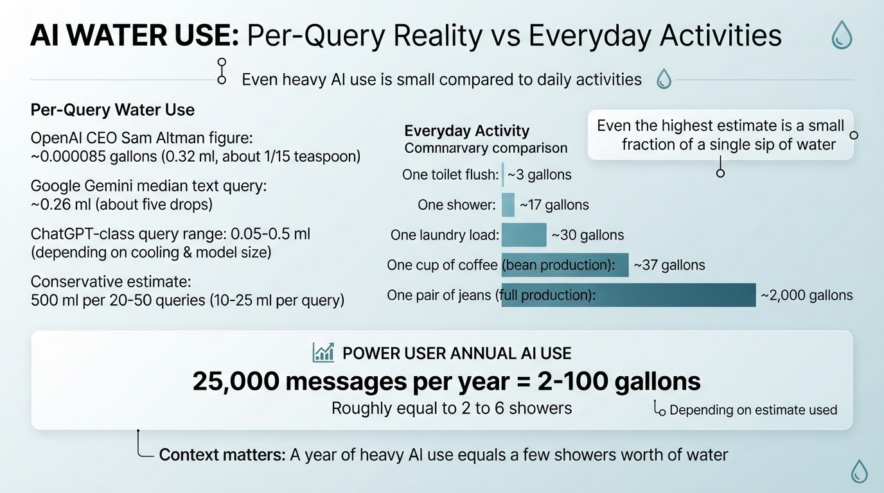
Source / Estimate | Water Per Query |
OpenAI CEO Sam Altman’s stated figure | ~0.000085 gallons (about 0.32 ml, roughly 1/15 of a teaspoon) |
Google Gemini, median text query | ~0.26 ml (about five drops) |
Broader ChatGPT-class query range | 0.05-0.5 ml depending on cooling method and model size |
More conservative estimate | 500 ml per 20-50 queries (about 10-25 ml per query) |
Even the higher end of these estimates is a small fraction of a single sip of water. For comparison:
Everyday Activity | Water Used |
One toilet flush | ~3 gallons |
One shower | ~17 gallons |
One load of laundry | ~30 gallons |
One cup of coffee (growing the beans included) | ~37 gallons |
One pair of jeans (full production) | ~2,000 gallons |
A power user’s entire year of AI use (~25,000 messages) | 2-100 gallons, depending on estimate used — roughly equal to two to six showers |
By this measure, a full year of heavy personal AI use costs less water than a handful of showers. This is the statistic that “AI water use is basically nothing” arguments lean on, and at the individual level, it’s accurate.
Per-Query Energy Use: Also Small, But More Variable
Metric | Figure |
Energy per ChatGPT-class query | ~0.3 to 3 Wh |
Comparison to a standard Google search | Roughly 3-10x more energy than one search query |
Range explanation | Depends heavily on model size, whether the query requires reasoning steps, and data center efficiency |
The comparison to a Google search is a useful anchor: a single AI query costs meaningfully more energy than a search, but “meaningfully more than a search” is still a very small number in absolute terms — a typical LED light bulb uses more energy running for a few minutes than a single AI query does.
Where the Numbers Stop Being Small: Aggregate Global Use
This is where the two sides of the debate actually connect, and where the concern becomes legitimate even though each individual query is tiny.
Metric | 2025-2026 Figure |
Global AI data center water use, 2025 | ~264 billion gallons (nearly 1 trillion liters) |
Daily equivalent | ~550 million gallons per day |
Comparison | Equal to the basic annual domestic water needs of all 1.3 billion people in Sub-Saharan Africa |
Global data center electricity demand, 2025 | ~460-490 TWh |
Projected growth by 2030 | Roughly doubling |
A number that looks negligible multiplied by billions of daily queries, running through data centers that need constant water-based cooling, adds up to a genuinely large industrial-scale resource draw. Multiplying a small number by an enormous number is exactly how “practically nothing per use” and “a serious environmental question at scale” end up both being true.
The 2030 Projections: Where This Is Heading
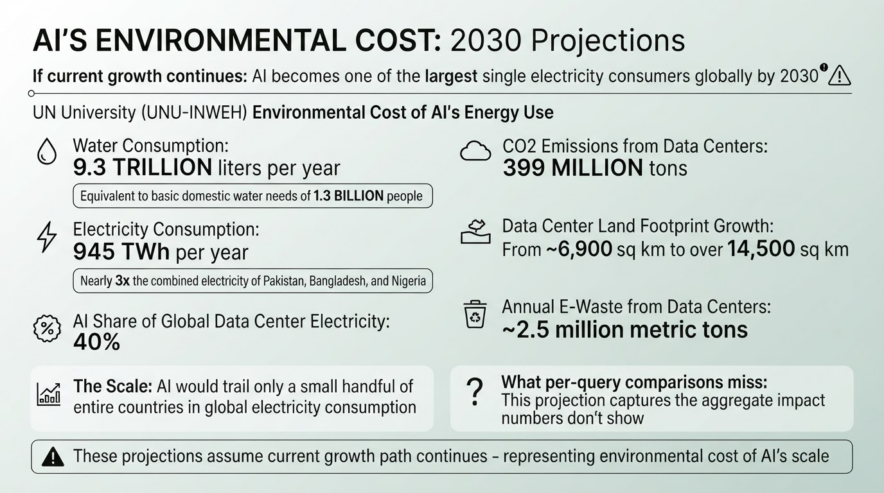
A UN University report (UNU-INWEH), titled “Environmental Cost of AI’s Energy Use,” modeled out where current trends lead by 2030 if growth continues on its current path.
Metric | 2030 Projection |
AI data center water consumption | 9.3 trillion liters per year |
Comparison | Equivalent to the basic domestic water needs of 1.3 billion people |
AI data center electricity consumption | 945 TWh per year |
Comparison | Nearly 3x the combined electricity use of Pakistan, Bangladesh, and Nigeria |
AI’s projected share of global data center electricity use | 40% |
CO2 emissions from data centers, projected | 399 million tons |
Data center land footprint growth | From ~6,900 sq km to over 14,500 sq km |
Projected annual e-waste from data centers | ~2.5 million metric tons |
If these projections hold, AI would become one of the largest single electricity consumers in the world by 2030, trailing only a small handful of entire countries. This is the number that per-query comparisons — however accurate on their own terms — don’t capture.
Why This Directly Connects to the AI News Cycle
This isn’t an abstract environmental debate happening separately from the AI industry news covered elsewhere. It’s directly tied to it. Meta’s newly announced “Meta Compute” cloud business, its doubling of total computing power by 2027, and its $10 billion, 1-gigawatt data center in Alberta are exactly the kind of infrastructure buildout driving these aggregate numbers upward. The same is true of Google’s Gemini 3.5-powered Search overhaul now serving over a billion AI Mode users, and of every other lab racing to add always-on agents to their products. Each of these announcements is, from a resource standpoint, a commitment to more data centers, more cooling water, and more electricity draw — even though none of the launch coverage frames it that way.
Why the Two Framings Keep Colliding in Public Debate
AI companies emphasize the per-query number because it’s true, defensible, and reassuring — comparing an individual prompt to a teaspoon of water is not manipulative, it’s just an incomplete picture on its own
Environmental researchers emphasize the aggregate and projected numbers because that’s the scale at which real infrastructure decisions — new data centers, water rights, electricity grid strain — actually get made
Neither side is lying, but each is answering a different question, which is why the same underlying industry can be described as “using almost no water per interaction” and “on track to strain water systems serving over a billion people” in the same week, by different sources, without either being factually wrong
Conclusion
Both halves of the AI water and energy debate are factually correct, and the confusion comes entirely from treating them as the same claim. A single AI query is genuinely a tiny draw on water and energy — smaller than a cup of coffee’s water footprint, smaller than most people assume. But that small number, multiplied across a global user base sending billions of queries a day through data centers built specifically to support this growth, adds up to a real and rapidly increasing industrial resource footprint — one UN researchers project could hit 9.3 trillion liters of water and 945 terawatt-hours of electricity annually by 2030. The honest takeaway isn’t that individuals should feel guilty about asking a chatbot a question. It’s that the infrastructure decisions being made right now by the same companies announcing bigger models and bigger data centers are the actual thing worth watching — not any single prompt.
Frequently Asked Questions
Most credible estimates place a single ChatGPT query at somewhere between 0.05 ml and 25 ml of water, depending on the data center and cooling method used. That is a small fraction of a standard water bottle, not a full one as some headlines have claimed.
AI queries require significantly more computational processing than a standard web search, with estimates suggesting AI uses roughly 3 to 10 times more energy per query. However, both remain relatively small in absolute terms compared to typical everyday household electricity consumption.
Yes, despite improvements in per-query efficiency, total industry-wide water use is still projected to grow substantially as new data center capacity is built faster than efficiency gains can offset it. UN researchers estimate AI water use could reach 9.3 trillion liters annually by 2030.
The primary factors are the type of cooling technology employed, the geographic location of the facility, and local climate conditions. These are infrastructure decisions made by the companies building data centers, not variables influenced by individual users.
Yes, the electricity grid mix powering a data center is one of the biggest levers for reducing AI's carbon footprint, since fossil-fueled power amplifies the environmental cost of high energy consumption. Companies choosing to site data centers near renewable energy sources can significantly lower the overall environmental impact of their AI operations.