Mark Zuckerberg’s Meta has never been shy about launching new apps — but its latest product arrived with barely a whisper. On June 29, 2026, Meta quietly published a brand-new standalone application called Pocket on both the Google Play Store and the Apple App Store, without any official announcement, press release, or public fanfare.
It was a reverse engineer and app-spotter named Alessandro Paluzzi who first spotted the launch on July 2 and shared a Play Store screenshot on X, setting off a wave of coverage and excitement across the tech world. Meta has yet to officially comment on the app — but what Pocket does is fascinating, timely, and potentially a glimpse at how the next generation of social media could work.
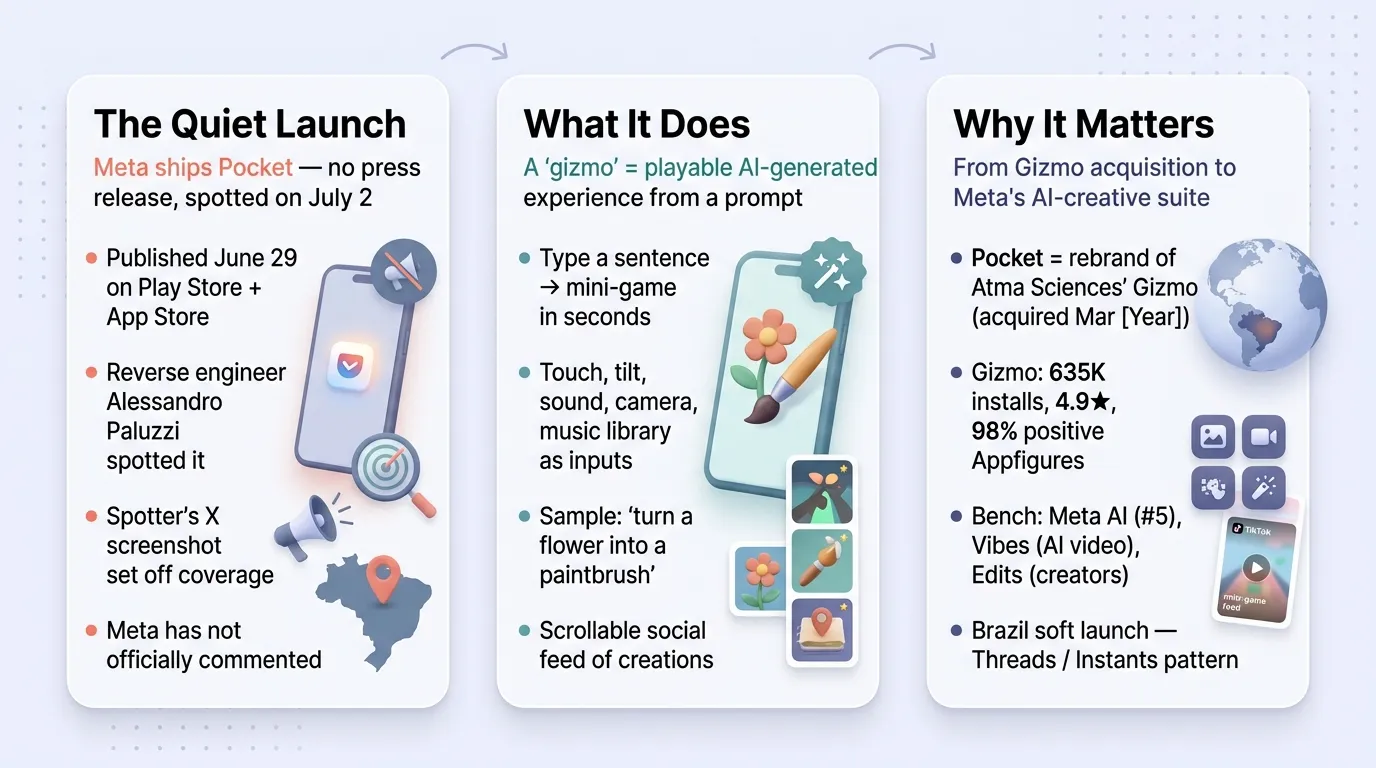
Pocket describes itself simply as “a creative platform for making and sharing gizmos.” And what exactly is a gizmo? In Meta’s own words: “a gizmo is an interactive, playable AI-generated experience.”
n practice, it means that anyone — regardless of their coding knowledge or technical background — can type a text prompt and, within seconds, generate a fully functioning mini-game or interactive experience that responds to touch, phone tilt, sound, the device camera, and even a user’s music library.
A sample prompt from the app’s own description: “Turn a flower into a paintbrush and let me draw on the screen.” Within moments, Pocket generates exactly that — a touchscreen drawing experience powered by a petal-shaped brush. No code written. No developer hired. Just a sentence typed into a box.
From Gizmo to Pocket: The Acquisition Story Behind the App
Pocket did not emerge from nowhere. Its roots trace directly back to a company called Atma Sciences Inc., the startup behind a vibe-coding app called Gizmo — which Business Insider exclusively reported in March 2026 had been acquired by Meta.
The Gizmo team, which included engineers previously from Snapchat, was absorbed into Meta Superintelligence Labs — the same division headed by Meta’s Chief AI Officer Alexandr Wang that is also driving the development of Meta’s frontier AI models. Meta acquired a non-exclusive licence to Atma Sciences’ technology as part of the deal, though financial terms were not disclosed.
The original Gizmo app had already demonstrated powerful proof of concept before Meta came knocking. It had accumulated over 635,000 lifetime installs across iOS and Android, earned a remarkable 4.9 star rating on the Apple App Store from over 14,000 ratings, and maintained a 98% positive sentiment score according to app intelligence firm Appfigures — extraordinary numbers for an experimental product. Meta recognised what Gizmo had quietly built and moved quickly to bring both the team and the technology under its roof.
Pocket is the first public product of that acquisition, and the similarities to Gizmo’s original design are immediately apparent. Both apps offer a scrollable social feed of AI-generated interactive experiences created by other users, alongside a creation tool powered by natural language prompts. The difference now is Meta’s distribution muscle, AI infrastructure, and the social graph of billions of users sitting behind it.
📺 Watch: Meta Launches Pocket — Vibe-Coded Gaming App Explained
At first glance, Pocket might seem like a novelty — a fun toy for generating quirky mini-games to share with friends. But the implications run considerably deeper when viewed in the context of what Meta is trying to build and where social media is heading in 2026.
Pocket is currently only available in Brazil, suggesting it is still in early experimental rollout — a pattern Meta has used many times before with products like Threads (which launched in Brazil ahead of wider markets) and Instagram’s Snapchat-like app Instants.
The restricted launch allows Meta to observe organic user behaviour, stress-test the infrastructure, and refine the product before a global push. Given how quickly Gizmo built a loyal user base from scratch, Pocket’s potential with Meta’s distribution behind it is considerable.
The launch also fits neatly into a broader pattern of Meta building a parallel universe of standalone AI-powered creative apps. In April 2026, Meta’s Meta AI app climbed to the number five spot on the US App Store. In February 2026, it tested a standalone app called Vibes for AI-generated short videos.
Its video-editing app for creators, Edits, received an AI assistant and desktop version in June 2026. And now Pocket completes what is becoming a clearly intentional suite of AI creative tools — one for images, one for video, one for interactive games — all designed to lower the barrier to creation to the point where literally anyone can produce shareable, engaging content.
The timing is also strategically astute. Social media feeds, by Meta’s own internal data, have become less social and more algorithmically driven over recent years, with friend-generated content declining as a share of what users actually see. Interactive, playable content created by real users and discoverable through a TikTok-style scrollable feed represents a genuinely novel answer to that problem — one that competitors are also beginning to explore.
TikTok has been experimenting with its own feed of mini games, and a startup called Sekai, which offers a similar vibe-coded social gaming concept, recently raised $20 million in Series A funding, signalling that investors see real market potential in this space.
For Zuckerberg, who has repeatedly staked Meta’s future on AI becoming the defining feature of every product the company builds, Pocket is one more quiet but significant step toward a world where the line between creator and audience, between player and game designer, dissolves entirely — replaced by a prompt box and a few seconds of AI generation. 🎮📱✨
Quick Links: