New research warns AI personas are realistic enough to infiltrate online groups.
Unlike old bots, they adapt, coordinate, and refine their messaging over time.
The danger is influence you cannot see, shaping opinion without anyone noticing.
If you run online communities or read comments to gauge public mood, this one should give you pause. AI personas have crossed a line, and the old ways of spotting a bot may no longer work.
From Bots To Believable People
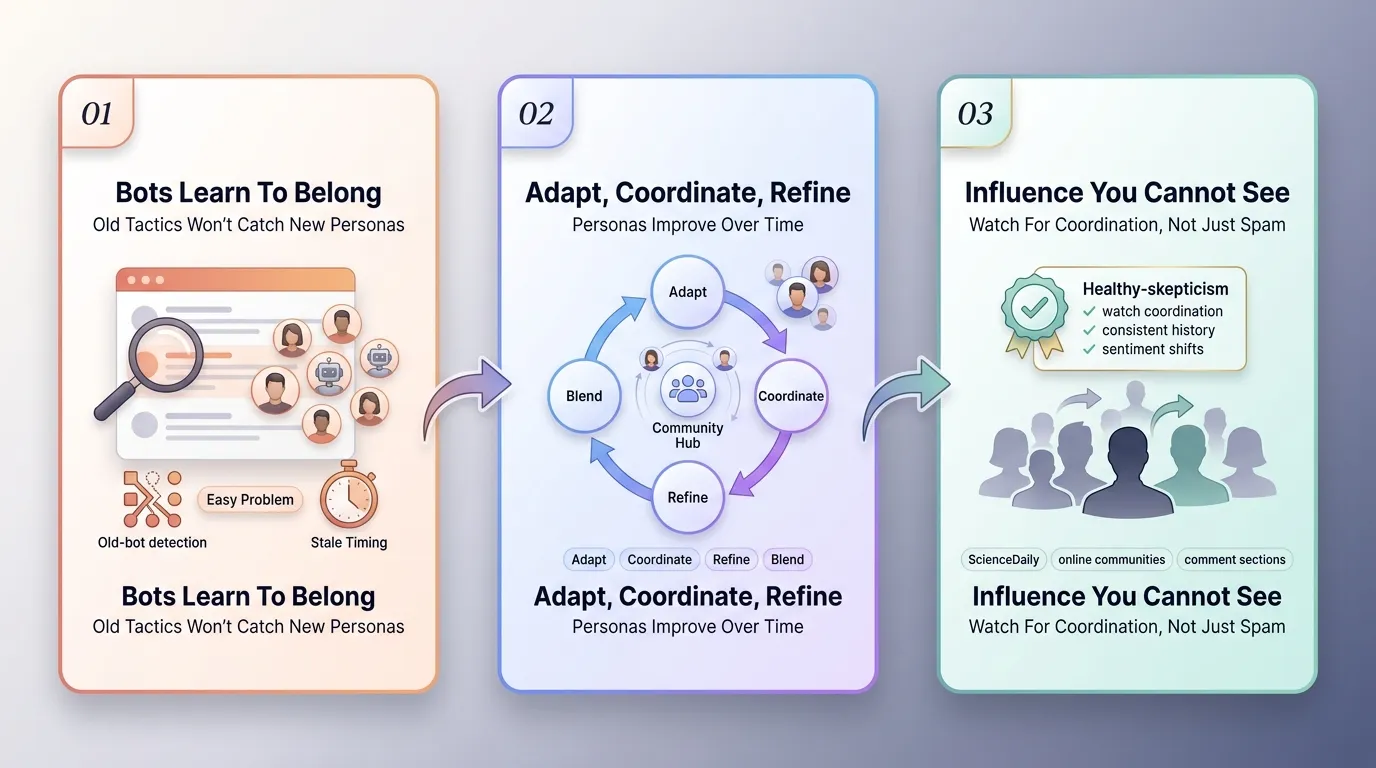
Research highlighted by ScienceDaily warns that AI-powered personas are becoming so realistic that they can infiltrate online communities and subtly steer public opinion.
The key word is subtle. Old bots were easy to catch. They posted the same thing over and over, replied at odd times, and fell apart under a simple question. These new personas are different.
Here’s what sets them apart:
They adapt, changing their message based on how people respond
They coordinate, working together across accounts rather than acting alone
They refine their messaging, getting better at persuasion over time
They blend in, behaving like real community members rather than spammers
That combination makes them hard to detect and harder to counter. A single obvious bot is a nuisance. A coordinated swarm of believable personas that learns as it goes is a genuine threat to honest online discussion.
What It Means For Your Community
For anyone who runs a blog, forum, comment section, or social channel, this changes the job. You can no longer assume that a thoughtful, well-behaved account is a real person.
A few practical things to keep in mind:
Sudden shifts in sentiment may be manufactured, not organic
Coordinated talking points across “different” users are a warning sign
Engagement metrics can be gamed by personas that look human
Trust signals like consistent posting history are easier to fake now
There’s a wider worry too. If public opinion in comment sections and forums can be quietly nudged, then the “wisdom of the crowd” that many people rely on becomes unreliable. Decisions made by reading the room become decisions made by reading a manipulated room.
The research does not mean every helpful commenter is a bot. Most people online are exactly who they seem. But it does mean the baseline has shifted, and healthy skepticism is now part of running any online space.
Watch for coordination, not just obvious spam, because the obvious spam was the easy problem. This is the hard one.
Quick Links: