The Gap Between How Good Your Content Is and How Credible Your Site Appears
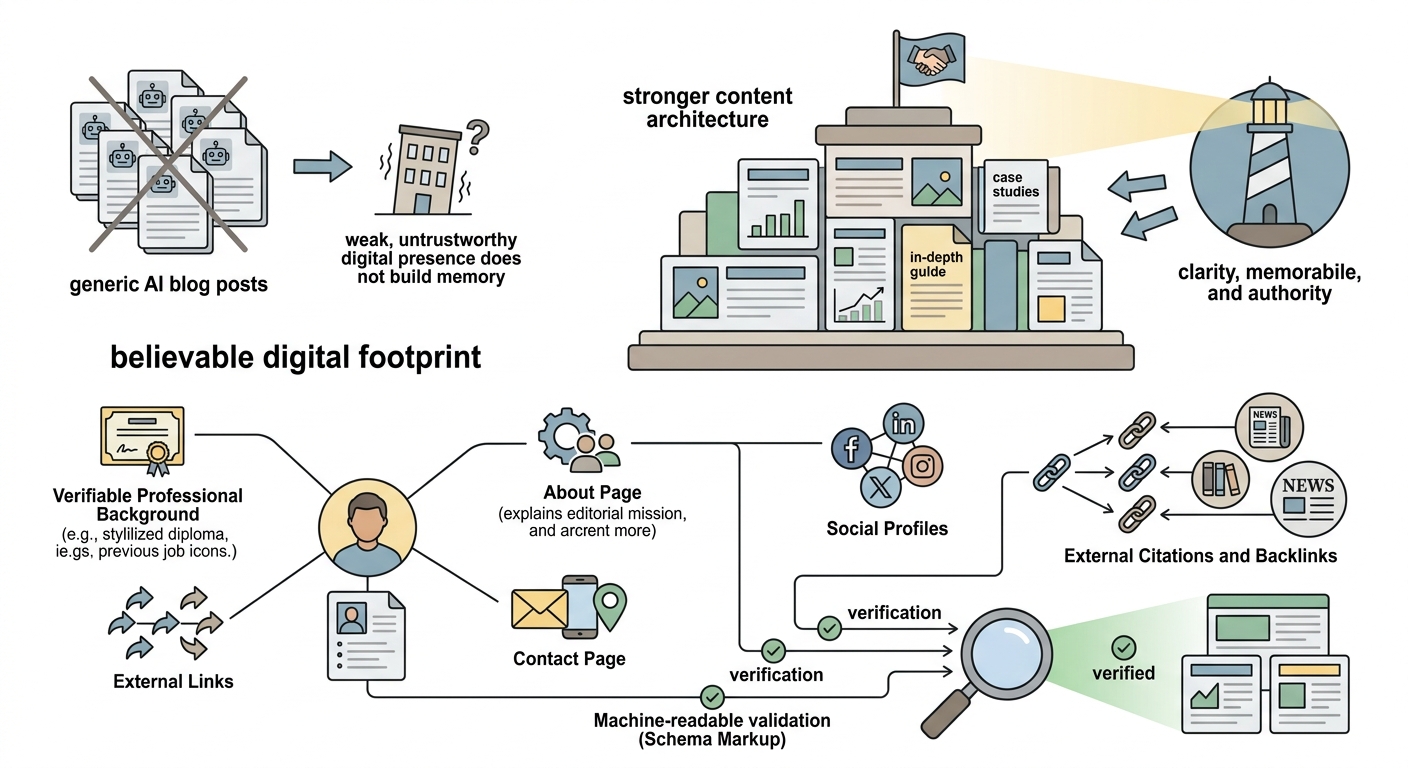
Most businesses do not need more content. They need stronger content architecture and a more believable digital footprint. Publishing generic AI blog posts at scale may fill your site but you do not build memory, trust, or citations.
The believable digital footprint concept is the most useful framework for explaining why some blogs with excellent content rank significantly below what their quality should earn, while others with thinner content rank higher than expected. The difference is almost always in the credibility infrastructure surrounding the content rather than in the content itself.
A believable digital footprint for a blog means several specific things all working together. A clear, named author with a bio page that includes verifiable professional background and external links. An About page that explains the blog’s editorial mission, its expertise basis, and why readers should trust its recommendations.
A Contact page with real contact information. Social profiles that match the blog’s name and identity. External citations and backlinks from relevant authoritative sources in the same niche. And schema markup that declares all of this in machine-readable form so Google’s quality systems can verify the editorial claims independently.
The Verification Gap
Search systems reward entity clarity, real search intent, strong internal links, and pages that explain what you do, who it is for, and why you are credible.
The verification gap is the difference between a blogger saying “I am an expert in this field” and Google’s systems being able to independently verify that claim.
The first approach relies on the quality of the content to signal expertise. The second approach provides machine-readable evidence — Author schema linking to LinkedIn, external publications, or professional profiles that confirm the claimed expertise independently of what the blog itself says.
Closing the verification gap does not require you to be famous or widely cited. It requires you to make your genuine credentials machine-readable in ways that Google can cross-reference.
A food blogger with ten years of professional cooking experience who has never implemented Author schema linking to their professional history is leaving their most important EEAT signal invisible to the systems that evaluate content quality.
Adding that schema is an afternoon of work that makes years of genuine expertise suddenly machine-verifiable.
💬 Reddit — r/SEO and r/blogging on building a believable digital footprint: 🔗 https://www.reddit.com/r/blogging/search/?q=believable+digital+footprint+blog+SEO+2026
🐦 X/Twitter — bloggers sharing author schema and credibility improvements: 🔗 https://x.com/search?q=digital+footprint+blogger+author+schema+credibility+2026&f=live
💬 Quora — how do bloggers build a credible digital footprint for SEO in 2026: 🔗 https://www.quora.com/search?q=blogger+digital+footprint+credibility+SEO+2026
Quick Links: