Google just rolled out its biggest Search redesign in 25 years. AI Mode now runs on Gemini 3.5 Flash. It has crossed 1 billion monthly users. Every tech outlet has covered the launch. Almost none of them have gone back and connected it to the traffic numbers underneath it. This article does that. It pulls together the scattered data on AI Overviews, zero-click search, and click-through rates into one clear picture: what is actually happening to websites, publishers, and businesses as AI answers take over the search results page.
What Is a Zero-Click Search?
A zero-click search happens when a person searches for something on Google and gets their answer right there on the results page — without clicking through to any website. This isn’t new. Weather, sports scores, and simple facts have shown up this way for years. What’s new in 2026 is the scale. AI Overviews and AI Mode now write full paragraph answers, summarizing information pulled from many sites at once. The user reads the answer, gets what they need, and never visits the sites the answer came from.
For website owners, publishers, and businesses that rely on search traffic, this is a serious problem. Their content is being used to build the answer, but they’re not getting the visit, the ad view, or the sale that used to come with it.
The Big Numbers: How Much Has Changed
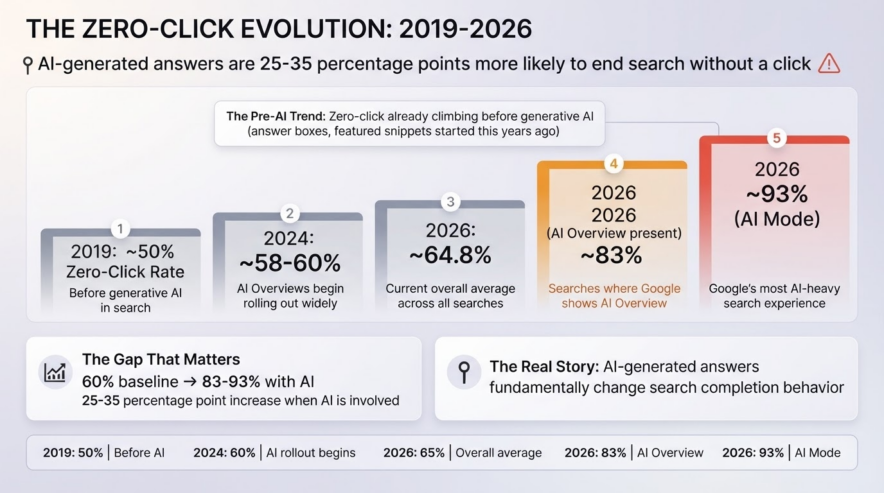
Here is a simple table showing how the zero-click rate has grown over time.
Year | Overall Zero-Click Rate | Notes |
2019 | ~50% | Before generative AI in search |
2024 | ~58-60% | AI Overviews begin rolling out widely |
2026 | ~64.8% | Current overall average across all searches |
2026 (AI Overview present) | ~83% | Searches where Google shows an AI Overview |
2026 (AI Mode) | ~93% | Google’s most AI-heavy search experience |
A few things stand out here. First, the zero-click rate was already climbing before generative AI arrived — simple answer boxes and featured snippets started this trend years ago. Second, the jump from a 60-ish percent baseline to 83-93% when AI Overviews or AI Mode are involved is large. That gap is the real story: AI-generated answers are roughly 25 to 35 percentage points more likely to end a search without a click than a standard results page.
How Many Searches Actually Show an AI Overview?
This is the part most coverage skips. AI Overviews don’t show up on every search — but they show up on a lot more than people realize.
In a study covering nearly 22 million searches, roughly 25% of all Google searches triggered an AI Overview in the first quarter of 2026.
Some tracking tools now put AI Overview coverage closer to 48% of tracked queries, depending on which keyword set is measured.
AI Overviews reach about 2.5 billion people every month, according to Google’s own figures.
Google’s AI Mode alone has more than 1 billion monthly active users, less than a year and a half after launch.
The exact percentage depends on which study you read and which set of keywords it tracked, but the direction is the same everywhere: AI Overviews are not a small experiment anymore. They’re showing up on a meaningful share of everyday searches.
Click-Through Rate: The Real Damage
Click-through rate (CTR) measures how often people click a specific result. This is where the money is for websites — no click, no ad revenue, no product sale, no subscriber.
Metric | Without AI Overview | With AI Overview |
Click rate on a traditional #1 result | ~15% | ~8% (roughly 58% fewer clicks) |
Organic CTR on AI Overview-triggering searches (June 2024) | 1.76% | — |
Organic CTR on the same searches (September 2025) | — | 0.61% (a 65% collapse) |
Organic CTR recovery (Dec 2025 to Feb 2026) | — | Rebounded from 1.3% to 2.4% |
That last row matters. CTR didn’t just crash and stay crashed — it fell hard through 2025 and then partly recovered in early 2026. This suggests two things are happening at once: Google has been tweaking how AI Overviews link out to sources, and websites that get properly cited are starting to claw back some traffic.
Which Industries Are Hit the Hardest
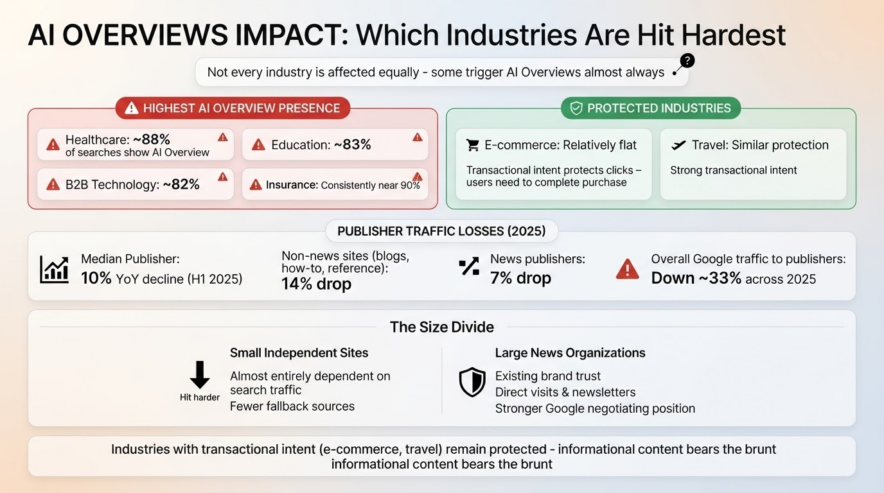
Not every type of website is affected equally. Some topics almost always trigger an AI Overview. Others rarely do, usually because the person searching needs to actually visit a website to finish their task — like buying something.
Industries with the highest AI Overview presence:
Healthcare: around 88% of relevant searches show an AI Overview
Education: around 83%
B2B technology: around 82%
Insurance: consistently near 90% in some tracking
Industries with more stable, lower AI Overview presence:
E-commerce: relatively flat, because people usually still need to click through to buy
Travel: similar — strong “transactional intent” protects some clicks
Publisher traffic losses by size and type:
The median publisher saw a 10% year-over-year traffic decline in the first half of 2025
Non-news content sites (blogs, how-to guides, reference sites) dropped about 14%
News publishers specifically dropped about 7%
Publisher traffic from Google overall fell by roughly a third across 2025
Smaller, independent sites are getting hit harder than large news organizations. That’s likely because big publishers have existing brand trust, other traffic sources like direct visits and newsletters, and stronger negotiating positions with Google. Smaller sites depending almost entirely on search traffic have fewer places to fall back on.
The Flip Side: Who Actually Wins From AI Overviews
It’s not all bad news for everyone. Getting cited inside an AI Overview appears to carry its own benefit, even with fewer total clicks happening.
Brands cited within an AI Overview earn about 35% more organic clicks than uncited brands for the same type of query
Cited brands see about 91% more paid clicks
About 84% of the sources AI systems cite come from earned media — meaning independent articles and mentions — rather than a brand’s own website
Content that includes clear statistics, direct quotes, and named citations sees 30-40% higher visibility in AI-generated answers
In other words, being invisible to AI Overviews is worse than being cited in one. The businesses in the most trouble are the ones whose content gets used to build the answer but never gets named or linked as a source.
Google’s Side of the Story
None of this is happening by accident. Google has been explicit that Search is shifting from a list of links to an answer engine. The company’s Gemini 3.5 Flash-powered redesign, its “biggest upgrade to Search in over 25 years,” is built around a search box that reasons across text, images, files, and even a user’s open browser tabs — and increasingly, it’s built to answer directly rather than hand off to another website.
Google frames this as better for users: faster answers, less digging through multiple pages. Gartner, the research firm, expects this shift to cause a roughly 25% decline in traditional search engine volume by the end of 2026, largely because AI chatbots and AI-native assistants are absorbing queries that used to go to a search bar at all.
For businesses built on search traffic, the practical response has shifted too. Search engine optimization (SEO) — writing content to rank well in search results — is increasingly being paired with something new: getting cited correctly inside AI-generated answers, sometimes called AI answer engine optimization. The tactics overlap, but the goal is different. Ranking #1 doesn’t matter much if nobody clicks past the AI Overview to see it.
What This Means Going Forward
The zero-click trend is not slowing down — it’s accelerating as AI Mode expands and more of Google’s user base gets moved onto AI-first search by default. Businesses and publishers that depend heavily on search traffic have three real choices: get better at earning citations inside AI answers, build traffic sources that don’t depend on Google at all (email lists, apps, direct visits, social platforms), or accept a smaller but potentially higher-intent slice of visitors — since the people who do still click through after seeing an AI Overview may be more seriously interested than someone who used to click five different links before deciding.
Conclusion
The zero-click search story isn’t really about whether AI Overviews exist — that debate is over. It’s about the actual size of the shift, and the numbers are bigger than most casual coverage suggests: an 83% zero-click rate when an AI Overview appears, a roughly 58% drop in clicks for the traditional top result, and publisher traffic down by double digits across much of 2025. At the same time, the data shows this isn’t a flat, one-directional collapse — CTR has partially recovered in early 2026, and properly cited sources are seeing real upside. The businesses and publishers who treat this as a solvable problem, by earning citations and diversifying beyond Google traffic, are in a very different position than those who simply wait for the numbers to go back to how they used to be. They won’t.
Frequently Asked Questions
A zero-click search happens when a user finds the answer they need directly on the Google results page without clicking through to any website. This is increasingly common because features like AI Overviews, featured snippets, and knowledge panels deliver complete answers instantly.
The rapid expansion of AI Overviews and the launch of Google's AI Mode have made it far easier for users to get detailed, multi-source answers without ever leaving Google. More search queries than ever before are now being resolved on the results page itself, shrinking the pool of clicks available to outside websites.
Check your Google Search Console data for queries where your impressions have stayed high or grown but your click-through rate has dropped sharply — that pattern often signals your content is being used to build an AI Overview without sending you the traffic. Comparing your CTR trends from early 2024 to current data can help you isolate the AI Overview effect.
Yes, publishing clear, well-structured, authoritative content that directly answers specific questions gives Google a stronger reason to pull from your site and link back to it inside an AI Overview. Using concise definitions, organized headings, and credible sourcing all improve your chances of being named as a cited source rather than silently used.
Largely yes, because a user searching to buy a product or book a service still needs to complete a transaction that Google cannot do for them, which preserves click intent. However, even these businesses should monitor informational content like buying guides or comparison pages, which are more vulnerable to being absorbed into AI-generated summaries.