Anyone still running the same search playbook they used in 2022 isn’t falling behind slowly. They’re falling behind fast, and the data backs that up in a way that’s hard to argue with.
The Old Rules Don’t Cover the Whole Game Anymore
Start with one number: 80% of Google searches in 2026 end with zero clicks. Eight out of every ten people who type a question into Google never actually land on a website. They read the answer right there on the results page and move on.
That’s a fundamental break from how search worked for the better part of two decades. The old deal was straightforward: publish something good, climb to Page 1, collect the traffic. That was SEO, and for a long time it was basically the entire game.
Then three things landed on top of each other in quick succession: Google rolled out AI Overviews, conversational tools like ChatGPT and Perplexity went mainstream, and voice assistants started answering questions out loud instead of just returning a list of links. One game turned into three.
Here’s the short version of each:
SEO (Search Engine Optimization): the original discipline, ranking your pages so people click through from traditional results.
AEO (Answer Engine Optimization): structuring content so featured snippets, voice assistants, and AI Overviews quote you directly as the answer.
GEO (Generative Engine Optimization): making sure tools like ChatGPT, Gemini, and Perplexity actually cite or reference your brand when they generate a response.
None of these are throwaway acronyms. Each one points to where attention, and budget, is actually moving, and each carries real consequences for who gets left behind.
SEO Still Moves Massive Volume, But It’s Carrying More Weight Than It Should
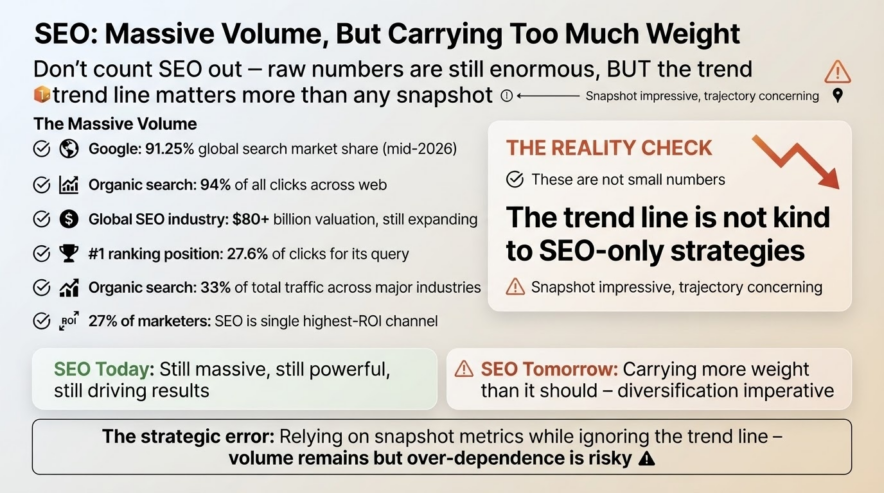
Don’t count SEO out. The raw numbers are still enormous:
Google controls 91.25% of global search market share as of mid-2026
Organic search accounts for 94% of all clicks across the web
The global SEO industry is now valued above $80 billion and still expanding
The #1 ranking position on Google still pulls in roughly 27.6% of clicks for its query
Organic search drives 33% of total traffic across major industries
27% of marketers rank SEO as their single highest-ROI channel
Those are not small numbers. But the trend line matters more than any single snapshot, and the trend line is not kind to SEO-only strategies.
Zero-Click Search Has Gone From an Edge Case to the Default
The zero-click rate has climbed from 50% in 2019 to 64.82% in 2026. At their 2025 peak, Google’s AI Overviews were showing up on nearly 25% of all keyword searches. Ahrefs ran the numbers across 300,000 keywords and found that AI Overviews cut click-through rates by 34.5% on average.
For anyone who built a content business around blog traffic, that’s a rough number to sit with. The practical takeaway: SEO hasn’t become useless, it’s become a foundation you have to build on top of, not a complete strategy on its own.
AEO Is About Getting Chosen, Not Just Getting Found
If SEO’s job is visibility, AEO’s job is selection. That distinction matters enormously once you accept that AI systems are reading your content and deciding, in real time, whether it’s worth quoting.
AEO specifically targets:
Featured snippets (the boxed answer sitting above regular results)
Google’s AI Overviews
Voice search answers read aloud by Siri, Alexa, and Google Assistant
Direct chatbot references, when tools like ChatGPT pull straight from your page
People Also Ask boxes nested inside the SERP
Voice Search Rewards a Very Narrow Slice of Content
Roughly 153.5 million people use voice assistants worldwide, and 40.7% of voice answers are lifted directly from featured snippets. More strikingly, over 80% of all voice answers come from whatever is sitting in the top 3 organic results. Miss the top 3, and your voice search visibility is effectively zero.
Here’s the number that captures AEO’s urgency best: zero-click search jumped from 56% in 2024 to 69% in 2025. That’s the gap between someone asking a question and someone actually visiting a website, and it’s widening fast. AEO exists to let you benefit from that behavior instead of losing to it. Getting quoted in a featured snippet still buys you visibility, trust, and sometimes traffic, even without a traditional click.
Show Image
Budgets Are Shifting Toward AEO Quickly
Companies put an average of 12% of their digital marketing budget toward AEO in 2025
56% of marketing leaders report high satisfaction with their AEO spend so far
Brands that have adopted AEO are pulling in 3.4x more AI-search traffic than those that haven’t
GEO Is the Newest Battlefield, and It’s Growing Faster Than Anyone Expected
GEO is the most complicated of the three, and arguably the most consequential. It’s about making sure that when a generative AI model synthesizes an answer by pulling from across the web, your content is actually part of that synthesis.
Think about the last time you asked ChatGPT something. You didn’t get ten blue links back, you got a paragraph, a confident answer stitched together from dozens of sources, some cited outright and others absorbed silently into the phrasing. GEO is the practice of making sure you’re one of those sources.
The Market Size Alone Tells the Story
Year | Global GEO Market Size | Growth Rate |
2025 | ~$770 million | — |
2026 | $1,089.3 million | 40.6% CAGR |
US market alone (2026) | $365.4 million | 42.9% CAGR |
A market that barely existed two years ago is now sitting north of a billion dollars globally.
The Referral Traffic Numbers Border on Absurd
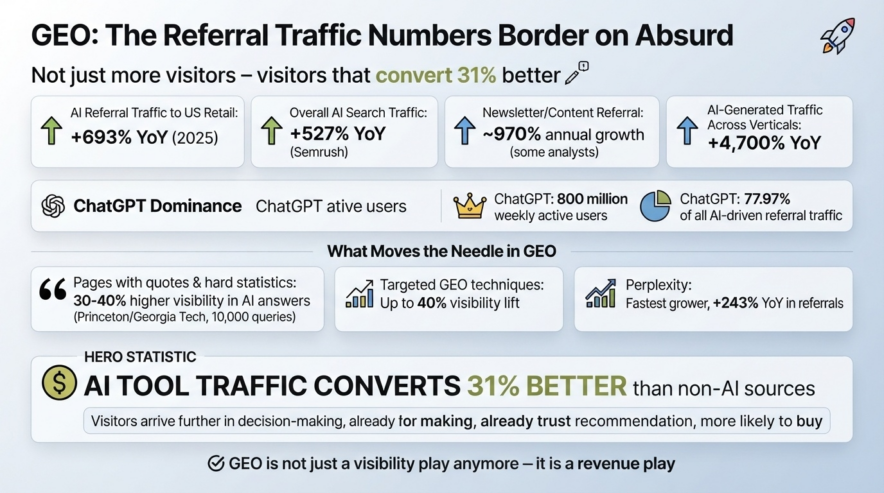
AI referral traffic to US retail sites grew 693% year-over-year during 2025
Overall AI search traffic is up 527% year-over-year, per Semrush’s latest data
Some analysts tracking newsletter and content referral data put annual growth closer to 970%
Year-over-year growth in AI-generated traffic across verticals hit 4,700%
What Actually Moves the Needle in GEO
Pages containing quotes and hard statistics see 30-40% higher visibility in AI-generated answers, according to Princeton and Georgia Tech research spanning 10,000 real queries
Targeted GEO techniques can lift AI-response visibility by up to 40%
ChatGPT alone now serves 800 million weekly active users
ChatGPT accounts for 77.97% of all AI-driven referral traffic
Perplexity is the fastest grower among AI platforms, up 243% year-over-year in referrals
Traffic arriving via AI tools converts 31% better than traffic from non-AI sources
That last figure deserves its own moment. AI search isn’t just sending more visitors, the visitors it sends are further along in their decision-making, already primed to trust the recommendation, and more likely to buy. GEO isn’t only a visibility play anymore. It’s a revenue play.
Putting All Three Side by Side
Factor | SEO | AEO | GEO |
Primary goal | Rank high in results | Become the quoted answer | Get cited by AI models |
Main platforms | Google, Bing | Snippets, voice, AI Overviews | ChatGPT, Perplexity, Gemini, Copilot |
Key metric | Rankings + CTR | Snippet wins + voice answers | AI citations + referral traffic |
Content format | Long-form, keyword-rich | Concise Q&A, structured data | Authoritative, data-rich, quotable |
Technical focus | Backlinks, speed, crawlability | Schema markup, clear answers | E-E-A-T signals, citations, facts |
ROI timeline | 3-12 months | 1-4 months | 2-8 months (still maturing) |
2025 avg. budget share | 40-60% of SEO budget | 12% of digital budget | Fastest-growing allocation |
Zero-click impact | Hurt by it | Benefits from it | Largely immune to it |
Best fit for | E-commerce, local business, publishers | High-intent brands, voice use cases | SaaS, B2B, consultancies, thought leaders |
One Question, Three Completely Different Answers
The cleanest way to see the difference between these three disciplines is to watch how each one handles the exact same query: “What is the best CRM for small businesses?”
The SEO approach builds a comprehensive, 3,000-word guide targeting that exact keyword phrase, earns backlinks pointing to it, and aims for the #1 spot on Google, optimizing for click-through rate and time on page.
The AEO approach turns the same topic into a tight, conversational answer: a clean definition up front, FAQ schema wrapped around it, and an opening paragraph short enough to be lifted whole into a featured snippet or read aloud by a voice assistant with zero clicks required.
The GEO approach loads the article with original data, expert quotes, and claims specific enough that when ChatGPT or Perplexity builds an answer about CRM software, it pulls from that article and either cites it directly or echoes its framing in the generated response.
The real insight here: none of these approaches actually compete with each other. They can all live inside the same piece of content at once, layered rather than chosen between.
Who’s Actually Pulling Ahead Right Now
The brands making real noise in 2025-2026 are the ones treating search as an interconnected ecosystem rather than a single channel to optimize.
Still winning mostly on SEO: local service businesses (plumbers, dentists, contractors), large e-commerce brands sitting on years of domain authority, and news publishers with a real-time content edge. Their advantage is sheer volume, millions of indexed pages built up over years.
Winning on AEO: brands operating in high-intent question categories, financial advisors, health platforms, legal information sites, and SaaS tools whose product names get typed as questions (“how does [Tool] actually work?”). Their content is built to be lifted and quoted, not just read.
Winning on GEO: companies investing seriously in original research and thought leadership. AI models don’t cite random blog posts, they cite sources that repeated, consistent exposure has taught them to trust. That trust gets built slowly, through accurate, well-structured, data-backed content published over time, not overnight.
The Number That Should End Every Strategy Meeting
Here’s arguably the single most important statistic in this whole conversation: according to 2025 McKinsey research, 44% of AI-powered search users now say AI is their primary, preferred source of information, ahead of traditional search (31%), retailer websites, and social platforms combined.
That’s a genuine behavioral shift, and it’s moving faster than most marketing teams are adapting to it. A few more data points worth sitting with:
AI platforms’ overall share of web traffic has quadrupled in twelve months, from 0.03% to 0.13% and still rising
ChatGPT hit 55.2 billion visits by June 2025, up 80% year-over-year
Google AI Overviews now appear on 15-25% of all search queries, depending on the month
Year-over-year growth in AI-generated traffic sits at 4,700%
Publish a post, rank it, collect clicks, convert some of them, that model isn’t dead. It’s just no longer enough to stand on its own.
Building a Search Strategy That Covers All Three
The good news: these three disciplines stack cleanly on top of each other. Nothing here requires scrapping your existing SEO work, it requires building deliberately on top of it.
Layer One: SEO, Your Non-Negotiable Base
Keep technical fundamentals solid: page speed, Core Web Vitals, mobile usability
Earn genuine backlinks from authoritative sites in your space
Target both informational and transactional keywords with thorough, well-organized content
Publish consistently enough to build the kind of topical authority both Google and AI models recognize
Layer Two: AEO, Turning Content Into Direct Answers
Structure pages around clear question-and-answer formatting throughout
Add FAQ and HowTo schema markup wherever it genuinely applies
Write opening paragraphs that work as standalone answers, no additional context required
Target People Also Ask questions to grab secondary real estate on the SERP
Write for natural, conversational, long-tail phrasing that matches how people actually talk to voice assistants
Layer Three: GEO, Building Real Authority
Include original data, statistics, or research in every major piece you publish
Quote credible experts and cite real external sources so AI systems trust your accuracy
Build genuine E-E-A-T signals, real Experience, Expertise, Authoritativeness, and Trustworthiness, not just the appearance of them
Write the kind of clear, structured, factual content an AI model would actually want to reference
Build consistent brand mentions across the web so AI systems learn to recognize and prioritize your name
Where This Leaves Everyone
Search in 2026 isn’t one battlefield anymore, it’s three running at once. Brands sitting out AEO and GEO because “SEO still works” aren’t wrong yet, but they’re on a clock, and the clock is running faster than most of them realize.
SEO still delivers the traffic that’s genuinely up for grabs. AEO makes sure you capture value even in a world where fewer people click through at all. GEO ensures you’re part of the AI-generated conversation shaping decisions before anyone even opens a browser tab.
One stat is worth carrying out of this piece and into your next strategy meeting: AI-referred traffic converts 31% better than traditional traffic, and grew 693% in a single year. That’s not a trend worth keeping an eye on. That train has already left.
The real question isn’t whether to invest in all three disciplines. It’s how quickly you can move.
FAQs
SEO (Search Engine Optimization) focuses on ranking in traditional search results, AEO (Answer Engine Optimization) targets direct answers in AI-powered assistants and featured snippets, and GEO (Generative Engine Optimization) optimizes content to appear within AI-generated responses from tools like ChatGPT and Google Gemini. In 2026, all three disciplines work together as search behavior rapidly shifts across multiple platforms and answer formats.
By 2026, studies show that over 60% of searches now result in zero-click outcomes, meaning users get their answers directly from AI overviews or featured snippets without visiting a website. This dramatic shift makes AEO and GEO strategies just as critical as traditional SEO for maintaining organic visibility and traffic.
Generative AI tools are now responsible for a significant portion of how consumers discover products, services, and information, meaning brands not optimized for AI-generated responses risk being completely invisible to a growing audience. Investing in GEO ensures your content is structured, authoritative, and trustworthy enough to be cited or summarized by large language models.
Traditional SEO is still effective in 2026, but its role has evolved rather than disappeared, with technical SEO, backlinks, and on-page optimization forming the foundation that supports both AEO and GEO strategies. Businesses that abandon classic SEO entirely risk losing the authority signals that AI engines rely on to validate and surface content.
Small businesses can compete by focusing on niche topical authority, creating highly structured and factually accurate content that answers specific user questions, and earning credible backlinks that signal expertise to both traditional and AI-driven search engines. Consistently optimizing for conversational queries and long-tail keywords also increases the likelihood of appearing in AI-generated answers where larger brands may overlook hyper-specific topics.