Headlines say AI is wiping out jobs. Company memos say the same thing. But the same companies announcing “AI-driven” layoffs are also announcing record AI spending — sometimes in the same earnings call. This article separates what’s actually been measured from what’s simply been claimed, using the tracking data from Challenger, Gray & Christmas, Stanford’s payroll research, and Anthropic’s own economic studies.
The Headline Numbers
Here’s what the raw layoff tracking data shows for the first half of 2026.
Metric | Figure |
US tech job cuts announced, Jan-June 2026 | 139,156 (an 83% surge versus the same period in 2025) |
Total layoffs across the US economy citing AI, YTD | 101,743 (about 23% of all cuts tracked) |
Consecutive months AI has led all cited reasons for job cuts | 4 (March through June 2026) |
Tech’s share of all H1 2026 layoffs | 31% |
At first glance, this looks like clear evidence of an AI-driven jobs crisis. But the monthly breakdown, and what companies are doing with their money at the same time, tells a more complicated story.
Month-by-Month: AI as the Stated Reason for Layoffs
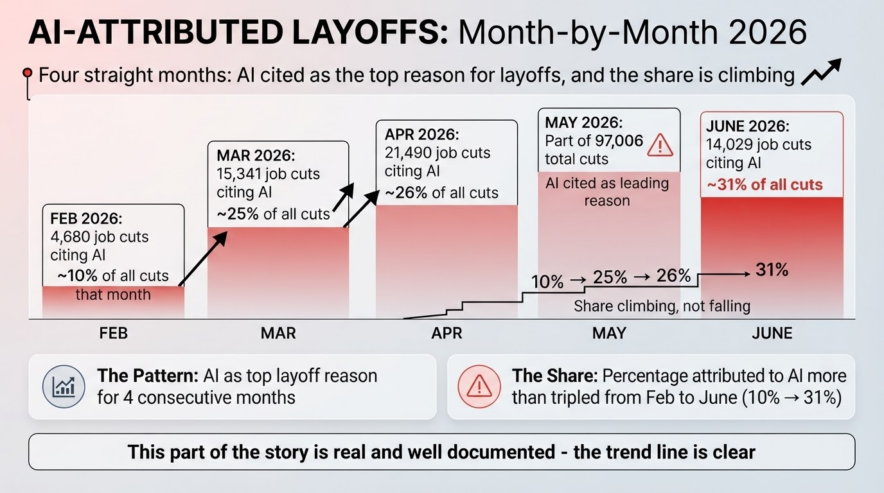
Month (2026) | Job Cuts Citing AI | Share of All Cuts That Month |
February | 4,680 | ~10% |
March | 15,341 | ~25% |
April | 21,490 | ~26% |
May | Part of 97,006 total cuts | AI cited as leading reason |
June | 14,029 | ~31% |
The trend line is clear: AI has been cited as the top reason for layoffs for four straight months, and the share of cuts attributed to it has been climbing, not falling. That part of the story is real and well documented.
The Part That Gets Left Out: Attribution Is Not the Same as Cause
Here’s where the data gets messy. “AI cited as the reason” is a company’s own stated explanation in a press release or layoff announcement — not an independently verified cause. Several data points suggest that stated reason and actual reason often diverge.
Nearly 6 in 10 companies admit, when surveyed candidly, that they frame layoffs or hiring slowdowns as “AI-driven” when the real underlying reason is financial
OpenAI CEO Sam Altman himself has publicly acknowledged that “almost every company that does layoffs is blaming AI, whether or not it really is about AI”
Attribution estimates for the same time period vary wildly depending on the source — Challenger, Gray & Christmas alone has attributed between 8% and 26% of cuts to AI in different individual months, a range wide enough to suggest real measurement difficulty, not just changing conditions
This pattern has a name among labor researchers: “AI washing” — using AI as a convenient, forward-looking, market-friendly explanation for cuts that are actually about cost-cutting, over-hiring correction, or missed financial targets.
The Spending Contradiction
This is the single most important number in the entire dataset, and it rarely appears next to the layoff headlines it directly contradicts.
Company Behavior | 2026 Figure |
Combined 2026 capex guidance from Amazon, Microsoft, Alphabet, and Meta | ~$700 billion (nearly double their combined 2025 actual spend) |
Meta Q1 2026 revenue | $56.3 billion, up 33% year-over-year |
Meta layoffs announced in May 2026, same quarter | 8,000 jobs |
Meta’s 2026 capex guidance, raised the same period | $115-145 billion |
Companies posting record revenue growth, raising capital spending guidance to record highs, and announcing thousands of layoffs — all inside the same quarter — is difficult to explain as a simple story of “AI is replacing these workers.” A company genuinely being disrupted by a technology doesn’t typically respond by dramatically increasing its investment in that same technology while also growing revenue 33% year over year. This pattern looks more consistent with layoffs driven by other factors, with AI serving as convenient cover.
Where the Independent Research Actually Finds Real AI Impact
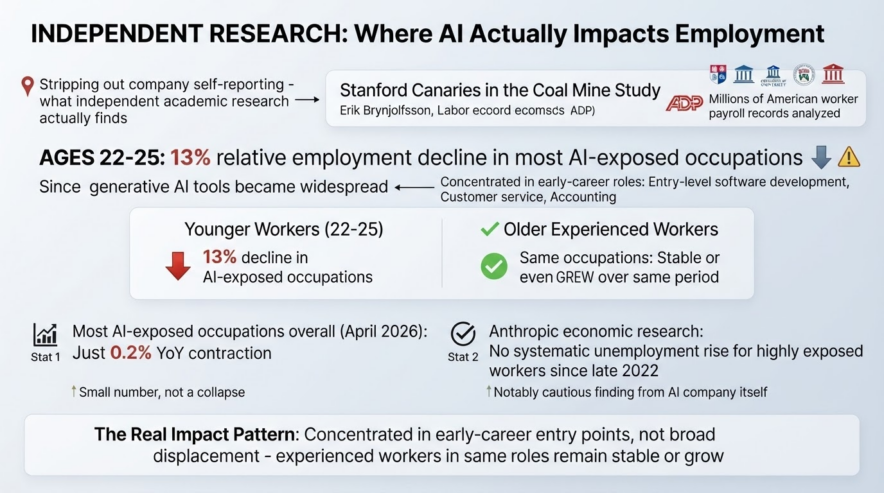
Stripping out company self-reporting, independent academic research has found a narrower — but real — impact, concentrated in a specific group.
Stanford’s “Canaries in the Coal Mine” study, led by economist Erik Brynjolfsson, analyzed payroll records from millions of American workers via ADP data:
Workers aged 22-25 in the most AI-exposed occupations saw a 13% relative decline in employment since generative AI tools became widespread
This decline was concentrated specifically in early-career roles: entry-level software development, customer service, and accounting
Employment for older, more experienced workers in the exact same occupations remained stable or even grew over the same period
As of April 2026, the most AI-exposed occupations overall contracted just 0.2% year-over-year — a small number, not a collapse
Anthropic’s own economic research, notably, found no systematic rise in unemployment for workers in highly AI-exposed jobs since late 2022 — a more cautious finding than the headline layoff numbers would suggest, coming directly from a company with every incentive to either downplay or highlight AI’s labor impact.
Reconciling the Two Stories
Putting the company-announced numbers next to the independent research produces a fairly consistent picture once you separate “stated reason” from “measured cause”:
Company-cited AI layoffs are large and rising in raw numbers (101,743+ year-to-date), but a substantial share of that citation appears to be strategic framing rather than a literal cause-and-effect
The clearest, most defensible independent evidence of real AI-driven job loss is narrow: a 13% relative decline for a specific slice of the workforce — early-career workers in a handful of highly AI-exposed roles
Broader occupational-level effects, even in the most exposed job categories, remain small (a 0.2% year-over-year contraction) rather than catastrophic
The honest summary, echoed by labor economists studying this directly, is that “job losses are real, but they precede any proven productivity gains from generative AI” — companies appear to be cutting based on what they expect AI to eventually do, not what it has already demonstrably done at scale
Who’s Actually at Risk, Based on the Evidence
Rather than a broad “AI is taking jobs” framing, the data supports a narrower, more specific risk profile:
Entry-level and early-career workers in roles where AI automates rather than assists (junior coding, first-tier customer support, routine accounting tasks)
Roles where the work is highly codified and repeatable — the kind of “book learning” tasks AI systems currently handle best
Workers without significant tacit, job-specific experience, since that kind of experience appears to function as a real buffer against AI-driven displacement, based on the stable-to-growing employment seen among more experienced workers in the same occupations
Conclusion
The honest read of the 2026 data is that two real but different things are happening at once. Companies are citing AI as a reason for layoffs at a rising rate — over 100,000 job cuts and counting — and a meaningful share of that citation is convenient framing rather than a demonstrated cause, especially given that the same companies are simultaneously raising AI capital spending to record levels while posting double-digit revenue growth. Underneath that noisy company-level signal, independent academic research has found a real, but much narrower effect: a 13% relative employment decline concentrated specifically among early-career workers in highly AI-exposed entry-level roles, with more experienced workers in the same jobs largely unaffected. The story isn’t “AI is taking everyone’s job” or “AI layoffs are all fake” — it’s that a genuine, targeted disruption for young workers in specific roles is being amplified into a much bigger, blurrier narrative by companies that have every incentive to let AI take the blame.
Frequently Asked Questions
AI is the most commonly cited reason in layoff announcements for four consecutive months through June 2026, but that doesn't mean it's always the true driver. Many companies use AI framing even when the real cause is over-hiring, missed revenue targets, or straightforward cost-cutting.
Blaming AI signals innovation and forward-thinking efficiency to investors, which plays better than admitting financial mismanagement or missed targets. It reframes a reactive cost-cutting decision as a proactive strategic move.
Early-career workers aged 22 to 25 in highly AI-exposed roles like junior software development, entry-level customer service, and routine accounting show the clearest evidence of real impact. More experienced workers in the same fields have not seen comparable declines.
Layoffs and AI investment are largely separate financial decisions made on different timelines. Headcount reductions often address short-term cost targets or past over-hiring, while AI capital expenditure is a long-term competitive bet that can move in the opposite direction within the same quarter.
Not entirely — the data shows a real but narrow effect, such as a documented 13% relative employment decline among specific early-career workers, rather than the sweeping workforce replacement implied by aggregate layoff announcements. The gap between what companies claim and what independent data confirms remains significant.