Every week brings a new headline about agentic AI. Gartner says $234 billion in SaaS spending is at risk. Meta just launched a paid developer API for its own agentic models. Google added “information agents” to Search. The adoption numbers sound unstoppable. But almost nobody puts those adoption headlines next to the failure data from the same research firms — and when you do, a very different picture shows up. This article lays both sets of numbers side by side, in one place, so you can see the real gap between what companies are buying and what’s actually working.
The Adoption Story Everyone Already Knows
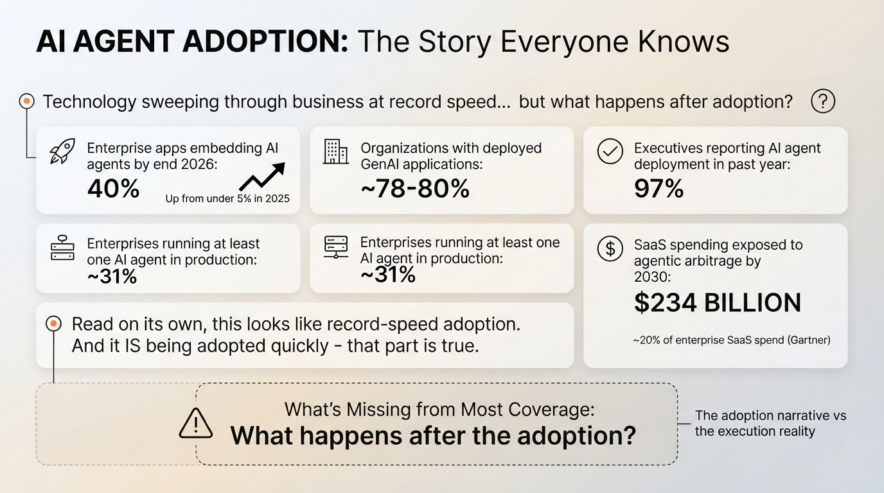
Before getting to the failure data, here’s the adoption picture that’s been widely covered:
Adoption Metric | Figure |
Enterprise applications expected to embed AI agents by end of 2026 | 40% (up from under 5% in 2025) |
Organizations reporting deployed GenAI applications | ~78-80% |
Executives saying their company deployed AI agents in the past year | 97% |
Enterprises running at least one AI agent in production | ~31% |
SaaS spending Gartner predicts is exposed to “agentic arbitrage” by 2030 | $234 billion (about 20% of enterprise SaaS spend) |
Read on its own, this looks like a technology sweeping through business at record speed. And it is being adopted quickly — that part is true. What’s missing from most coverage is what happens after the adoption.
The Failure Numbers Nobody Headlines
Here’s the data that rarely makes it into the same article as the adoption stats above.
Failure Metric | Figure | Source |
Generative AI pilots that fail to deliver measurable P&L impact | ~95% | MIT NANDA study |
Overall AI projects that fail, roughly 2x the failure rate of normal IT projects | ~80%+ | RAND Corporation |
Organizations seeing significant ROI from generative AI | ~29% | Industry survey data |
Organizations seeing significant ROI specifically from AI agents | ~23% | Industry survey data |
CEOs reporting both revenue gain and cost reduction from AI | ~12% | Industry survey data |
Agentic AI projects Gartner expects to be canceled by end of 2027 | 40%+ | Gartner |
Enterprises that scaled agentic AI beyond pilot stage, despite most having experimented | Under 10% | Gartner |
Put plainly: nearly all companies say they’ve deployed AI agents. Fewer than one in four say they’re actually seeing meaningful return. And Gartner — the same firm predicting $234 billion in disrupted SaaS spending — is separately predicting that 4 in 10 agentic AI projects will be shut down within two years of that same forecast.
These aren’t contradictory numbers from rival research firms with different agendas. They’re often from the same sources, published within months of each other. The adoption story and the failure story are just rarely told together.
Why the Gap Is So Big: What MIT Actually Found
MIT’s Project NANDA looked at roughly 300 real, public AI deployments inside companies — not surveys asking executives how they feel about AI, but actual measured outcomes. Their conclusion: about 95% of generative AI pilots showed no measurable impact on profit and loss.
The researchers identified what they called a “learning gap.” It wasn’t that the AI models were bad. It was that most organizations didn’t know how to design workflows that captured AI’s strengths while managing its weaknesses. Common, specific problems included:
Unclear definitions of what “success” for the project actually meant
Weak or messy underlying company data that the AI had to work with
Poor integration into how people actually already did their jobs
Chasing the technology itself rather than a clear business outcome
Executive sponsors losing interest or moving on before the project matured
The One Number That Actually Predicts Success: Build vs. Buy
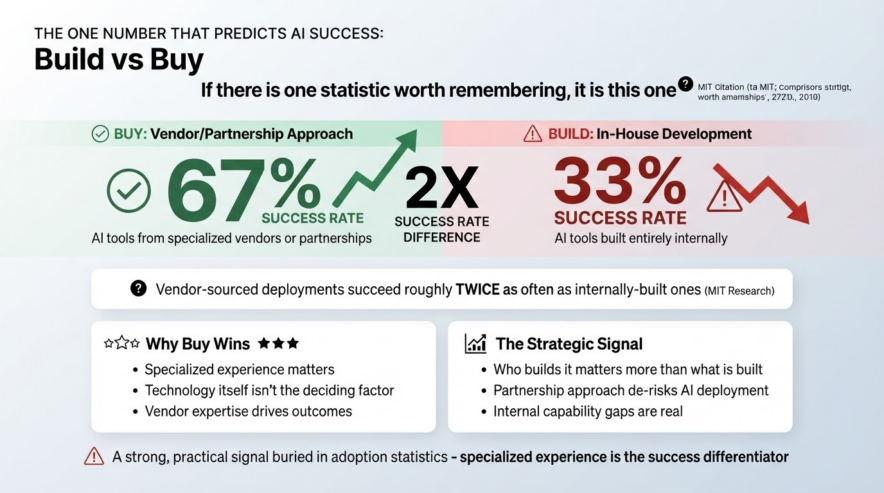
If there’s a single statistic in this entire dataset worth remembering, it’s this one. MIT’s research found a massive difference in outcomes based on how companies got their AI tools:
Approach | Success Rate |
Buying AI tools from specialized vendors or forming partnerships | ~67% |
Building AI tools entirely in-house | ~33% |
Vendor-sourced or partnership-based AI deployments succeeded roughly twice as often as internally-built ones. This is a strong, practical signal buried inside a mountain of adoption statistics: the technology itself isn’t usually the deciding factor in whether an AI project works. Who builds it, and how much specialized experience they bring, seems to matter more.
Where the Failures Are Concentrated
Not every use case fails at the same rate. Based on the available data, certain patterns show up repeatedly:
Back-office and administrative agents (scheduling, internal documentation, routine data entry) tend to have the highest success rates, because the tasks are narrow and repeatable
Customer-facing or judgment-heavy agents (complex customer service, financial advice, medical-adjacent tasks) show much higher failure and cancellation rates, because errors are costlier and workflows are less predictable
Projects with a single, clear KPI (like “reduce average handling time by X minutes”) succeed more often than projects framed around vague goals like “become more AI-driven”
Projects with continued executive sponsorship through year two were significantly more likely to survive past the pilot stage than those where sponsorship faded after the initial launch announcement
Why the Adoption Numbers Keep Climbing Anyway
If the failure rate is this high, why does adoption keep accelerating? A few things are happening at once:
Vendors, including Meta, Google, Microsoft, and Anthropic, are all racing to embed agents into existing products, so “adoption” is increasingly something that happens automatically when a company updates its software — not necessarily a deliberate strategic bet.
Pilot programs are cheap to start and easy to announce publicly, which inflates adoption figures relative to the number of projects that actually mature into permanent, scaled deployments.
Competitive pressure plays a role — companies are often willing to fund a failed pilot rather than risk being seen as behind the curve on AI.
The definition of “using AI agents” is broad and inconsistent across surveys, so a company using a single simple chatbot for internal FAQs can count the same as a company running dozens of production agents across the business.
What This Means for Businesses Evaluating Agentic AI
The data suggests a fairly clear, practical takeaway: the technology adoption curve and the value-realization curve are not the same curve, and treating them as if they are is where most of the wasted spending comes from. Companies that buy proven, specialized agentic tools rather than building from scratch, that set one clear measurable goal per project, and that keep senior sponsors engaged well past the launch date are seeing meaningfully better outcomes than the broader averages suggest. The 95% failure figure isn’t a reason to avoid agentic AI — it’s a reason to be much more deliberate about how it gets deployed.
Conclusion
The agentic AI story being told in most headlines is only half the story. Adoption is real and accelerating — 97% of executives say they’ve deployed agents, and Gartner expects agentic AI to reshape a fifth of enterprise SaaS spending by 2030. But sitting right next to those numbers, often from the very same research firms, is a much less flattering picture: 95% of pilots showing no measurable financial impact, over 80% of AI projects failing broadly, and 40% of agentic AI projects expected to be canceled within two years. The gap between those two realities isn’t a contradiction to be resolved — it’s the actual state of the industry right now. Businesses that understand this gap, and specifically that vendor-built tools succeed roughly twice as often as homegrown ones, are the ones most likely to end up in the small percentage that actually works.
Frequently Asked Questions
Most AI agent pilots fail not because the technology doesn't work, but because of poor implementation strategies, vague success metrics, and overly ambitious scopes. High adoption simply means companies are starting projects, not that those projects are surviving long enough to deliver measurable value.
Narrow, repetitive back-office tasks with a single clear performance metric tend to succeed far more often than broad, judgment-heavy projects. Customer-facing or open-ended use cases with vague goals are among the most common failure points in agentic AI deployments.
Research from MIT suggests buying or partnering with a vendor is significantly more effective, with roughly 67% success compared to about 33% for internally built tools. Vendors bring specialized expertise and mature workflows that most organizations haven't yet developed on their own.
Companies can improve success rates by starting with a narrow, well-defined use case, establishing a single measurable success metric before launch, and seriously considering vendor-sourced tools over internal builds. Avoiding vague goals and overly broad project scopes is one of the most reliable ways to avoid joining the 95% failure group.
Most researchers expect failure rates to improve gradually as enterprise experience grows, workflows mature, and vendors release more purpose-built solutions. However, data through mid-2026 shows no sharp decline yet, and a significant gap between adoption enthusiasm and realized value still exists.