Listicles are one of the most powerful and versatile types of pre-sell pages used by large direct-to-consumer brands. When written correctly, they can significantly increase conversion rates — often by 20% to 100%. Many brands scaling past eight figures use listicles as a core part of their funnel strategy.
In this article, we’ll break down exactly how these high-performing listicles are structured, why they work so well, and how you can write them step by step.
Why Listicles Matter for Scaling
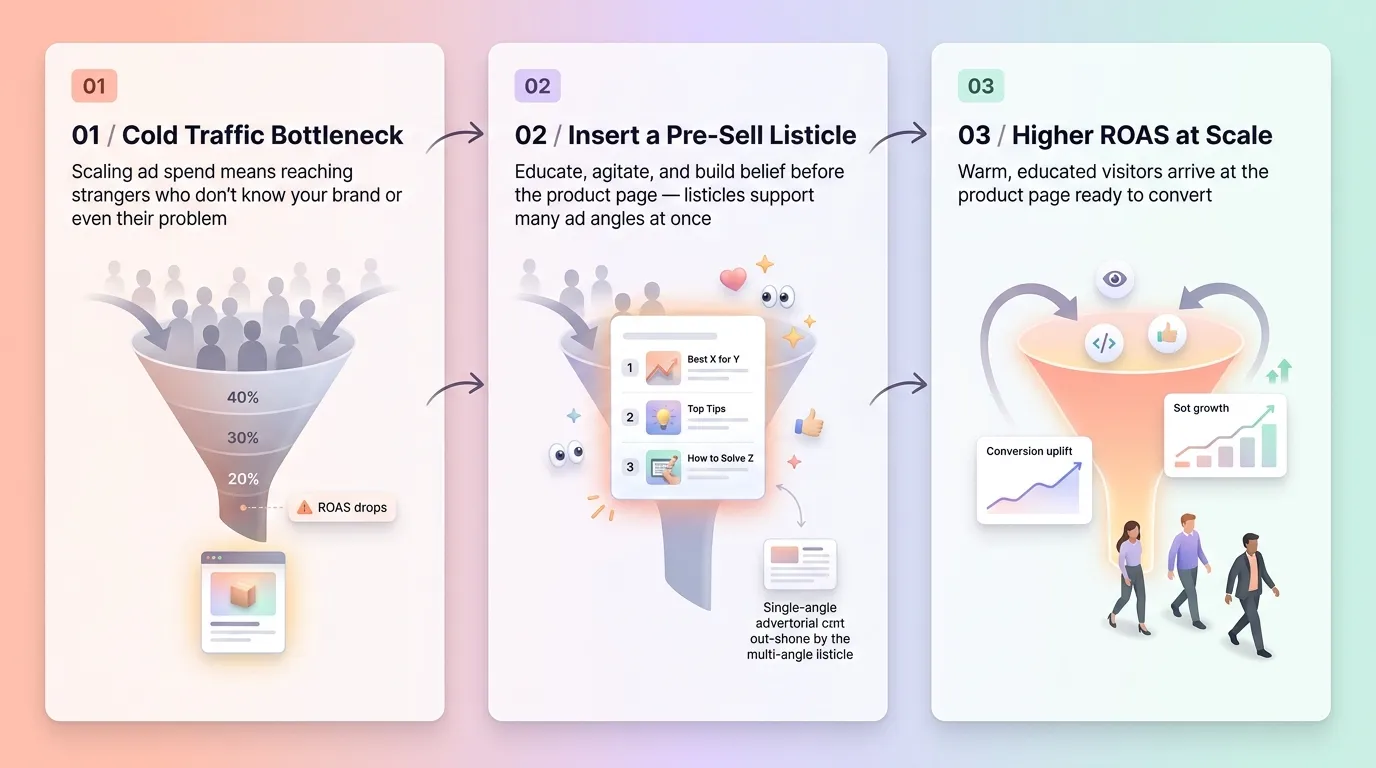
When you want to scale ad spend, you inevitably start reaching colder audiences. These people usually don’t know your brand, don’t fully understand the problem you solve, and may not even realize they have a problem in the first place.
If you send this cold traffic straight to a product page, conversion rates drop and ROAS suffers. This is where pre-sell pages become essential.
A good pre-sell page educates the visitor, agitates the problem, and builds belief in your solution before they ever reach the product page. Listicles are especially effective for this because they are broad enough to support multiple ad angles at once, unlike advertorials which usually focus on a single deep story or angle.
The Core Beliefs a Listicle Must Install
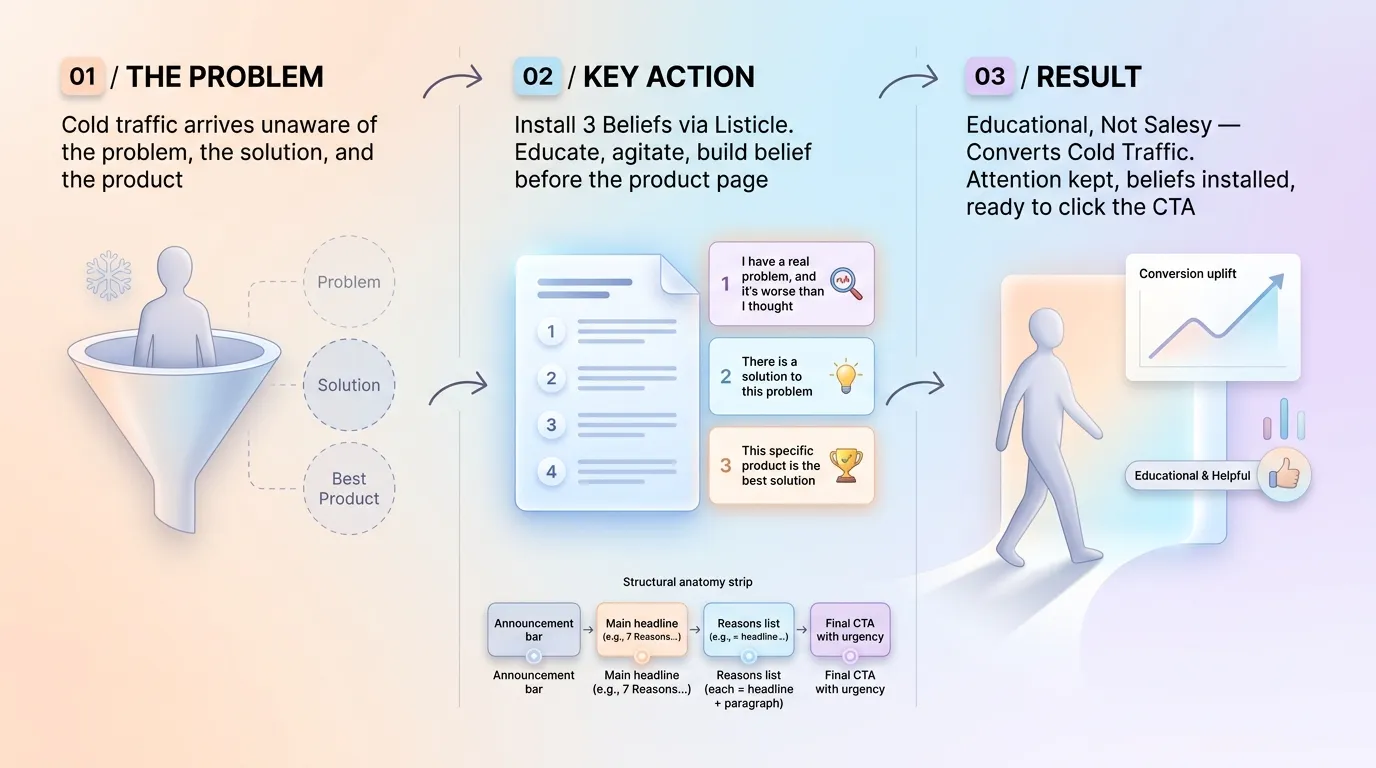
A high-converting funnel works by moving people through a series of beliefs while agitating pain. For a listicle to convert cold traffic, it needs to install these three key beliefs:
“I have a real problem, and it’s worse than I thought.”
“There is a solution to this problem.”
“This specific product is the best solution available.”
If your listicle successfully installs these beliefs while keeping the reader’s attention, it can convert even completely unaware traffic.
Overall Structure of a High-Performing Listicle
A typical listicle follows this simple but effective structure:
Announcement bar (optional) – Creates urgency at the very top of the page.
Main headline – Something like “7 Reasons Over 50,000 People Are Switching to [Your Product].”
Optional sub-headline – Highlights key benefits.
List of reasons – Each reason gets its own section with a strong headline and supporting paragraph.
Final CTA – Sends the visitor to the product page, ideally with urgency or scarcity.
The page should feel educational and helpful rather than overly salesy.
How to Choose the “Reasons”
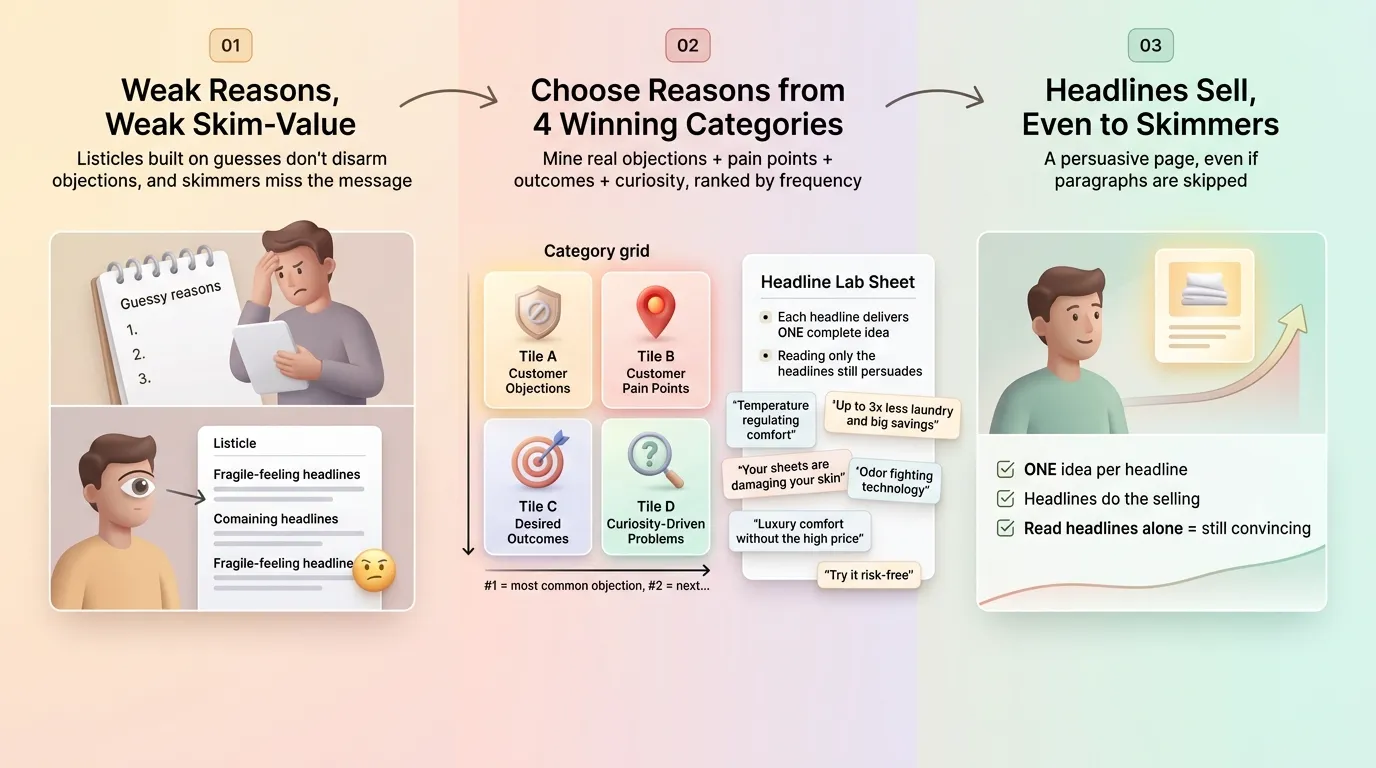
Every point in your listicle should come from one of these four categories:
Customer objections
Customer pain points
Desired outcomes
Curiosity-driven problems
The easiest and most reliable method is to base your reasons on common objections. During customer research, collect the objections you hear most often and rank them by frequency. The most common objection becomes Reason #1, the second most common becomes Reason #2, and so on.
You can also mix in pain points and desired outcomes. The goal is to address the biggest barriers standing between the visitor and a purchase.
Writing Headlines That Sell on Their Own
Many visitors will only skim the page. This means your headlines must do a large portion of the selling work by themselves.
Each headline should clearly communicate one complete idea. Someone who only reads the headlines (and skips every paragraph) should still walk away understanding the core value of your product and having some of their objections handled.
For example, strong listicle headlines might look like:
Temperature regulating comfort
Up to 3x less laundry and big savings
Your sheets are damaging your skin
Odor fighting technology
Luxury comfort without the high price
Try it risk-free
When you finish writing your headlines, test them by reading only the headlines in order. If the page still feels persuasive, you’re on the right track.
How to Write the Paragraph Under Each Headline
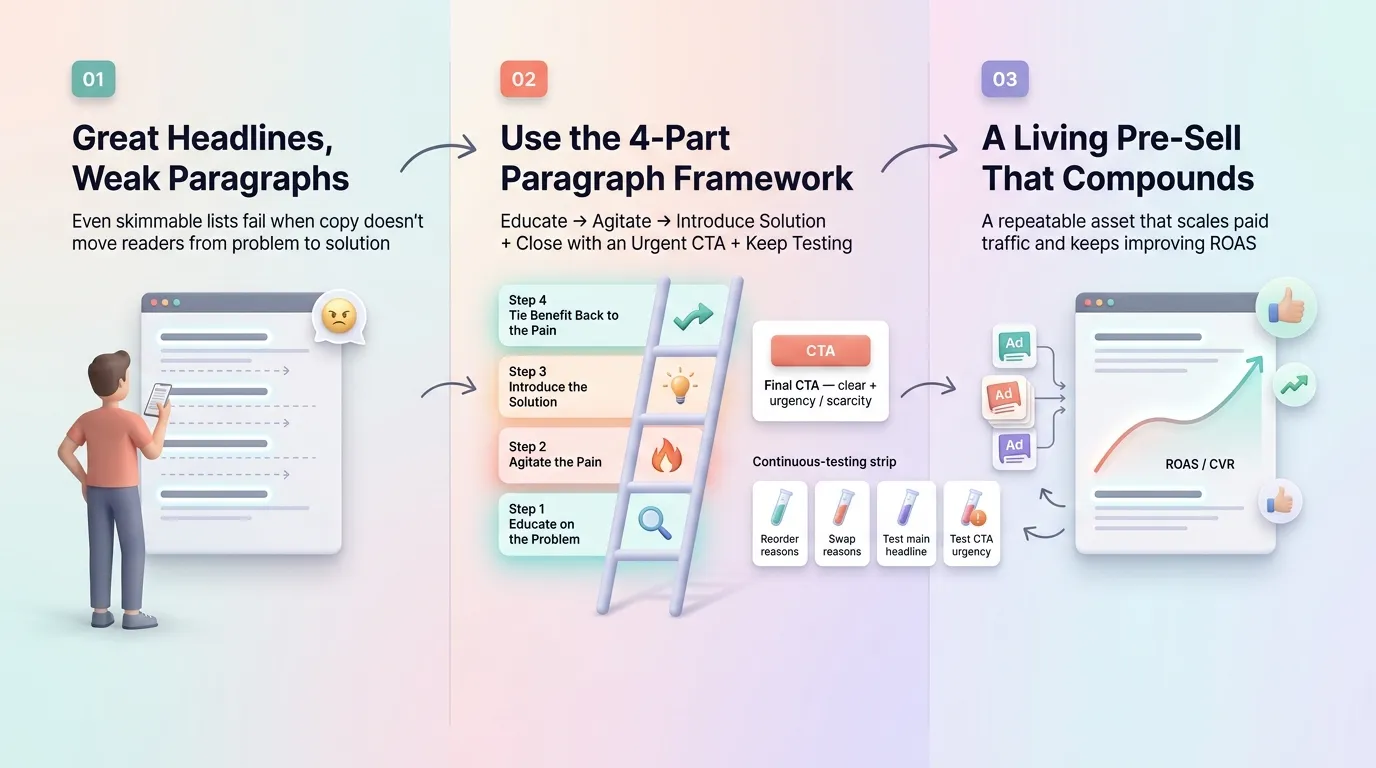
Every supporting paragraph follows a clear four-part structure:
Educate on the problem – Share a surprising fact, statistic, or insight that makes the reader more aware of the issue.
Agitate the pain – Show how this problem affects their daily life and what negative consequences it creates.
Introduce the solution – Present the unique feature or mechanism of your product.
Tie the benefit back to the pain – Clearly explain how your product solves the exact problem you just agitated.
Here’s an example based on this structure:
“According to research, after just one week of use, regular bedsheets can have more bacteria than a bathroom doorknob. After two weeks, the bacteria levels can exceed those found on a pet toy. Most people don’t have time to wash their sheets constantly, and the cost of frequent laundry adds up quickly in water, electricity, and detergent.
Our sheets use silver-infused fiber technology that helps prevent up to 99.7% of bacteria growth. This means you can wash them far less often, saving both time and hundreds of dollars every year.”
Notice how the paragraph first builds the problem, then presents the product as the logical solution to that exact problem.
Writing the Final CTA
The call-to-action at the bottom of the page should be clear and direct. Whenever possible, include an element of urgency or scarcity, such as limited stock messaging or language that encourages the visitor to check availability now.
The CTA’s only job is to move the now-educated and warmer visitor to the product page.
Continuous Testing Is Essential
Even a well-written listicle can be improved. Successful brands constantly split test these pages. Common tests include:
Changing the order of reasons
Replacing some reasons with completely new ones
Testing different main headlines
Testing individual section headlines
Testing urgency elements in the CTA
The brands that treat listicles as living pages (rather than one-time assets) are the ones that continue to improve conversion rates over time.
Final Thoughts
Listicles work because they systematically educate cold traffic, handle objections, and build belief in a structured way. When written with strong skim-able headlines and carefully constructed paragraphs, they become one of the most reliable tools for scaling paid traffic.
The process is straightforward once you understand the principles: identify the biggest objections and pains, turn them into clear reasons, write headlines that sell on their own, and support each point with problem-agitation-solution copy.
Master this format, and you’ll have a pre-sell asset that can support multiple ad angles while consistently improving conversion rates as you scale.
Quick Links: