SEO researcher Lily Ray has documented a pattern of steep visibility drops hitting SaaS and B2B sites that rank their own product first in “best of” listicles, with the damage now confirmed to spread into AI answer engines too.
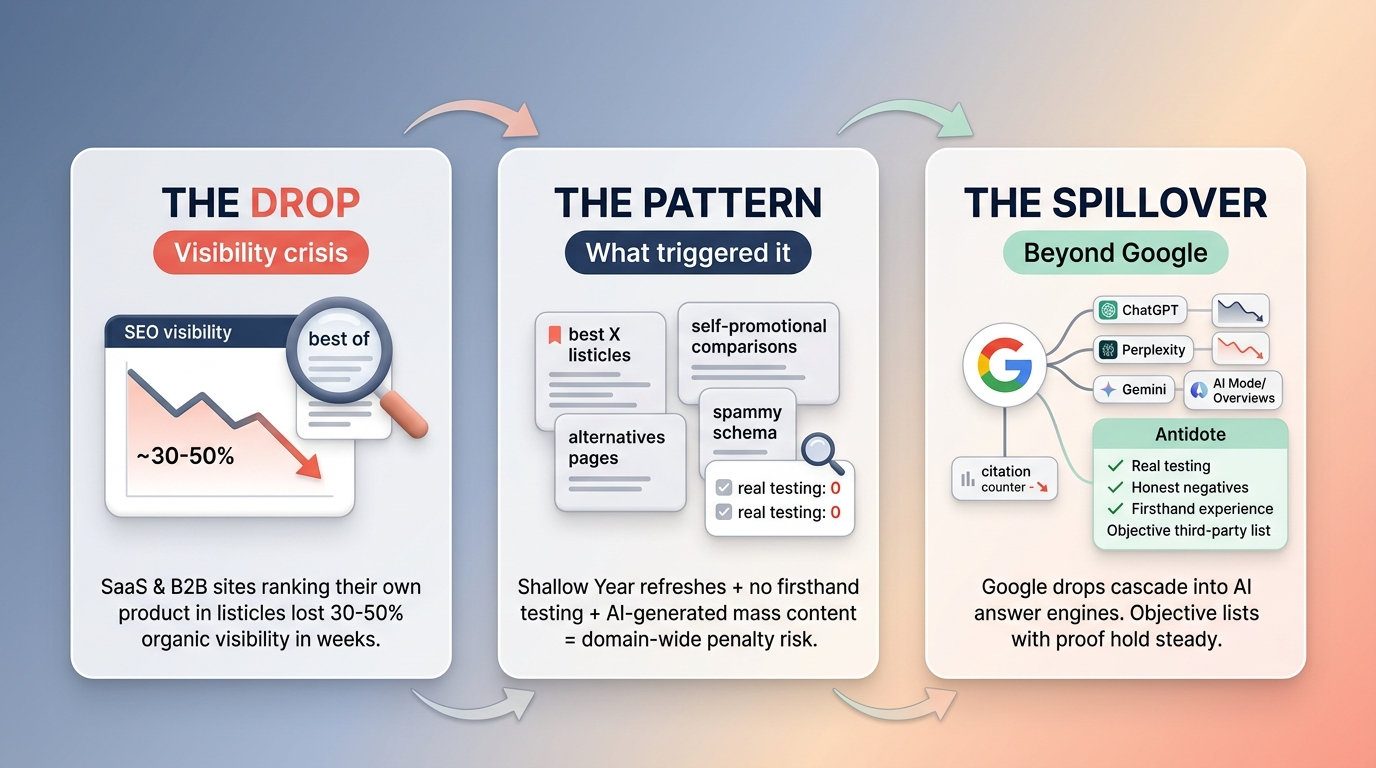
Affected sites saw organic visibility drop 30% to 50% within weeks, concentrated in blog subfolders and comparison pages, not homepages or product pages
The pattern points to listicles where the publisher ranks its own product as the top pick, often with shallow “2026” title refreshes and little real testing behind the rankings
Ray warns the effect is not limited to Google. Visibility losses can carry over to ChatGPT, Perplexity, and other AI systems that lean on Google’s index for retrieval
What triggered the drops
Google has not confirmed any new update by name, but the timing lines up with volatility that followed the December 2025 core update.
Ray’s research found the hardest-hit sites shared a specific content pattern: mass-produced “best X” listicles, self-promotional comparison pages, scaled competitor “alternatives” pages, and spammy structured data. In several cases, the AI-generated content sat in a single subfolder, yet the visibility hit landed across the entire domain.
Ray also raised a pointed question in her analysis: how many of these companies had actually used the competitor products they ranked against their own? In most cases the answer was zero. Listicles built without real testing or firsthand use are the ones losing ground.
Why it matters beyond Google
Because AI Overviews, AI Mode, and Gemini pull directly from Google’s index, a ranking drop there can mean fewer citations in AI-generated answers. ChatGPT, which relies heavily on Bing alongside some Google signals, and Perplexity, which retrieves from multiple indices in real time, are both exposed to the same downstream effect. A brand that loses Google visibility risks losing AI visibility at the same time, not as a separate problem to manage later.
What still works
Not every listicle is at risk. Objective third-party lists, ones without an obvious self-promotional angle, have held steady through the same period. Analysts tracking the fallout say the deciding factor is proof: real testing, honest negatives, and firsthand experience outperform templated rankings that crown the publisher’s own product every time.
Quick Links: