
Twilio still has the deepest communications API on the market. It’s also the platform people search their way out of most often. Registered SMS costs more than the rate card suggests, 10DLC campaigns can sit in review for weeks, and support past the basics lives behind a paid tier. We pulled pricing, registration timelines, and AI feature claims from seven alternatives and checked them against each vendor’s own published pages, so what follows is what’s actually live right now, not what’s sitting on a roadmap slide.
The Short Version: Signal House Wins for Most Teams
If you send business SMS and would rather run campaigns than babysit telecom infrastructure, start with Signal House. It publishes a US rate of $0.0065 a segment with no minimum, against Twilio’s $0.0083. It registers your A2P 10DLC campaign for you and quotes approval in about 48 hours for standard cases. Support comes with the account, not gated behind a pricier plan. Out of everything in this comparison, it’s the one built for a team that wants to stop thinking about carrier compliance and just get back to sending messages.
If cost per message is the only number that matters and your team writes its own code, Telnyx publishes $0.0040 a part on a network it owns outright. Plivo is the easiest move if you’re carrying an existing Twilio codebase. Bandwidth, Sinch, and Vonage fit enterprise buyers with a procurement team behind them, and Bird’s worth a look if you’re based in Europe.
Get Started with Signal House → https://signalhouse.io/
Why Teams Actually Leave Twilio
Twilio isn’t standing still. Its Agent Connect SDK for building conversational agents went generally available earlier this year, a hosted MCP server that lets Cursor or Claude read the full API reference is in public beta, and its documentation is still the best in the category. Nobody’s leaving because Twilio stopped shipping.
They’re leaving over three plain, unglamorous problems.
Price is the plainest one. Twilio charges $0.0083 per US SMS segment in each direction, the highest list rate in this comparison, and that’s before the carrier fees every provider passes through on top of it: $0.0035 per outbound message at AT&T, $0.0045 at T-Mobile and Verizon, with AT&T having already raised its rate this spring and Verizon’s climbing to $0.0050 this fall.
Then there’s registration. A thread on r/twilio describes a 10DLC campaign and a toll-free number, each rejected four times, taking more than four and a half weeks to clear. Another thread describes six rejections on a single campaign. Twilio sells a paid Fast Track option for teams stuck in that loop, which tells you something about how common the loop is. To be fair, registration delays are an industry-wide headache, not something Twilio invented. But how a provider handles that process has turned into one of the sharpest differences between platforms, and it’s the exact problem Signal House built its whole pitch around, more on that shortly.
And support. Twilio’s base tier is self-serve, with paid plans stacked above it. Its fraud-prevention page lists excessive opt-outs, suspected fraud, and non-payment among the reasons an account can get suspended until support steps in and reactivates it. Reasonable policies on paper. But picture a two-person marketing team with a paused sending number and a ticket queue between them and their next campaign, and you’ve got the exact scenario that leads someone to type “twilio alternative” into Google at 11pm.
One honest note before the rankings start. Near the end there’s a section on who should actually stay with Twilio, and it’s written with just as much care as everything above it. If you’re a developer-led team building a custom communications stack, Twilio’s breadth is genuinely hard to match, and nothing here is going to pretend otherwise.
The 7 Twilio Alternatives at a Glance
Platform | Best for | US SMS out / in (list) | A2P registration | Support | AI live today |
Signal House | Business SMS without the engineering project | $0.0065 out; tiers to $0.0030 at 10M+/mo | Guided, ~2 days quoted for standard cases | Included with every account | AI replies in Shopify app; Cursor and Lovable SDK guides |
Telnyx | Developer control at the lowest public rate | $0.0040 / $0.0040 | Self-serve; TCR fees passed through | Varies by plan | Voice AI Agent $0.05/min; BYOK OpenAI and Anthropic |
Plivo | Twilio-compatible API on a budget | $0.0077 / $0.0077 | Self-serve; 1–2 weeks per third-party reviews | Varies by account | No-code voice agent builder; LiveKit and Pipecat |
Bandwidth | Carrier-grade US enterprise | $0.0035 / $0.0035 (registered 10DLC) | Handled; timeline not published | Enterprise plans | Maestro AI call orchestration |
Sinch | Global multi-channel at volume | $0.0078 / $0.0078 | Handled; timeline not published | Scaled to deployment | Smart Conversations; MCP support |
Vonage | Telephony plus low-code AI agents | $0.00809 / $0.00649 | Handled; timeline not published | Tiered, paid 24/7 option | AI Studio; Knowledge AI |
Bird | EU-first omnichannel | $0.0035 long code (pricing tool) | Fee table published, no timeline | Contact sales | AI-first CRM positioning; quote-based |
Rates above are what each vendor had listed on its own pricing page as of early September 2026, before carrier pass-through fees and number rental get added. Bandwidth and Bird only publish partial rate cards and quote most accounts individually, so treat their numbers as a starting point rather than a final bill.
Worth saying plainly: this isn’t a hands-on test run across production accounts on all eight platforms. Every figure traces back to a vendor’s published page or a dated public source, named as we go.
Search “best twilio alternatives 2026” and look at who wrote what ranks. Prelude ranks Prelude first. Textellent ranks Textellent. CloudTalk ranks CloudTalk. Even the prices disagree across these pages, one lists Vonage SMS at $0.0067, another at $0.0086. This guide isn’t trying to sell you an SMS platform in general. It’s written for the person who just shipped a product and now needs it to send a text without a week of telecom homework first, which happens to be exactly the gap Signal House fills.
1. Signal House: The Best Twilio Alternative for Business SMS
Signal House opens this list, and it earns the spot, because it was built for exactly the reader this guide is written for: a marketing team, an agency, or a SaaS company that wants compliant business SMS running this week, not after a sprint cycle. Founded in 2023 in Columbus, Ohio, the whole company is built around one idea: take the three jobs Twilio hands back to your team, registration, campaign management, and support tickets, and just handle them as part of the product instead of charging extra for it or leaving you to figure it out alone.
The published US rate is $0.0065 per SMS segment with no minimum, sliding to $0.0030 above 10 million messages a month. MMS runs $0.0200, and carrier fees are itemized at the same pass-through rates every other provider here charges. Signal House’s own materials claim total savings against Twilio of up to 70 to 90 percent at volume, though on list rates alone the real gap is closer to 22 percent. The bigger number depends on your support costs and how your campaigns are set up today, so treat it as a claim to check rather than a given.
Here’s the cleanest way to check it: pull your last three Twilio invoices, note the message count, carrier fees, campaign charges, and any support plan you’re paying for, and send those numbers to Signal House for a like-for-like quote in writing. That answer is worth more than any percentage on a comparison page, this one included.
Where Signal House actually beats Twilio
Registration is the big one. Most teams don’t switch providers over a rate card, they switch after a campaign sits in Twilio’s review queue for a month. Signal House registers your brand and campaign for you and quotes approval at about 48 hours for standard cases, which is the whole reason it sits at the top of this list rather than just being another rate comparison entry.
Support matters just as much. It comes bundled with the account from day one. No separate tier to unlock before a human answers a question, no paid add-on just to get help with a stuck campaign. For a small team without dedicated technical staff, that difference shows up far more often than any other line item on this page.
And then there’s the fact that it doesn’t require touching an API at all if you don’t want to. There’s a Shopify app, free to install with 100 segments included, with paid plans from $29 a month for 1,500 segments, and GoHighLevel integration starting at $20 a month for 2,000 messages. Both skip code entirely, which matters if your team is marketers and store owners rather than developers.
The AI features that are actually running
Two things are shipping today rather than sitting in a pitch deck. Inside the Shopify app, when a shopper answers an abandoned-cart text, the reply gets drafted by AI in your brand’s own voice and lands in a shared inbox where a person can take over the conversation whenever they want. It’s a smaller feature than a flashy voice agent demo, but it sits exactly where a non-developer, a store owner or a support rep, actually touches the product.
For builders, there’s a recent guide on adding SMS to an app built in Cursor or Lovable: install the @signalhousellc/sdk package, paste the scripted prompt, and let the editor read the types and write the send call itself. A companion guide covers Claude Code, Codex, and Vercel projects the same way, and there’s a Python SDK on PyPI too. The guide is upfront that A2P registration is still required no matter how fast the code gets wired up, which is more honesty than most comparison pages bother with. An MCP server that would let your own agent handle carrier appeals is on the roadmap but not shipped yet, worth checking back on later this year.
What’s worth asking before you commit
Twilio has HD voice API’s. No fair comparison skips the limits. The messaging API is live and documented, with SDKs for both npm and Python. Voice is the piece to ask about directly, since it runs through the GoHighLevel dialer launched earlier this year. Confirm wider voice support before you build a whole workflow around it. HubSpot and Shopify are the documented integrations right now; Zapier and Make connectivity is worth confirming before you plan around either one. And that headline savings percentage stays a vendor claim until your own invoices back it up, which is exactly why the invoice test above is worth thirty minutes of your time.
Signal House makes the most sense if you send A2P SMS for marketing, sales, or support, want registration and support handled instead of managed in-house, and would rather check the savings against your own bills than take a percentage on faith.
Get Started with Signal House → https://signalhouse.io/
2. Telnyx: The Developer’s Answer on Cost and Control
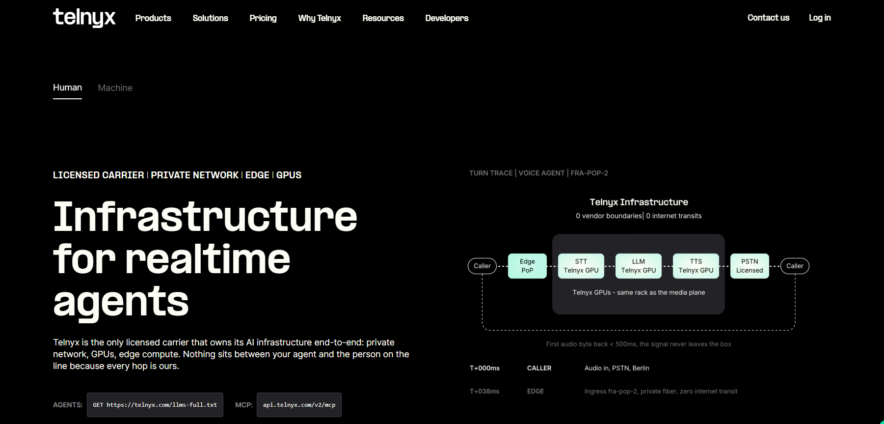
Telnyx is the cheapest fully published option here, and it’s built for a team willing to write its own code. It owns its network end to end instead of reselling carrier capacity, and the rate card is short: $0.0040 per SMS part in either direction, $0.015 for outbound MMS, a dollar a month per number, no minimums, pay as you go from your first message. Outbound voice comes out to roughly $0.007 a minute, a $0.002 call-control fee plus termination, and inbound local numbers start at $0.0032 a minute.
It’s also the most interesting voice AI option here for anyone who wants to pick their own model. The Telnyx Voice AI Agent bundles SIP, speech-to-text, the model, and text-to-speech at $0.05 a minute all-in, running on either Telnyx-hosted models like Qwen3-235B or your own OpenAI or Anthropic key. Independent write-ups put the real number closer to $0.056 to $0.061 a minute once tokens and telephony are counted, which still beats Twilio’s ConversationRelay at $0.07 a minute before telephony and tokens.
What you give up compared to Signal House is the hand-holding. Campaign workflows need setting up yourself, A2P registration is self-serve with registry fees passed straight through, and there’s no WhatsApp Business offering, so a multi-channel team will need a second vendor alongside it.
Telnyx is the pick if your team writes code, cost per part and per minute is the number that decides things, and voice AI on your own chosen model matters to the roadmap.
3. Plivo: The Closest Drop-In for a Twilio Codebase
Plivo is the migration pick. It was founded by former Twilio engineers, positions its API as Twilio-compatible, and in practice a lot of teams port their send logic over without much of a rewrite. Published US pricing runs $0.0077 per SMS on long codes and short codes, $0.0079 on toll-free, MMS at $0.018, carrier fees itemized separately, no minimum on self-serve accounts, and $10 in free credit for new accounts to test with.
The AI side is bigger than the rate card alone suggests. Plivo sells a full voice AI stack now: a no-code Agent Studio for teams that don’t want to write the agent themselves, LiveKit and Pipecat integration for teams that do, and native APIs underneath both. Third-party breakdowns put agent minutes around $0.05 plus call charges.
Two things worth checking before you budget around it. Some of the lowest Plivo rates quoted elsewhere belong to the Enterprise plan, which starts at $1,000 a month, not the self-serve tier. And outside reviews put 10DLC approval at one to two weeks, average for the industry but noticeably slower than Signal House’s roughly two-day quote.
Plivo fits best if you’ve got existing Twilio code you want to keep mostly intact and want a lower rate without signing a contract.
4. Bandwidth: Carrier-Grade Infrastructure for US Enterprises
Bandwidth is a different kind of company from the rest of this list. It’s a US carrier in its own right, with its own network, emergency-services coverage, and the procurement relationship a large organization expects from a telecom vendor. Its latest fee update lists the registered 10DLC rate at $0.0035 per message each way, next to the same carrier fees it passes through, including T-Mobile’s $0.0045 rate and Verizon’s bump due this fall.
Its AI story is about orchestration rather than a single feature. The Maestro layer can route a live call to several AI services at once, transcription, sentiment, fraud detection, and lets a team choose the cloud behind each one, a Cisco environment or Google’s models, for instance. Maestro powers Salesforce’s Agentforce Contact Center, and Bandwidth says it attaches Maestro to every enterprise deal it signs now.
The trade-off is accessibility. There’s no self-serve SMS rate card, no published approval timeline, and support runs through customer success plans rather than a help desk. A five-person marketing team is at the wrong door here. A contact center with a procurement department is probably at the right one.
5. Sinch: Global Reach and Multi-Channel at Volume
Sinch is the pick when SMS is one channel among several rather than the whole product. It runs a big carrier network across SMS, MMS, RCS, WhatsApp, email, and voice, publishes US SMS at $0.0078 per message with numbers running $1.00 to $2.00 a month, and has a pay-as-you-go tier that needs no card to start testing.
Its AI approach is bring-your-own. Smart Conversations layers in sentiment detection, PII masking, and speech-to-text, artificial-inflated-traffic detection guards OTP budgets against fraud, and Sinch documents MCP support so a team’s own agents can plug directly in. Setup is heavier than the newer names on this list, one comparison guide puts standard onboarding at 7 to 10 business days, and Sinch itself doesn’t publish an approval timeline.
Sinch is the right call if you run multi-channel programs across several countries, RCS is on your near-term roadmap, and you’ve got the internal team to configure an enterprise platform properly.
6. Vonage: Telephony Depth With a Low-Code AI Builder
Vonage, now part of Ericsson, is the broadest CPaaS platform on this list: messaging, voice, video, and verification under one account. Published US SMS is $0.00809 outbound and $0.00649 inbound on long virtual numbers, outbound domestic voice runs $0.00798 a minute, and pay-as-you-go has no minimum. Third-party trackers quote Vonage SMS anywhere from $0.0067 to $0.0086, which usually means the real number gets settled on a sales call rather than off the published card.
The standout is AI Studio, a low-code flow builder for virtual agents across voice, SMS, WhatsApp, and web chat, with Vonage’s own speech recognition, a native Salesforce integration, and a Knowledge AI feature that answers questions straight from your own documents. If a support or sales team wants to build an agent without a developer, this is the most complete builder in the whole comparison.
The cost of that breadth is more setup paths to choose from and a 24/7 support tier one tracker prices at $3,300 a month.
Vonage is worth it if you want one vendor covering voice, video, verification, and messaging, and a low-code agent builder your own ops team can run.
7. Bird: Omnichannel for EU-Based Teams
Bird, formerly MessageBird, fits teams headquartered in Europe that want SMS, WhatsApp, and email in one GDPR-first platform. Its pricing tool shows US long-code and toll-free SMS at the same rate Bandwidth lists, the lowest in this entire comparison, it prints the full Campaign Registry fee schedule right on its pricing page, and there’s a free tier for five SMS a day to test with.
The catch is transparency. A review of Bird’s live pricing found only email fully published, with SMS, WhatsApp, and voice all routed to a sales call, and other pricing trackers quote Bird SMS anywhere from $0.0033 to $0.0070. Treat the pricing-tool number as an opening position, not a final one, and get everything in writing.
Bird markets itself as an AI-first CRM with agents across every channel, but with pricing set entirely by quote there’s no independent way to confirm what those AI add-ons actually cost, so it’s listed here as positioning rather than a priced feature.
Bird makes sense if you’re EU-based, WhatsApp and email matter as much as SMS, and you don’t mind negotiating a custom quote.
What Each Platform’s AI Actually Does Today
Most Twilio alternative round-ups skip this, and it’s the thing people actually ask about. Below is only what’s live and documented right now, roadmap items are called out as such, and “not documented” just means it wasn’t found on the vendor’s own pages.
Platform | Voice AI agent | AI SMS replies | LLM and agent integrations | MCP server |
Twilio | ConversationRelay (GA) | Via Agent Connect SDK | OpenAI adapter, Azure, AWS Bedrock | Yes, public beta, read-only |
Signal House | Not a standalone product | Yes, Shopify app, brand voice + human takeover | Cursor, Lovable, Claude Code guides + SDKs | Roadmap |
Telnyx | Voice AI Agent | Not documented | Hosted models or BYOK OpenAI/Anthropic | Not found |
Plivo | Full-stack voice AI | Not documented | LiveKit, Pipecat, native APIs | Not found |
Bandwidth | Maestro orchestration | Not documented | Cloud-agnostic (Cisco, Google AI) | Not found |
Sinch | Smart Conversations tooling | Sentiment and PII tooling | Bring your own AI | Yes, documented |
Vonage | AI Studio agents | Via AI Studio flows | Salesforce, Knowledge AI (RAG) | Not found |
Bird | AI agents (positioning) | In marketing copy | Not documented | Not found |
Twilio is still the deepest AI platform of the eight, and if agents are your actual product, that depth is a legitimate reason to stay. Telnyx and Plivo have turned voice AI into a price race, both landing around five cents a minute against Twilio’s seven before add-ons.
Signal House is the only one on this list whose AI shows up exactly where a non-developer meets the product, the reply inbox. That’s narrower than a full voice agent on purpose. For a store recovering abandoned carts or a clinic confirming appointments, an AI that drafts the reply while a person stays in control tends to pay for itself faster than a demo that impresses in a sales call and then sits unused.
What SMS Actually Costs at Volume
List rates hide most of the real bill. Every US provider adds a carrier fee per outbound message on top of its own rate, then number rental and campaign fees stack on top of that. The table below uses each vendor’s published rate for one number sending one segment per message, with AT&T’s fee as the pass-through example. A real mix of carriers usually lands a bit higher.
Monthly volume | Twilio | Signal House | Telnyx | Plivo |
10,000 SMS, platform rate only | $83 | $65 | $40 | $77 |
10,000 SMS, with AT&T fee | $118 | $100 | $75 | $112 |
50,000 SMS, platform rate only | $415 | $325 | $200 | $385 |
50,000 SMS, with AT&T fee | $590 | $500 | $375 | $560 |
250,000 SMS, platform rate only | $2,075 | $1,625 | $1,000 | $1,925 |
250,000 SMS, with AT&T fee | $2,950 | $2,500 | $1,875 | $2,800 |
At 50,000 messages a month with AT&T’s fee folded in, Twilio runs $590, Plivo $560, Signal House $500, Telnyx $375. That’s before counting what a paid Twilio support tier or a Fast Track registration fee would add, both of which Signal House includes for free.
The formula is messages times platform rate, plus messages times carrier fee, plus number rental and monthly campaign fees. Independent breakdowns of Twilio invoices find real bills often run 1.5 to 2 times the headline rate once fees, registration costs, and failed-message charges get counted, which is exactly why a rate card alone tells you so little. Signal House’s volume discounts kick in above 500,000 segments a month, so the table uses its entry rate rather than its best case. Bandwidth, Sinch, Vonage, and Bird are left out here since their effective rates get set by individual contract.
A2P 10DLC in 2026: What It Costs and How Long It Takes
Every US provider passes through the same registry fees, so this isn’t really where platforms differ. The Campaign Registry schedule lists a one-time brand registration fee of $4.50 ($4 for sole proprietors), optional standard vetting at $41.50 and enhanced vetting at $101.50, campaign vetting at $15 per attempt with a $50 expedite fee for 48-hour turnaround, and monthly campaign fees running from $1.50 for low-volume mixed use up to $10 for most standard and marketing campaigns and $30 for agents and franchises.
What actually differs is who does the work and how long it takes. Signal House registers on your behalf and quotes roughly two days for standard cases, a vendor claim, and worth noting that no independent timing study confirms this for any provider here, Signal House included. Twilio registers through Trust Hub with a paid Fast Track option, and user threads describe multi-week waits after rejections. Outside reviews put Plivo at one to two weeks. Telnyx, Bandwidth, Sinch, Vonage, and Bird all handle registration but don’t publish a timeline for it.
One practical note regardless of which provider you pick: rejections usually trace back to brand details that don’t match business records, missing opt-in language, or sample messages that don’t match what was filed with the registry. A provider that checks your submission before it hits the registry, which is what Signal House’s guided process does, saves more real time than any expedite fee will.
Switching From Twilio: What It Actually Looks Like
Fear of the switch keeps more teams on Twilio than any single feature does. The realistic sequence goes like this.
Account and A2P setup come first, since registration is the step that sets your whole timeline, and a campaign approved at Twilio doesn’t transfer anywhere else. Number porting runs in parallel, so your current setup keeps sending while the port completes: Bandwidth’s porting guide puts simple US ports at 3 to 7 business days, Twilio’s own documentation cites 5 to 15 days and up to four weeks after a rejection, with four to six weeks for bulk ports of 50 or more numbers, and Telnyx’s FastPort completes eligible numbers in 1 to 4 business days.
Campaign rebuild comes next. On a no-code platform like Signal House, built-in templates replace custom workflows without a rebuild from scratch. On an API platform your send logic ports over more directly, and Plivo’s Twilio-compatible API is the easiest of those moves specifically. Then a short parallel run, comparing delivery reports side by side, before cutting over fully.
One migration playbook estimates a full Twilio-to-Telnyx move, porting plus re-registration, at four to eight weeks end to end. On a platform that handles registration for you, the same move can be a lot shorter. Either way, the registry is what actually sets your timeline, not the vendor.
Who Should Actually Stay on Twilio
An honest alternatives article owes you this part too. If you’re a developer-led team building a fully custom communications stack, stay, nothing here matches Twilio’s product surface across Flex, Segment, Verify, Studio, and Conversation Intelligence combined. If AI agents are your actual product, stay too, since Agent Connect, ConversationRelay, and the MCP server together form the most complete agent toolkit of the eight platforms compared here. Already deeply integrated? The switching cost, especially re-registering campaigns, can easily outweigh a rate difference that at 50,000 messages a month runs from about $90 to $215 depending on where you’d move. And if your traffic is global and complicated, Twilio’s coverage and documentation are still the reference point for the whole industry, so that’s reason enough on its own.
If that’s your situation, the math rarely works out in favor of switching, and there’s nothing wrong with that.
How to Pick Between Them
Match the platform to the actual reason you’re leaving, not to a feature list. If it’s registration delays and support tickets specifically, go with Signal House, which solves both and includes support rather than selling it separately. If it’s purely the per-message rate and your team writes code, look at Telnyx first, or Plivo if you want to keep your existing Twilio code intact. Want out with zero engineering involvement at all? Signal House’s Shopify or GoHighLevel packages fit that exactly. Running an enterprise with a procurement process behind you, Bandwidth covers US carrier ownership, Sinch handles global multi-channel, and Vonage brings telephony breadth plus a low-code builder. EU-based and omnichannel points to Bird. Building AI voice agents specifically means Telnyx or Plivo on price, Twilio on depth. And if none of this actually describes your situation, stay put, and revisit the question when Verizon’s October fee increase shows up on your bill.
The Bottom Line
Twilio is still the most complete platform and the best AI agent toolkit in this category, and that’s exactly why the alternatives around it have specialized so hard. Signal House takes the registration, campaign, and support work entirely off the plate of teams that never wanted to manage telecom infrastructure in the first place, at a lower published rate than Twilio, with support included that would otherwise cost extra. Telnyx and Plivo cut the per-message and per-minute rate hardest for teams comfortable writing their own code. Bandwidth, Sinch, and Vonage serve enterprise programs with the procurement resources to configure them properly. Bird serves Europe specifically.
Before committing anywhere, run the two-invoice test: send your last two Twilio bills to your top two finalists and ask for a written, like-for-like quote that includes carrier fees and campaign charges, not just the headline rate. It answers more than any comparison article, this one included. For most teams sending business SMS right now, that quote request should start with Signal House.
Get Started with Signal House → https://signalhouse.io/
FAQs
Signal House is the best fit for most teams sending business SMS, since it registers your A2P campaign for you, quotes about two days for standard approvals, includes support with every account, and publishes a lower per-segment rate than Twilio. Developer-led teams wanting the lowest published price should check Telnyx, while those migrating existing Twilio code should look at Plivo.
Telnyx and Bandwidth publish lower raw per-message rates, but neither bundles guided registration or support into that price like Signal House does. Once you factor in the cost of handling registration and support yourself, Signal House often wins on total cost despite not having the single lowest list rate.
Yes, Signal House is about 22 percent cheaper on published US SMS list rates before carrier fees, and it cites total savings of up to 70 to 90 percent at volume once support and tiers are included. Since that larger figure depends on your specific volume and routing, request a written quote using your last Twilio invoices to confirm actual savings.
Signal House quotes roughly two days for standard cases because it registers the campaign for you and checks the submission before it reaches the registry. Twilio's Trust Hub process has documented waits of four and a half weeks or longer after repeated rejections, with a paid Fast Track option available for faster approval.
Voice currently runs through Signal House's GoHighLevel dialer, which launched earlier this year, but SMS and campaign management remain the more mature part of the product. Confirm broader voice availability directly with the Signal House team before building a plan around it.
