
In 2025, chatbots have become essential tools for customer engagement, with the market projected to reach $10.32 billion and grow to $29.5 billion by 2029.
Over 987 million people globally use AI chatbots, primarily for sales (41%), customer support (37%), and marketing (17%).
This article explores the rapid growth of chatbots, their diverse applications, and how businesses can leverage them to enhance operations, improve customer satisfaction, and drive revenue.
The Unstoppable Ascent of Chatbots: Key Statistics for 2026
The trajectory of chatbot adoption and market growth is nothing short of revolutionary. Businesses are increasingly recognizing the immense value propositions that AI-driven conversational interfaces offer, leading to a rapid integration into core operational strategies.
| Statistic | Impact |
| Chatbot market valuation 2025 | Expected to hit $10.32 billion |
| Potential working hours saved by chatbots | Up to 2.5 billion hours |
| Companies adopting chatbots as primary interface by 2027 | 25% of all companies |
| Chatbots capable of completing conversations | 70% of conversations |
| Global AI chatbot users | More than 987 million people |
| Global chatbot market value 2025 (alternative estimate) | $15.57 billion |
| Global chatbot market projection by 2029 (alternative estimate) | $46.64 billion |
These compelling statistics illustrate not only the current widespread adoption but also the significant future growth and transformative potential of chatbots in reshaping business efficiency and customer engagement.
Also read about: ChatGPT Statistics
How Many AI Chatbots Are There? A Glimpse into a Proliferating Ecosystem
While obtaining a definitive count of all AI chatbots in use worldwide remains a challenge due to their sheer volume and dynamic nature, it is undeniable that they number in the millions, potentially billions.
The digital landscape is permeated with these intelligent agents, addressing virtually every conceivable online task. Among the vast multitude, certain platforms have garnered immense attention and user bases, becoming household names in the AI chatbot realm.
The Most Popular AI Chatbots Globally: A Competitive Landscape
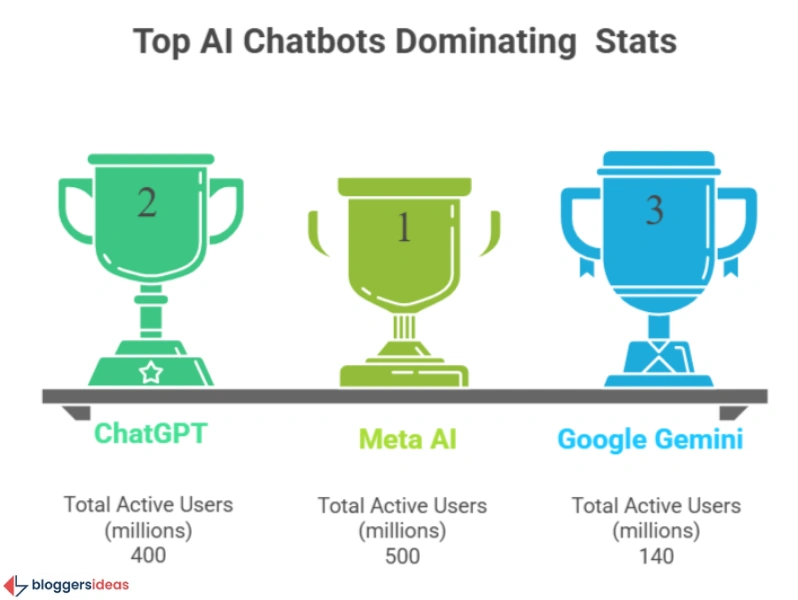
The competition among AI chatbot developers is intense, with platforms vying for user attention and market dominance. The following table showcases the leaders in this rapidly evolving space, ranked by their total active users.
| AI Chatbot | Total Active Users (Millions) | Total Monthly Visits (Millions) |
| Meta AI | 500 | 11.4 |
| ChatGPT | 300 (or 400) | 4600 (4.6 billion) |
| Google Gemini | 275 (or 140) | 124.8 |
| Microsoft Copilot | 100 | 98.9 |
| Grok | 1.3 (or 35) | 141.9 |
| Claude | 20 | 119.1 |
| Perplexity | 15 | 159.7 |
| Pi | 6 | 1.8 |
| Poe | 4 | 33.8 |
| HuggingChat | 1.2 | 42.1 |
Source: StatCounter, Statista
Note: Discrepancies in user numbers reflect data from different sources and reporting periods, indicating rapid growth and fluctuating user bases in this dynamic market.
Character.AI, a platform empowering users to create their own AI chatbots, impressively boasts over 16 million unique chatbot creations, further underscoring the creative potential and growing interest in personalized AI interactions.
Also read about: DeepSeek AI Statistics
The Exploding Chatbot Market: Revenue and Size Projections
The financial trajectory of the chatbot market is robust, demonstrating a compelling investment opportunity and a clear indicator of its future centrality in business operations.
- Market Valuation and Growth: The chatbot market is poised for rapid expansion, projected to reach $10.32 billion by 2025, driven by an impressive 24.8% annual growth rate. This builds on a valuation of $8.27 billion in 2024, with expectations to surge to $29.5 billion by 2029 at a compound annual growth rate (CAGR) of 30.0%. Another estimate places the global chatbot market at $15.57 billion in 2025, further growing to $46.64 billion by 2029 with a 24.53% CAGR.
- Driving Forces of Growth: This significant growth is primarily propelled by several key factors including the increasing demand for enhanced personalization in customer interactions, the development of industry-specific chatbots tailored to unique sector needs, deeper business integration across various functions, broader applications in HR and recruitment, and the continuous strengthening of security protocols for AI interactions.
- Key Trends Shaping the Market: Major trends influencing this growth encompass continuous advancements in AI and machine learning, the rising popularity of voice-based chatbots, the imperative for omnichannel support to ensure seamless customer journeys, sophisticated user personalization capabilities, the establishment of ethical AI practices, and the effortless integration with existing virtual assistants and smart devices.
| Year | Market Value (Billion USD) – Source A | Market Value (Billion USD) – Source B |
| 2021 | – | $2.47 |
| 2022 | $11 (cost savings) | $4.92 |
| 2023 | – | $6.09 |
| 2024 | $8.27 (market value) | $15.57 |
| 2025 | $10.32 (expected market value) | $19.39 (projected) |
| 2026 | – | $24.15 (projected) |
| 2027 | $455 (million globally, revenue) | $30.06 (projected) |
| 2028 | – | $37.44 (projected) |
| 2029 | $29.5 (projected market value) | $46.64 (projected) |
Chatbot Insights Associated with eCommerce: Revolutionizing Online Retail
The eCommerce sector is experiencing a profound transformation due to chatbot integration, yielding substantial improvements in customer experience, operational efficiency, and revenue generation.
- Boosting Conversion Rates: Chatbots possess the remarkable ability to improve conversion rates for eCommerce businesses by an impressive 30%. By guiding customers through the buying journey, answering questions, and offering personalized recommendations, chatbots directly contribute to increased sales.
- Significant Cost Reduction in Customer Service: Chatbots offer a compelling economic advantage, helping eCommerce businesses drastically cut down on customer service costs. The average cost of a chatbot interaction is a mere $0.50, a stark contrast to the $6.00 average for a human customer service interaction. This translates into substantial savings for businesses.
- Widespread eCommerce Adoption by 2025: An estimated 80% of eCommerce businesses are projected to be utilizing chatbots by 2025, indicating a near-universal embrace of this technology within the online retail space.
- Reducing Cart Abandonment: eCommerce chatbots are highly effective in reducing cart abandonment rates by 20-30%. They achieve this by proactively engaging customers who have left items in their cart, persuading them to return and complete their purchases through timely reminders and incentives.
- Revenue Boost from Messenger Chatbots: eCommerce stores that strategically implement Facebook Messenger with abandoned cart chatbots have reported a sweet revenue boost ranging from 7% to 25%, showcasing the power of platform-specific chatbot strategies.
- Enhanced Order Tracking and User Experience: Chatbots have led to a 30% increase in order tracking efficiency, providing a seamless user experience during product purchases. This improvement contributes significantly to customer satisfaction and repeat business.
- Projected Retail Sales Generation: Chatbots are forecasted to generate a staggering $112 billion in retail sales, underscoring their profound economic impact on the sector.
Also read about: Meta AI Statistics
Chatbot Benefits Statistics: Beyond Cost Savings to Enhanced Satisfaction
The advantages of integrating chatbots extend far beyond mere cost savings, encompassing improved customer satisfaction, operational agility, and enhanced business efficiency across multiple dimensions.
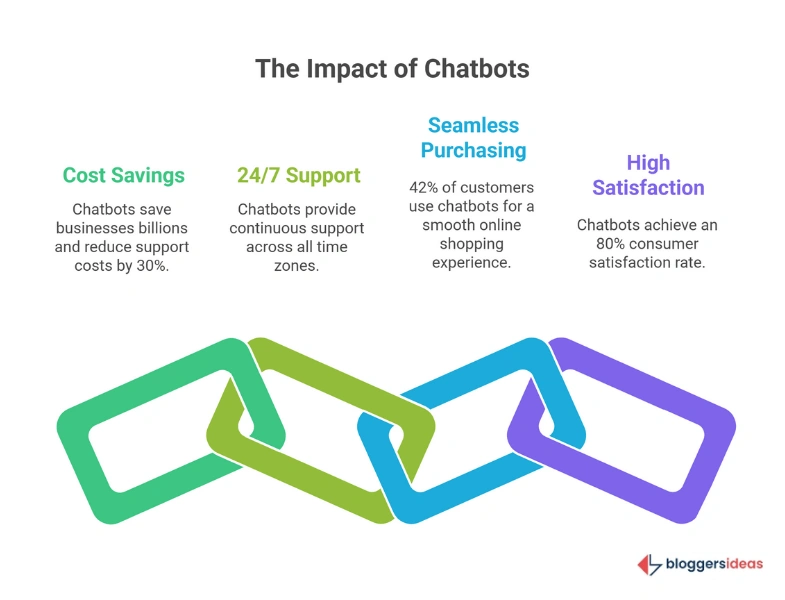
- Massive Cost Savings: The total cost savings realized from using chatbots reached an estimated $11 billion in 2022. Businesses can specifically save up to 30% on customer support costs alone by deploying chatbots. IBM estimates that chatbots replace potential chat support workers, saving businesses up to 30% in total costs.
- 24/7 Uninterrupted Support: Chatbots are uniquely designed to provide continuous 24/7 support to customers across all geographies, irrespective of time zone differences. This constant availability ensures that customer queries are addressed promptly, improving service delivery.
- Seamless Online Purchasing Experience: Almost 42% of potential customers actively use chatbots when purchasing products online, seeking a seamless service experience free from doubts or delays.
- High Consumer Satisfaction: The use of chatbots has resulted in an impressive 80% consumer satisfaction rate, largely because most chatbots are programmed to deliver accurate and consistent results.
- Customer Preference Over Human Agents: The majority of customers express a preference for interacting with a chatbot over a human corporate agent to resolve their queries, particularly for straightforward issues.
- Exceptional Response Rates: High-quality chatbots boast response rates of 80-90%, offering a seamless customer service experience that often surpasses the speed and consistency of human agents.
Chatbot Business Statistics: Driving Efficiency and Sales Growth
Chatbots are proving to be powerful assets for businesses, not only in monetary savings but also in optimizing time and enhancing sales capabilities.
- Significant Time Savings: Integrating chatbots into business operations can save an astonishing 2.5 billion working hours, which translates into substantial productivity gains alongside monetary benefits.
- Estimated Savings in Retail: Businesses and retail stores are projected to save $8 billion through reduced chat support costs, underscoring the financial leverage of chatbot adoption.
- Increased Sales for Businesses: A Drift study found that 55% of businesses saw increased sales when chatbots were actively used, underscoring their direct impact on revenue.
- Overwhelming Preference for Chatbots: Only a small minority, 9% of users, desire the elimination of chatbots from businesses, indicating a widespread preference for these automated tools among the vast majority of consumers.
- Customer Preference for Reservations: A study by Drift also found that 33% of customers prefer interacting with chatbots over phone calls for hotel, restaurant, and resort reservations, underscoring a preference for quick, automated booking processes.
- Instant Complaint Resolution: MIT Technology strongly believes that chatbots can resolve 90% of complaints instantly, provided the query is properly explained, demonstrating their efficacy in rapid problem-solving.
- Widespread Implementation Efforts: An impressive 80% of organizations are actively exploring ways to implement chatbots into their services, indicating a broad industry-wide movement towards chatbot integration.
Chatbot Customer Support Statistics: Personalization and Problem Solving
Chatbots are fundamentally transforming the landscape of customer support, offering personalized interactions and efficient problem-solving capabilities.
- Personalized Customer Support: A significant 64% of businesses trust chatbots to deliver more personalized customer support compared to traditional customer service methods.
- Customer Preference for Chatbot Communication: Approximately 34% of customers prefer communicating with a customer agent via a chatbot rather than by phone or in person.
- High Customer Satisfaction with Live Chat: Customer satisfaction ratings for live chat, which often incorporates chatbots, stand at a high 85%, second only to traditional phone support at 91%, indicating strong acceptance and effectiveness.
- Limitations in Complex Issue Resolution: While highly efficient for routine queries, some studies, such as those by NewVoiceMedia, suggest that most complex issues are not resolved instantly by chatbots and may require escalation to a human customer support agent.
- Customer Apathy Towards Agent Type: A notable 48% of customers express indifference as to whether their customer support is provided by a human agent with personality or an AI-powered chatbot, as long as their query is resolved efficiently.
- Cost Savings in Specific Sectors: Juniper Research predicts that the insurance sector alone will save up to $1.3 billion in the coming years by incorporating chatbots for more effective customer support, highlighting industry-specific financial benefits.
Chatbot Usage in Everyday Work Statistics: Enhancing Productivity
Chatbots are not only revolutionizing customer interactions but also permeating internal business operations, enhancing employee productivity and streamlining daily tasks.
- Primary Business Applications: Chatbots find their main applications in sales (41%) and customer support (37%), with marketing (17%) being the third most common area of use within businesses.
- White-Collar Employee Adoption: A significant 70% of white-collar employees actively use chatbots to efficiently manage daily tasks and projects, contributing to enhanced workplace productivity.
- Employee Focus on Strategic Tasks: According to SalesForce, 64% of employees report that chatbots allow them to concentrate on more strategic aspects of their work by handling routine customer support inquiries.
- Millennial Purchase Intent Driven by Chatbots: Chatbot Magazine predicts that 67% of US Millennials will make a purchase if the market utilizes chatbots to smooth out the user experience and suggest relevant offers, underscoring their influence on a key demographic.
- High Query Resolution Rate: Chatbots are projected to resolve more than 75% of users’ queries, demonstrating their increasing capability to act as primary contact points for support.
- Millennial Engagement for Deals and Discounts: A substantial 40% of millennials engage with chatbots specifically to discover deals, offers, and upcoming discounts from their desired stores or on specific products, highlighting a direct consumer benefit.
Global Chatbot Statistics: A World Embracing AI Conversations
The global adoption of chatbots is widespread, reflecting a universal shift towards automated, efficient digital interactions.
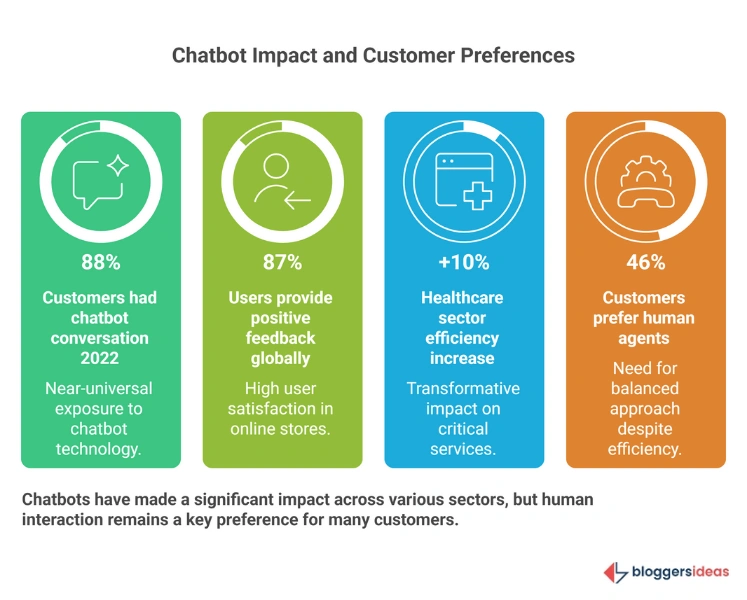
- Near-Universal Customer Interaction: In 2022, a remarkable 88% of customers had at least one conversation with a chatbot, indicating near-universal exposure to this technology.
- Overwhelmingly Positive Feedback: Globally, 87% of users provide positive feedback on chatbots in various online stores, with very few negative reviews, signaling high user satisfaction.
- Impact on Healthcare Sector: The healthcare sector experienced an instant 10% increase in efficiency and service delivery after incorporating chatbots, showcasing their transformative impact on critical services.
- Preference for Human Agents: Despite the efficiency of chatbots, a revealing 46% of customers still express a preference for human customer agents, even if chatbots offer time savings, suggesting a need for a balanced approach.
- Significant Investment in Chatbot Incorporation: An investment of $4.5 billion was made for the incorporation of chatbots across various sectors, primarily aimed at improving customer support, demonstrating substantial financial commitment.
- Projected Industry Value: The chatbot industry is forecasted to reach a whopping $994 million by 2024, highlighting its robust economic trajectory.
- Global Usage for Customer Support: At least 67% of the global population has utilized chatbots for customer support, emphasizing their broad acceptance as a primary channel for assistance.
- Blurring Lines Between AI and Human Interaction: A PwC study revealed that 27% of customers engaging with customer support are unaware if their conversation was with a chatbot or an actual human agent, underscoring the sophistication of modern AI.
- Projected Revenue Growth: Statista predicts that global chatbot revenue will hit $455 million by 2027, provided there is continuous adoption and integration of chatbot technology.
- User Confidence with Direct Brand Interaction: A Facebook survey found that 79% of users feel more confident when they interact directly with a brand’s human customer agent rather than a chatbot, suggesting a continued preference for direct human connection in certain contexts.
- Historical Revenue Growth: A throwback to 2018 by Kindly revealed that chatbot revenue was $41 million, showcasing the exponential growth in value compared to today’s figures.
- Focus on Chatbot Development: In 2021, most brands prioritized developing their chatbots over enhancing their mobile applications, as indicated by Gartner, reflecting a strategic shift towards conversational AI.
Challenges of Chatbot Usage: Areas for Improvement
While chatbots offer numerous benefits, acknowledging their limitations and addressing user concerns is crucial for their continued evolution and widespread acceptance.
- Understanding Complex Queries: A significant 60% of consumers are concerned that chatbots may not fully understand their complex queries, highlighting the need for more sophisticated natural language processing capabilities.
- Preference for Live Support: Even with faster service from chatbots, 46% of people would still prefer to receive live human support, especially for sensitive or intricate issues.
- Personal Information Storage Concerns: A troubling 25% of customers have reported instances where personal information, such as passwords or credit card numbers, was mistakenly stored by a chatbot, emphasizing critical security and privacy concerns.
- User Frustration with Chatbot Interactions: Over half of customers, 53%, have expressed frustration when interacting with a chatbot, indicating that imperfect implementations can negatively impact user experience.
- Limited Resolution for Specific Issues: Chatbots are highly effective in resolving 58% of returns and cancellations but are significantly less effective, resolving only 17% of billing disputes, as per Gartner, pointing to varying levels of capability across different types of inquiries.
What Do U.S. Citizens Think About Chatbot’s Impact On Jobs?
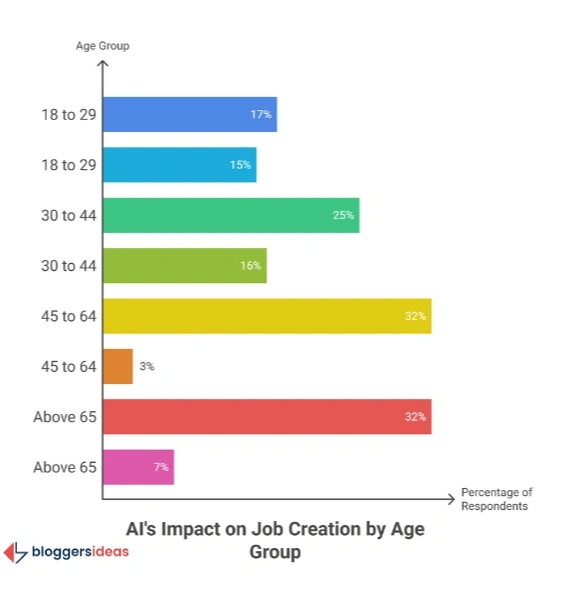
The increasing integration of AI chatbots into the workplace naturally sparks discussions about their impact on employment. While chatbots are automating many tasks traditionally performed by humans—including customer service, data entry, and scheduling—the situation is nuanced.
Some jobs may be displaced, but new roles, particularly for chatbot developers, trainers, and AI ethicists, are simultaneously emerging. Moreover, chatbots are freeing up human workers to concentrate on more strategic, creative, and complex tasks that require uniquely human skills.
AI Impact On Jobs: A Detailed Perspective from US Citizens
| Age Group | AI Will Create More Jobs (%) | AI Will Lessen The Number Of Jobs (%) |
| 18 to 29 | 17 | 15 |
| 30 to 44 | 25 | 16 |
| 45 to 64 | 3 | 23 |
| Above 65 | 3 | 27 |
These figures indicate a mixed perception, with younger demographics being more optimistic about job creation by AI, while older groups tend to foresee job displacement.
ChatGPT Statistics: The Global Leader in Conversational AI
ChatGPT has undeniably taken the world by storm since its launch in late 2022, rapidly establishing itself as the leading AI chatbot.
Its versatility extends beyond basic chatting to advanced applications like rephrasing, grammar checking, content generation, and even gaming.
The rollout of GPT-4 technology for ChatGPT Plus users has further expanded its capabilities, pushing the boundaries of what is possible with conversational AI.
- Massive User Base: ChatGPT boasts over 300 million (or 400 million by another source) monthly active users and an impressive 100 million weekly active users.
- Rapid Adoption: It surpassed 1 million users in less than a week of its official launch, demonstrating unprecedented initial uptake.
- Developer and Corporate Adoption: Over 2 million developers actively use ChatGPT, and more than 92% of Fortune 500 companies have integrated it into their operations.
- Web Traffic Dominance: ChatGPT’s website receives over 1 billion visits every month on average, accumulating over 16 billion all-time page visits, solidifying its position as a digital powerhouse.
- Revenue Projection: ChatGPT was forecasted to generate a substantial $1 billion in revenue in 2024, underscoring its significant commercial success.
Google Gemini Statistics (Formerly Bard): A Formidable Competitor
Google Gemini, previously known as Bard, represents ChatGPT’s primary competitor, integrating the features of both Bard and Deut AI. It leverages Google’s advanced LaMDA (Language Models for Dialog Applications) conversation technology, positioning itself as a strong contender in the AI chatbot market.
- Significant Monthly Visits: Gemini averages 330.9 million monthly visits (or 124.8 million by another source), indicating its substantial engagement.
- Extensive Training Data: It is trained on an immense dataset of 1.56 trillion words and 137 billion parameters, contributing to its sophisticated conversational abilities.
- Geographic Traffic Distribution: The majority of Google Gemini’s traffic originates from the United States (37.24%), followed by India (9.56%), and Japan (6.67%).
- Direct Traffic Dominance: A significant 76.74% of Bard’s traffic comes from direct sources, highlighting strong brand recognition and user intent.
- Social Media Traffic from YouTube: Among all social media platforms, YouTube sends the most traffic to Google Gemini, reflecting its integration with Google’s vast ecosystem.
- Global Availability: Google Gemini is available in over 239 countries and territories worldwide, ensuring broad accessibility.
What Users Are Asking on Quora and Reddit: Emerging Chatbot Frontiers
The dynamic conversations on platforms like Quora and Reddit reveal nuanced user concerns and forward-looking questions about chatbots:
- “How can I ensure my chatbot sounds natural and not robotic?” This question frequently appears, indicating a strong user desire for more human-like, empathetic, and context-aware conversational experiences, moving beyond rigid scripts.
- “What are the ethical implications of using AI chatbots for sensitive customer data?” Privacy, data security, and the responsible handling of personal information are paramount concerns. Users are seeking assurances and best practices for ethical AI deployment, especially regarding data storage and potential misuse.
- “Can chatbots truly understand complex emotional states or sarcasm?” This highlights the limitations of current AI in interpreting subtle human communication nuances. Users are curious about advancements in emotional intelligence and intent recognition to handle more delicate interactions effectively.
- “How do I prevent my chatbot from becoming a ‘black box’ that I can’t control or understand?” This points to a demand for transparency and interpretability in AI. Businesses want to understand how chatbots arrive at their responses and have mechanisms for fine-tuning their behavior and correcting errors.
- “What are the best strategies for integrating chatbots with existing CRM and ERP systems for a truly unified customer view?” This reflects a growing need for seamless integration into existing business ecosystems, moving beyond standalone chatbots to those that can access, update, and leverage customer data across all touchpoints for a holistic view.
These questions underscore a shift towards more sophisticated, ethical, and deeply integrated chatbot solutions, emphasizing user experience, data integrity, and strategic business alignment.
FAQs About Chatbot Statistics
1. What is driving the significant growth of the chatbot market towards $10.32 billion by 2025?
The chatbot market’s growth is driven by rising demand for automated customer service, advancements in AI and machine learning, the need for operational efficiency, omnichannel support, and the focus on personalized customer experiences.
2. How are chatbots helping eCommerce businesses reduce cart abandonment and increase revenue?
Chatbots reduce cart abandonment by engaging customers with reminders, personalized incentives, and answering questions, boosting conversion rates by 30% and increasing revenue by 7-25% for businesses using them.
3. What are the primary benefits for businesses implementing chatbots beyond just cost savings?
Businesses enjoy benefits such as 24/7 support, 80% customer satisfaction, increased sales (55% of businesses report this), and improved operational efficiency, allowing employees to focus on strategic tasks.
4. Are customers generally satisfied with chatbot interactions, or do they still prefer human agents for most queries?
87% of users are satisfied with chatbots, especially for quick resolutions. However, 46% prefer human agents for complex issues, and 27% can’t tell if they interacted with a bot or human, indicating growing chatbot sophistication.
5. How are AI chatbots impacting employment, and what are the future job implications?
Chatbots may displace jobs in areas like customer service, but they also create new roles in AI development and ethical oversight, shifting job functions to more strategic, creative, and emotionally intelligent tasks.
Also Read:
- YouTube Statistics
- Microsoft Teams Statistics
- Google Gemini Statistics
- Apple Music Statistics
- Podcast Statistics
Conclusion:
Chatbots are undeniably at the forefront of shaping the future of business and customer interactions. The market is not just growing; it is exploding, with projections placing the chatbot market value at $10.32 billion by 2025 and an impressive $29.5 billion by 2029.
This rapid expansion is a testament to their proven efficacy and the increasing reliance on AI-driven solutions across industries.
With over 987 million people actively engaging with AI chatbots, these tools have become an indispensable component for businesses worldwide.
By 2027, a significant 25% of all companies will be depending on chatbots as a primary customer interaction channel, and they are already adept at handling a remarkable 70% of customer conversations independently.
Beyond customer-facing roles, chatbots are delivering tangible internal benefits, capable of saving businesses up to 2.5 billion working hours.
As advancements in AI and machine learning continue to accelerate, chatbots are poised to assume an even more central role in driving business efficiency, elevating customer engagement, and boosting overall productivity, cementing their status as a cornerstone of the modern digital enterprise.
