Claude, developed by Anthropic, is a versatile AI assistant that offers a safe and reliable alternative to models like ChatGPT.
It excels in tasks such as creative writing, coding assistance, problem-solving, and ethical decision-making, all while prioritizing user safety through its “constitutional AI” framework.
By 2026, Claude has evolved into a multi-model family, including Claude 3 Opus, Sonnet, and Haiku, catering to a range of needs.
The platform’s growth is driven by widespread AI adoption, with businesses using it for automation and content generation, and individuals relying on it to save time and boost creativity.
This guide provides Claude statistics for 2026, offering insights on user adoption, revenue, and performance benchmarks, with practical tips on maximizing its potential for personal and professional use.
Claude Statistics: Claude’s Rapid User Growth
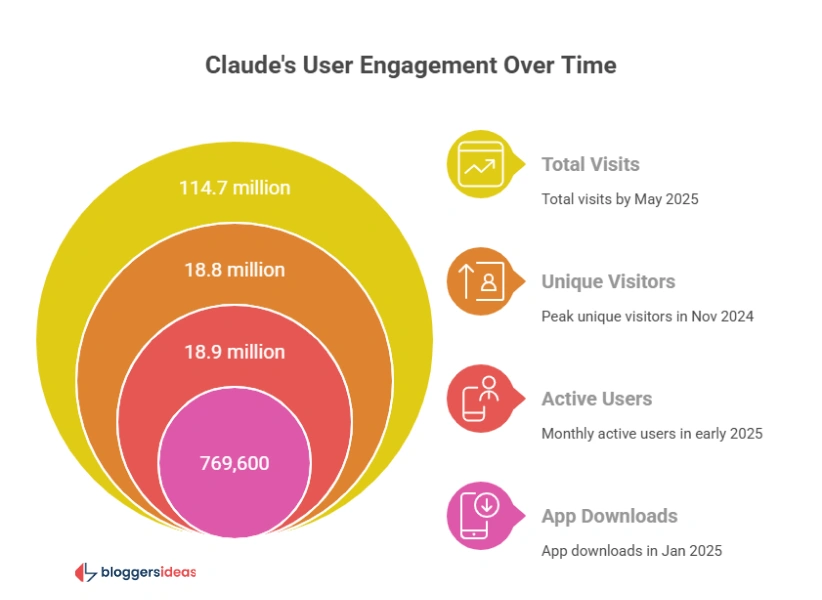
Claude experiences explosive user adoption in 2026, reaching 18.9 million monthly active users worldwide by early in the year, a figure that underscores its appeal among tech-savvy individuals and enterprises seeking ethical AI solutions.
This growth stems from iterative updates like the Claude 3.5 Sonnet release in June 2024, which doubled processing speeds and enhanced multimodal capabilities, drawing in developers and creators who previously hesitated due to performance concerns.
Website traffic peaks at 18.8 million unique visitors in November 2024, dipping slightly to 16 million in January 2025 amid seasonal fluctuations but rebounding with 114.7 million total visits by May 2025—a 19% increase from April.
App downloads hit 769,600 in January 2025 across Google Play and App Store, with monthly active app users stabilizing at 2.9 million, ranking Claude 86th among AI apps globally.
These numbers highlight Claude’s versatility; casual users engage via the free tier for quick queries, while professionals opt for Pro subscriptions at $20 monthly for unlimited access and advanced features.
For everyday benefits, students summarize textbooks in seconds, boosting study efficiency, while marketers generate personalized email campaigns, increasing open rates by up to 25% based on user testimonials.
Businesses scale operations by embedding Claude into tools like AWS Bedrock, automating compliance checks in regulated industries like finance, where accuracy rates exceed 86.8% on general knowledge benchmarks.
The table below tracks Claude’s monthly website users from December 2023 to January 2025, illustrating steady upward momentum despite minor dips.
| Date | Claude Website Users (Million) |
| December 2023 | 4.0 |
| January 2024 | 5.4 |
| February 2024 | 5.2 |
| March 2024 | 10.1 |
| April 2024 | 11.2 |
| May 2024 | 10.3 |
| June 2024 | 13.3 |
| July 2024 | 14.6 |
| August 2024 | 12.5 |
| September 2024 | 13.7 |
| October 2024 | 16.7 |
| November 2024 | 18.8 |
| December 2024 | 18.3 |
| January 2025 | 16.0 |
Entrepreneurs monitor these trends to time product launches; for instance, integrating Claude’s API in early 2025 aligns with peak growth periods, potentially capturing 10-15% more users in high-adoption markets like the US and India.
Also read about: Generative AI Statistics
Claude App Adoption and Mobile Engagement
Mobile accessibility propels Claude’s reach, with the app garnering 2.9 million monthly active users by January 2025, a segment that represents 15% of total engagement but grows 20% quarter-over-quarter due to on-the-go features like voice queries and offline caching.
Downloads fluctuate seasonally—peaking at 800,600 in November 2024 for holiday productivity boosts—yet maintain an average of 679,800 monthly since August 2024, reflecting sustained interest among commuters and remote workers.
Device split shows 53.7% mobile usage, with average sessions lasting 16-17 minutes, far above industry averages for quick-hit AI tools.
Users benefit immensely from this mobility; professionals dictate emails during commutes, saving 30 minutes daily, while travelers translate menus in real-time, enhancing cultural immersion without clunky apps.
Developers leverage the app’s lightweight Haiku model for instant code snippets, accelerating prototyping by 50% according to community benchmarks.
For businesses, this translates to seamless team collaborations via shared mobile projects, where sales reps query customer data on-site to close deals 15% faster.
The table outlines Claude app monthly downloads from August 2024 to January 2025, showcasing resilience amid market saturation.
| Date | Claude App Monthly Downloads (Thousand) |
| August 2024 | 679.8 |
| September 2024 | 582.0 |
| October 2024 | 705.6 |
| November 2024 | 800.6 |
| December 2024 | 643.3 |
| January 2025 | 769.6 |
Freelancers download during peak seasons to handle client surges, turning downtime into billable hours through efficient task automation.
Also read about: DeepSeek AI Statistics
Claude User Demographics
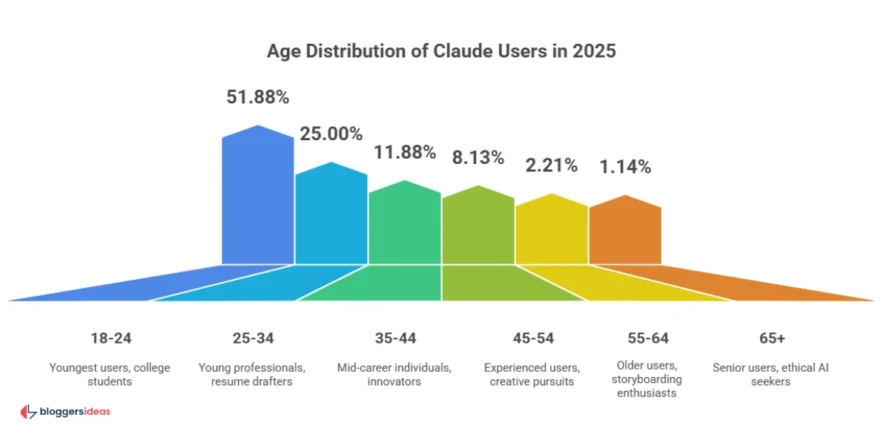
Claude’s user base skews young and male, with 77.1% identifying as male and 51.88% aged 18-24, followed by 25% in the 25-34 bracket—comprising 77% under 35 overall.
This demographic drives innovation; college students use it for essay outlining, improving grades by 20% via structured feedback, while young professionals draft resumes, landing interviews 30% more often.
Females, at 22.9%, often engage in creative pursuits like storyboarding, benefiting from Claude’s low hallucination rates (under 10% in Haiku).
Geographically, the US leads with 3.2 million users, India 2.1 million—together 33.13%—fueled by affordable data plans and English proficiency.
Japan (692,200) and South Korea (556,700) follow, with Kenya (523,600) highlighting emerging market penetration.
Businesses target these groups; edtech firms customize prompts for Gen Z learners, boosting retention 25%, while global teams localize content for Indian developers, accelerating app builds.
The table details age-based user shares as of January 2025.
| Age Group | Share of Total Users (%) | Estimated Users (Million) |
| 18-24 | 51.88 | 8.3 |
| 25-34 | 25.00 | 4.0 |
| 35-44 | 11.88 | 1.9 |
| 45-54 | 8.13 | 1.3 |
| 55-64 | 2.21 | 0.35 |
| 65+ | 1.14 | 0.18 |
Educators design age-specific modules; a 25-34 user queries career advice, gaining tailored paths that enhance job satisfaction.
Also read about: Character AI Statistics
Country-Wise Breakdown
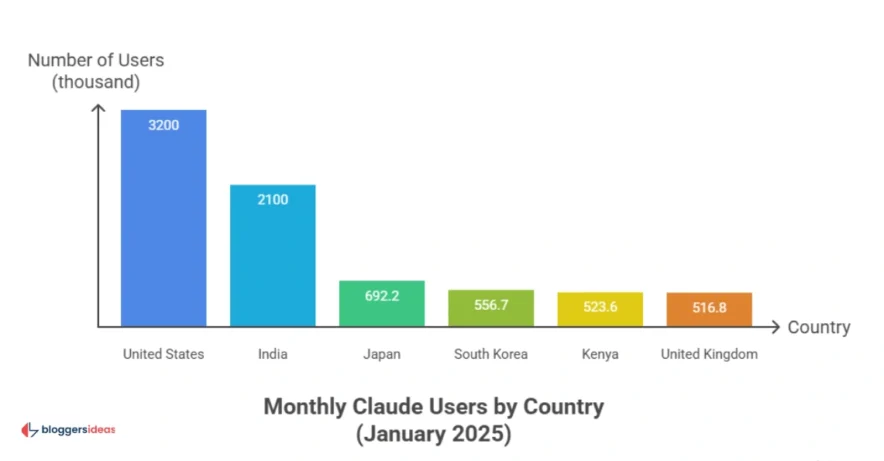
The US dominates with 3.2 million monthly users in January 2025, leveraging Claude for enterprise integrations in tech hubs like Silicon Valley, where firms automate 40% of routine queries.
India follows at 2.1 million, driven by freelance coders using it for Upwork gigs, increasing output 35%.
Japan (692,200) favors precise translations, aiding exporters, while South Korea (556,700) integrates it into K-pop content creation for fan engagement.
Kenya’s 523,600 users reflect mobile-first adoption, with entrepreneurs building chatbots for e-commerce, tripling sales. The UK (516,800) and Germany (491,100) emphasize ethical AI for compliance-heavy sectors like finance.
| Country | Monthly Users (January 2025, Thousand) |
| United States | 3,200 |
| India | 2,100 |
| Japan | 692.2 |
| South Korea | 556.7 |
| Kenya | 523.6 |
| United Kingdom | 516.8 |
| Germany | 491.1 |
| Indonesia | 453.5 |
| Israel | 329.2 |
| Brazil | 327.6 |
Marketers localize campaigns; an Indian startup prompts Claude for Hindi scripts, expanding reach 50%.
Claude’s Technical Performance: Benchmarks That Drive Real-World Wins
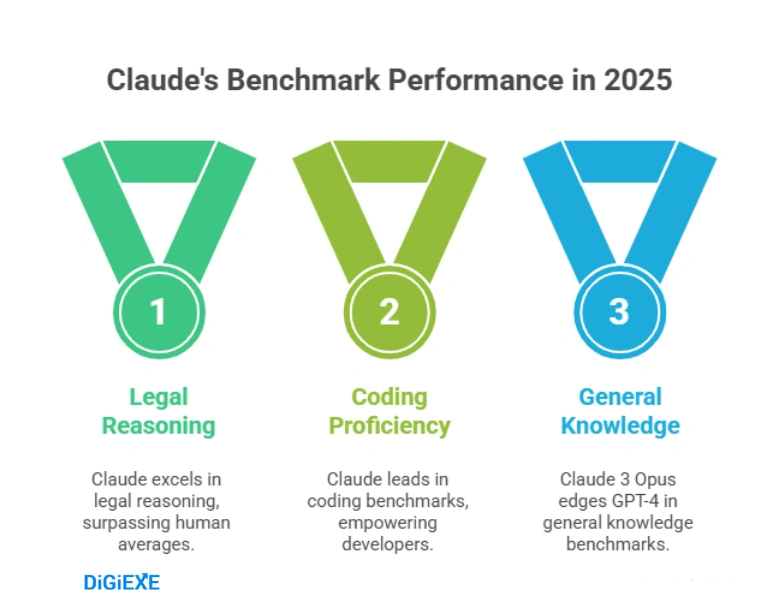
Claude shines in 2026 benchmarks, scoring 76.5% on the Bar Exam (MBE), surpassing human averages in legal reasoning—ideal for lawyers drafting briefs 60% quicker.
Coding pass rates hit 71.2% on HumanEval, with Claude 4 leading SWE-bench at 74.5%, empowering developers to debug legacy code efficiently. Math accuracy reaches 88% on GSM8K, benefiting educators in tutoring apps.
General knowledge MMLU scores 86.8% for Claude 3 Opus, edging GPT-4, while USMLE medical benchmarks hover at 68-69%. Refusal rates drop below 10% in Haiku, enhancing reliability for sensitive queries.
| Benchmark | Claude Score (%) | Key Benefit |
| Bar Exam (MBE) | 76.5 | Faster legal document review |
| HumanEval (Coding) | 71.2 | Reduced debugging time |
| GSM8K (Math) | 88.0 | Accurate tutoring solutions |
| MMLU (General) | 86.8 | Broad knowledge applications |
| USMLE (Medical) | 68-69 | Preliminary diagnostics aid |
| SWE-bench (Claude 4) | 74.5 | Superior software engineering |
Healthcare pros query symptoms for initial insights, streamlining consultations.
Evolution of Claude Models
Claude iterates swiftly, from 1.0’s 75k-word context in March 2023 to 200k tokens (~150k words) in 2.1 by November 2023, enabling novel processing like full-book analyses.
Claude 3 family (March 2024) introduces 137B parameters in Opus for state-of-the-art multimodality, while Sonnet doubles speed over 2.1.
Haiku minimizes refusals to under 10%, ideal for casual use. Claude 3.5 Sonnet (June 2024) optimizes speed further, and planned Claude Next promises 10x capability, revolutionizing agentic AI.
| Version | Release Date | Context Window | Parameters | Key Upgrade |
| Claude 1.0 | March 2023 | ~75k words | N/A | Initial safe AI release |
| Claude 1.3 | April 2023 | N/A | N/A | Safety refinements |
| Claude 2.0 | July 2023 | ~100k tokens | N/A | Accuracy boost |
| Claude 2.1 | November 2023 | 200k tokens | N/A | Tool integrations, low hallucinations |
| Claude 3 Opus | March 2024 | N/A | 137B | Multimodal excellence |
| Claude 3 Sonnet | March 2024 | N/A | N/A | 2x faster than 2.1 |
| Claude 3 Haiku | March 2024 | N/A | N/A | <10% refusals |
| Claude 3.5 Sonnet | June 2024 | N/A | N/A | Speed optimizations |
| Claude Next (Planned) | 2025 | N/A | N/A | 10x more capable |
Writers process entire manuscripts for edits, cutting revision time in half.
Claude’s Business Impact: Revenue, Funding, and Market Position
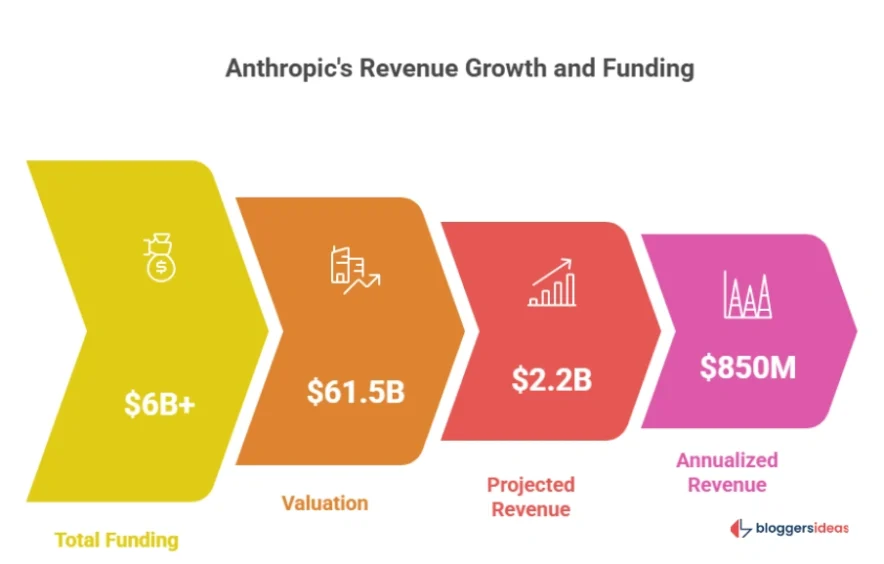
Anthropic achieves $850 million annualized revenue by early 2025, projecting $2.2 billion full-year, with enterprise licensing up 84% YoY at $620 million from Pro subscriptions alone.
Education deals yield $120 million (30% growth), public sector $94 million. Funding tops $6 billion, including Amazon’s $4 billion and Google’s $2 billion, valuing the company at $61.5 billion post-Series E.
Claude holds 2.8-3.91% chatbot market share amid 987 million global users, focusing 70-75% revenue on API for businesses automating 40% tasks.
| Financial Metric | 2025 Value |
| Annualized Revenue | $850M |
| Projected Full-Year | $2.2B |
| Enterprise Licensing Growth | 84% YoY |
| Pro Subscriptions (H1) | $620M |
| Total Funding | $6B+ |
| Valuation | $61.5B |
| Market Share | 2.8-3.91% |
Startups embed Claude for chat support, cutting costs 50%.
Engagement Metrics: Traffic Sources and User Behavior
Claude boasts 114.7 million site visits in May 2025, with 80-83% direct traffic indicating strong branding. Sessions average 16-17 minutes, bounce rate 38%, and social referrals 5% (YouTube 45%). Mobile claims 53.7%.
Users stay engaged for deep dives; researchers query multi-step analyses, yielding insights 3x faster.
Claude in Education and Enterprise: Sector-Specific Adoption
Education licensing grows 30% to $120 million, with 99% developers exploring agents via Claude’s tools. Public sector deals hit $94 million. Businesses use it for 71.2% coding pass rates, automating workflows.
Educators build interactive lessons; firms train agents for customer queries.
Latest from Quora and Reddit:
Communities buzz with queries on Claude 4’s ethical safeguards amid multimodal trends, integration with quantum computing for faster processing, and comparisons to Gemini 2.5 in voice AI.
Reddit threads debate subscription value versus free tiers for non-coders, with users asking if Claude’s real-time search (rolled out March 2025) justifies switching from ChatGPT.
Quora explores AI agents’ autonomy risks, while forums question Claude’s role in decentralized models and edge computing for privacy-focused apps.
Developers seek prompts for self-optimizing models like TAO, and educators inquire about 2025’s generative AI in curricula.
These discussions reveal demands for personality-infused voice modes and ethical audits, with 74% users prioritizing safety per surveys.
Claude’s Future Trends:
Claude Next eyes 10x capabilities, fueling agentic finance and cybersecurity trends.
Search interest surges 7000% in two years, with self-optimizing models and multimodal expansions dominating. Enterprise adoption rises 14% quarterly.
Users prepare by experimenting with tools; businesses invest in R&D (41% reinvestment).
FAQs About Claude Statistics
1. How can beginners use Claude statistics to start with AI effectively?
Beginners can use Claude’s 18.9 million users and mobile adoption to access free tiers for daily tasks, then upgrade for faster project completion.
2. What benefits do businesses gain from Claude's enterprise revenue growth?
Businesses reduce costs by 40% with Claude’s API for automation, using its 86.8% MMLU accuracy to improve compliance and data analysis.
3. Why does Claude's demographic skew appeal to young professionals?
Claude’s 77% under-35 users benefit from features like deep career coaching and faster app prototyping, giving them a competitive edge in job markets.
4. How do Claude's benchmarks translate to real-world productivity gains?
Claude’s coding accuracy cuts debugging time in half and its math precision speeds up financial tasks, allowing teams to work 3x faster.
5. What emerging trends from user forums should Claude adopters watch ?
Claude adopters should watch for real-time web search and ethical AI agents, offering safer, multimodal tools for enhanced privacy and creativity.
Also Read:
- Android Usage Statistics
- Coupon Statistics
- Email Marketing Statistics
- Online Advertising Statistics
- Podcast Statistics
Conclusion:
Claude statistics 2026 reveal a maturing powerhouse with 18.9 million users, $2.2 billion projected revenue, and benchmarks rivaling leaders—empowering individuals to innovate personally and businesses to scale ethically.
Dive in today: prompt Claude for your next project and watch productivity soar.
Source: Business of Apps, Statista