
The year 2025 has undoubtedly marked a pivotal moment for artificial intelligence, with DeepSeek AI emerging as a significant disruptor.
DeepSeek AI, a Chinese startup founded in 2023, has rapidly captivated global attention. Its public release of DeepSeek R-1 in January 2025 sent ripples through the tech community, immediately drawing comparisons to established giants like OpenAI’s ChatGPT.
This comprehensive article delves into the latest statistics, trends, and projections surrounding DeepSeek AI, providing an in-depth understanding of its current standing and its trajectory for the future.
We will explore how this innovative platform is attracting millions of users, impacting the AI landscape, and offering compelling benefits to its ever-growing user base.
DeepSeek AI Statistics: The Meteoric Rise of DeepSeek AI
DeepSeek AI’s rise from a modest 7,475 daily visitors in August 2024 to 22.15 million in May 2025 showcases its rapid growth and global appeal.
With over 57.2 million downloads across Google Play and the App Store, including 3 million downloads within the first two weeks of the January 2025 release, the app has made a significant impact.
By April 2025, DeepSeek AI reached 96.88 million monthly active users, a 25.81% increase from March, making it the fourth most popular AI app globally. This growth highlights DeepSeek AI’s seamless integration into millions of daily lives.
Understanding the DeepSeek AI User Demographics: A Young and Global Audience
DeepSeek AI has particularly resonated with a younger demographic, indicating its appeal to the generation that actively embraces new technologies.
Analysis of user demographics reveals a significant concentration of users in the 18-24 age group. Among iOS users, this age bracket constitutes 38.7% of the total, while for Android users, it is even higher at 44.9%.
This strong engagement from younger individuals suggests that DeepSeek AI is successfully capturing the attention of the next wave of AI users.
Here is a detailed breakdown of DeepSeek user demographics by age group across iOS and Android platforms:
| Age Group | iOS Users | Android Users |
| 18-24 | 38.7% | 44.9% |
| 25-34 | 22.1% | 13.2% |
| 35-49 | 15.3% | 14.9% |
| 50-64 | 23.3% | 26.1% |
| 65+ | 0.6% | 1% |
Source: Statista
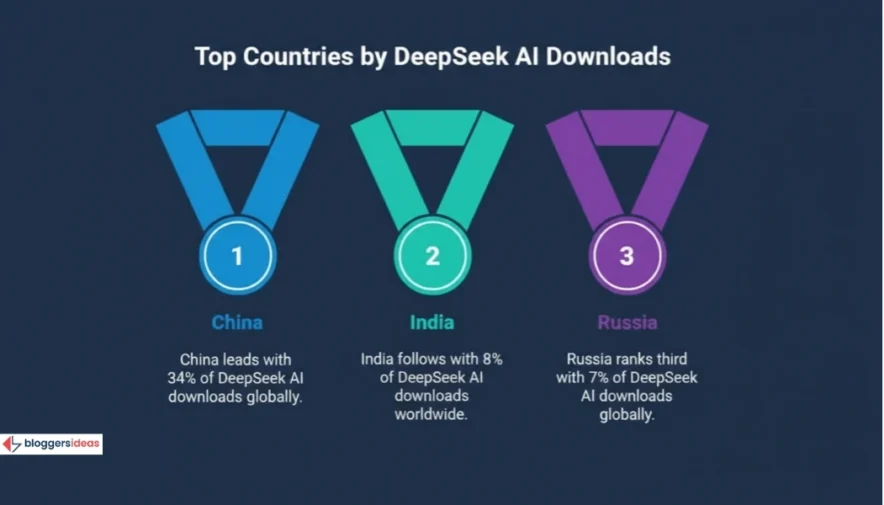
Beyond age, the geographical distribution of DeepSeek AI’s users highlights its growing global footprint. China leads in iOS app downloads, accounting for a substantial 30.71% of the total, followed by India at 13.59%.
Other nations such as Russia, Saudi Arabia, and Brazil are also demonstrating strong adoption, signifying DeepSeek AI’s expanding international reach.
Examining the monthly active user share by country further emphasizes its global adoption:
| Country | Share of Total |
| China | 30.71% |
| India | 13.59% |
| Indonesia | 6.94% |
| The United States | 4.34% |
| France | 3.21% |
Similarly, download statistics by country reveal a similar pattern, with China representing the largest portion of DeepSeek downloads at 34%.
The United States follows with 6%, and France with 3%. These statistics collectively paint a picture of DeepSeek AI as a globally impactful platform, particularly strong in Asian markets but steadily gaining traction in Western countries.
Also read about: ChatGPT Statistics
The Performance and Power of DeepSeek AI: Technical Prowess and Cost-Efficiency
DeepSeek AI’s impressive user growth is underpinned by its robust technical capabilities and remarkable cost-efficiency. The platform’s models are trained on an immense dataset of 14.8 trillion tokens, showcasing a commitment to comprehensive learning.
This intensive training required approximately 2.788 million H800 GPU hours, utilizing around 2,000 Nvidia H800 chips. Such substantial computational power highlights the advanced infrastructure supporting DeepSeek AI’s development.
One of the most compelling aspects of DeepSeek AI is its reported cost-effectiveness. The third version of DeepSeek (DeepSeek-V3) cost an estimated $5.5 million to create.
This figure is astonishing when compared to the development cost of OpenAI’s GPT-4, which is approximately 18 times higher. This ability to achieve powerful AI capabilities with significantly fewer resources has been a major talking point and a key differentiator for DeepSeek AI.
DeepSeek AI models also demonstrate impressive memory and response generation capabilities. The platform can remember up to 128,000 tokens at once, enabling it to process and understand exceptionally long pieces of text. In response, it can generate up to 8,000 tokens in a single output, facilitating detailed and extensive interactions.
The platform’s performance metrics further illustrate its rapid ascent. DeepSeek AI’s website traffic experienced explosive growth, particularly in January 2025. The monthly breakdown of traffic value and average daily visitors clearly illustrates this trend:
| Month | Avg Daily Visitors | Traffic Value ($) |
| Aug 2024 | 12,473 | $6,571 |
| Sept 2024 | 14,891 | $12,044 |
| Oct 2024 | 14,753 | $14,302 |
| Nov 2024 | 13,089 | $20,486 |
| Dec 2024 | 17,825 | $31,246 |
| Jan 2025 | 73,493 | $89,147 |
| Feb 2025* | 97,193 | $103,459 |
Source: eMarketer
*February data is partial (first week only)
This dramatic increase, with traffic growing by 312% in January 2025 compared to December 2024, directly coincided with the DeepSeek R1 release.
The value of DeepSeek’s organic traffic, if acquired through paid advertising, also saw a substantial increase from approximately $2,800 per day to over $100,000 per day in January 2025, highlighting its significant market impact.
Also read about: Meta AI Statistics
DeepSeek AI vs. OpenAI: A Head-to-Head Comparison
One of the most intriguing aspects of DeepSeek AI’s rise is its direct comparison to established industry leaders like OpenAI. DeepSeek AI has demonstrated its ability to perform on par with, and in some cases even surpass, OpenAI’s models in various benchmarks.
In mathematical reasoning tasks, DeepSeek AI has shown particularly strong performance:
- AIME 2024: DeepSeek (79.8%) vs. OpenAI (79.2%)
- MATH-500: DeepSeek (97.3%) vs. OpenAI (96.4%)
These results indicate that DeepSeek AI is not just a low-cost alternative but a formidable competitor in core AI functionalities.
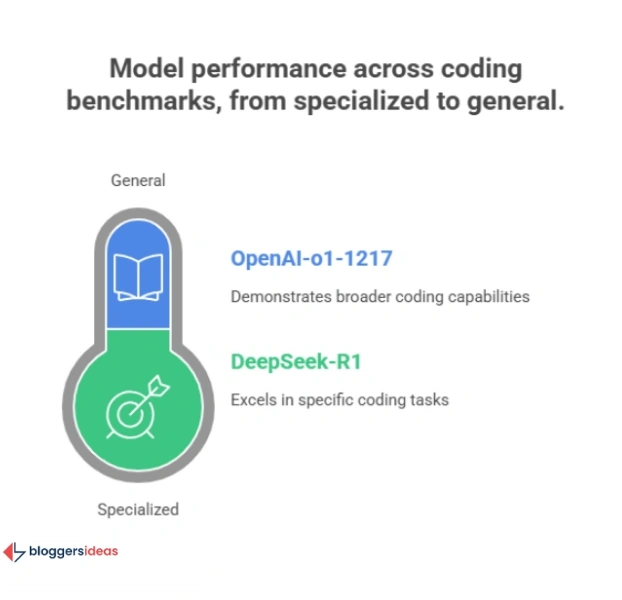
A closer look at coding benchmarks provides a more nuanced comparison between DeepSeek-R1 and OpenAI-o1-1217:
| Benchmark | DeepSeek-R1 | OpenAI-o1-1217 | Winner |
| LiveCodeBench | 65.9% | 63.4% | DeepSeek |
| Codeforces Rating | 2029 | 2061 | OpenAI |
| Codeforces Percentile | 96.3% | 96.6% | OpenAI |
| SWE Verified | 49.2% | 48.9% | DeepSeek |
| Aider-Polyglot | 53.3% | 61.7% | OpenAI |
DeepSeek-R1 outperforms OpenAI-o1-1217 in 2 out of 5 coding benchmarks (40%), leading in LiveCodeBench (65.9% vs. 63.4%) and SWE Verified (49.2% vs. 48.9%). This suggests stronger general coding performance for DeepSeek-R1.
Conversely, OpenAI-o1-1217 secures victories in 3 out of 5 benchmarks (60%), including Codeforces Rating (2061 vs. 2029), Codeforces Percentile (96.6% vs. 96.3%), and Aider-Polyglot (61.7% vs. 53.3%), indicating better multilingual coding capabilities and a slight edge in competitive programming contexts.
The near-identical performance in SWE Verified, with only a 0.3% difference, underscores the close competition between these two powerful AI models.
The DeepSeek AI Cost Advantage: Unbeatable Affordability
DeepSeek AI’s development cost, estimated to be under $10 million, stands in stark contrast to that of many other AI companies with comparable capabilities.
This cost-efficiency translates directly into significantly lower operational costs, making DeepSeek AI an exceptionally attractive option for developers and businesses.
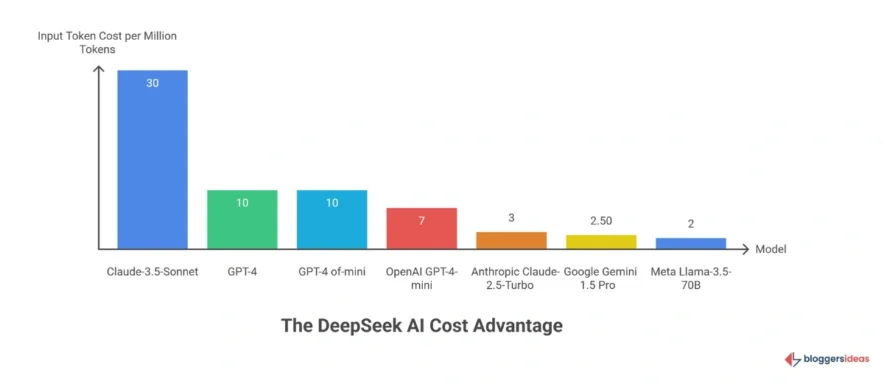
When examining input token costs, DeepSeek-V3 emerges as the most cost-efficient model available:
| Model | Input Token Cost per Million Tokens |
| Claude-3.5-Sonnet | $30.00 |
| GPT-4 | $10.00 |
| GPT-4 of-mini | $10.00 |
| OpenAI GPT-4-mini | $7.00 |
| Anthropic Claude-2.5-Turbo | $3.00 |
| Google Gemini 1.5 Pro | $2.50 |
| Meta Llama-3.5-70B | $2.00 |
| Meta Llama-2.0-70B | $1.00 |
| Meta Llama-2.0-110B | $0.70 |
| Amazon Nova-SageMaker Pro | $0.30 |
| OpenAI GPT-3.5 | $0.10 |
| OpenAI GPT-4 Mini | $0.07 |
| Mistral-Medium-Small-2k109 | $0.04 |
| DeepSeek-V3 | $0.01 |
DeepSeek-V3, at a mere $0.01 per million input tokens, significantly undercuts its competitors, making advanced AI more accessible than ever before.
Similarly, DeepSeek models (DeepSeek-V3 and DeepSeek-R1) offer highly competitive output token costs:
| Model | Output Cost per Million Tokens |
| OpenAI GPT-4 | $30.00 |
| OpenAI GPT-4-preview | $30.00 |
| Claude-3.5-Sonnet | $30.00 |
| OpenAI GPT-4-Turbo | $15.00 |
| GPT-4 | $10.00 |
| Google Gemini 1.5 Pro | $10.00 |
| Google Gemini 1.5 Flash | $7.00 |
| OpenAI GPT-4-mini | $3.00 |
| Meta Llama-3.5-70B | $2.00 |
| Meta Llama-2.0-70B | $1.00 |
| Meta Llama-2.0-110B | $0.70 |
| Amazon Nova-SageMaker Pro | $0.30 |
| Cohere Command | $0.30 |
| Mistral-Medium-Small-2k109 | $0.28 |
| DeepSeek-V3 | $0.28 |
| DeepSeek-R1 | $0.28 |
At $0.28 per million output tokens, DeepSeek AI models are among the most affordable options, challenging high-end models that charge $30 per million tokens generated. This significant cost advantage positions DeepSeek AI as a powerful tool for businesses and individuals seeking to leverage advanced AI without incurring prohibitive expenses.
The “DeepSeek 2025 Controversy”: A Market Shaker
DeepSeek AI’s emergence has not been without controversy, particularly concerning its impact on the hardware market.
The company gained significant attention for developing an AI that did not necessitate the latest, most expensive chips, yet rivaled the capabilities of models from Google and OpenAI.
This achievement, accomplished on a budget of under $10 million, contrasted sharply with the massive investments made by its US competitors.
This revelation sent shockwaves through the tech industry, notably causing Nvidia’s stock to crash. The incident wiped out an estimated $600 billion in market value (a 17% drop), leading to widespread investor concern about the future demand for high-end AI chips.
Interestingly, prior to export bans, DeepSeek had strategically stockpiled 10,000 Nvidia A100 GPUs, securing long-term access to high-performance computing resources and demonstrating foresight in its resource management.
Navigating Challenges: Security Concerns and International Relations
Despite its remarkable growth, DeepSeek AI faces challenges, particularly regarding security and international regulations.
Reports of cyberattacks have led DeepSeek to restrict new registrations, indicating potential security vulnerabilities that the company must address to maintain user trust and ensure data integrity.
Furthermore, several countries have expressed security concerns, leading to bans or restrictions on DeepSeek AI’s use. Italy removed it from app stores following a privacy probe.
Taiwan and Australia have banned its use in government agencies, and South Korea has restricted it across key ministries. The U.S. Congress, Navy, Pentagon, NASA, and the state of Texas have also blocked or limited its deployment.
These restrictions highlight the complex geopolitical landscape in which AI companies operate and the need for DeepSeek AI to navigate international regulations and privacy concerns meticulously as it pursues global expansion.
Investing in DeepSeek AI: A Look at its Private Status
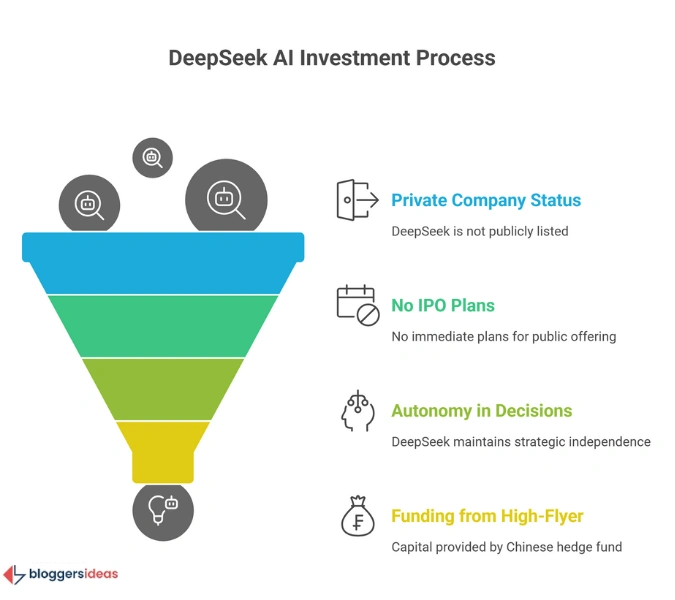
For those interested in capitalizing on DeepSeek AI’s success, it is important to note that DeepSeek is currently a private company. This means it is not yet listed on public stock exchanges, and therefore, individuals cannot invest in DeepSeek stock.
There is currently no indication that the company plans an initial public offering (IPO) in the near future. This private status allows DeepSeek to maintain a degree of autonomy in its development and strategic decisions without the immediate pressures of public market scrutiny.
The company receives funding from High-Flyer, a Chinese hedge fund, which provides the necessary capital for its ambitious research and development initiatives.
The Future of DeepSeek AI: Predictions and Possibilities
DeepSeek AI’s future appears exceptionally promising, driven by its powerful capabilities and unparalleled cost-effectiveness. Its affordability makes it an attractive tool across diverse sectors, including healthcare, finance, customer service, and education.
By lowering the barrier to entry for advanced AI, DeepSeek AI has the potential to democratize access to cutting-edge technology, fostering innovation and efficiency in numerous industries.
However, to sustain its leadership, DeepSeek AI must continue to evolve and introduce advanced features. The development of multimodal support, encompassing text, voice, natural language processing for humanization, and AI image generation, will be crucial.
Addressing Quora and Reddit discussions, users are increasingly asking for more intuitive conversational abilities and the seamless integration of visual content creation.
For example, many users want DeepSeek AI to generate high-quality images directly from text prompts, as it does with written language. This functionality would significantly expand its utility and appeal.
If DeepSeek AI maintains its leadership in open AI development, it could play a pivotal role in establishing standards for ethical AI practices, promoting transparency, and ensuring accessibility for everyone.
Collaborative partnerships with major tech companies utilizing AI or government agencies, particularly in regions prioritizing AI development like China and Russia, are also plausible avenues for future growth.
However, as it expands globally, the company will face the significant challenge of adhering to the diverse array of local laws and regulatory frameworks.
DeepSeek AI’s fundamental architecture, a Mixture of Experts (MoE) model with 37 billion active parameters and 671 billion total parameters, provides a flexible and scalable foundation for future enhancements.
Its commitment to open licensing for certain versions of its models (including 1.5B, 7B, 8B, 14B, 32B, 70B distilled model sizes) further fosters community engagement and accelerated development, ensuring a vibrant ecosystem around its technology.
FAQs About DeepSeek AI
1. What is DeepSeek AI and why has it become so popular in 2025?
DeepSeek AI, a Chinese startup founded in 2023, gained popularity in 2025 with its cost-efficient DeepSeek R-1 model, offering powerful AI chatbot capabilities at a fraction of the cost of competitors like ChatGPT.
2. How many users does DeepSeek AI currently have, and where are they located?
As of April 2025, DeepSeek AI has 96.88 million monthly active users. The largest markets are China, India, and Indonesia, with a young user base, especially in the 18-24 age group.
3. What are the key technical specifications and performance highlights of DeepSeek AI?
DeepSeek AI models are trained on 14.8 trillion tokens, with the DeepSeek-V3 model costing just $5.5 million to develop. It processes 128,000 tokens and generates 8,000 tokens per response, excelling in coding and math tasks.
4. What makes DeepSeek AI so much more cost-effective compared to other AI models?
DeepSeek AI’s development cost is under $10 million, with token costs significantly lower than high-end models, offering $0.01 per million input tokens and $0.28 per million output tokens.
5. What challenges does DeepSeek AI face, and what is its potential future trajectory?
DeepSeek AI faces security and regulatory challenges, including cyberattacks and bans in some countries. Its future includes expanding features like multimodal support and forming partnerships, but navigating global legal issues is key.
Also Read:
- WhatsApp Statistics
- Email Marketing Statistics
- CRM Statistics
- Social Media Statistics
- Google Search Statistics
Conclusion:
DeepSeek AI has undeniably emerged as a significant force in the artificial intelligence landscape of 2025. Its remarkable user growth, technical prowess, and unprecedented cost-efficiency position it as a formidable competitor to established AI giants.
While challenges related to security and international regulations persist, DeepSeek AI’s potential to democratize advanced AI and drive innovation across various sectors remains immense.
As it continues to evolve and address the evolving needs of its users, DeepSeek AI is poised to shape the future of artificial intelligence in profound ways.
Its ongoing development of features that users are actively requesting, such as integrated image generation and more human-like conversational flows, will be key to solidifying its position as a leading AI platform.
