
Mobile applications have firmly cemented their position as an indispensable part of our daily existence. From communication and entertainment to commerce and productivity, apps power virtually every aspect of our digital lives.
For businesses, developers, and marketers, understanding the intricate dynamics of the mobile app market, particularly Mobile App Download Statistics 2025, is not merely advantageous but absolutely crucial for strategic decision-making and sustained success.
This comprehensive article delves into the latest trends, key statistics, and forward-looking insights that will shape the app landscape in the coming years, offering a roadmap for leveraging these powerful tools for benefit.
The Ubiquity of Apps: A Digital Revolution Unfolding
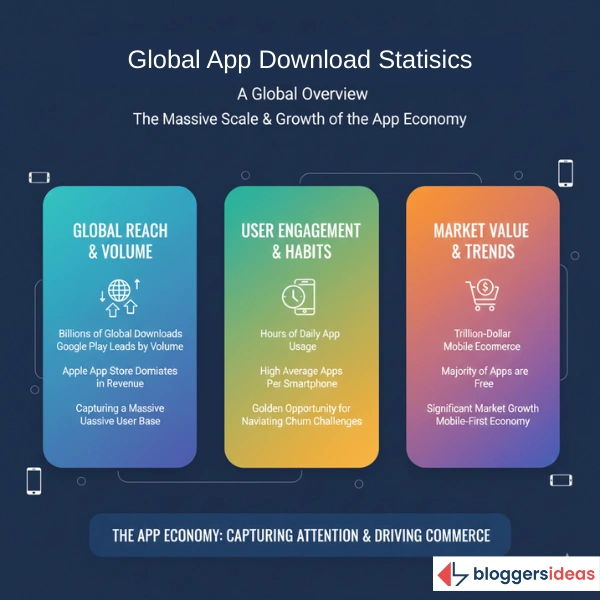
The digital revolution, driven significantly by mobile applications, continues its relentless expansion. Billions of downloads each year unequivocally highlight the escalating importance of apps in our everyday routines.
These pocket-sized powerhouses transform how we interact with the world, consume information, and conduct business.
The sheer accessibility of applications is underscored by a remarkable statistic: 97% of all apps are free to download, fostering widespread adoption and democratizing access to a vast array of digital services.
This accessibility is particularly pronounced within the Android ecosystem, where free apps constitute 97% of the offerings, leaving a 3% share for paid applications.
This model profoundly influences user behavior and developer monetization strategies.
Also read about: Mobile Internet Traffic Statistics
Consumer Spending and the Economic Power of Apps
The financial footprint of mobile applications is staggering and continues its upward trajectory.
In Q2 2025, global consumer spending on mobile apps reached an astonishing $40 billion, a clear indicator of the immense economic value generated by the app ecosystem.
This impressive figure reflects a robust and growing market where users are increasingly willing to invest in premium features, subscriptions, and in-app purchases.
Looking back to Q3 2023, the average consumer spending per smartphone stood at $5.05, demonstrating a consistent expenditure pattern that businesses can tap into.
Furthermore, the mobile eCommerce market is projected to skyrocket, reaching an estimated $3.35 trillion by 2028.
This projection signals a monumental shift towards mobile-first shopping experiences and presents unparalleled opportunities for businesses to integrate commerce seamlessly within their app strategies.
Also read about: Top 10 Mobile Ad Networks
Understanding User Engagement: Beyond the Download
While download numbers provide an initial measure of an app’s popularity, true success hinges on user engagement and retention.
Users download a multitude of apps, yet only a select few become integral to their daily routines.
On average, a smartphone user has approximately 80 apps installed on their device. However, a more telling statistic reveals that they actively use only 9 of these apps daily and revisit around 30 apps monthly.
This disparity highlights the challenge of maintaining user attention and underscores the importance of developing compelling and sticky app experiences.
Time Spent on Apps: A Deep Dive into Daily Habits
The amount of time users dedicate to mobile apps is a testament to their pervasive influence. Users spend an average of 4 hours and 37 minutes daily on mobile applications.
This significant allocation of time indicates that apps are not merely tools but deeply embedded components of modern lifestyles.
The aggregate monthly time spent on mobile apps in 2024 reached a colossal 1.12 trillion minutes, representing a substantial 13.01% growth from 2023.
This continuous increase in usage time underscores the expanding role of apps in our lives. A detailed breakdown of this time reveals that a significant 62.30% is concentrated in communication, entertainment, shopping, and social media applications.
These categories dominate user attention, offering critical insights for developers and marketers seeking to capture and retain engagement.
Also read about: Smartphone Usage Statistics
Mobile Advertising: A Potent Force
Mobile advertising stands as a powerful mechanism for capturing user attention and driving monetization within the app ecosystem.
Businesses that strategically invest in well-targeted ad campaigns can significantly enhance their app’s visibility and revenue potential.
The effectiveness of app-based advertising is evident in user recall rates: 47% of users recall app ads, a figure that surpasses mobile web ads (46%) and desktop ads (36%).
This superior recall rate suggests that in-app advertisements often resonate more deeply with users.
Furthermore, apps leveraging mobile ad networks for monetization are anticipated to experience a 60% growth, reinforcing the viability and profitability of advertising as a core component of an app’s business model.
The Retention Challenge: Keeping Users Engaged
Despite the immense popularity and widespread adoption of mobile apps, the industry faces substantial retention challenges.
A significant proportion of users uninstall apps shortly after installation, posing a critical hurdle for sustained growth.
A striking 56% of mobile apps are uninstalled within just seven days of their initial download. Several key factors contribute to this rapid attrition:
Table 1: Reasons for Mobile App Uninstallation
| Reason for Uninstallation | Percentage of Users Affected |
| Large memory space requirements | 50.6% |
| Persistent notifications | 71% |
| Performance issues | 62% |
| Privacy and security concerns | 29.6% |
| Complex registration processes | (Data not specified, but highlighted as a significant factor) |
On average, an app loses 77% of its daily active users (DAUs) over time. This significant churn rate necessitates a strategic focus on user experience, performance optimization, and value delivery.
Businesses should proactively address these concerns by investing in the development of Progressive Web Apps (PWAs) and Lite versions of their applications.
These alternatives can mitigate app size concerns, reduce data consumption, and provide a smoother user experience, thereby enhancing retention rates and fostering long-term engagement.
Global App Download Hotspots: A Geographic Perspective
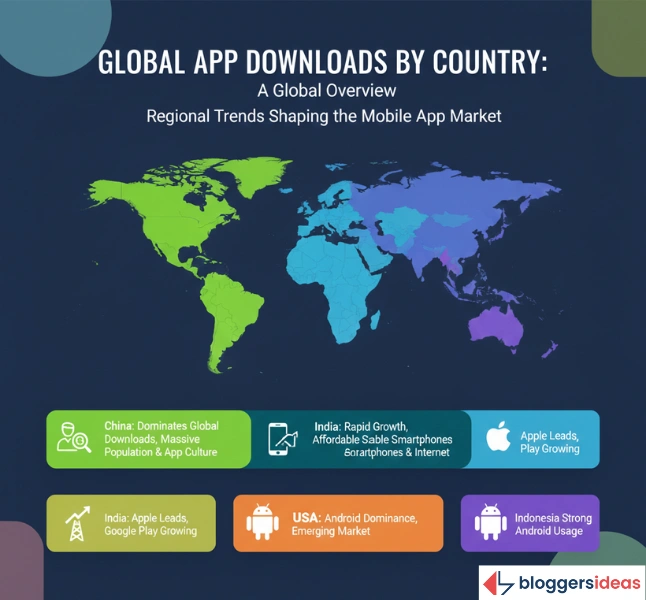
The global app download market exhibits distinct geographic concentrations, with certain countries leading the charge in terms of volume.
China consistently dominates this landscape, recording an astounding 113 billion downloads in 2023. This colossal figure reflects China’s massive smartphone user base and its deeply integrated digital economy.
India follows as a significant market, registering 26 billion downloads, which underscores the country’s burgeoning digital transformation and increasing mobile penetration.
Table 2: Top 5 Countries by Mobile App Downloads (Billions)
| Country | Mobile App Downloads (in billions) |
| India | 75 |
| China | 62 |
| USA | 35 |
| Brazil | 28 |
| Indonesia | 18 |
Across all major markets, the time users spend on mobile apps continues to rise annually, indicating a global trend of increasing reliance on mobile digital platforms.
Countries such as India and Italy, for instance, experienced a remarkable 30% growth in the average time spent using apps between 2019 and 2020, illustrating the accelerated adoption of mobile technologies in these regions.
Leading the Pack: Top Mobile App Categories and Emerging Trends
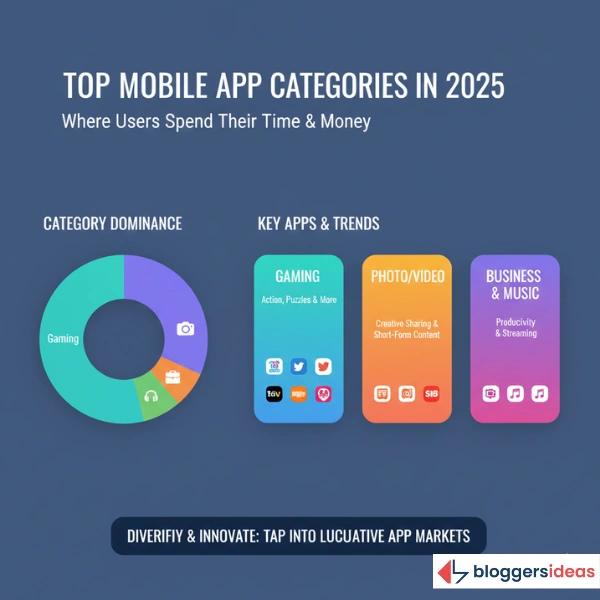
The gaming category consistently maintains its stronghold as the most downloaded app category globally, captivating a vast audience across demographics.
Table 3: Top Mobile App Categories for 2024
| App Category | Percentage of Global Downloads (2023-2024) |
| Games | 49%+ |
| Photo and Video | 10% |
| Business | 4% |
| Music | 4% |
Between 2023 and 2024, games accounted for over 49% of all app downloads worldwide, solidifying their position as the undisputed leader.
Photo and video applications ranked a distant second, representing 10% of all downloads, reflecting the pervasive influence of visual content creation and sharing.
Categories like business and music apps captured a smaller yet notable market share, each contributing 4% to global downloads.
These trends highlight the enduring appeal of entertainment and utility-focused applications, while also pointing to the growing importance of apps that facilitate work and creative expression.
App Store Giants: Apple App Store vs. Google Play Store
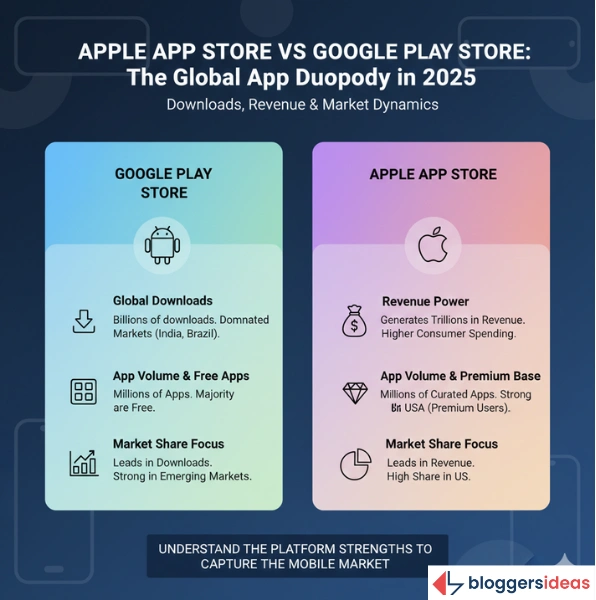
The mobile app distribution landscape is largely dominated by two formidable entities: the Apple App Store, serving iOS users, and the Google Play Store, catering to Android users. A comparative analysis reveals distinct patterns in their performance and market reach.
Google Play consistently leads in overall app installs, significantly outpacing the Apple App Store. In 2025, Google Play witnessed an impressive 299 billion new app installs, marking an 8% year-over-year increase from 277 billion installs in 2024.
This dominance is particularly pronounced in Android-heavy markets, where, on average, 74% of downloads in the Top 10 countries originate from the Google Play Store.
Countries such as India, Indonesia, Brazil, and Mexico exhibit an even higher Android preference, with 90% of downloads coming from the Google Play Store.
Conversely, the Apple App Store records fewer installs globally, primarily due to the Android market’s larger overall user base.
However, in specific regions like the United States, the Apple App Store holds a lead, accounting for 63% of downloads, while the Google Play Store captures a growing 40% share.
This indicates a more balanced competitive landscape in some developed markets, even as Android maintains a global lead in terms of sheer download volume.
The Most Popular Apps: A Glimpse into User Preferences
Understanding which apps capture the most attention offers valuable insights into current user preferences and emerging trends. ChatGPT has emerged as a particularly dominant force in recent months.
Table 4: Most Popular Apps Worldwide (July 2025)
| Rank | App | July 2025 Downloads Worldwide (Millions) |
| 1 | ChatGPT | 52 |
| 2 | TikTok | 39 |
| 3 | 38 | |
| 4 | 30 | |
| 5 | 27 | |
| 6 | Temu | 26 |
| 7 | CapCut | 23 |
| 8 | Threads | 23 |
| 9 | Telegram | 20 |
| 10 | Snapchat | 20 |
In July 2025, ChatGPT was the most downloaded app worldwide, garnering 52 million downloads across both Google Play and the iOS App Store.
This highlights the burgeoning interest in AI-powered tools and conversational interfaces.
Social media giants like TikTok, Instagram, Facebook, and WhatsApp continue to command significant download volumes, underscoring the enduring appeal of connectivity and content sharing.
Temu’s presence on the list as a shopping app indicates the continuous growth of mobile commerce.
Looking back slightly, in June 2025, ChatGPT also held the top spot with 50 million downloads.
The consistent high performance of ChatGPT reflects a rapidly evolving technological landscape where users are actively seeking out innovative AI-driven solutions.
Table 5: Most Popular Apps Worldwide (June 2025)
| Rank | App | June 2025 Downloads Worldwide (Millions) |
| 1 | ChatGPT | 50 |
| 2 | TikTok | 37 |
| 3 | 36 | |
| 4 | 30 | |
| 5 | 28 | |
| 6 | CapCut | 24 |
| 7 | Temu | 23 |
| 8 | Threads | 22 |
| 9 | Snapchat | 20 |
| 10 | Telegram | 19 |
Regional App Preferences: A Diverse Landscape
App popularity often varies significantly by country, reflecting local cultural nuances, dominant platforms, and specific market demands.
In the United States, Q2 2025 saw ChatGPT as the most downloaded app, followed by TikTok and Threads. This indicates a strong interest in AI and social platforms. The United Kingdom also placed ChatGPT at number one, with the shopping app Temu securing the second spot, highlighting a blend of utility and commerce.
Australia’s Q2 2025 downloads were led by ChatGPT, followed by the streaming service HBO Max, suggesting a strong appetite for both innovative tools and entertainment. Canada mirrored the US and UK with ChatGPT as its top download, and Temu again in second place.
India, a unique market, saw Instagram claim the top spot in Q2 2025, followed by the video app Kuku TV and then ChatGPT. This distinct preference for social media and local content underscores the importance of understanding regional user behavior.
France and Brazil both showed ChatGPT as their most downloaded app in Q2 2025, with Temu frequently appearing in the top ranks. This global consistency for ChatGPT and the rise of mobile shopping apps like Temu are significant trends.
Historical Context: App Dominance Through the Years
Examining previous years’ data provides valuable context for understanding the long-term trends in app popularity.
In 2023, Threads, Meta’s competitor to Twitter, made a significant splash, becoming the most downloaded app in the US with 192.7 million downloads. This demonstrates the potential for new social platforms to rapidly gain traction. Temu and TikTok also had strong performances, reinforcing their market presence.
Table 6: Most Downloaded Apps in the US (2023)
| App | Downloads in 2023 (Millions) |
| Threads | 192.7 |
| Temu | 113 |
| TikTok | 80.9 |
| CapCut | 69.3 |
| SHEIN | 68.4 |
| WhatsApp Messenger | 68.2 |
| 67.3 | |
| MONOPOLY GO! | 57.5 |
| Cash App | 55.7 |
| Snapchat | 52 |
TikTok consistently dominated global downloads in earlier years. In 2022, TikTok was the most downloaded mobile app with 672 million downloads worldwide. This strong performance continued from 2021, where TikTok hit 656 million downloads, and even further back to 2020, where it recorded an impressive 850 million downloads. This sustained leadership highlights TikTok’s profound impact on global digital culture and entertainment.
Table 7: Most Popular Apps Worldwide (2022)
| App | Downloads in 2022 (Millions) |
| TikTok | 672 |
| 548 | |
| 424 | |
| CapCut | 357 |
| Snapchat | 330 |
| Telegram | 310 |
| Subway Surfers | 304 |
| 298 | |
| Stumble Guys | 254 |
| Spotify | 238 |
Table 8: Most Popular Apps Worldwide (2021)
| App | Downloads in 2021 (Millions) |
| TikTok | 656 |
| 545 | |
| 416 | |
| 395 | |
| Telegram | 329 |
| Snapchat | 327 |
| Zoom | 300 |
| Messenger | 268 |
| CapCut | 255 |
| Spotify | 203 |
Table 9: Most Popular Apps Worldwide (2020)
| App | Downloads in 2020 (Millions) |
| TikTok | 850 |
| 600 | |
| 540 | |
| 503 | |
| Zoom | 477 |
| Messenger | 404 |
| Snapchat | 281 |
| Telegram | 256 |
| Google Meet | 254 |
| Netflix | 223 |
What Users Are Asking: Insights from Quora and Reddit
Beyond the statistics, the real-time pulse of user sentiment and emerging needs can be found in online communities like Quora and Reddit.
Users frequently inquire about strategies to make their apps stand out in a crowded market, asking questions such as “How can I improve app discoverability without a huge marketing budget?” or “What are the most effective ways to monetize a niche app?”
Many are also increasingly concerned about data privacy and how apps handle their personal information, often questioning “Which apps genuinely prioritize user privacy?” or “Are there transparent alternatives to popular apps with questionable data practices?”
This indicates a growing demand for transparency and ethical data handling from app developers. The rising interest in AI-powered tools is also a recurring theme, with users asking “What are the best AI apps for daily productivity?” or “How can AI features enhance my existing app?”
These inquiries highlight several critical areas for app developers:
- Discoverability and Organic Growth: While advertising is crucial, strategies for organic growth through App Store Optimization (ASO), strong community engagement, and viral features are highly valued.
- Diverse Monetization Models: Beyond traditional ads and in-app purchases, users are interested in subscription models, freemium options, and value-added premium features that genuinely enhance their experience.
- Privacy and Trust: Building user trust through transparent data practices, robust security, and clear privacy policies is paramount. Apps that offer genuine control over personal data will likely gain a competitive edge.
- Integration of AI: Users are actively seeking apps that leverage artificial intelligence to offer personalized experiences, automate tasks, and provide intelligent insights. Incorporating thoughtful AI features can significantly boost an app’s appeal and utility.
- Lite Versions and Performance: The consistent concern about app size and performance (as seen in uninstallation reasons) indicates that “lite” versions or highly optimized, efficient apps are not just a nice-to-have but a critical requirement for broad market adoption, especially in emerging markets.
The Future of Mobile App Downloads: Key Takeaways for Success
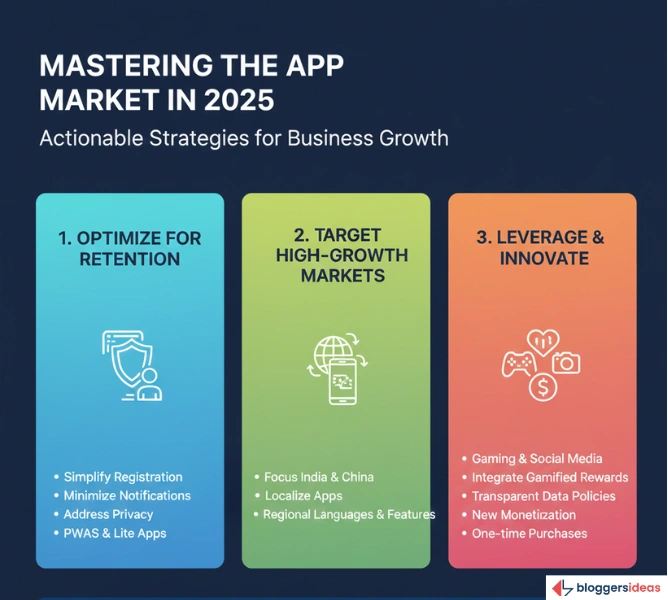
The mobile app landscape in 2025 and beyond is characterized by relentless growth, fierce competition, and evolving user expectations. For businesses and developers looking to thrive, several key takeaways emerge from these comprehensive statistics and user insights:
- Focus on Value and Retention: The initial download is only the first step. Sustained success depends on providing continuous value, optimizing performance, and addressing user concerns about app size, notifications, and privacy to mitigate high uninstallation rates.
- Embrace AI Integration: The overwhelming popularity of ChatGPT signals a strong user appetite for intelligent, AI-powered features that enhance productivity, entertainment, and communication. Developers should explore how AI can meaningfully integrate into their offerings.
- Strategic Monetization: While free apps dominate downloads, effective monetization strategies, including well-targeted advertising, in-app purchases, and flexible subscription models, are vital for generating revenue and funding continued development.
- Prioritize User Experience (UX): A seamless and intuitive user experience is non-negotiable. Complex registration processes, performance glitches, and excessive notifications drive users away. Investing in UX research and iterative design is paramount.
- Understand Regional Differences: Global success requires an understanding of local preferences. Tailoring app features, marketing strategies, and content to specific countries and cultural contexts can unlock significant market potential.
- Transparency and Trust in Privacy: With growing user awareness, apps that demonstrate a clear commitment to user privacy and data security will build stronger relationships and foster greater loyalty.
- Optimize for Discoverability: In a crowded market, robust App Store Optimization (ASO) and clever marketing are essential to cut through the noise and ensure your app is discoverable by its target audience.
The mobile app download statistics for 2025 paint a vivid picture of an industry that is dynamic, expansive, and ripe with opportunity.
By understanding these trends, consumer behaviors, and emerging technological advancements, businesses and developers can strategically position themselves to capture market share, drive engagement, and achieve lasting success in the ever-evolving world of mobile applications.
FAQs About Mobile App Download Statistics
1. What trends are influencing mobile app downloads in 2025?
AI apps like ChatGPT, mobile commerce growth, privacy-centric apps, performance optimization, and smaller app sizes are key trends driving downloads.
2. How can developers improve app retention?
Focus on optimizing app size, simplifying onboarding, enhancing performance, managing notifications, and ensuring privacy and security.
3. Which countries lead in mobile app downloads?
China, India, the USA, Brazil, and Indonesia are top markets, emphasizing the need for localized content and optimization for Google Play.
4. What role does mobile advertising play in app marketing?
Mobile advertising is crucial for user acquisition and monetization, with 47% of users recalling app ads, driving growth and visibility.
5. How do the Apple App Store and Google Play Store compare?
Google Play leads with 299 billion installs in 2025, driven by Android’s dominance in emerging markets, while Apple leads in developed regions like the U.S.
Also Read:
- YouTube Creator Statistics
- Email Marketing Statistics
- Content Marketing Statistics
- Digital PR Statistics
- Telegram Statistics
Conclusion
In conclusion, the mobile app landscape in 2025 continues to thrive with remarkable growth driven by AI-powered apps, mobile commerce, and a strong demand for privacy.
With billions of downloads globally, apps have become essential to daily life, with users spending more time on apps than ever before.
However, challenges like high uninstallation rates remain, pushing developers to prioritize user retention through optimized performance and seamless user experiences.
As markets in countries like China and India lead in downloads, businesses should tailor their strategies to these regions while leveraging mobile advertising and app store optimization for greater visibility.
The future of mobile apps looks bright, offering businesses opportunities to innovate and engage users in meaningful ways.
Source: Statista, Business Of Apps
