
The world has undeniably gone mobile. We hold pocket-sized digital doorways in our hands, relying on smartphones for everything from reading the morning news to binging our favorite shows in the evening.
This pervasive reliance has opened up an unprecedented marketing opportunity for businesses, allowing them to directly influence the purchasing behavior of mobile consumers.
As we look towards 2025, understanding the intricate landscape of mobile marketing is not just an advantage, it is a necessity for any business aiming to thrive.
This comprehensive guide delves into the latest mobile marketing statistics, trends, and strategies, empowering you to leverage this powerful channel for your benefit.
The Unstoppable Ascent of Mobile Usage
Imagine a day without your smartphone. For most, that thought alone presents a significant challenge. This deep integration of mobile devices into our daily lives forms the bedrock of modern marketing.
The numbers tell a compelling story, illustrating a global shift towards mobile-first interactions and consumption.
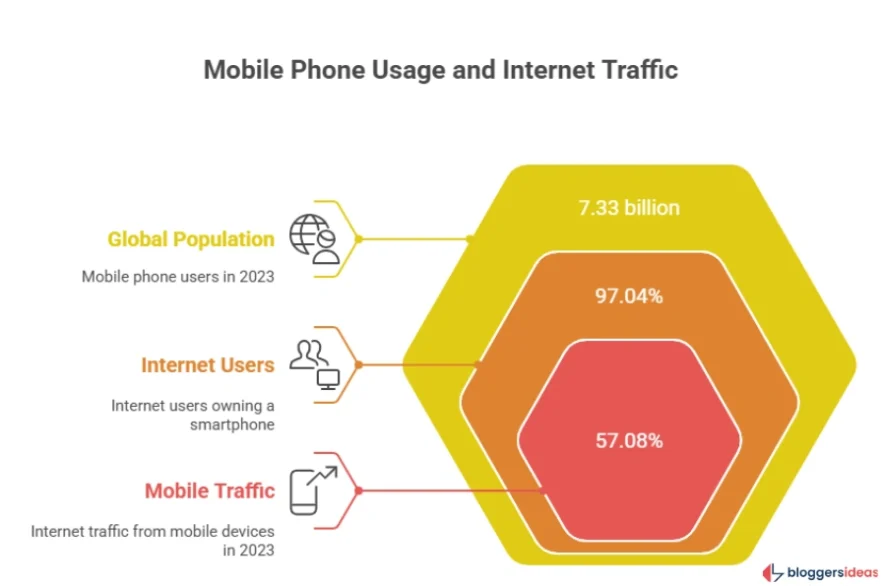
As of early 2023, a staggering 7.33 billion people actively used mobile phones worldwide, meaning over 90% of the global population is connected through these devices.
This figure is not just static; it is projected to grow, with mobile devices expected to exceed 18 billion by 2025. This means nearly every internet user, with over 97% owning a smartphone, is a potential touchpoint for your mobile marketing efforts.
The sheer volume of time individuals dedicate to their mobile devices further emphasizes their importance. In 2022, Android users collectively spent over 4.1 trillion hours engaged with their phones.
On average, users across the globe spent an impressive 4 hours and 6 minutes per day on their mobile devices in 2023, with even higher usage rates observed in countries like Indonesia, Brazil, Saudi Arabia, Singapore, and South Korea.
This consistent, daily engagement creates a fertile ground for businesses to capture attention and build meaningful connections.
Table 1: Global Mobile Usage Statistics (2023-2025 Projections)
| Metric | 2023 | 2025 (Projected) | Significance for Marketers |
| Global Mobile Phone Users | 7.33 billion | >18 billion devices | Massive reach for mobile campaigns |
| Percentage of Global Population Using Mobile Phones | 90.93% | Increasing | Near universal access to mobile audiences |
| Internet Users Owning a Smartphone | >97.04% | Consistent | Mobile-first approach is crucial |
| Average Daily Mobile Usage (Hours/Minutes) | 4h 6m | Consistent/Increasing | Sustained opportunities for engagement |
| Mobile Traffic as Percentage of Total Internet Traffic | 57.08% | ~25% Increase by 2025 | Dominant channel for web content consumption |
This profound reliance on mobile devices is not limited to personal use; it extends into professional spheres as well. Mobile marketing statistics reveal that 80% of B2B buyers now utilize mobile phones in their workspace.
Furthermore, B2B mobile marketing has significantly influenced purchase behavior by a remarkable 60%.
This demonstrates that a well-executed mobile strategy can resonate across both consumer and business markets, driving substantial impact.
Also read about: Mobile Internet Traffic Statistics
The Booming Mobile Advertising and Marketing Market

The pervasive nature of mobile usage directly translates into a flourishing mobile advertising and marketing market.
Businesses are recognizing the immense potential of this channel, allocating substantial budgets to reach their audiences where they spend most of their digital time.
It was estimated that mobile advertising spending surpassed $413 billion in 2024, a clear indicator of its growing importance.
This massive investment is projected to continue its upward trajectory, with mobile dominating digital advertising and expected to account for 69.61% of total global ad revenue by 2028.
The United States leads this charge, representing the largest mobile advertising market globally, with projected spending reaching $233.35 billion in 2025.
The mobile marketing market itself is experiencing explosive growth. Valued at $153.7 billion in 2023, it is predicted to surge to $57.85 billion by 2030, signifying a compound annual growth rate (CAGR) of over 19%.
This represents an astounding growth of over 500% from 2020 to 2030, underscoring the dynamic and rapidly expanding nature of this sector.
Table 2: Mobile Marketing and Advertising Market Growth
| Metric | 2020 | 2023 | 2024 | 2025 (Projected) | 2028 (Projected) | 2030 (Projected) |
| Mobile Marketing Market Size (USD Billion) | – | 153.7 | – | – | – | 57.85 (by 2030 from $153.7B in 2023) |
| Mobile Advertising Spending (USD Billion) | – | 362 (projected) | 413 (estimated) | 228.12 (US) | ~69.61% of global digital ad revenue | – |
| CAGR (Mobile Marketing Market) | – | – | – | – | – | >19% (2020-2030) |
Within mobile advertising, certain formats and channels demonstrate exceptional effectiveness. Native ads, for instance, prove significantly more impactful on mobile devices compared to desktops.
Their average click-through rate on mobile is 0.38%, more than double the 0.16% seen on desktops. This highlights the importance of seamlessly integrating advertisements into the user experience on mobile platforms.
Furthermore, consumers are increasingly receptive to mobile ads, especially when they offer value.
A notable 55% of Americans prefer watching mobile ads within an app rather than paying for the app, and 21% explicitly state that they enjoy in-app advertisements.
This suggests that well-designed, non-intrusive mobile ads can be a win-win for both businesses and consumers.
The dominance of mobile in the digital advertising landscape is further evidenced by specific platform statistics.
An impressive 94% of Facebook’s advertising revenues are generated through mobile, showcasing the platform’s mobile-first strategy and user engagement.
One out of three users actively visits a brand’s website after viewing a mobile ad, demonstrating a clear call-to-action effectiveness.
Moreover, 60% of mobile searchers directly call businesses from search results, emphasizing the immediate impact of mobile search advertising.
This immediacy is also reflected in pay-per-click (PPC) campaigns, with 52% of all PPC clicks originating from mobile devices.
Also read about: Mobile App Download Statistics
Mobile Commerce: The New Retail Frontier
The shift towards mobile extends powerfully into the realm of commerce, fundamentally transforming how consumers discover, browse, and purchase products and services.
Mobile commerce, or m-commerce, is not merely a trend; it is the present and future of retail.
Mobile users currently account for a substantial 75% of website traffic and contribute to an impressive 63% of sales on e-commerce platforms.
In the United States, mobile commerce represented 8% of retail sales in 2023, a figure projected to rise to over 10% by 2025. This consistent growth underscores the critical need for businesses to prioritize mobile-friendly shopping experiences.
Table 3: Mobile Commerce Impact
| Metric | 2023 | 2025 (Projected) | Marketer Takeaway |
| Mobile User Traffic on E-commerce | 75% | Increasing | Optimize entire user journey for mobile |
| Mobile Sales on E-commerce | 63% | Increasing | Mobile conversion optimization is vital |
| US Mobile Commerce Share of Retail Sales | 8% | >10% | Significant revenue stream to focus on |
| Consumers Who Buy Online via Smartphone (18-49) | 91% | Consistent | Targeting this demographic is essential |
| Online Transactions on Mobile Devices | >40% | Increasing | Ensure smooth mobile checkout processes |
| Hours Spent in Shopping Apps | ~500 billion | Increasing | Prioritize app-based marketing strategies |
The convenience of mobile shopping resonates strongly with consumers. Around nine out of ten Americans aged 18 to 49 (91%) regularly make online purchases using their smartphones.
Over 40% of all online transactions now occur on mobile devices, highlighting the direct impact of mobile on sales figures. Consumers’ engagement with shopping apps is also immense, with nearly 500 billion hours spent in these apps in 2023.
Beyond direct purchases, mobile devices play a crucial role in influencing in-store shopping behaviors. A significant 69% of in-store shoppers prefer to read product reviews on their phones rather than consult a store associate.
More than half of retail customers use their mobile phones to find online deals and discount codes while shopping in physical stores.
Interestingly, 38% of shoppers who initiate their product search on mobile phones ultimately complete their purchase in-store, demonstrating the blended nature of modern retail journeys.
Customer expectations regarding mobile shopping functionality are high, with 59% considering it important when choosing a brand or retailer.
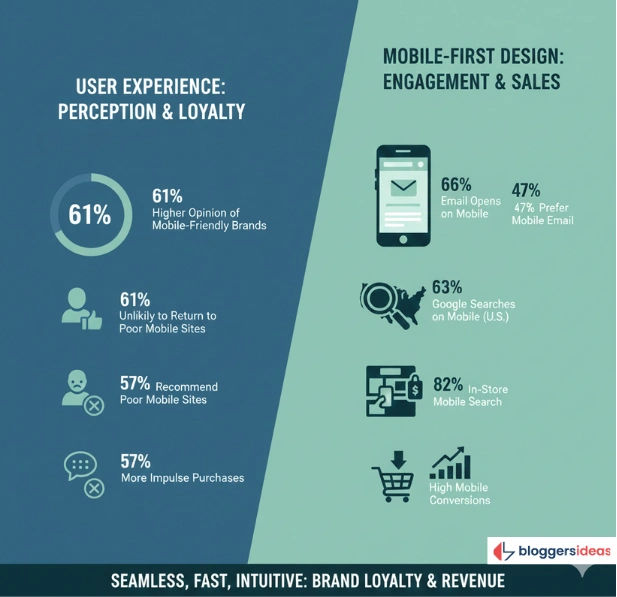
The user experience on mobile websites is paramount; 61% of customers are more likely to purchase from a mobile-friendly site, and 79% are more likely to revisit or share a mobile site if it is easy to use.
Despite this, a notable 53% of smartphone users do not have their favorite brand’s app installed, suggesting an opportunity for businesses to enhance app adoption and engagement through compelling value propositions.
However, once users are engaged, data suggests that 46% of shoppers are less likely to explore other options when using a brand’s dedicated shopping app.
Also read about: Email Marketing Statistics
Top Mobile Marketing Channels and Strategies for 2025
Identifying the most effective channels is crucial for any successful mobile marketing strategy. Understanding where your audience spends their time allows for targeted and impactful campaigns.
YouTube stands out with the highest number of users among all mobile apps, followed closely by Google, Google Chrome, and Facebook.
The dominance of Google-powered apps in the top three suggests that Google Ads remains a preferred and highly effective advertising platform for reaching mobile users. Furthermore, 89% of YouTube’s traffic originates from mobile devices, making it an indispensable channel for video marketing.
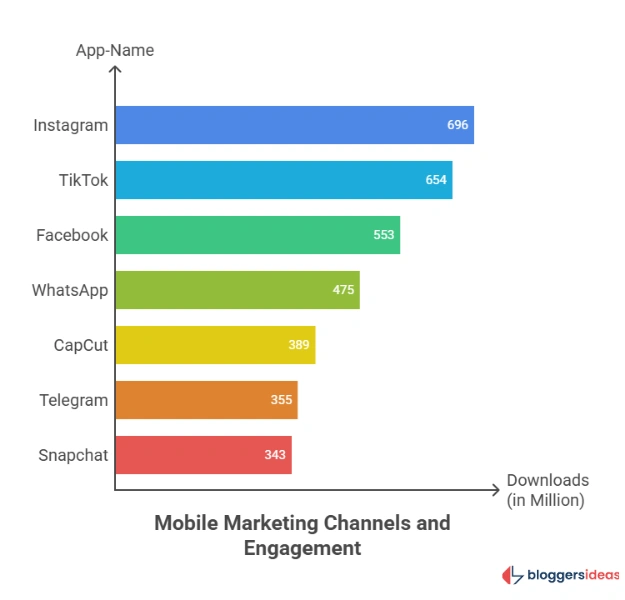
In 2023, mobile users dedicated most of their time to Instagram, TikTok, and Facebook.
These social media platforms offer robust opportunities for businesses to engage audiences through organic content, paid advertisements, and influencer collaborations.
The rapidly expanding short-video market, driven by platforms like TikTok, should be a key component of any modern mobile marketing plan.
Table 4: Most Popular Mobile Apps by Downloads (2023)
| App | Downloads (in millions) |
| 696 | |
| TikTok | 654 |
| 553 | |
| 475 | |
| CapCut | 389 |
| Telegram | 355 |
| Snapchat | 343 |
Beyond social media, other channels continue to prove their worth. Email remains a preferred communication method for 46% of mobile users, emphasizing the need for mobile-optimized email campaigns.
WhatsApp leads as the most popular messaging platform globally, presenting opportunities for direct customer communication and support.
Push notifications, when used strategically, can significantly drive engagement, influencing 20% of app opens and driving 15% of e-commerce conversions.
Also read about: Marketing Automation Statistics
Current User Insights and Emerging Trends from Online Communities
Beyond traditional statistics, understanding what users are discussing on platforms like Quora and Reddit provides invaluable, real-time insights into evolving mobile marketing landscapes.
Users are frequently asking about the effectiveness of newer ad formats, the balance between personalization and privacy, and how to genuinely cut through the noise in an increasingly crowded mobile space.
One recurring theme is the desire for authentic and non-intrusive mobile ad experiences. Users on Reddit often lament overly aggressive pop-ups or ads that disrupt their content consumption.
This reinforces the statistical finding that while many are open to ads, they prefer them to be relevant and integrated seamlessly, much like native advertising. Businesses must prioritize contextually relevant ads that add value rather than interrupting the user journey.
Another significant area of discussion revolves around privacy and data usage. With increasing awareness about data collection, users are more discerning about which apps they grant permissions to and how their information is utilized.
This highlights the importance of transparent data practices and offering users control over their privacy settings. Businesses that demonstrate respect for user privacy will build greater trust and loyalty, which are critical in mobile marketing.
Finally, the discussion around hyper-personalization versus feeling “spied upon” is prominent. While statistics show that 91% of smartphone users are influenced by relevant ads, the line between helpful personalization and intrusive tracking is thin.
Marketers need to use data not just to target, but to genuinely understand user needs and deliver tailored content that feels organic and valuable.
Leveraging AI for predictive analytics, for example, can help anticipate needs without overtly tracking every single action. The goal is to create a delightful, customized experience that feels assistive, not manipulative.
Leading Mobile Marketing Strategies for 2025
To capitalize on the insights and trends discussed, businesses must adopt a strategic and agile approach to mobile marketing. Here are key strategies to implement:
- Optimize for Smaller Screens and Speed: Your content, ads, and website layouts must load quickly, display clearly, and adapt seamlessly to different devices. This means responsive design is non-negotiable. Performance issues, such as slow page loads and JavaScript errors, cause high frustration (40.1% of user sessions in 2024) and significantly increase bounce rates (50.3% on mobile). A fast, intuitive mobile site or app is the foundation for engagement.
- Prioritize Personalization to Strengthen Connections: Tailor offers, messaging, and timing based on user behavior, location, and browsing history to make each interaction more relevant. Leveraging advanced analytics and AI can help you understand individual customer journeys and deliver truly personalized experiences.
- Strengthen Local Targeting: Utilize location-based data and geotargeting to reach users with relevant offers or messages at the right moment, such as when they are near a physical store or attending an event.
- Invest in In-App Engagement: Build deeper relationships with mobile users through personalized push notifications, loyalty features, or exclusive content within your app. For brands without an app, consider the value proposition and whether an app could enhance customer loyalty and conversion.
- Create Mobile-Friendly Content: Craft short, clear copy and visuals that are easy to scan on a small screen. Ensure headlines and calls-to-action (CTAs) stand out immediately, guiding users efficiently. Short-form video content, given its immense popularity, should be a central part of your content strategy.
- Test Across Browsers and Platforms: Regularly verify how your campaigns perform on Chrome, Safari, and other major mobile environments to ensure consistency and optimal user experience across all touchpoints.
- Utilize Analytics for Continuous Refinement: Track performance metrics drawn from mobile marketing statistics to identify what resonates with your audience, where users might be dropping off, and how to continuously improve your campaigns for maximum impact and ROI.
FAQs About Mobile Marketing Statistics
1. Why is mobile marketing so crucial for businesses in 2025?
Mobile marketing is essential as most of the global population spends over 4 hours daily on smartphones, driving traffic and purchases across sectors.
2. What are the key trends driving mobile marketing growth towards 2025?
Key trends include rising mobile ad spending over $400 billion, mobile commerce growth in retail, and effective in-app native ads due to improved user engagement.
3. How can businesses effectively leverage mobile commerce?
Businesses can optimize mobile-friendly websites, enhance speed, create shopping apps, and integrate mobile search and social media strategies for better sales.
4. Which mobile marketing channels are most effective for reaching consumers today?
Effective channels include Google Ads, YouTube, Instagram, TikTok, Facebook, and personalized mobile email campaigns and push notifications.
5. What new insights from online communities should businesses consider for their mobile marketing strategy?
Insights emphasize authentic, non-intrusive ads, transparent privacy practices, and balancing hyper-personalization with user comfort to avoid intrusive marketing.
Also Read:
- Android Usage Statistics
- Coupon Statistics
- Android Usage Statistics
- Content Marketing Statistics
- Live Streaming Statistics
Conclusion
The mobile revolution is far from over; it is continuously evolving, presenting both challenges and immense opportunities for businesses.
By understanding the profound impact of mobile usage, recognizing the explosive growth of the mobile advertising market, and embracing mobile-first commerce strategies, businesses can position themselves for unparalleled success in 2025 and beyond.
The key lies in creating seamless, personalized, and valuable mobile experiences that resonate with users and drive tangible results.
Source: Statista, StatCounter
