US startups raised $412.7 billion in the first half of 2026.
About $355.9 billion of that, 86 percent, went to AI companies.
Everything else, from biotech to consumer apps, split the leftover 14 percent.
Record funding years used to mean a lot of founders got paid. In 2026 it means a handful did.
The concentration nobody planned
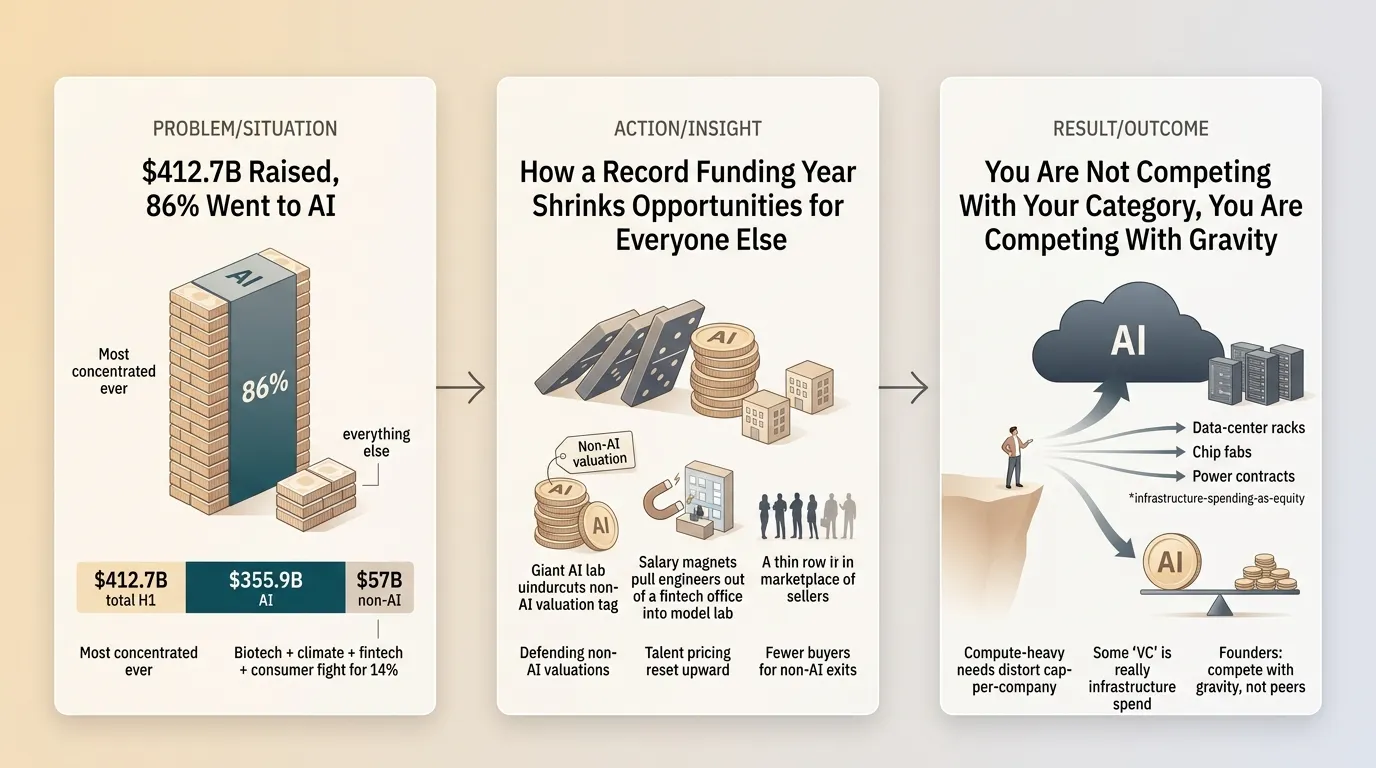
The first half of 2026 saw US startups raise $412.7 billion, and a stunning 86 percent of that, about $355.9 billion, went to AI companies. That is the most concentrated the startup funding world has ever been.
Sit with the leftovers for a second. Biotech, climate, fintech, consumer apps, developer tools, marketplaces, hardware, every category that is not AI, together fought over roughly $57 billion. In a normal year that would be a decent haul. In a year where one sector took $355.9 billion, it looks like a rounding error.
The shape of the boom matters more than the size. In past cycles, a record funding year meant lots of different companies got money. This time a record year means a small group of AI giants absorbed almost everything while other founders watched the room empty out.
What it means if you are not building AI
Three practical consequences follow, and none of them are hypothetical.
Valuations outside AI are getting harder to defend. If a partner can put $500 million into a model lab at a headline-grabbing markup, your $8 million seed for a solid non-AI business competes for attention it will not get.
Talent pricing has broken. Engineers who would have joined a fintech in 2023 now field offers from labs with effectively unlimited budgets. Salary benchmarks in adjacent sectors are being dragged upward by companies that do not care about the benchmark.
And the exit math changed. When capital concentrates this hard, the acquirers concentrate too. Fewer buyers, fewer bidders, worse terms for founders selling anything that is not an AI asset.
There is a fair counterpoint worth including. Some of that $355.9 billion is not really venture capital in the classic sense. It is infrastructure spending dressed as equity, money that flows straight into chips, data centres, and power contracts rather than into product experiments.
Compute-heavy companies simply need more dollars per company than a SaaS startup ever did, which inflates the percentage without necessarily meaning nine of ten good ideas were AI ideas.
Either way, the signal for founders is the same. If you are raising in 2026 and you are not in AI, you are not competing with other startups in your category. You are competing with the gravity of a sector that ate the room.
Quick Links: