
Referral marketing stands as a powerful and enduring strategy in today’s dynamic business landscape, consistently demonstrating its ability to drive superior conversion rates, cultivate lasting customer loyalty, and deliver exceptional returns on investment.
As we approach 2025, the insights gleaned from the latest statistics highlight an increasingly sophisticated and technology-driven approach to leveraging the inherent trust in personal recommendations.
This detailed article explores the multifaceted impact of referral marketing, offering a roadmap for businesses aiming to harness its benefits.
The Undeniable Effectiveness of Referral Marketing
Businesses consistently find that referral marketing outperforms many traditional acquisition channels.
It taps into an inherent human tendency to trust recommendations from known individuals, making it a highly effective engine for growth.
Higher Conversion Rates and Profit Margins
Referral marketing is not just about acquiring new customers; it is about acquiring better customers. Businesses consistently achieve significantly higher conversion rates through referrals.
Key Statistics:
- Referral marketing helps companies and businesses generate three to five times higher conversion rates than other marketing methods.
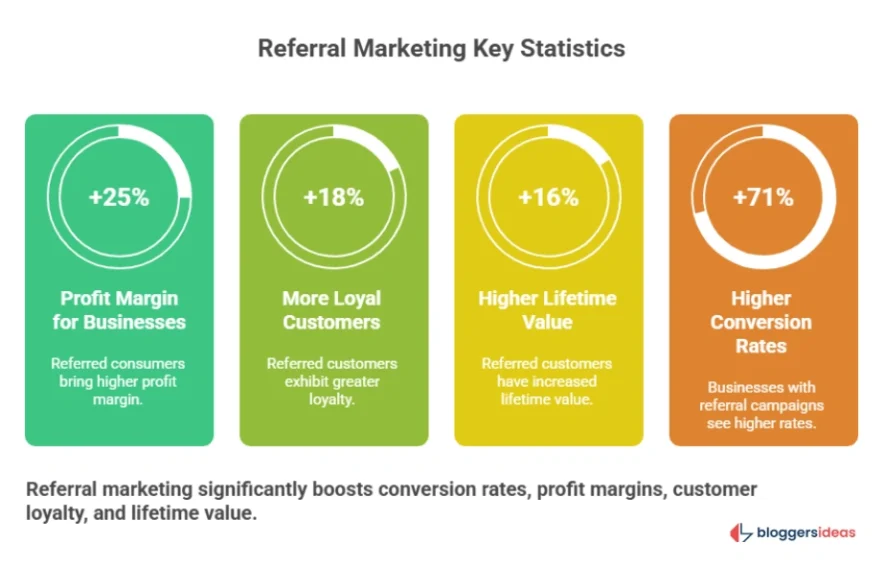
- Referred consumers typically bring a 25% or higher profit margin for businesses.
- Referred customers are 18% more loyal and exhibit a 16% higher lifetime value compared to customers acquired through other means.
- Businesses with referral campaigns experience 71% higher conversion rates than those without such programs.
This demonstrates that customers arriving through a referral are not only more likely to convert but also become more valuable assets to a business over their lifetime.
Trust as the Cornerstone of Referral Marketing
The foundation of referral marketing’s success lies in trust. Consumers inherently place more faith in the opinions of their social circles than in direct advertising.
Key Statistics:
- More than 90% of consumers trust word-of-mouth referrals more than other forms of marketing.
- Specifically, 92% of consumers trust recommendations from their family and friends.
- Happy customers share their positive experiences with an average of nine people.
- Word-of-mouth affects 20% to 50% of all purchasing decisions.
- Word of mouth is five times more effective than paid advertisements, driving an average of five times more sales.
This profound trust translates directly into purchasing decisions and brand perception, making word-of-mouth an invaluable asset.
Also read about: Marketing Automation Statistics
Measuring the Business Impact
Referrals significantly contribute to a business’s bottom line, driving new opportunities and increasing overall sales.
Key Statistics:
- Approximately 65% of all new business opportunities originate from referrals and recommendations.
- 82% of small businesses report referrals as their primary source for new startups or clients.
- Almost all software companies acquire 20% to 50% of their new consumers through existing customers.
- Companies that invest in referral marketing campaigns witness an 86% increase in revenue compared to the previous year.
The sheer volume of business generated through referrals underscores its importance as a core growth strategy.
Strategic Referral Program Statistics
Implementing structured referral programs amplifies the inherent power of word-of-mouth, transforming organic recommendations into a scalable and measurable growth channel.
Key Statistics on Referral Program ROI:
| Business Size | ROI Generated Through Referral Marketing |
| Enterprises | 10.2 times |
| Medium-sized businesses | 9.4 times |
| Small businesses | 3.6 times |
- Referred consumers are $0.45 (45 cents) more profitable per day than other customers.
- The customer acquisition cost (CAC) for referred consumers is $23.12 less than that for non-referred customers.
- Over an initial six-year span, referred consumers deliver a 60% higher return on investment than non-referred consumers.
- Customers acquired by referrals spend 200% more than the average consumer and are four times more likely to refer your brand to others. They also boast a 37% higher retention rate.
- PayPal experienced daily growth of 7-10% through its referral marketing efforts.
These statistics unequivocally demonstrate the financial advantages of establishing and maintaining robust referral programs.
Most Popular Referral Methods

Marketers employ various channels to facilitate referrals, with some methods proving more effective than others for both B2B and B2C contexts.
Key Statistics:
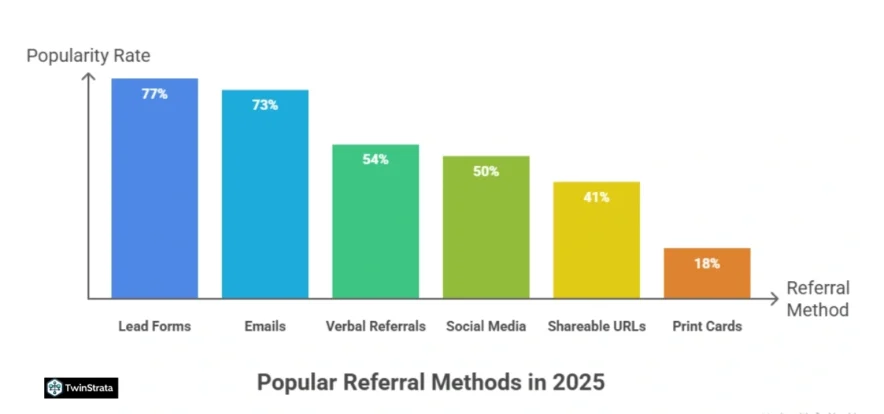
- 77% of marketers consider lead forms as the top referral method for both B2B and B2C business owners.
- 73% of marketers view emails as a popular referral method.
- Other popular methods include verbal referrals (54%), social media referrals (50%), shareable URLs (41%), and print cards (18%).
Businesses should strategically select and optimize referral methods based on their target audience and industry.
Also read about: Content Marketing Statistic
B2B Referral Marketing: A Catalyst for Growth
In the business-to-business sector, referrals play an even more critical role, often initiating the buying process and leading to higher-quality leads.
Key Statistics:
- 84% of B2B decision-makers state that their B2B buying process begins with a referral.
- Peer recommendations or referrals influence more than 90% of B2B purchases.
- 87% of sales and marketing efforts prove effective when utilizing B2B referral marketing.
- 86% of B2B companies with a referral program experience growth.
- 78% of B2B marketers believe referral programs generate good or excellent leads.
- 82% of B2B sales leaders concur that referrals produce the best leads, leading to 30% more leads overall.
- 70% of sales leaders, 69% of B2B frontline sales personnel, and 67% of marketers believe referred leads close faster than others.
- 49% of B2B marketers consider customer relations the most effective marketing tactic. Other top tactics include personalized messages (37%), online events (35%), investing in SEO (31%), and lead generation with data (27%).
For B2B firms, cultivating strong customer relationships that naturally lead to referrals is a paramount strategy.
Also read about: Email Marketing Statistics
The Power of Social Media in Referral Marketing
With billions of users worldwide, social media platforms have become indispensable channels for amplifying referral marketing efforts, directly influencing consumer purchasing behavior.
Key Statistics:
- 71% of consumers are more likely to purchase a product based on social media referrals.
- Social media accounts for nearly 31.24% of new business through marketing and advertising.
- Facebook and Instagram collectively hold approximately a 77% share of respondents for social media influence.
- 78% of consumers admit they are influenced by posts and media shared by their favorite brands on social media.
- 73.6% of consumers purchase more frequently because of brand communities.
- 40.9% of consumers plan to increase their participation in online communities.
- 75% agree that communities improve customer experience.
- Over 30% of total revenue can sometimes be traced back to community influence.
- 59% of Pinterest users have purchased an item after viewing it on the site.
- 33% of Facebook users have purchased an item they saw on friends’ walls or news feeds.
- 53% of customers are more likely to purchase from a company through Facebook Live chat.
- 55% of consumers report sharing their purchases on social media platforms, often sharing positive experiences and seeking opinions.
- 82% of Americans ask for recommendations from family or friends before purchasing.
- 67% of people are more likely to purchase a product suggested by a family member or friend on social media.
- 88% of Americans report a desire for incentives when sharing products on social media, a number that jumps to 95% for millennials and Gen Z.
Social media’s pervasive influence makes it a critical component of any comprehensive referral marketing strategy.
Generational Trust in Referrals
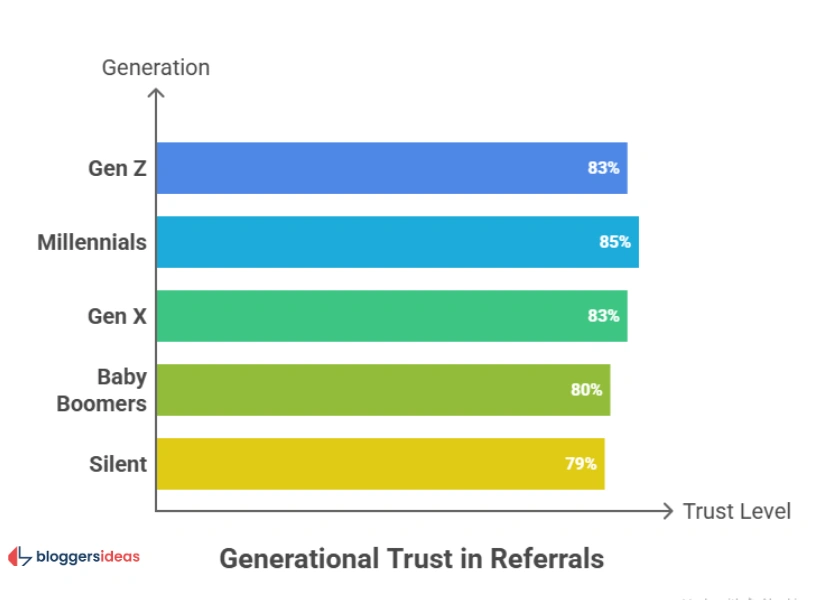
Trust in referrals transcends age groups, but some generations demonstrate a particularly strong reliance on recommendations from their inner circles.
Percentage of Trust in Referral Marketing by Generation:
| Generation | Percentage of Trust in Referral Marketing |
| Gen Z | 83% |
| Millennials | 85% |
| Gen X | 83% |
| Baby Boomers | 80% |
| Silent Generation | 79% |
- 88% of millennials trust recommendations and referrals from friends and family.
- 28% of millennials would not consider a product if their friends and family disliked it.
- 77% of consumers, including millennials, are more likely to buy a new product when learning about it from friends or family.
- Gen Alpha is among the most impactful referrers, with 81% of Gen Alpha kids influencing their family’s purchasing decisions.
- A satisfied customer can yield at least nine referrals.
- 83% of consumers are ready to refer a business after a positive experience.
- 91% of people in the United States share exclusive offers and good deals with family and friends.
This broad generational trust underscores the universal appeal and effectiveness of referral marketing.
The Strategic Advantage of Employee Referral Programs
Beyond customer acquisition, referral marketing extends into human resources, with employee referral programs proving highly effective for talent acquisition and retention.
Key Statistics:
- 84% of companies run employee referral programs, accounting for 30% to 50% of all hires.
- The cost per hire for employee referral programs is lower than other recruiting methods, saving an average of $3,000 or more per hire.
- Referred candidates are 2.6% to 6.6% more likely to accept an offer and have the highest applicant-to-hire conversion rates (7% apply, 40% hired).
- Referred employees typically join within 29 days, compared to 39 days for other applicants.
- 50% of referral hires originate from employee-submitted referrals.
- Referred candidates are 15 times more likely to be hired.
- Referrals from high-performing candidates are highly valued, as they are 10% more likely to refer high-quality candidates.
- Hiring candidates through referral programs is 55% faster and more efficient than through career websites.
- New hires via referral programs generate around 25% more profit for their companies than those sourced via other channels.
- 71% of employees with successful referrals feel satisfied with their role, compared to 56% of employees from other hiring sources.
Employee referral programs offer a dual benefit: cost-effective recruitment and the acquisition of high-quality, long-tenured employees.
Incentives and Rewards: Fueling Referrals
While trust is paramount, strategic incentives can significantly boost participation and engagement in referral programs.
Key Statistics:
- Referred consumers are expected to have a 34% higher average order value than other consumers.
- Customers who make referrals are four times more likely to buy a new product, 54% more likely to make another purchase, have a 34% higher order value, and spend 25% more.
- RhinoShield, using referral marketing software, successfully converted 17.3% of referred traffic.
- Offering a reward increases the likelihood of getting a referral, regardless of the reward’s size.
- 84% of Americans state that an exclusive offer would prompt them to buy from a specific brand and refer it to a friend.
- 91% of Americans would share an exclusive offer with family and friends.
- Double-sided rewards (benefiting both referrer and referred) are the most effective way to increase participation.
- 50% of consumers cite monetary rewards as motivation for making referrals.
- 82% of Americans desire some form of incentive for sharing a product.
Thoughtfully designed reward structures are crucial for maximizing the impact of referral programs.
Referral Marketing Conversion Rate Statistics
The effectiveness of referral marketing shines brightest when examining its conversion rates, which consistently surpass those of other channels.
Key Conversion Statistics:
- Referred customers convert 30% better than non-referred leads.
- Referral leads close 69% faster than non-referral leads.
- The average referral program conversion rate is 2.35%.
- Referred customers have a 37% higher retention rate.
- Mobile referral programs convert 4.2 times better than desktop programs.
- Social media referrals have a lower 1.5% conversion rate, but contribute significantly to brand awareness.
- In the US, smartphones account for 70.5% of referral traffic to e-commerce websites, while desktops and laptops account for 19.5% and 10%, respectively.
These robust conversion rates underscore the efficiency and profitability of referral-driven customer acquisition.
The Evolving Landscape: Trends in Referral Marketing 2026
Referral marketing is not static; it continually evolves with technological advancements and changing consumer behaviors. Staying abreast of these trends is vital for maintaining a competitive edge.
Emerging Trends:
- Social Proof Integration: 66% of brands are integrating social proof directly into referral marketing strategies, recognizing its direct relation to buying decisions. This includes testimonials, user-generated content, and influencer endorsements.
- Automation in Referral Programs: 75% of companies are now using automation within their referral programs, streamlining processes from invitation to reward distribution. This enhances efficiency and scalability.
- Video Testimonials: Video testimonials in referral programs increase conversion by 88%, leveraging the power of visual storytelling and authentic endorsements.
- Review Websites and Forums: Customers increasingly consult review websites and online forums before purchasing products and services, highlighting the importance of positive online reputation and encouraging public feedback.
- Gamified Referral Programs: 70% of businesses using gamified referral programs report higher engagement. Gamification adds an element of fun and competition, motivating users to participate more actively.
- AI-Powered Personalization: Artificial intelligence is enabling more personalized referral experiences, from tailored incentive suggestions to intelligent matching of referrers and potential customers.
- Omnichannel Integration: Businesses are moving towards seamless integration of referral programs across all customer touchpoints – online, in-store, and through customer service – ensuring a consistent and accessible referral experience.
- Mobile-First Approach: With the dominance of mobile in digital interactions, referral programs are increasingly designed with a mobile-first philosophy, optimizing for ease of use on smartphones and tablets.
- Community-Led Growth: Building strong brand communities fosters an environment where referrals happen organically, transforming customers into brand advocates.
These trends collectively point towards a more integrated, data-driven, and engaging future for referral marketing, where technology enhances human connection and trust.
FAQs About Referral Marketing Statistics
1. Why is referral marketing more effective than other methods?
Because people trust recommendations from friends and peers more than ads, referrals convert better and build stronger customer loyalty.
2. How do referral programs affect revenue and acquisition costs?
They boost revenue by bringing in higher-value customers while lowering acquisition costs since referrals are cheaper and convert faster.
3. What role does social media play in referral marketing?
Social media makes it easy to share recommendations and offers, expanding reach and strengthening word-of-mouth influence.
4. Are incentives necessary, and which work best?
Yes, incentives increase participation. Double-sided rewards work best by motivating both the referrer and the new customer.
5. How do AI and automation shape referral marketing’s future?
They improve personalization, automate management, detect fraud, and optimize performance, making referral programs more effective.
Also Read:
- Android Usage Statistics
- Coupon Statistics
- Android Usage Statistics
- Content Marketing Statistics
- Live Streaming Statistics
Conclusion
The comprehensive array of referral marketing statistics for 2025 paints a clear picture: personal recommendations remain an unparalleled force in driving business growth.
The data consistently demonstrates that referred customers exhibit higher trust, greater loyalty, increased spending, and superior retention rates across all industries and demographics.
Businesses that strategically invest in well-structured referral programs, embracing technological advancements like automation, AI, and social media integration, stand to reap substantial rewards.
The future of marketing is not about shouting the loudest; it is about empowering satisfied customers to share their authentic, positive experiences, transforming them into invaluable brand advocates.
By focusing on exceptional customer experiences and facilitating easy, rewarding referral processes, businesses can unlock a powerful and sustainable engine for success well into 2025 and beyond.
