
Software as a Service (SaaS) is revolutionizing business operations by offering cloud-based software on a subscription model.
Companies can access tools like CRM systems and project management apps from anywhere, without the need for complex installations or IT maintenance.
SaaS lowers upfront costs, allows for seamless scaling, and boosts productivity through integrations and automation.
This article explores SaaS statistics for 2025, offering insights into market trends, growth projections, and emerging technologies to help businesses make informed decisions and stay competitive.
Key SaaS Statistics 2026

Experts project that the global SaaS market will expand significantly in the coming years, reflecting its increasing importance across industries.
Companies worldwide recognize the value of SaaS in enhancing efficiency and reducing operational complexities. For readers interested in SaaS statistics 2025, these figures highlight the market’s robustness and potential for growth.
Businesses can capitalize on this by adopting SaaS tools that align with their goals, such as improving collaboration through platforms like Slack or Microsoft Teams.
The table below summarizes essential SaaS statistics 2025, showcasing market projections and adoption rates.
| Statistic | Value |
| Global SaaS market size by 2032 | $1.23 trillion |
| CAGR from 2023 to 2032 | 18.4% |
| Percentage of business applications that will be SaaS-based by 2025 | 85% |
| Number of SaaS companies in the United States in 2024 | 9,100 |
| Percentage of enterprise buyers planning to increase or maintain SaaS budgets | 86% |
| Percentage of businesses expected to use at least one SaaS application by 2024 | 99% |
| Average annual churn rate for SaaS customers | 5-7% |
These statistics demonstrate how SaaS drives innovation. Entrepreneurs can benefit by launching their own SaaS products, targeting niches like e-commerce or healthcare, where demand surges.
For example, a company might develop a SaaS tool for inventory management, helping retailers track stock in real time and avoid overstocking issues.
Also read about: 15+ Top SaaS Affiliate Programs
SaaS Market Size and Growth Statistics
The SaaS market grows rapidly because businesses seek efficient ways to manage operations without heavy infrastructure investments.
In 2024, the global SaaS market reaches $317.55 billion, and projections indicate it will climb to $1,228.87 billion by 2032.
This expansion occurs as companies shift from on-premise software to cloud-based alternatives, which offer scalability and lower costs.
Readers exploring SaaS statistics 2025 can see how this growth creates opportunities for cost savings; for instance, a mid-sized firm might save thousands by subscribing to SaaS accounting software instead of purchasing licenses outright.
The table below outlines the SaaS market size from 2020 to 2024, including growth rates.
| Year | Market Size (USD Billion) | Growth Rate (%) |
| 2020 | 178 | 13.4 |
| 2021 | 197 | 10.7 |
| 2022 | 217 | 10.2 |
| 2023 | 273.55 | 26.1 |
| 2024 | 317.55 | 16.1 |
This data reveals consistent upward momentum. The SaaS industry expands approximately 500% over the last seven years, underscoring its resilience.
In 2024, estimated expenditure on SaaS applications per employee hits $92.19, allowing companies to budget effectively.
The United States leads in revenue generation, expecting $221.50 billion in 2025. Public cloud spending will rise from 17% of company IT budgets in 2021 to over 45% by 2026.
Businesses can use these insights to plan expansions; a marketing agency, for example, might adopt SaaS analytics tools to track campaign performance, leading to better ROI and client satisfaction.
Also read about: CRM Statistics
SaaS Adoption Statistics
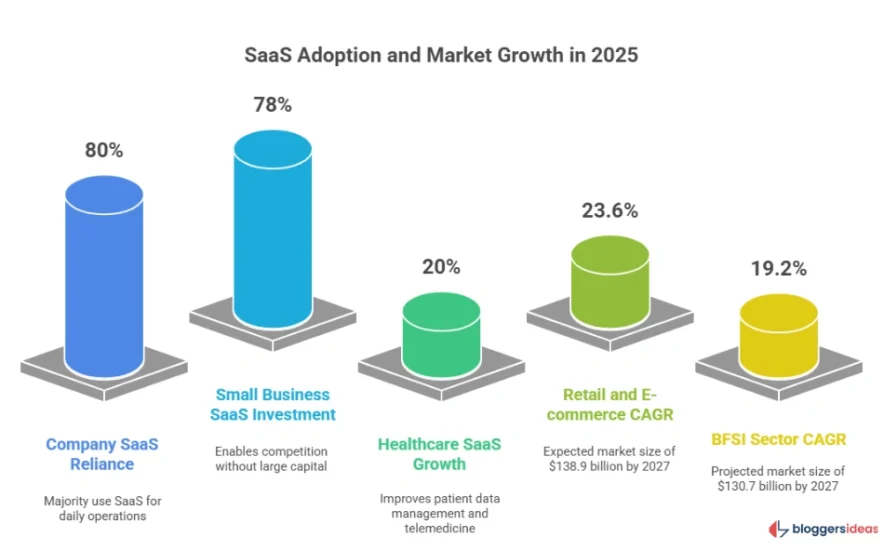
Industries across the board adopt SaaS applications to integrate seamlessly into their workflows. More than 80% of companies rely on at least one SaaS tool for daily operations, which simplifies processes and enhances collaboration.
A significant 78% of small businesses invest in SaaS solutions, enabling them to compete with larger entities without massive capital outlay.
SaaS adoption in healthcare grows at 20% annually, improving patient data management and telemedicine services. Larger organizations with over 10,000 employees use about 447 SaaS applications on average, demonstrating the model’s versatility.
The retail and e-commerce sectors expect a CAGR of 23.6%, reaching $138.9 billion by 2027. The global BFSI sector will attain $130.7 billion by 2027, with a 19.2% CAGR.
Readers can apply these SaaS statistics 2025 by selecting tools that fit their industry; a retailer might implement SaaS inventory systems to optimize stock levels and reduce waste, ultimately boosting profits.
SaaS Usage Statistics
Businesses utilize SaaS to achieve quicker results and better experiences. Eighty percent of organizations employ at least one SaaS application, emphasizing its role in modern operations.
Seventy percent of CIOs prefer SaaS for its flexibility and scalability, allowing teams to adjust resources as needed. By the end of 2024, nearly every company uses at least one SaaS solution, and experts predict 85% of business apps will be SaaS-based by 2025.
Organizations increase their SaaS app usage from 80 in 2020 to 130 in 2022, showing a rapid shift to cloud environments. On average, companies use 112 SaaS apps, with smaller firms (under 200 employees) averaging 42 and large ones (over 5,000 employees) reaching 158.
Companies spend between $1,000 and $3,500 per employee annually on SaaS. Seventy-one percent of organizations plan to invest in AI-powered software, integrating intelligence into their workflows.
The table below breaks down average SaaS apps by company size.
| Company Size | Average SaaS Apps |
| 1-199 employees | 42 |
| 200-749 employees | 103 |
| 750-1,499 employees | 86 |
| 1,500-4,999 employees | 142 |
| 5,000+ employees | 158 |
These figures illustrate how SaaS becomes standard. Businesses can benefit by auditing their app usage to eliminate redundancies, ensuring they maximize value from subscriptions.
SaaS Customer Retention and Churn Statistics

SaaS companies maintain customer loyalty through reliable service and continuous improvements. A good churn rate for SaaS targeting small businesses stands at 3-5%.
Businesses generate 65% of revenue from returning customers, who spend 67% more than new ones. Retaining existing customers costs five times less than acquiring new ones. Increasing retention by 5% can boost profits by 25% to 95%.
Readers can use these SaaS statistics 2025 to focus on customer success strategies, such as offering personalized onboarding, which reduces churn and fosters long-term relationships.
SaaS Pricing Model Statistics
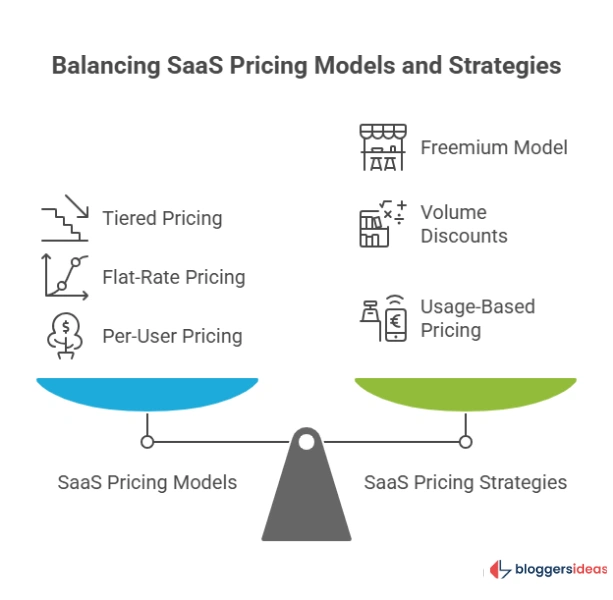
SaaS providers offer various pricing models to suit different needs, with per-user pricing emerging as the most popular due to its simplicity.
Tiered, flat-rate, and usage-based options also exist. Price inflation for SaaS products reaches 8.7%, making subscriptions nearly 9% more expensive than the previous year.
Over 94% of B2B SaaS leaders adjust pricing annually, with 40% doing so quarterly. Only 10% use cost-plus pricing.
Fifty-four percent of SaaS businesses employ per-user models. Businesses can negotiate better terms by understanding these models, potentially saving on costs while scaling usage.
SaaS Security and Compliance Statistics
Organizations prioritize security in SaaS environments to protect sensitive data. In the last two years, 55% faced a SaaS security incident, and 12% remain uncertain.
Fifty-eight percent report their solutions cover 50% or less of applications, with 7% lacking monitoring. Thirty-one percent experienced data breaches, up 5% from last year.
Thirty-eight percent worry about data risks from generative AI. Fifteen percent centralize SaaS security within cybersecurity teams.
Seventy percent of organizations have dedicated SaaS security teams, and 70% achieve moderate to full visibility. Businesses can enhance protection by choosing providers with robust compliance features, ensuring data integrity and regulatory adherence.
Regional SaaS Market Statistics
SaaS markets vary by region, with the United States dominating due to its innovation ecosystem. The table below lists SaaS companies by country.
| Country | Number of SaaS Companies |
| United States | 9,100 |
| United Kingdom | 1,500 |
| Canada | 992 |
| Germany | 840 |
| India | 711 |
| France | 684 |
| China | 443 |
| Australia | 408 |
| Netherlands | 402 |
| Brazil | 342 |
The U.S. accounts for 46% of the market, with North America’s value at $131.18 billion in 2023. Germany leads Europe, while China tops Asia Pacific, followed by Japan and India.
India’s SaaS market is projected to reach $20-25 billion by 2025, offering opportunities for global expansion. Businesses can enter emerging markets like India by localizing products, tapping into growing demand for affordable cloud solutions.
SaaS Marketing and Sales Statistics
SaaS companies allocate about 15% of annual budgets to marketing, employing tactics like email (84%), social media advertising (75%), and content marketing (69%).
B2B SaaS sales cycles average 69 days. Companies lose 18% of contract value to discounts. Forty-seven percent of users review 3-5 content pieces before contacting sales. Blogs help SaaS firms gain 67% more leads.
In 2025, only 41% of software sales reps hit quotas, reflecting a competitive market. Businesses can improve sales by focusing on value-driven content, attracting qualified leads and shortening cycles.
SaaS Startup Funding Statistics
Venture capitalists invest heavily in SaaS startups, with U.S. firms raising $17.4 billion in 2023 across 880 rounds. In 2024, funding reaches $4.7 billion across 282 rounds by May.
SaaS captures 47% of VC funding in 2023, up from 36% in 2019. Worldwide, SaaS startups secure $72.3 billion in H1 2024.
The table below shows global VC investments in SaaS since 2020.
| Year | VC Investment (Billion USD) |
| 2020 | 118.7 |
| 2021 | 276.9 |
| 2022 | 209.3 |
| 2023 | 186.8 |
| 2024 (H1) | 72.3 |
Early-stage funding hits $10.3 billion in H1 2024, down 20.16%. Enterprise SaaS receives $21.9 billion in Q2 2024. Startups can attract funding by demonstrating strong growth metrics, such as 15-25% monthly for early stages or 20-50% annually for mature ones.
The Use of AI in SaaS
AI integrates deeply into SaaS, enhancing features and user experiences. The global AI SaaS market values at $101.73 billion in 2025, growing at 39.4% CAGR to 2032.
Seventy percent of SaaS companies with AI features experiment or monetize them. Thirty-nine percent cite implementation costs as a challenge. Ninety-one percent of organizations use unmanaged AI tools.
Eighty percent of companies will use AI by 2025. Latest trends include generative AI for content creation, AI agents for automation, multimodal AI handling text and images, quantum computing for complex calculations, and edge computing for faster processing.
Businesses can leverage AI SaaS for predictive analytics, personalizing customer interactions and improving decision-making.
SaaS Companies Statistics
Leading SaaS companies set benchmarks for success. Salesforce generates $34.86 billion in 2024, holding 21.7% of the CRM market with over 150,000 customers.
Microsoft earns $77.73 billion from productivity and $105.36 billion from intelligent cloud. Over 1.2 million U.S. companies use Microsoft 365, with Azure projected at $200 billion by 2028. Top SaaS firms see 26.6% average stock price increases in 2024.
Financial services lead with $25.6 billion revenue and 133,100 employees. Businesses can partner with these giants for reliable tools, ensuring seamless operations.
SaaS Industry Trends
AI and machine learning become essential in SaaS, improving automation and personalization. Remote work demands boost collaboration tools for distributed teams.
Low-code and no-code platforms empower non-technical users to build apps, accelerating workflows. Cyber threats prompt stronger security measures.
In 2025, AI saturation challenges startups, with enterprise SaaS facing 32% shutdown rates. Discussions on platforms like Reddit highlight tougher sales environments and the need for daily product updates.
Quora users note India’s booming market and AI trends like agents and multimodal capabilities. Businesses can stay ahead by adopting these trends, such as using no-code tools to prototype ideas quickly.
1. What does the growth of the SaaS market mean for small businesses in 2025?
The growth of the SaaS market in 2025 means that small businesses gain access to affordable, scalable tools that level the playing field against larger competitors, allowing them to automate processes and focus on innovation without significant upfront investments.
2. How can companies reduce SaaS churn rates effectively?
Companies can reduce SaaS churn rates effectively by implementing personalized customer success programs, gathering regular feedback, and offering timely updates that address user needs, which fosters loyalty and encourages long-term subscriptions.
3. What role does AI play in SaaS trends for 2025?
AI plays a crucial role in SaaS trends for 2025 by enabling advanced features like predictive analytics and automation, which help businesses make data-driven decisions and improve operational efficiency.
4. Why should businesses prioritize SaaS security in 2025?
Businesses should prioritize SaaS security in 2025 because increasing cyber threats and data breaches can lead to significant financial and reputational damage, making robust protection measures essential for safeguarding sensitive information.
5. How do regional differences affect SaaS adoption strategies?
Regional differences affect SaaS adoption strategies by requiring tailored approaches, such as localizing pricing and features for markets like India or China, where growth is rapid but infrastructure varies.
Also Read:
- Android Usage Statistics
- Email Marketing Statistics
- Content Marketing Statistics
- Online Advertising Statistics
- Google Gemini Statistics
Conclusion
SaaS evolves as an indispensable tool for businesses, with 99% utilizing it for efficiency.
Companies plan AI integrations and no-code platforms, making SaaS accessible. These SaaS statistics 2025 provide a roadmap for leveraging opportunities.
