In 2025, personalization is reshaping customer interactions, driving higher engagement and revenue growth. 71% of shoppers are frustrated with impersonal experiences, while 76% prefer personalized ones.
AI accelerates this trend, with 95% of customer interactions relying on AI for faster, more accurate recommendations. Personalization boosts sales, as 80% of consumers are more likely to buy from brands offering tailored experiences.
However, challenges like data privacy and achieving omnichannel personalization remain. This article explores key personalization statistics and strategies to help businesses and consumers leverage this trend effectively.
The Current State of Personalization in 2026
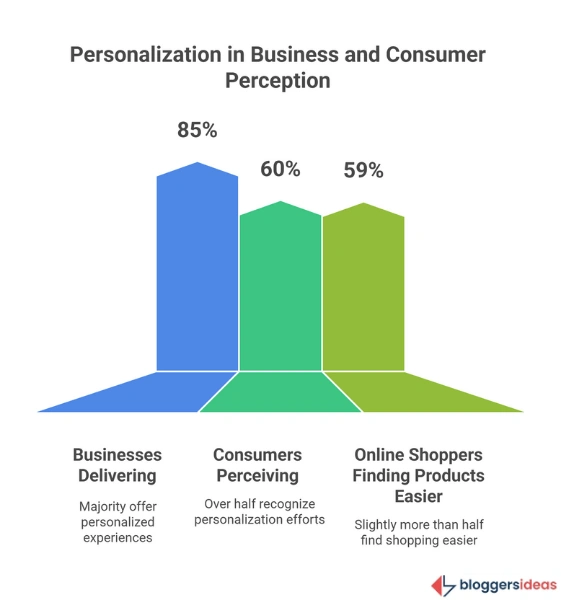
Businesses actively deliver personalized experiences to over 85% of their consumers, yet only 60% of those consumers actually perceive the interactions as tailored to them.
This gap underscores the need for more effective strategies that align business efforts with customer expectations. Companies address this by refining their data analysis to ensure personalization feels genuine and relevant. Readers can use this insight to evaluate their own brand interactions and seek out those that truly understand their preferences.
Online shoppers find personalized stores make product discovery easier, with 59% believing this approach streamlines their experience. Brands implement this through dynamic website content that adjusts based on user behavior. For businesses, adopting such features can reduce bounce rates and increase time spent on site.
Personalization statistics 2025 also show that 37% of brands rely solely on first-party data for customization, avoiding privacy issues associated with third-party sources. Readers benefit by sharing data with trusted brands to receive more accurate recommendations.
Consumers show 80% higher likelihood of purchasing from companies that provide tailored experiences, driving businesses to prioritize this in their operations. Retailers struggle with execution, as 96% report difficulties in implementing effective personalization. To overcome this, companies invest in training and tools that simplify the process.
In 2025, AI powers 95% of customer interactions, making personalization more efficient and scalable. Businesses use AI to automate chatbots and recommendations, ensuring every customer feels valued without manual intervention.
The recommendation engine market reaches $12 billion in 2025, up from $1 billion in 2018, reflecting the growing demand for personalized suggestions.
Companies analyze market data to offer these, boosting sales through relevance. Readers can apply this by using apps that provide custom recommendations, saving time in decision-making.
| Personalization Adoption Metrics | Percentage |
| Businesses delivering personalized experiences | 85% |
| Consumers perceiving personalized experiences | 60% |
| Online shoppers finding products easier in personalized stores | 59% |
| Brands using only first-party data | 37% |
| Consumers more likely to purchase from tailored experiences | 80% |
| Retailers struggling with personalization execution | 96% |
| Customer interactions driven by AI in 2025 | 95% |
Consumers lose loyalty to brands without personalization, with 62% reporting this issue. Businesses counteract this by focusing on understanding customer needs, as 66% of customers expect brands to do so.
Satisfaction increases for 52% of customers due to personalization, encouraging repeat business. Readers can leverage this by choosing brands that remember their preferences, enhancing their overall shopping satisfaction.
Investment and Market Growth in Personalization
Companies invest actively in personalization, with 90% of online businesses allocating resources to it. This investment pays off, as personalization supports business growth and attracts funding.
Beauty startups raised $1 billion in 2021 for personalized products, and the trend continues into 2025 with even more capital flowing in. Businesses like Function of Beauty create custom hair care through quizzes, demonstrating how personalization serves as a unique selling point.
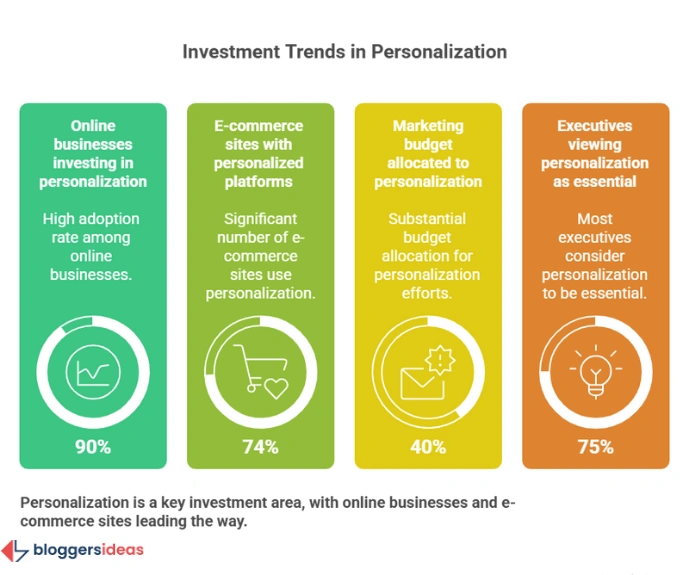
E-commerce sites personalize their platforms, with 74% doing so to attract customers. This extends to emails and ads, where tailored content drives engagement.
Readers can benefit by building their own online stores with personalization tools, increasing visitor retention. Marketing decision-makers view personalization as essential for success over the next three years, with 89% agreeing on this. Executives see it as critical for digital experiences, allocating 40% of budgets to it, nearly double from previous years.
The customer experience software market projects to hit $11.6 billion by 2026, growing from $7.6 billion in 2021. This growth reflects the demand for tools that enable seamless personalization.
Businesses face challenges like budget constraints, cited by 43% as the biggest hurdle. To navigate this, companies start small with free AI tools before scaling up.
| Investment Trends | Details |
| Online businesses investing in personalization | 90% |
| E-commerce sites with personalized platforms | 74% |
| Marketing budget allocated to personalization | 40% |
| Market size projection by 2026 | $11.6 billion |
| Executives viewing personalization as essential | 75% |
Retail businesses invest in personalization tools, with 79% doing so to enhance customer experiences. Marketers aim to improve interactions, with 88% focusing on this through personalization.
Content serves as the primary format for delivery, used by 62% of marketers. Readers can implement this in their marketing by segmenting audiences and creating targeted content.
AI-Driven Personalization in 2026
AI transforms personalization by enabling hyper-personalized experiences at scale, as discussed in recent user queries on platforms like Quora.
Users ask how AI tools lead this change, emphasizing automated content and smarter advertising. Businesses leverage AI for 92% of their personalization tactics, driving growth through accurate recommendations. AI improves real-time speed for 44% of companies and boosts retention for another 44%.
Marketing professionals integrate AI as a critical strategy for the next year, with 74% saying so. Only 17% use it extensively now, but 84% believe in its potential. Consumers expect higher engagement from AI-driven experiences, with 63% anticipating this. Businesses automate tasks with AI, using it for content creation in 37% of cases.
From Reddit discussions, users highlight AI-powered personalization alongside short-form video and authentic content. They inquire about blending AI with creator content for better segmentation. AR/VR emerges as a trend, with immersive experiences enhancing personalization. Small businesses use AI chatbots to elevate customer service, providing instant, tailored support.
Personalization statistics 2025 show that 73% of leaders agree AI reshapes strategies fundamentally. Companies adopt generative AI for 1:1 experiences, adjusting messaging dynamically. Readers can benefit by using AI tools in their apps or websites to predict needs and offer proactive solutions.
| AI Personalization Metrics | Percentage |
| Businesses using AI-driven tactics | 92% |
| Leaders saying AI reshapes strategies | 73% |
| Marketers using AI critically in strategies | 74% |
| Consumers expecting higher engagement from AI | 63% |
| Companies improving speed with AI | 44% |
Voice search optimization gains traction, as users on Quora ask about its role in personalization. Businesses optimize for conversational queries to deliver relevant results. Interactive short-form videos personalize content, engaging viewers with tailored narratives.
ROI and Conversion Benefits from Personalization
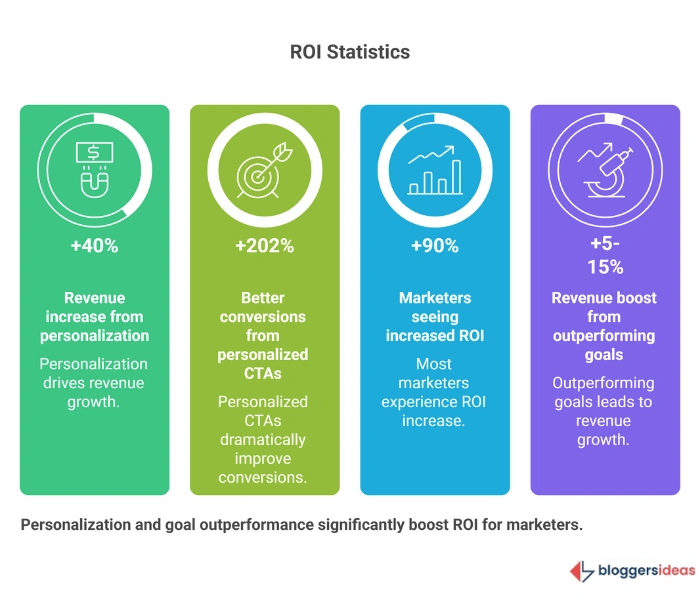
Companies generate 40% more revenue through personalized experiences, according to personalization statistics 2025. Fast-growing firms outpace competitors by this margin, emphasizing personalization’s role in growth. Businesses could unlock $1 trillion in the US by enhancing efforts. Personalized calls to action boost conversions by 202%, outperforming generic ones.
Marketers see increased ROI, with 9 out of 10 reporting better returns. Personalization enhances profitability for 90% of leading marketers. Businesses that outperform revenue goals invest in personalization, with 79% doing so. This leads to 5% to 15% revenue increases on average.
Personalized emails improve open rates by 26% and click-through rates, as noted by 75% of marketers. Transactions rise six times with tailored emails. In advertising, retargeted ads achieve 10x better click-through rates. Revenue increases by 38% with transparent targeted ads.
| ROI Statistics | Impact |
| Revenue increase from personalization | 40% |
| Better conversions from personalized CTAs | 202% |
| Marketers seeing increased ROI | 90% |
| Revenue boost from outperforming goals | 5-15% |
| Email open rate increase | 26% |
| Ad CTR improvement from retargeting | 10x |
Consumers prefer personalized ads, with 40.5% aligning them to interests. Businesses use this to avoid irrelevant content, which frustrates 77%. Readers can apply personalization in their campaigns to measure direct sales uplifts.
Customer Loyalty and Engagement Through Personalization
Consumers purchase more from personalized brands, with 76% more likely to do so. They recommend such brands, as 78% report. Loyalty impacts 70% of consumers when needs are addressed. Frustration from impersonal experiences affects 71%, leading to 63% customer loss.
Personalization increases satisfaction for 52% of customers, encouraging repeat buys. After tailored experiences, 60% become repeat buyers. Businesses reduce acquisition costs by 28% with personalization. Leaders report improved retention, with 62% seeing this.
Gen Z avoids impersonal brands, with 49% less likely to buy. Personalized messages engage 72% of customers. In e-commerce, 92% influence purchases through cart recommendations, and 56% revisit sites with them.
| Loyalty Metrics | Percentage |
| Consumers more likely to purchase | 76% |
| Repeat buyers after personalization | 60% |
| Improved retention reported | 62% |
| Engagement with personalized messages | 72% |
| Gen Z less likely to buy without it | 49% |
Customers expect understanding, with 66% demanding it. Businesses build loyalty by treating customers as individuals, appealing to 84%. Readers foster loyalty by engaging with brands that personalize, sharing feedback to improve experiences.
Data Privacy and Consumer Trust in Personalization
Consumers appreciate personalization based on shared data, with 69% agreeing. They trust companies less, with only 37% doing so. Businesses value first-party data most, with 78% considering it key. Privacy regulations challenge 50% of companies, prompting tech upgrades for 53%.
Personalization statistics 2025 show 83% of customers share data for tailored experiences. However, 28% dislike use of unshared info. Marketers struggle with data inconsistencies, affecting 57%. Businesses respond by emphasizing transparency and control.
From Quora and Reddit, users ask about ethical personalization, demanding fairness and explainable AI. They inquire how to balance data use with privacy, suggesting preference centers. Businesses implement zero-party data collection through interactive content.
| Privacy Statistics | Percentage |
| Appreciation for shared-data personalization | 69% |
| Trust in companies with data | 37% |
| Value of first-party data | 78% |
| Challenges from privacy regulations | 50% |
| Customers sharing data for experiences | 83% |
Readers protect their data by reviewing privacy policies and opting for brands with clear value exchanges.
Omnichannel Personalization Challenges
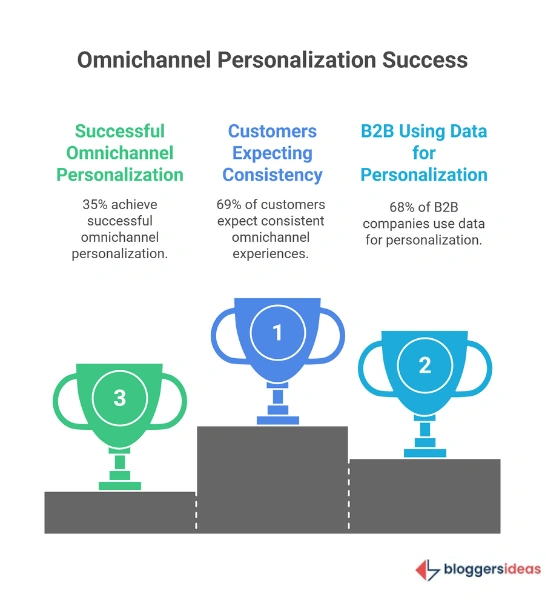
Companies achieve omnichannel personalization in only 35% of cases, hindered by silos and outdated tech. Customers expect consistency across channels, with 69% demanding it. Businesses struggle with real-time data, affecting 43%.
B2B companies use data for website personalization, with 68% doing so. They personalize site search results for 58%, proving effective. Challenges include unifying data from systems, achieved by 67%.
| Omnichannel Metrics | Percentage |
| Successful omnichannel personalization | 35% |
| Customers expecting consistency | 69% |
| Struggle with real-time data | 43% |
| B2B using data for personalization | 68% |
| Personalized site search effectiveness | 58% |
Businesses invest in improving user experiences, with 63% of B2B firms doing so. Readers benefit by choosing brands that maintain personalization across apps, websites, and stores.
Benefits of Personalization and Implementation Strategies
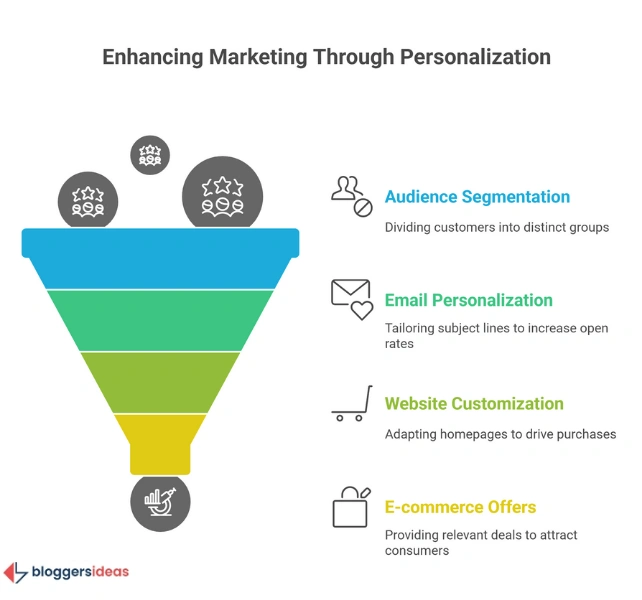
Personalization increases marketing efficiency by 30% and advances relationships for 98% of marketers. Visitor engagement improves for 55%. Businesses implement by starting with customer data collection and segmenting audiences.
For emails, personalize subject lines to boost opens. On websites, customize homepages, prompting 85% of purchases. In e-commerce, offer relevant offers, appealing to 91% of consumers.
Readers apply this by using tools like CDPs, which 72% of businesses employ. Address challenges like lack of data, affecting 39% of marketers, by building robust collection methods.
FAQs About Personalization Statistics
1. What does personalization mean in business contexts?
Personalization in business contexts means tailoring products, services, and communications to meet individual customer preferences and behaviors, using data to create unique experiences that make customers feel valued and understood.
2. How can small businesses start implementing personalization?
Small businesses can start implementing personalization by collecting first-party data through customer surveys and website interactions, then using affordable AI tools to deliver targeted emails and product recommendations that align with customer needs.
3. Why is AI important for personalization in 2025?
AI is important for personalization in 2025 because it enables real-time analysis of customer data, automates tailored interactions, and scales customization efforts to handle large audiences efficiently while improving accuracy and engagement.
4. What are the main challenges in achieving effective personalization?
The main challenges in achieving effective personalization include managing data privacy concerns, unifying information from multiple sources, and overcoming budget constraints to invest in the necessary technology and training.
5. How does personalization impact customer loyalty?
Personalization impacts customer loyalty by making interactions more relevant and satisfying, which encourages repeat purchases, reduces churn, and fosters positive recommendations to others, ultimately strengthening long-term relationships with the brand.
Also Read:
- Infographics Statistics
- YouTube Statistics
- Marketing Automation Statistics
- Chatbot Statistics
- Google Gemini Statistics
Conclusion:
Personalization evolves with hyper-personalization and emotion AI, as users on Reddit discuss. They ask about AI-driven journeys and first-party data dominance amid privacy tightenings. By 2026, predictive content will autonomous campaigns.
Quora users inquire about AR/VR for immersive personalization, integrating with voice search. Businesses prepare by adopting these technologies for adaptive experiences.
Ethical aspects gain focus, with users seeking inclusive designs. Personalization statistics 2025 project more investment, with 66% of companies planning increases.
In conclusion, personalization drives business success in 2025, offering tailored experiences that benefit both companies and customers. By implementing these strategies, readers can enhance their interactions and achieve growth.