Marketing automation is revolutionizing business operations in 2025 by streamlining tasks and boosting efficiency. With 96% of marketers either using or planning to adopt these platforms, automation helps businesses save time and focus on growth-driven strategies.
By integrating AI for personalized campaigns, marketing automation drives higher ROI, with 75% of email revenue coming from triggered emails. The global market is expected to reach $7.47 billion in 2025, reflecting rapid growth.
This article offers key insights into how marketing automation enhances productivity, improves customer satisfaction, and helps businesses achieve measurable results.
General Marketing Automation Statistics in 2026
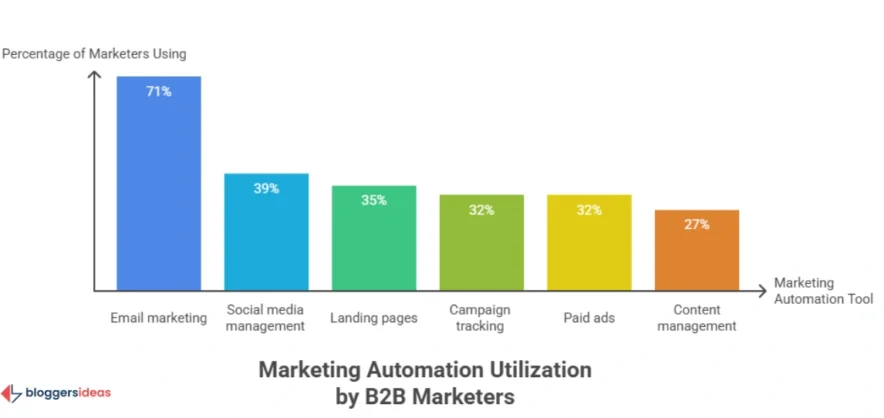
Businesses widely adopt marketing automation to enhance their operations, with 75% using at least one form of these tools. Marketers find that automation makes their strategies 46% more effective, allowing them to focus on high-impact activities.
Companies report that 91% of users view marketing automation as vital for online marketing success. Professionals in marketing and communications rely on these tools daily, with 86% incorporating them into their routines.
Organizations recognize the importance of actionable analytics, as 59% of B2B marketers in the US consider this feature crucial when choosing software. Marketers utilize automation across various fields, ensuring comprehensive coverage of their campaigns.
| Utilization of Marketing Automation by B2B Marketers | Percentage |
| Email marketing | 71% |
| Social media management | 39% |
| Landing pages | 35% |
| Campaign tracking | 32% |
| Paid ads | 32% |
| Content management | 27% |
Source: Statista
Marketers plan to expand their use of automation, with 63% expecting budget increases. Companies feel new to the concept in some cases, as 27% work to learn more about it.
Users prioritize ease of use, with 86% citing this as essential. Businesses see automation as a way to save time and money, automating tasks that once required manual effort.
Also read about: Digital Marketing Statistics
Marketing Automation Trends Shaping 2026
Marketers embrace new trends in automation to stay competitive, focusing on improved targeting and efficiency. Users aim to enhance campaign targeting, with 22% identifying this as their main goal. Companies nurture leads through automation, as 66% report using it for this purpose.
| Crucial Reasons for Using Marketing Automation | Percentage |
| Increasing lead generation | 61% |
| Increasing sales revenue | 47% |
| Nurturing leads | 57% |
| Improving customer engagement | 36% |
| Increasing marketing productivity | 29% |
| Improving campaign measurability | 28% |
| Improving campaign targeting | 22% |
Businesses apply automation in diverse areas, ensuring broad application across their strategies. Marketers automate email marketing most frequently, with 65% doing so. They manage social media through automation, as 47% report this usage.
| Areas Where Users Utilize Marketing Automation | Percentage |
| Email marketing | 65% |
| Social media management | 47% |
| Landing pages | 30% |
| Paid ads | 28% |
| Campaign tracking | 25% |
| Content management | 23% |
| SEO efforts | 18% |
| Account-based marketing | 18% |
| SMS marketing | 17% |
| Lead scoring | 17% |
| Workflows/automation visualization | 16% |
| Sales funnel communications | 14% |
| Push notifications | 13% |
| Live chat | 13% |
| Dynamic web forms | 12% |
Source: eMarketer
Companies start using automation platforms for the first time, with nearly 50% adopting them in the last decade. Marketers rank automation highly among digital techniques, as 17.4% consider it one of the most effective. Businesses achieve ROI quickly, with 76% seeing returns within the first year.
Users streamline marketing and sales efforts, with 35% citing this as a top reason. Marketers use more automation technologies than sales teams, with 76% higher usage.
| Top Reasons for Using Marketing Automation | Percentage |
| Streamlining marketing and sales efforts | 35% |
| Improving customer engagement | 34% |
| Minimizing manual tasks | 30% |
| Increasing number of leads captured | 28% |
| Optimizing workflows | 25% |
| Improving lead quality | 24% |
| Integrating/centralizing data | 21% |
| Improving marketing attribution | 17% |
| Improving multi-channel touch | 10% |
From recent discussions on Quora, users highlight AI-powered hyper-personalization as a dominant trend in 2025, where AI analyzes real-time data to create customized content and campaigns.
They discuss how predictive analytics will improve customer behavior forecasting, enabling proactive marketing. On Reddit, marketers share experiences with AI-generated content and automated email sequences, noting these deliver real ROI by scaling personalization without extra effort.
Users ask about integrating AI tools like Salesforge for automated cold emails, emphasizing how these revolutionize sales automation in 2025.
Also read about: Email Marketing Statistics
Marketing Automation Market Size and Growth Projections

The marketing automation industry expands rapidly, reaching $344.8 billion worldwide in 2021. Organizations adopt these tools widely, with 81% of marketing teams using them.
Content marketing teams incorporate automation, as 19% report usage. The market size projects to hit $13.71 billion by 2030, growing at a CAGR of 12.9% from 2021.
Revenue forecasts show steady increases, reflecting strong demand.
| Marketing Automation Market Revenue (Worldwide) | Amount |
| 2021 | $4.79 billion |
| 2022 | $5.19 billion |
| 2023 | $5.86 billion |
| 2024 | $6.62 billion |
| 2025 | $7.47 billion |
| 2026 | $8.44 billion |
| 2027 | $9.53 billion |
| 2028 | $10.76 billion |
| 2029 | $12.14 billion |
| 2030 | $13.71 billion |
Solution vendors expect revenue to reach $6.6 billion by 2026, up from $2.9 billion in 2020. Marketers anticipate budget growth, with 61% expecting increases. HubSpot leads the market with 38.27% share, followed by Adobe Experience Cloud at 7.97%.
| Leading Marketing Automation Software Tools | Market Share Percentage |
| HubSpot | 29.51% |
| Adobe Experience Cloud | 12.11% |
| Oracle Marketing Cloud | 8.63% |
| Active Campaign | 8.01% |
| Salesforce Pardot | 4.89% |
Over 398 companies offer marketing automation solutions as of 2024, providing diverse options. The global market will reach $21.7 billion by 2032, according to updated projections. HubSpot serves over 300,000 companies, demonstrating its popularity. Over 430 providers compete in the space, offering features for various needs.
From Quora, users share that the market will grow to USD 22.4 billion by 2033 with a 13.85% CAGR, driven by AI integration. On Reddit, discussions focus on how small businesses can access affordable tools amid this growth, with users recommending starting with free trials to test ROI.
Also read about: Video Marketing Statistics
Lead Generation Through Marketing Automation
Businesses prioritize lead generation, with 92% using automation to enhance their qualified lead pipeline. Marketers nurture leads effectively, as 66% apply automation for this. Industry leaders measure success through conversion rates and revenue, with 58% focusing on these metrics.
Marketing departments increase conversions, with over 75% seeing improvements after implementation. B2B organizations use automation extensively, with 46% doing so. They streamline processes across channels, as 78% rely on it for complexity management.
Users generate more leads, with 80% reporting increases. Video automation boosts qualified leads by 451%, providing a powerful tool. Readers can benefit by integrating automation into their lead funnels, starting with simple triggers for follow-ups.
Email Automation Statistics for 2025
Small businesses send automated campaigns, with 50% using software for this. Targeted emails generate 18 times more revenue, enhancing profitability. Personalized emails achieve 46% higher open rates, encouraging engagement.
Triggered emails outperform newsletters, with 38% open rates versus 18.7%. Welcome emails reach 86% open rates, setting strong first impressions. Cart abandonment emails hit 29.64% opens, recovering lost sales.
Triggered emails boast 152% higher click-through rates and 70.5% higher opens than generics. Personalized campaigns produce 75% of email revenue, driving significant income. Businesses send relevant messages 133% more often with automation.
Email automation ranks as the fourth most known tactic among companies. Marketers automate email most, with 63% usage. They plan further implementation, with 28% adding it soon.
From Reddit, users note that email marketing in 2025 becomes smarter with AI-driven segmentation and interactive elements, focusing on hyper-relevant messaging to comply with stricter privacy laws.
Social Media Automation Statistics
Small businesses manage handles through automation, with 47% using software. Marketers automate social media second most, at 47%. Teams save 6 hours weekly by automating content and ads.
Companies save 175 hours monthly by automating 50% of comment moderation. Marketers handle multiple responsibilities, with 64% benefiting from automation. They plan to implement it, with 29% adding social management.
On Quora, users predict social commerce and live shopping will integrate with automation for seamless experiences in 2025.
Customer Service Automation Statistics
Users retain customers through automation, with 81% focusing on this. Omnichannel approaches yield 90% higher retention than single-channel. Chatbots reduce support costs by 30%, improving efficiency.
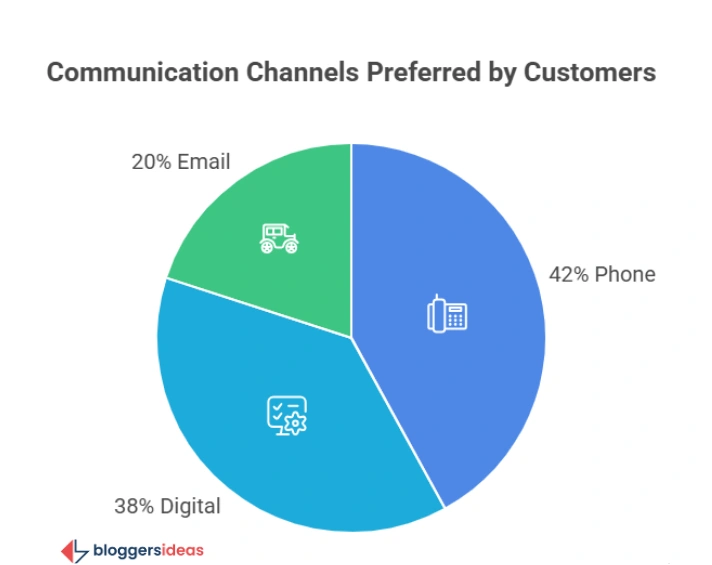
Customers expect quick responses on social media, within 24 hours. Agents feel overwhelmed by manual work, affecting 68%. Customers prefer phones for issues, with 42% choosing this.
| Communication Channels Preferred by Customers | Percentage |
| Digital channel | 38% |
| 20% | |
| Phone | 42% |
Marketers value tools that reduce reporting time, with 88% appreciating this. On Reddit, users discuss AI tools like Regie.ai for generating relevant copy, enhancing customer interactions.
Advertising Automation Statistics
Programmatic advertising valued at $129.1 billion in 2020, with 80% of ads predicted automated. Marketers upsell through automation, with 58% doing so. One-click upselling increases order size by 360%.
Personalized offers boost sales by 20%, based on history. Marketers automate paid ads, with 40% usage. They plan expansions, with 29% adding it.
Marketing Automation Tools and Features
HubSpot dominates with 34.72% market share, serving vast users. Marketers prioritize integration, with 55% valuing this. They consider lead scoring important, as 45% report.
| Important Features in Marketing Automation | Percentage |
| Integration with existing tools | 55% |
| Lead qualification and scoring | 45% |
| Email outreach and content creation | 35% |
| Social media content distribution | 24% |
Systems integrate partially for 39%, showing room for improvement.
| Integration Levels with Technology Stack | Percentage |
| Partially integrated | 39% |
| Mostly integrated | 29% |
| Not at all integrated | 25% |
| Entirely integrated | 7% |
Readers select tools like Active Campaign for ease, ensuring compatibility.
Benefits and Results of Marketing Automation
Users see improved lead generation, with 80% reporting this. Marketers handle repetitive tasks, with 36% citing this benefit. Productivity increases by 20%, allowing better focus.
Brands outperform competitors, with 63% achieving this. Sales productivity rises 14.5%, while overhead decreases 12.2%. Conversions increase for 77%, boosting revenue.
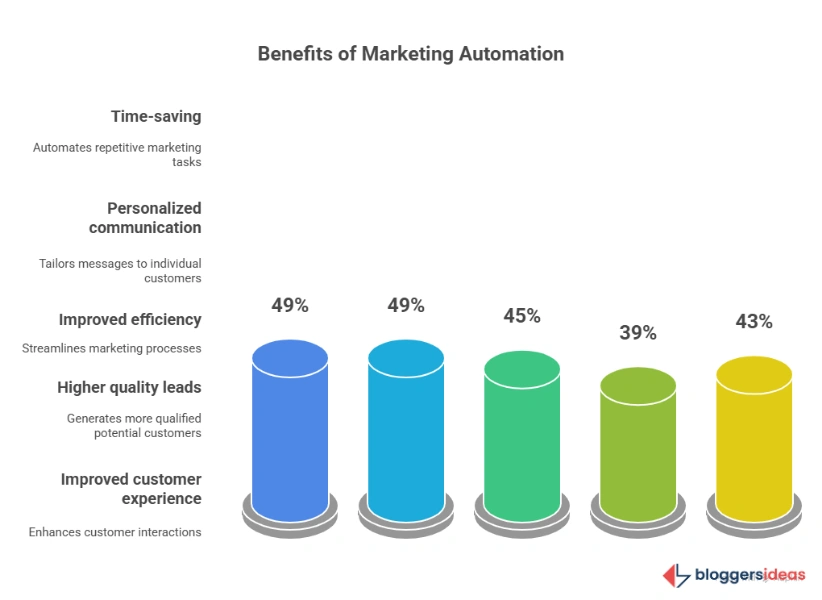
Leads grow for 80%, and time saves for 74%. B2B pipelines expand by 10%, enhancing opportunities. Personalized communications enable 49%, improving engagement.
| Crucial Benefits of Marketing Automation | Percentage |
| Time-saving on repetitive tasks | 49% |
| Personalized communication | 49% |
| Improved efficiency | 45% |
| Higher quality leads | 39% |
| Improved customer experience | 43% |
| Enables better use of time by staff | 38% |
| Better data and decision-making | 35% |
| Improved lead generation and nurturing | 34% |
Customer experience improves for 43%, fostering loyalty. Better data aids 35%, informing strategies. Marketers achieve objectives successfully, with 66% reporting somewhat success.
Challenges in Marketing Automation
Marketers underutilize tools, with 54% feeling this way. Users remain unsure, as 26% question maximization. Businesses face training lacks, with 39% citing this barrier.
| Major Challenges in Utilizing Marketing Automation | Percentage |
| Lack of training/knowledge | 39% |
| Lack of resources | 32% |
| Lack of budget | 31% |
Setup complexity challenges 25%, while experience lacks affect 33%. Priority issues impact 24%, and budgets constrain 23%. Systems complexity hinders 20%, and content creation challenges 16%.
B2B organizations struggle with strategies, with 49% noting this. Readers address these by investing in training and starting with simple tools.
The Use of AI in Marketing Automation
Businesses automate tasks intelligently, with 40% doing up to 10%. Marketers predict hyper-personalization impact, with 39% agreeing. Organizations explore AI use cases, as 44% report.
Skills development interests 40%, preparing for future. AI market value reaches $107.54 billion by 2028. Companies integrate AI for dynamic responses, enhancing traditional systems.
From Quora, users foresee AI transforming efficiency through predictive models and automation. On Reddit, marketers emphasize AI for content scaling and analytics, noting winners in 2025 use it fully.
AI enables hyper-personalization, with 77% using tools for content. Businesses classify journeys as automated, with 35% mostly or fully.
Future of Marketing Automation in 2025 and Beyond
Marketers optimize strategies, with 43% focusing on this. Data quality improves for 37%, aiding decisions. Customer identification prioritizes for 34%, refining targeting.
Multi-channel strategies automate fully for 5%, mostly for 21%. Platforms ease journey building, with 22% strongly agreeing. Purchase factors include price for 58%, ease for 54%.
CDP integration occurs for 18% in B2B. Benefits encompass experience for 43%, time use for 38%. Automation succeeds very for 25%, somewhat for 66%.
Quora users predict AI dominance with voice search and AR/VR integration. Reddit discussions highlight immersive experiences and sustainability branding, with automation central.
In conclusion, marketing automation drives success in 2025, offering tools for efficiency and growth. Readers implement these insights to enhance strategies and achieve results.
FAQs About Marketing Automation Statistics
1. What is marketing automation and how does it work?
Marketing automation involves using software to automate repetitive marketing tasks such as email campaigns and social media posts, where triggers based on customer behavior initiate personalized actions that streamline workflows and improve engagement.
2. How can small businesses benefit from marketing automation in 2025?
Small businesses benefit from marketing automation in 2025 by saving time on manual tasks, generating more leads through targeted campaigns, and competing with larger companies using affordable AI-integrated tools that enhance customer personalization.
3. What role does AI play in marketing automation trends for 2025?
AI plays a crucial role in marketing automation trends for 2025 by enabling hyper-personalization, predictive analytics, and real-time data analysis, which help businesses create dynamic campaigns that boost efficiency and ROI.
4. What are common challenges in implementing marketing automation?
Common challenges in implementing marketing automation include lack of training and knowledge among teams, integration issues with existing technology stacks, and budget constraints that limit access to advanced features.
5. How does marketing automation improve ROI for businesses?
Marketing automation improves ROI for businesses by delivering an average return of $5.44 for every dollar spent, through increased lead generation, higher conversion rates, and reduced marketing overhead from efficient, targeted campaigns.
Also Read:
Conclusion:
In conclusion, marketing automation is a game-changer for businesses in 2025, streamlining tasks and boosting efficiency. By automating repetitive processes like email campaigns and social media posts, businesses can focus on creativity and growth.
With the integration of AI, marketers can deliver personalized, targeted content that improves customer engagement and drives higher ROI.
Despite challenges like training and integration, marketing automation continues to evolve, helping businesses of all sizes generate leads, save time, and enhance customer experiences. By leveraging these tools, companies can stay competitive and achieve measurable success.