The Behavior Shift That Is No Longer Optional to Understand
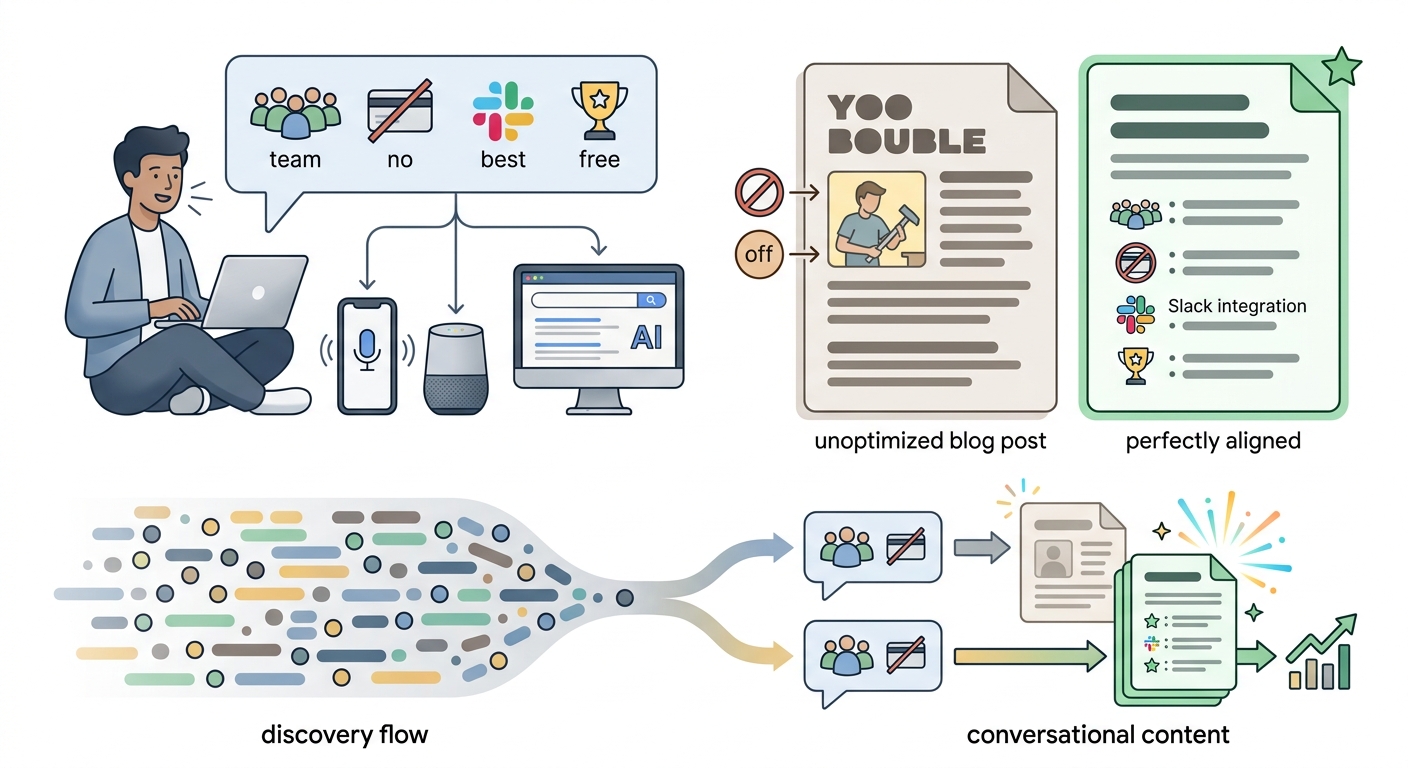
Voice and conversational discovery matter because buyers increasingly ask full questions in Google, AI tools, and assistants. Pages should mirror natural language and answer tasks clearly.
The voice search conversation has been running since 2016 and most bloggers either ignored it or checked a few boxes and moved on. In June 2026 it is no longer possible to ignore because the shift to conversational query patterns has merged with AI search in a way that affects every piece of content on every blog — not just content specifically optimized for voice assistants.
When users type “best free project management tool for remote team of five that integrates with Slack and does not require a credit card” into Google, they are using conversational, natural-language query patterns that look exactly like a voice query.
AI Overviews and Ask Maps both handle this query type by finding pages whose content directly addresses the specific attribute combination in the question. A blog post titled “Best Project Management Tools 2026” that never specifically addresses team size, Slack integration, and free tier availability is invisible to this query even if it is an excellent article otherwise.
The Natural Language Page Audit
The practical blog audit that converts existing content to perform better on conversational queries is simpler than most bloggers expect. Go through your top 10 articles by traffic and for each one ask: what is the most specific natural-language question a reader would ask to find this article?
Then check whether that specific question — or something very close to it — appears anywhere in the article. Ideally it should appear in the first 100 words as a direct, complete answer.
The local ranking game is becoming less about simple category relevance and more about attribute comprehension. Think less like a keyword tool and more like a real person speaking.
Thinking like a real person speaking is the content writing shift that matters most. Real people do not speak in keywords. They ask questions with context, constraints, and specific requirements baked in.
The blogger who writes as if answering a specific person’s specific question — rather than as if targeting a specific keyword — is producing content that matches conversational search patterns naturally, without the mechanical awkwardness of keyword insertion.
💬 Reddit — r/SEO and r/blogging on conversational search content optimisation: 🔗 https://www.reddit.com/r/SEO/search/?q=conversational+search+natural+language+blog+content+2026
🐦 X/Twitter — bloggers sharing conversational query optimization results: 🔗 https://x.com/search?q=conversational+search+voice+blog+SEO+2026&f=live
💬 Quora — how do bloggers optimize content for voice and conversational search in 2026: 🔗 https://www.quora.com/search?q=blogger+optimise+voice+conversational+search+2026
Quick Links: