Google rewrote the Core Web Vitals rulebook in March 2026 and a significant portion of websites that thought they were passing the metrics are now failing. The changes are concrete, documented, and already showing up in rankings data. This is not a future threat — it is happening right now.
The March 2026 Google core update brought the most significant changes to Core Web Vitals since the original 2021 rollout. Google lowered the Good LCP threshold from 2.5 seconds to 2.0 seconds. Sites with LCP between 2.0 seconds and 2.5 seconds now fall into the Needs Improvement zone. Sites with LCP above 2.5 seconds saw average ranking drops of 2 to 4 positions on competitive queries. INP moved from a supplementary metric to an equal ranking signal alongside LCP and CLS. ALM Corp
If your site had an LCP of 2.3 seconds before March 2026 and you had not checked it since, you went from passing to failing without changing a single line of code.
Fun Fact: Only 42% of mobile sites pass all three Core Web Vitals. Despite years of industry focus on performance, fewer than half of mobile experiences meet Google’s thresholds for LCP, INP, and CLS. Desktop pass rates are higher at 63%, but the mobile gap is where the revenue impact concentrates — mobile now accounts for 62% of all eCommerce traffic. mexc
Core Web Vitals Statistics 2026: Top Picks
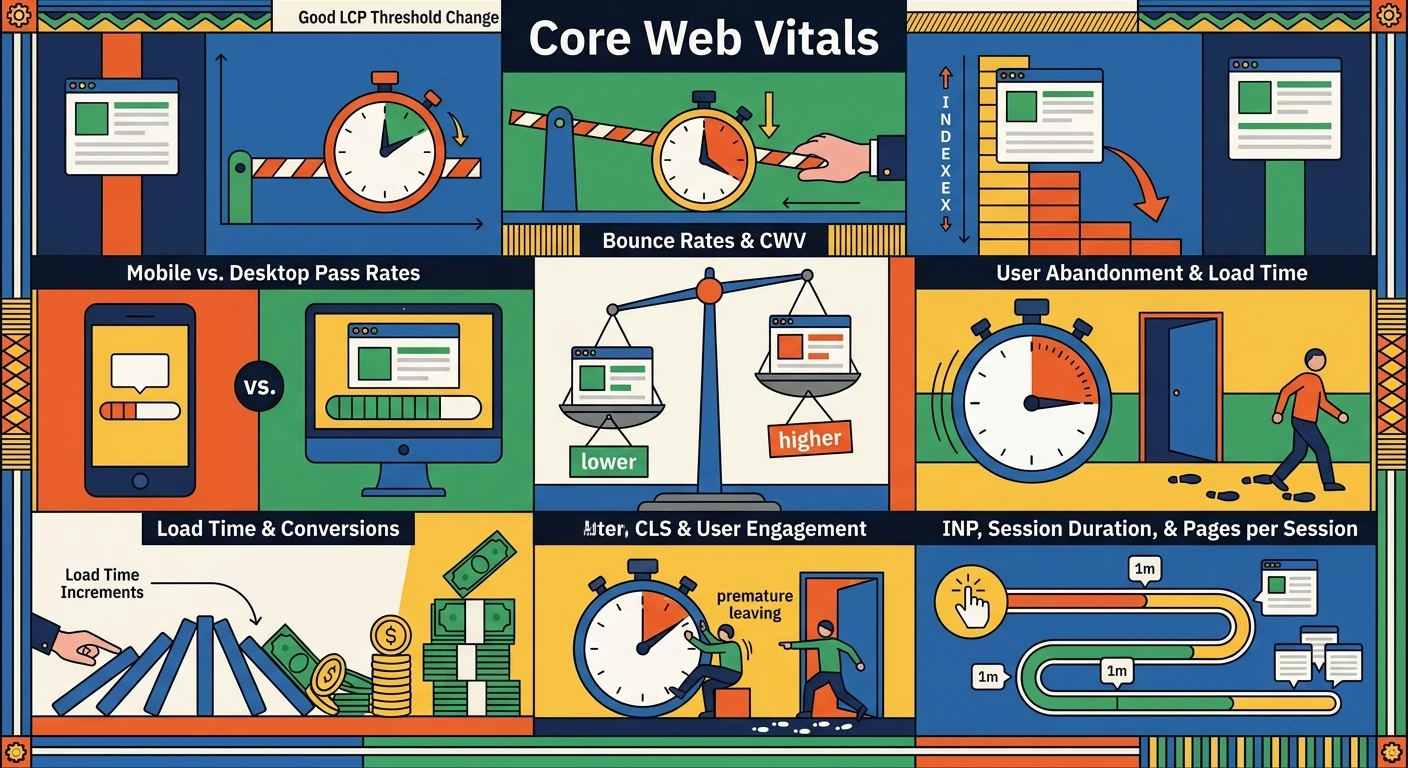
Google lowered the Good LCP threshold from 2.5s to 2.0s in the March 2026 core update. Sites with LCP above 2.5s saw average ranking drops of 2 to 4 positions. (Digital Applied, March 2026) ALM Corp
Only 42% of mobile sites pass all three Core Web Vitals. Desktop pass rates are 63%. (HTTP Archive / Google) mexc
Websites that pass all three CWV metrics see an average of 24% lower bounce rates than websites that fail. (Google) Foursixty
Every 100ms of load time costs approximately 1% in conversions. For an eCommerce site generating $10 million annually, a 500ms improvement translates to roughly $500,000 in recovered revenue. mexc
Over 50% of users abandon a page that takes more than 3 seconds to load. SQ Magazine
Websites with a CLS above 0.25 see an average of 38% more users leaving the page prematurely. (Google UX Research 2026) Foursixty
Improving INP by 100ms correlates with a 3.8% increase in session duration and 2.4% more pages per session. (Google) Foursixty
Improving site speed by just 0.1 seconds can boost conversions by up to 8%. SQ Magazine
The March 2026 Core Web Vitals Changes — What Actually Changed
Google confirmed both changes in a Search Central blog post published March 18, 2026, six days before the update began rolling out. The first change is the elevation of INP from a supplementary metric to a primary ranking signal with the same weight as LCP and CLS. The second is the downward adjustment of the LCP Good threshold, which reclassifies a segment of previously passing sites into Needs Improvement territory. Imagine.Art
This is the most consequential technical SEO change in 2026. Two changes happening simultaneously — a tighter LCP threshold and INP gaining full primary metric status — means many sites that were comfortable with their CWV status in February are now failing in March.
Metric | Pre-March 2026 | Post-March 2026 |
LCP Good threshold | Under 2.5s | Under 2.0s |
LCP Needs Improvement | 2.5s–4.0s | 2.0s–3.0s |
LCP Poor | Above 4.0s | Above 3.0s |
INP Good | Under 200ms | Under 200ms |
INP Status | Supplementary | Primary (equal to LCP) |
CLS Good | Under 0.1 | Under 0.1 |
Sites that passed CWV assessments under the old thresholds but have LCP between 2.0 seconds and 2.5 seconds are now flagged as Needs Improvement and have seen corresponding ranking pressure. Note that passing CWV assessment requires that at least 75% of real-user field data sessions fall in the Good range for every metric — a single failing metric fails the entire page. Imagine.Art
The 75th percentile rule is the practical catch that surprises many site owners. Passing CWV is not about your average experience — it is about whether 75% of real users have a Good experience. A site that loads fast on desktop for users with fibre connections may still fail if mobile users on 4G connections are experiencing LCP above 2.0 seconds.
What this means for you: Check your Google Search Console Core Web Vitals report today. Look specifically for pages that were previously passing that are now showing Needs Improvement. These are the pages where the March 2026 threshold change has reclassified your performance, and they are the priority for technical fixes.
Page Speed and Revenue — The Financial Case for Performance
The revenue impact data on page speed is some of the most compelling performance research ever published. Every millisecond of improvement has a measurable monetary value.
Every 100ms of load time costs approximately 1% in conversions. The speed-to-revenue relationship is now well-documented across industries. For an eCommerce site generating $10 million annually, a 500ms improvement in page load time translates to roughly $500,000 in recovered revenue. This is not a theoretical number — it is derived from aggregated A/B test data across thousands of sites. mexc
Load Time Improvement | Conversion Impact | Annual Revenue Impact ($10M site) |
100ms faster | +1% conversions | +$100,000 |
500ms faster | +5% conversions | +$500,000 |
1 second faster | +7–8% conversions | +$700,000–$800,000 |
3 seconds faster | +15%+ conversions | +$1,500,000+ |
Over 50% of users will abandon a page that takes more than 3 seconds to load. Research shows that improving site speed by just 0.1 seconds can boost conversions by up to 8%. SQ Magazine
Google’s research indicates that pages that load within 2.5 seconds have bounce rates up to 24% lower than those that are slower. Performance is no longer purely a technical concern — it has emerged as an explicit cause for concern in all ranking factors. SocialBee
Core Web Vitals Pass Rates — The Industry Landscape
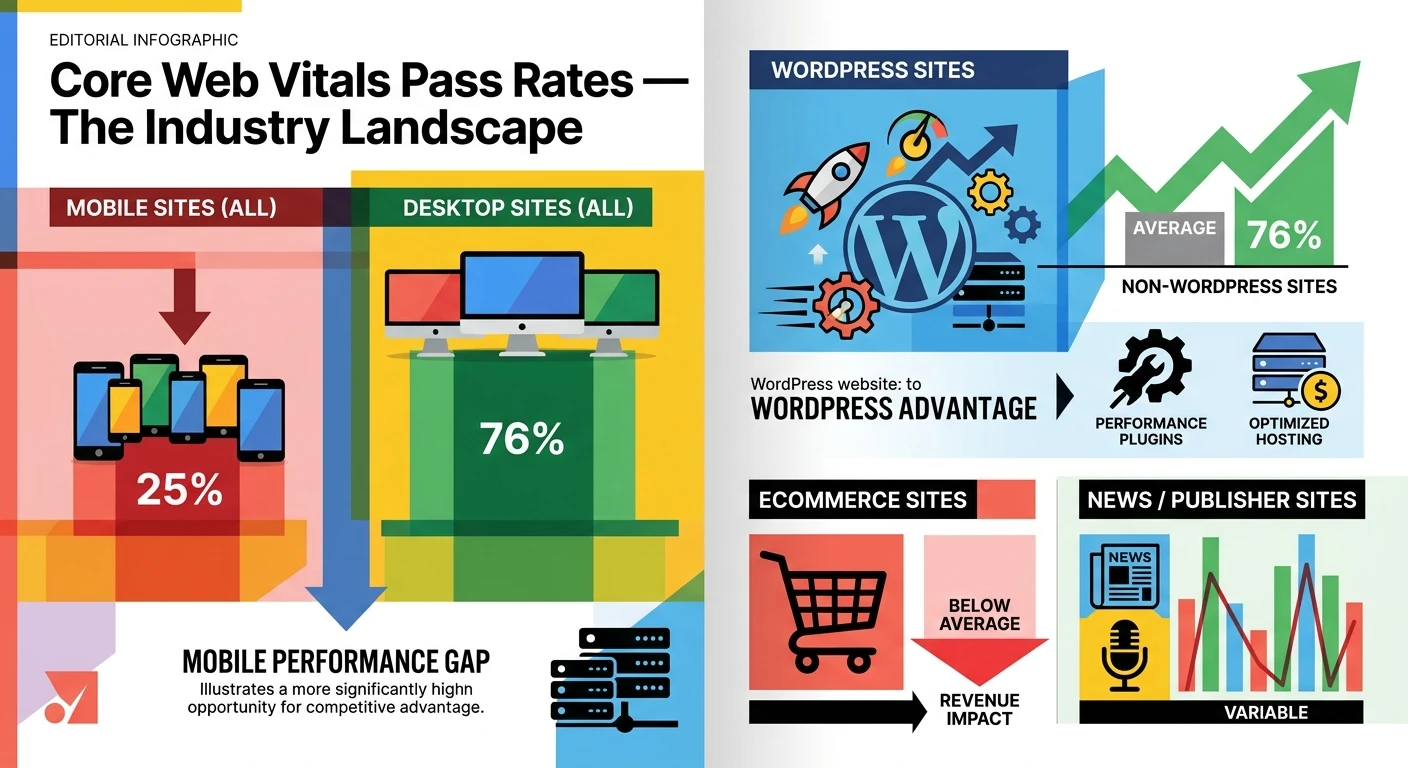
Understanding how your site compares to the broader web helps calibrate how much of a competitive advantage improving your CWV can generate.
Only 42% of mobile sites pass all three Core Web Vitals. Desktop pass rates are higher at 63%. Mobile accounts for 62% of all eCommerce traffic, meaning the mobile performance gap is where the largest revenue impact concentrates. mexc
Platform / Context | CWV Pass Rate |
Mobile sites (all) | 42% |
Desktop sites (all) | 63% |
WordPress sites | ~54% (12% above average) |
Non-WordPress sites | ~42% |
eCommerce sites | Below average |
News / publisher sites | Variable |
WordPress websites score 12% better on Core Web Vitals than average, thanks to performance plugins and hosting optimisations. (HTTP Archive WordPress Study) Foursixty
The WordPress finding is useful context. If you are on WordPress and using a performance-optimised theme with proper caching and image optimisation, you are starting from a better position than average. If you are on WordPress with a heavy theme, multiple page builder plugins, and unoptimised images, the 12% advantage evaporates quickly.
The Three Core Web Vitals Explained With Thresholds
LCP — Largest Contentful Paint
Measures how fast your main content loads. Think of it as the moment a user sees your hero image or headline fully appear. This is their first signal that your page is ready.
Score | Threshold (Post March 2026) |
Good | Under 2.0 seconds |
Needs Improvement | 2.0s–3.0s |
Poor | Above 3.0 seconds |
INP — Interaction to Next Paint
Measures how responsive your page is to user interactions throughout the entire visit — not just the first click.
Score | Threshold |
Good | Under 200ms |
Needs Improvement | 200ms–500ms |
Poor | Above 500ms |
Improving INP by 100ms correlates with a 3.8% increase in session duration and 2.4% more pages per session. Foursixty
CLS — Cumulative Layout Shift
Measures visual stability during page load — how much elements jump around while the page loads.
Score | Threshold |
Good | Under 0.1 |
Needs Improvement | 0.1–0.25 |
Poor | Above 0.25 |
Websites with a CLS above 0.25 see an average of 38% more users leaving the page prematurely. Foursixty
The Bounce Rate Connection
Websites that pass all three CWV metrics see an average of 24% lower bounce rates than websites that fail. Foursixty
The bounce rate and CWV relationship creates a positive feedback loop that compounds over time. Better performance reduces bounce rates. Lower bounce rates improve user engagement signals. Better engagement signals reinforce rankings. Higher rankings attract more quality traffic. More quality traffic generates more accurate real-user CWV field data, which further confirms the site’s performance quality.
CWV Status | Average Bounce Rate Impact | Long-Term SEO Effect |
All three passing | -24% bounce rate | Positive compounding |
One failing | Moderate negative | Gradual pressure |
Two failing | Significant negative | Clear ranking pressure |
All three failing | Severe negative | Active ranking suppression |
Benchmark Table: CWV Thresholds and Industry Targets
Metric | Poor | Needs Improvement | Good | Target for Competitive SEO |
LCP | Above 3.0s | 2.0s–3.0s | Under 2.0s | Under 1.5s |
INP | Above 500ms | 200ms–500ms | Under 200ms | Under 100ms |
CLS | Above 0.25 | 0.1–0.25 | Under 0.1 | Under 0.05 |
FCP (informational) | Above 3.0s | 1.8s–3.0s | Under 1.8s | Under 1.2s |
TTFB (informational) | Above 1.8s | 0.8s–1.8s | Under 0.8s | Under 0.4s |
Frequently Asked Questions
Google lowered the Good LCP threshold from 2.5 seconds to 2.0 seconds, pushing sites with LCP between 2.0 and 2.5 seconds into the Needs Improvement category. INP was also elevated to a primary ranking signal with equal weight to LCP and CLS.
Sites with LCP above 2.5 seconds saw average ranking drops of 2 to 4 positions after the March 2026 update, while poor INP scores caused average drops of 0.8 positions. The Good threshold requires 75% of real-user sessions to pass, not just best-case performance.
Only 42% of mobile sites and 63% of desktop sites pass all three Core Web Vitals. Failing on mobile is the higher-stakes issue since mobile drives 62% of eCommerce traffic.
Every 100ms of load time improvement correlates with roughly 1% more conversions. For a $10 million annual revenue site, a 500ms improvement can recover approximately $500,000 in revenue per year.
At minimum, check monthly using Google Search Console, or weekly if you are actively making site changes or running campaigns. Performance can silently drift as new images, scripts, and third-party tools accumulate over time.