A three-second audio clip. That’s all it takes to clone someone’s voice with enough accuracy to fool a bank, a family member, or a coworker. Coverage of this topic tends to lean on a single scary anecdote — a grandparent scammed, a CFO tricked into a wire transfer — without showing how widespread the underlying problem actually is. This article puts the anecdotes aside and works through the actual growth, scale, and financial data behind AI voice cloning fraud.
How the Technology Got This Easy
Capability | Figure |
Audio needed to clone a voice | ~3 seconds |
Accuracy of a clone made from that short a sample | ~85% |
Deepfake files in circulation, 2023 | ~500,000 |
Deepfake files in circulation, 2025 | ~8 million |
The jump from 500,000 to 8 million deepfake files in two years is a 16x increase. What used to require substantial audio samples, technical skill, and expensive software now takes seconds and is accessible through consumer-grade tools. That drop in the barrier to entry is the single biggest reason fraud volume has grown so quickly.
The Growth Numbers: How Fast This Is Actually Scaling
Metric | Growth Figure |
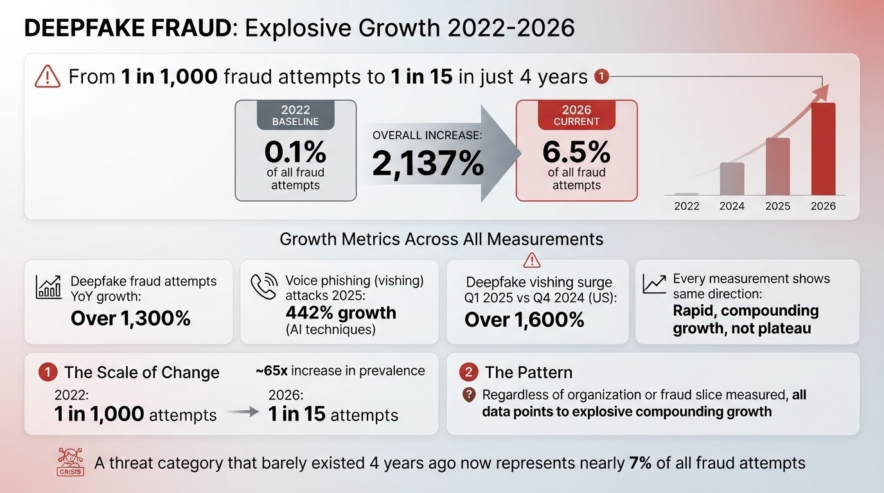
Deepfake fraud as a share of all fraud attempts, 2022 | ~0.1% |
Deepfake fraud as a share of all fraud attempts, 2026 | ~6.5% |
Overall increase over that period | ~2,137% |
Voice phishing (vishing) attack growth, 2025 | 442% (attributed to AI techniques) |
Deepfake-enabled vishing surge, Q1 2025 vs. Q4 2024 (US) | Over 1,600% |
Deepfake fraud attempts, year-over-year growth (broader measure) | Over 1,300% |
Every measurement of growth in this space, regardless of which organization tracked it or which specific slice of fraud they measured, points in the same direction: rapid, compounding growth, not a plateau. A category that represented roughly 1 in 1,000 fraud attempts in 2022 now represents roughly 1 in 15.
How Many People Have Actually Been Targeted
Metric | Figure |
Adults who have experienced an AI voice scam attempt | ~25% |
Adults worldwide who have encountered an AI voice scam | ~1 in 10 |
Americans who experienced a deepfake voice call, per a March 2026 survey | ~1 in 4 |
Targeted individuals who reported an actual financial loss | 77% |
That last figure is the one worth sitting with. This isn’t a category of scam where most attempts fail harmlessly — among people who report being targeted by an AI voice scam, more than three-quarters say they actually lost money. That’s an unusually high success rate for a fraud category, and it reflects how convincing the technology has become.
Who Gets Hit Hardest: The Age Gap
Group | Vulnerability |
Adults aged 60 and older | 40% more likely to fall victim to voice cloning scams |
Total reported elder-fraud losses, 2024 | ~$4.9 billion |
Highest-risk elderly subgroup | Those with access to sensitive data like login credentials or financial account information |
Older adults face substantially higher risk, which tracks with broader fraud patterns predating AI — but the “grandparent scam,” where a cloned voice claims to be a family member in an emergency needing money urgently, has become one of the most common specific applications of this technology. The near-$5 billion elder fraud total for 2024 includes scams beyond AI voice cloning specifically, but voice cloning is widely cited by fraud investigators as one of the fastest-growing contributors to that total.
The Financial Sector: Direct Institutional Losses
Metric | Figure |
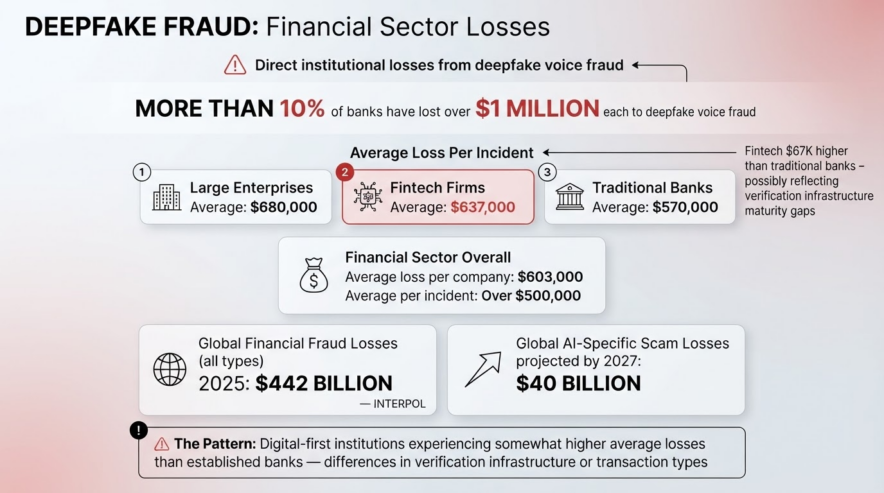
Banks that have lost over $1 million each to deepfake voice fraud | More than 10% |
Average loss per deepfake fraud incident | Over $500,000 |
Average loss per incident, large enterprises specifically | $680,000 |
Average loss per company affected, financial sector overall | $603,000 |
Fintech firms specifically, average loss per incident | $637,000 |
Traditional banking institutions, average loss per incident | $570,000 |
Global financial fraud losses (all types), 2025, per INTERPOL | $442 billion |
Global AI-specific scam losses, projected by 2027 | $40 billion |
The gap between fintech losses ($637,000 average) and traditional banking losses ($570,000 average) is notable — newer, digital-first financial institutions appear to be experiencing somewhat higher average losses per incident than established banks, possibly reflecting differences in verification infrastructure maturity or the types of high-value transactions each handles.
Why Detection Is So Hard: The Human Factor
This is the statistic that should worry security teams more than any dollar figure.
Detection Metric | Figure |
Rate at which humans correctly detect an AI-generated voice | ~60% |
Rate at which humans catch a deepfake without being specifically told to look for one | ~0.1% |
Companies with no established protocol for handling a deepfake-based attack | ~80% |
The 60% figure represents people actively trying to spot a fake voice under test conditions — essentially a coin flip with slightly better odds. The 0.1% figure, measuring real-world, unprompted detection, shows that in practice, almost nobody notices during a live interaction unless they already suspect something is wrong. Combined with the finding that 80% of companies have no protocol at all for handling this kind of attack, the picture is one of a threat that has scaled far faster than institutional defenses have caught up.
Why This Connects to the Bigger AI Story
None of this exists separately from the broader AI industry buildout covered elsewhere. The same voice-generation and audio AI capabilities being marketed as legitimate features — voice assistants, AI dubbing, synthetic customer service voices, the kind of multimodal capability every major lab is racing to add to its models — are the exact underlying technology fraud rings are repurposing. The three-second cloning threshold isn’t a fraud-specific tool; it’s a byproduct of voice AI getting good enough, fast enough, and cheap enough for legitimate commercial products, with the same capability available to anyone willing to misuse it.
Conclusion
AI voice cloning fraud isn’t a niche, anecdote-driven concern — the data shows a fraud category that grew from roughly 0.1% to 6.5% of all fraud attempts in four years, now successfully extracting money from over three-quarters of the people it targets, with individual bank losses regularly exceeding half a million dollars per incident. The technology enabling this, a three-second audio clip and consumer-accessible cloning tools, has scaled far faster than either human detection ability (stuck near chance performance) or institutional readiness (80% of companies with no response protocol at all). This is a case where the underlying numbers actually support the alarming headlines, rather than undercutting them — the real story here isn’t overhype, it’s a threat that’s scaling roughly as fast as the coverage suggests, aimed disproportionately at the people least equipped to catch it.
Frequently Asked Questions
As little as three seconds of audio is enough to clone a voice with roughly 85% accuracy using current AI technology. This is a dramatic drop from just a few years ago, when convincing voice cloning required much longer samples and significant technical expertise.
Not reliably — even when people are actively trying to detect a fake voice, they succeed only about 60% of the time, which is barely better than random chance. In real-world situations where someone isn't already suspicious, the detection rate falls to just 0.1%.
Adults aged 60 and older are about 40% more likely to fall victim to AI voice cloning scams, especially those with access to financial accounts or sensitive information. That said, roughly 1 in 4 Americans across all age groups report having already received a deepfake voice call.
Individual incidents average over $500,000 in losses, with large enterprises reporting an average of $680,000 per incident. More than 1 in 10 banks have lost over $1 million each specifically due to deepfake voice fraud.
No — approximately 80% of companies have no established protocol for responding to a deepfake-based attack, leaving them highly vulnerable. This lack of preparedness is especially concerning given that deepfake fraud has grown more than 20-fold as a share of all fraud attempts since 2022.