Model release pages love to advertise low hallucination scores — under 1% on standard accuracy tests. Those numbers are real. They’re also nearly meaningless for the domains where hallucinations matter most. This article puts the polished benchmark figures next to the field-tested numbers from legal, medical, and enterprise settings, and shows why the gap between them is one of the least-discussed problems in AI right now.
What Is an AI Hallucination?
A hallucination is when an AI model states something confidently and fluently that is factually wrong or entirely made up — a fake court case, a fabricated statistic, a medical claim with no basis, a citation that doesn’t exist. The danger isn’t that the AI is wrong. It’s that a hallucinated answer usually looks exactly as polished and confident as a correct one, which is what makes it hard to catch without checking.
The Benchmark Numbers: What Gets Advertised
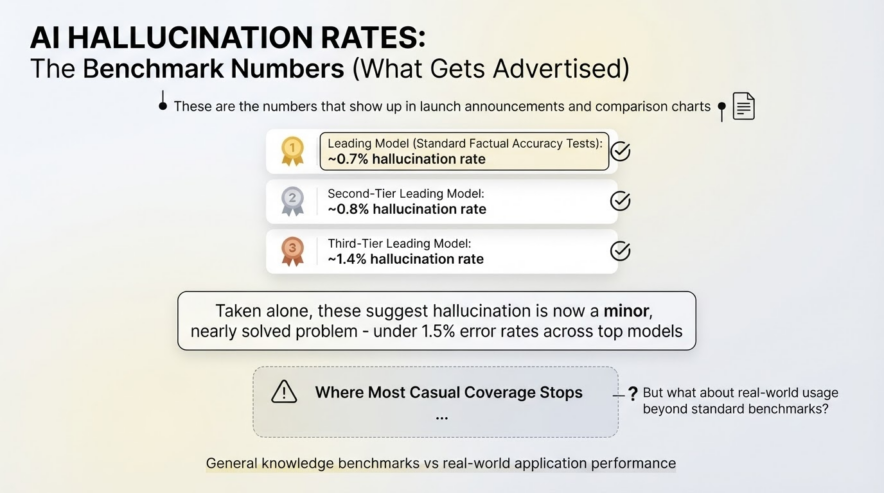
Model (General Knowledge Benchmark) | Hallucination Rate |
Leading model on standard factual accuracy tests | ~0.7% |
Second-tier leading model | ~0.8% |
Third-tier leading model | ~1.4% |
These are the numbers that show up in launch announcements and comparison charts. Taken alone, they suggest hallucination is now a minor, nearly solved problem — under 1.5% error rates across the top models. This is where most casual coverage of the topic stops.
The Real-World Numbers: What Happens in Specific Domains
Domain | Hallucination Rate | Source / Context |
General knowledge benchmark (marketing figure) | 0.7-1.4% | Standardized factual accuracy tests |
Legal AI, domain-specific tasks (average) | ~6.4% | Industry average across legal use cases |
Legal AI, specific legal queries (Stanford research) | 58-88% | Testing major models on real legal research questions |
Medical AI, domain-specific tasks (average) | 10-20% | Industry average across medical use cases |
Medical AI, prompt-quality-dependent testing | 43-64% | Depending on how the question was phrased |
The gap here is enormous — not a small difference, but a difference measured in tens of multiples. A model that hallucinates less than 1% of the time on a general trivia benchmark can hallucinate on more than half of real legal research questions. This is the number that essentially never appears in the same sentence as the marketing benchmark, even though both describe the same underlying models.
Why the Gap Is So Large
Several factors explain why domain-specific hallucination rates are so much worse than general benchmarks suggest:
General benchmarks test easy, well-documented facts — capital cities, basic science, common knowledge that appears constantly and consistently across a model’s training data
Legal and medical queries require precise, specific, and often obscure information — a specific case citation, a specific drug interaction, a specific regulatory detail — where being “close” to correct is functionally the same as being wrong
Models are trained to sound confident regardless of certainty — there’s no built-in mechanism forcing a model to say “I don’t know” instead of generating a plausible-sounding but fabricated answer
Specialized domains have less repeated, redundant training data — a model sees many descriptions of common facts and very few descriptions of any single obscure legal case, making it easier for the model to blend or invent details
The Business Cost
Hallucinations aren’t just an accuracy statistic — they carry a measurable financial cost that’s growing as adoption increases.
Metric | Figure |
Estimated global business cost of AI hallucinations, 2024 | $67.4 billion |
Projected cost, 2025 | $112 billion |
Trend | Rising in step with adoption, not falling |
This is a case where wider adoption is making the aggregate cost of the problem larger even as individual model accuracy slowly improves — more people relying on AI outputs for consequential decisions means more opportunities for an undetected hallucination to cause real damage.
What Actually Reduces Hallucinations (And What Doesn’t)
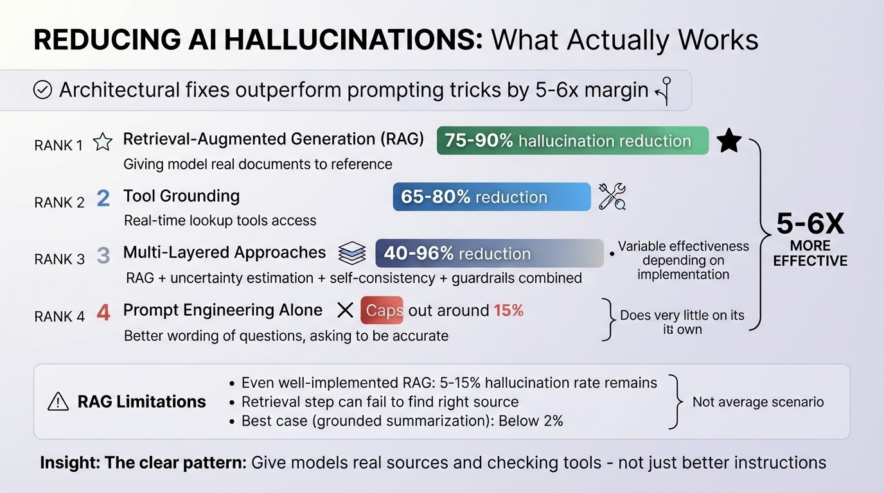
This is the part of the data that’s genuinely useful for anyone deploying AI in a real workflow.
Techniques ranked by effectiveness:
Technique | Hallucination Reduction |
Retrieval-augmented generation (RAG) | 75-90% |
Tool grounding (giving the model access to real-time lookup tools) | 65-80% |
Multi-layered approaches (RAG + uncertainty estimation + self-consistency + guardrails combined) | 40-96% |
Prompt engineering alone (better wording of the question) | Caps out around 15% |
The pattern is clear: architectural fixes — giving the model real documents to reference and tools to check its work — outperform prompting tricks by a wide margin, roughly five to six times more effective. Simply asking the model more carefully or telling it to “be accurate” does very little on its own.
Where RAG still falls short:
Even well-implemented RAG systems still produce hallucinations in 5-15% of cases, usually when the retrieval step itself fails to find the right source document. Grounded summarization tasks can get hallucination rates below 2%, but that’s the best-case scenario, not the average.
How Enterprises Are Actually Catching These Errors
Detection/Mitigation Method | Enterprise Adoption |
RAG as an automated mitigation | 68% of enterprises |
Human-in-the-loop review processes | 76% of enterprises |
Dedicated verification APIs | Only 19% of enterprises |
Real-time detection systems flagging responses | Flag roughly 20% of chatbot responses as potentially hallucinated |
The standout number here is the gap between RAG adoption (68%) and dedicated verification tooling adoption (19%). Most companies are relying on retrieval-based mitigation and human review rather than automated fact-checking systems specifically built for hallucination detection — meaning a meaningful share of enterprise AI deployment still depends on a person catching the error before it causes a problem.
Conclusion
The hallucination story that gets told through model release benchmarks — under 1.5% error rates — and the hallucination story that shows up in real domain-specific testing — as high as 88% in legal research — describe the same models but almost entirely different realities. General benchmarks measure how well a model handles easy, well-documented facts; specialized fields expose how often it fabricates plausible-sounding answers when the real information is obscure or absent from its training data. The good news in the data is that this gap is addressable: retrieval-augmented generation and tool grounding cut hallucination rates by 65-90%, far outperforming prompt tricks. The less comforting news is that enterprise adoption of dedicated verification tooling still sits at just 19%, meaning most organizations deploying AI in high-stakes domains are still relying heavily on humans catching the mistakes the model doesn’t know it’s making.
Frequently Asked Questions
On general benchmarks, hallucination rates have dropped roughly 96% since 2021, making overall averages look impressively low. However, domain-specific tasks in law and medicine still see hallucination rates as high as 43-88%, meaning the benchmark number rarely reflects real-world performance.
Legal research requires the model to produce exact case citations and jurisdiction-specific rulings, which is far harder than summarizing documents or answering general knowledge questions. This is why hallucination rates jump from around 6.4% on easier legal tasks to 58-88% when models are tested on specific, real legal research queries.
A well-implemented RAG system can reduce hallucination rates by 75-90% by grounding the AI in verified source documents. That said, even strong RAG implementations still produce hallucinations in 5-15% of cases, typically when the retrieval step fails to surface the right material.
No, prompt engineering alone is significantly less effective than architectural solutions like RAG and tool grounding. Data suggests that grounding-based approaches deliver roughly five to six times greater reduction in hallucination rates compared to prompt engineering by itself.
Not safely — hallucination rates in specific medical query testing range from 43-88%, which is far too high to act on without cross-checking against a qualified professional or a primary clinical source. AI outputs in medicine and law are best treated as a research starting point, not a final answer.