Survey after survey says the same thing: most companies are using open-source AI now. Eighty-nine percent, sixty-three percent, “near-universal” — pick your figure, they all point the same direction. But when you look at where actual usage, measured in tokens processed rather than checkboxes ticked, is going, a very different picture appears. This article puts the adoption surveys next to the real usage data, and shows why “we use open source” and “open source is where our AI work actually happens” are not the same claim.
The Headline Adoption Numbers
Survey Metric | Figure |
Organizations that already use open-source AI in some form | 63% |
Organizations using some open source anywhere in their AI stack | 89% |
AI projects integrating open-source models during development | 60%+ |
Enterprises deploying at least one open-source model in production | 89% |
Read on their own, these numbers suggest open-source AI has essentially won — near-universal adoption across enterprise AI. This is the version of the story that gets repeated most often in industry coverage.
The Number That Tells a Different Story: Where the Tokens Actually Go
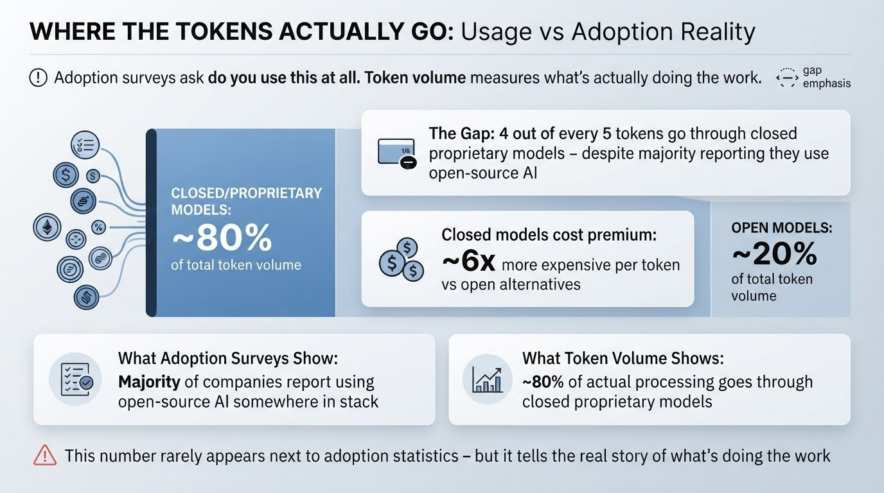
Adoption surveys ask “do you use this at all.” Token volume measures what’s actually doing the work. The gap between the two is the real story.
Metric | Figure |
Share of total AI token volume flowing to closed (proprietary) models | ~80% |
Share of total AI token volume flowing to open models | ~20% |
Average cost premium of closed models per token vs. open alternatives | ~6x more expensive |
This is the number that rarely appears next to the adoption statistics. Even though a large majority of companies report “using” open-source AI somewhere in their stack, roughly four out of every five tokens actually processed across the industry go through closed, proprietary models — models that cost about six times more per token than the open alternatives available.
Reconciling the Two Numbers
These aren’t contradictory statistics — they’re describing two different layers of how companies actually deploy AI:
Adoption surveys count breadth: a company running one small open-source model for an internal tool, alongside a much larger proprietary deployment for its main customer-facing product, counts as “using open source” in a survey — even if that open-source use represents a tiny fraction of total activity
Token volume measures depth: it captures where the actual computational work, and therefore the actual business value and cost, is concentrated
The typical enterprise pattern: open-source models for lower-stakes, cost-sensitive, or specialized internal workloads; proprietary flagship models for the highest-stakes, most customer-visible, most performance-critical work
This produces the seemingly odd but consistent combination of near-universal “adoption” alongside token volume still heavily concentrated in closed models.
Market Size and Growth
Metric | Figure |
Open-source AI model market size, 2026 | $23.08 billion |
Projected market size by 2030 | $50.03 billion |
Compound annual growth rate | ~21.3% |
Reported cost reduction from using open-source AI | ~35% lower total cost of ownership |
The market is genuinely growing fast, and the cost advantage is real and substantial — companies that do shift meaningful workloads to open models report roughly a third lower total cost of ownership. That’s a real, measurable incentive pulling in the open-source direction over time, even if it hasn’t yet flipped the overall token-volume balance.
The Performance Gap Is Closing, But Hasn’t Closed
Metric | Figure |
Performance gap, best closed model vs. best open model (as of March 2026) | 3.3% |
Closed models in the top 10 of the Arena Leaderboard | 6 out of 10 |
Open models in the top 10 | 4 out of 10 |
The gap has narrowed significantly compared to just a couple of years earlier, when open models trailed proprietary flagships by much wider margins. But closed models still hold a slight edge at the very top of the performance rankings, and still occupy a majority of the top-tier leaderboard spots — a small but real gap that likely explains part of why the highest-stakes workloads still skew toward proprietary models.
What Happened Among the Major Open-Weight Labs in the First Half of 2026
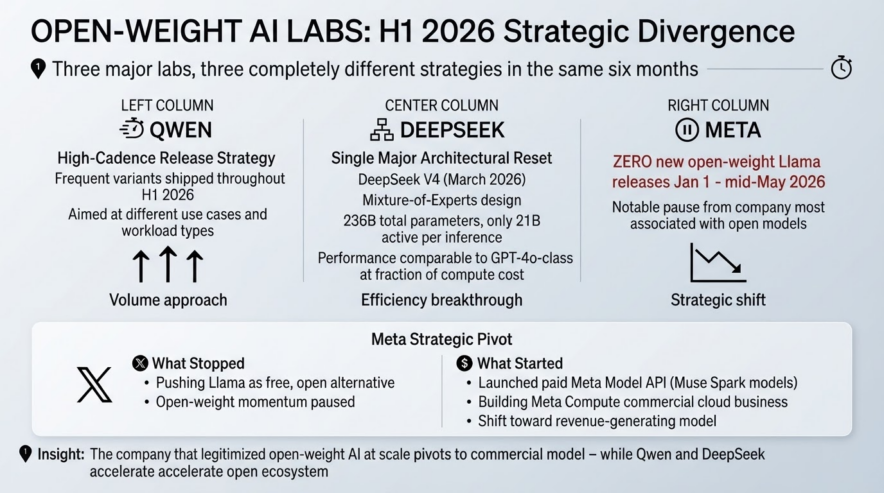
The open-weight landscape shifted meaningfully within 2026 itself, not just relative to prior years.
Qwen ran a high-cadence release strategy, shipping frequent variants aimed at different use cases and workload types throughout the first half of the year
DeepSeek took the opposite approach, betting on a single major architectural reset — DeepSeek V4, released in March 2026, uses a Mixture-of-Experts design with 236 billion total parameters but only 21 billion active per inference, achieving performance comparable to GPT-4o-class models at a fraction of the compute cost
Meta, despite being one of the earliest and most prominent open-weight AI labs with its Llama family, shipped zero new open-weight Llama releases between January 1 and mid-May 2026 — a notable pause from the company most associated with pushing open models into the mainstream
That Meta pause is a particularly interesting data point given the company’s other moves in 2026: rather than continuing to push Llama as a free, open alternative, Meta has instead launched a paid Meta Model API around its newer Muse Spark models and is building “Meta Compute,” a commercial cloud business. The company that helped legitimize open-weight AI at scale appears to be shifting at least part of its strategy toward a more traditional, revenue-generating model — even as the rest of the open-weight ecosystem (Qwen, DeepSeek) accelerates.
Why Enterprises Say Open Source Delivers Better ROI, Even With Lower Token Share
One statistic complicates the simple “closed models are winning” reading of the token-volume data: internal benchmarks show organizations using open-source AI models report roughly 25% higher return on investment compared to organizations relying exclusively on closed-model APIs.
This isn’t necessarily a contradiction. It likely reflects selection: companies that successfully deploy open-source models tend to do so for well-defined, cost-sensitive workloads where the ROI math is favorable and easy to measure — while companies relying entirely on closed APIs may be running a broader, messier mix of experimental and production workloads where measuring clean ROI is harder. In other words, open source may show a better ROI number partly because it’s being deployed more deliberately and selectively.
What This Means Going Forward
The trajectory in the data points toward gradual convergence rather than a clean winner. The performance gap is shrinking, the cost gap strongly favors open models, and market growth for open-source AI is outpacing overall AI market growth. But token volume — the number that actually reflects where the industry’s computational and business weight sits today — still leans heavily toward closed models, and the shift in that number has been much slower than the shift in adoption survey headlines would suggest. Enterprises appear to be building a genuinely mixed environment: open models for cost-sensitive and specialized work, proprietary flagships for the work where the last few percentage points of performance still matter most.
Conclusion
The open-source AI adoption story and the open-source AI usage story are not the same story, and most coverage only tells the first one. Adoption surveys paint a picture of near-total open-source penetration across enterprise AI, and that’s technically accurate — most companies do use it somewhere. But the token-volume data, the number that actually reflects where computational work and business value are concentrated, shows roughly 80% of activity still flowing through closed, proprietary models that cost about six times more per token. The real trend isn’t a clean handoff from closed to open models — it’s a widening, more deliberate split, with open models absorbing cost-sensitive and specialized workloads while proprietary flagships hold onto the highest-stakes work, at least until that shrinking 3.3% performance gap closes entirely.
Frequently Asked Questions
Adoption surveys count any company that uses open-source AI even for a single minor tool, while token volume reflects actual computational workload. Most enterprises rely on open models for small, cost-sensitive tasks while routing their largest, highest-stakes operations through proprietary models.
Yes, significantly. Closed models cost around six times more per token on average, and businesses that shift applicable workloads to open-source models report roughly 35% lower total cost of ownership.
They are competitive but not yet equal at the highest level, with the best closed model outperforming the best open model by approximately 3.3% as of early 2026. Closed models also still occupy six of the top ten spots on major AI performance leaderboards.
Meta has not offered a single official reason, but the timing aligns with the launch of its paid Meta Model API and a push to monetize newer models commercially. This suggests a strategic shift away from its previous open-weight-first approach.
Qwen and DeepSeek have been the most active contributors, with Qwen releasing frequent model updates and DeepSeek launching its V4 architecture in March 2026, which reportedly delivers GPT-4o-class performance at substantially lower compute cost.