In 2026, when Semrush has 28.9 billion keywords and Ahrefs refreshes its index constantly, is Moz Pro still relevant? Or is it a legacy brand coasting on reputation?
Moz is a comprehensive SEO and digital marketing platform offering tools for keyword research, rank tracking, site audits, competitor analysis, AI search monitoring, local SEO management, and enterprise level data through the Moz API. Used by over 500,000 SEO professionals and marketers worldwide.
Pros
- All in one SEO toolkit with keyword, rank, audit, and competitor tools
- AI search monitoring for LLM presence tracking
- Industry leading Domain Authority metric
- Free tier available with no card required
- Flexible plans from starter to enterprise
Cons
- Starter plan too limited, Standard is real entry point
- Hidden add ons inflate final pricing
Starting $49/month
Get Started with MozI spent time inside the platform and dug through current pricing, features, ratings, and what Semrush, Ahrefs, SE Ranking, and others do better. This Moz review gives you the straight answer.
Moz Pro at a Glance: Quick Moz Review Overview
Get a quick snapshot of Moz Pro’s core features, pricing tiers, and capabilities in this Moz review, perfect for understanding what the platform delivers.
Item | Details |
What it is | All in one SEO software platform |
Founded | 2004, Seattle, originally SEOmoz |
Founders | Rand Fishkin and Gillian Muessig |
Owner | iContact Marketing Corp (acquired 2021) |
Starting price | 49permonth(49 per month (39 billed annually) |
Most popular plan | Medium at $179 per month |
Free tools | MozBar, free Domain Analysis, Keyword Explorer limited use |
Free trial | 7 days, credit card required |
Keyword database | Around 1.25 billion keywords |
Backlink index | Over 45 trillion links claimed |
Rank tracking | Weekly |
Money back guarantee | 30 days |
G2 rating | 4.3 out of 5 |
Capterra rating | 4.5 out of 5 |
Trustpilot rating | 3.7 out of 5 |
What Is Moz and Who Is It For?
Moz is an SEO platform built around three core tools. Keyword Explorer for keyword research, Link Explorer for backlink analysis, and Site Crawl for technical audits. Around those sit rank tracking, on page optimization, reporting, and a set of newer AI features.
Moz is best for beginners, small businesses, and SEO learners who want a clean interface and genuinely good education. Moz’s blog, Whiteboard Friday series, and community built the knowledge base that most SEO professionals learned from.
The tool reflects that heritage. It explains things, it does not just dump data on you.
If you are an advanced SEO or an agency doing heavy competitive research every day, Moz will probably feel limiting. More on that below.
The Company Story: From SEOmoz to iContact
Moz, originally called SEOmoz, was founded in Seattle in 2004 by Rand Fishkin and Gillian Muessig. It started as a blog and community before becoming a software company, and it effectively created the category of SEO software as we know it.
The company went through the classic startup rollercoaster. It raised venture capital, nearly went public, then pivoted away from an IPO. In June 2021, iContact Marketing Corp acquired Moz, folding it into a family of email marketing brands.
Since then, Moz has been quieter than its rivals. No giant acquisitions, no splashy product launches on the scale of Semrush’s AI toolkit. What it has done is modernize steadily.
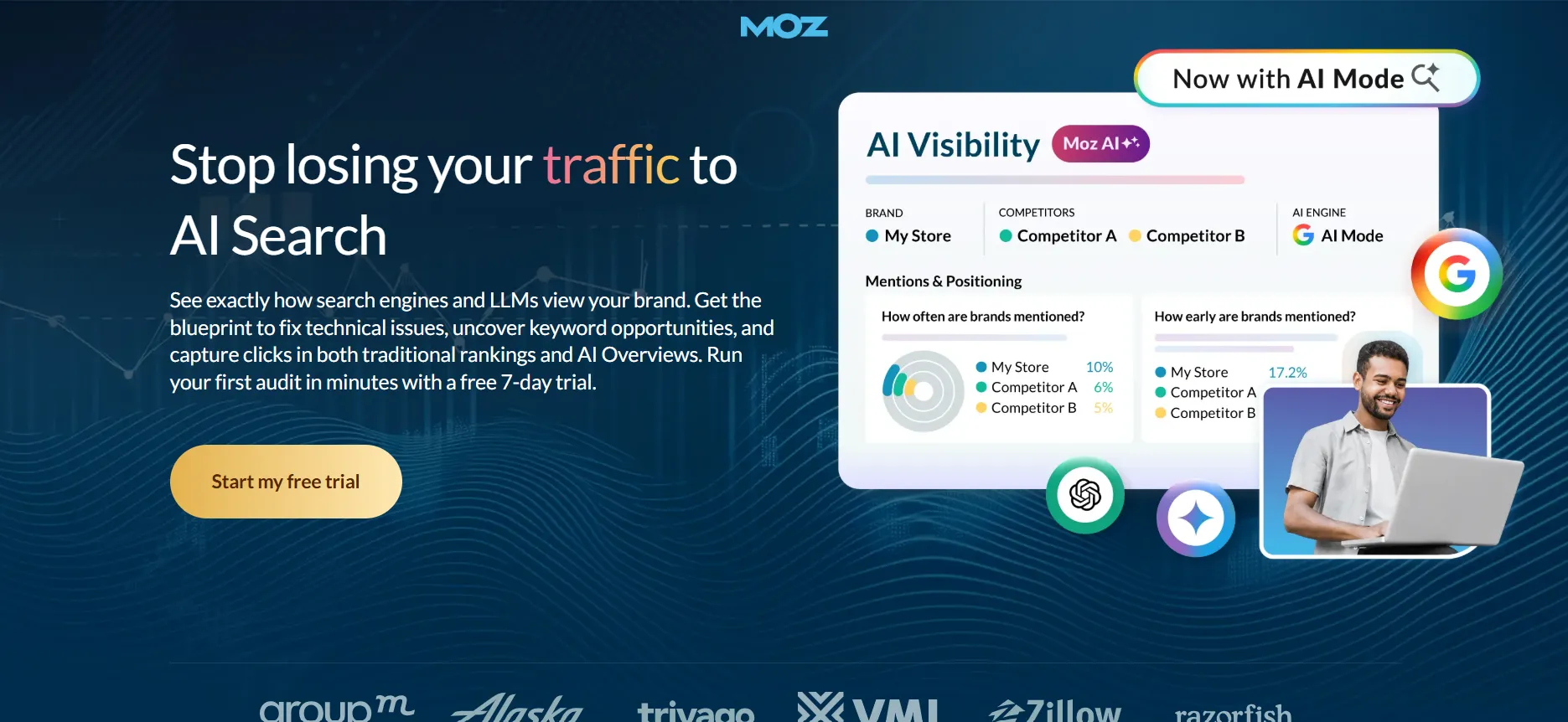
The big recent change for 2026 is an AI push. Moz Pro now includes AI Overviews by keyword, AI Visibility dashboards that track how your brand appears in GPT, Gemini, Google AI Mode, and Perplexity, prompt tracking, and AI generated content briefs.
Here is my honest take. Moz under iContact is a stable, profitable niche player. It is not trying to out data Semrush or out pace Ahrefs.
It is positioning as the friendly, educational, affordable option, and the new AI features show it does not want to be left behind in the AI search shift. That is a sensible strategy, but it also means the gap with the leaders stays wide.
Moz by the Numbers: Key Statistics and Moz Review Insights for 2026
Discover the important metrics and data points about Moz in this Moz review, including keyword database size, backlink index, pricing, and performance benchmarks.
Aspect | Details |
|---|---|
Keyword Database | ~1.25 billion keywords (Semrush: 28.9B, Ahrefs: similar range). Moz’s biggest structural weakness. |
Backlink Index | 45+ trillion links claimed. Large but updates lag behind fresher competitors. |
Authority Metrics | Domain Authority and Page Authority are industry’s most widely cited metrics used by agencies and journalists. |
Pricing Range | $49 to $299 per month. Core features identical across all plans; only data limits differ. |
API Access | Available and significantly cheaper than Semrush or Ahrefs for developers and budget conscious agencies. |
Review Scores | G2: 4.3/5, Capterra: 4.5/5, Trustpilot: 3.7/5, TrustRadius: 8/10. Solid but not class leading. |
Free Tools | MozBar Chrome extension shows DA and PA on any page; millions of users; one of best free SEO tools. |
Keyword Tracking Limits | Starter: 50 keywords, 1 site. Standard: 300 keywords. Active teams exceed limits quickly. |
Rank Tracking Speed | Weekly updates. Daily tracking is standard at competitors in 2026; weekly feels slow. |
Moz Pricing in 2026: Full Breakdown
One genuinely fair thing about Moz pricing is that every plan includes the same core features. You never pay to unlock functionality, only higher data limits. That is a pro consumer structure that Semrush and Ahrefs do not follow.
Starter
$49 per month, or 39permonthbilledannually(39 per month billed annually (470 per year). One user, 1 tracked site, 50 keywords per month, 20,000 pages crawled per month.
Includes Moz AI tools and MozBar Premium. In practice, the limits are so tight that this plan only works for a single small site with a narrow keyword set. Most users outgrow it within weeks.
Standard
$99 per month, or 79permonthbilledannually(79 per month billed annually (950 for the first year).
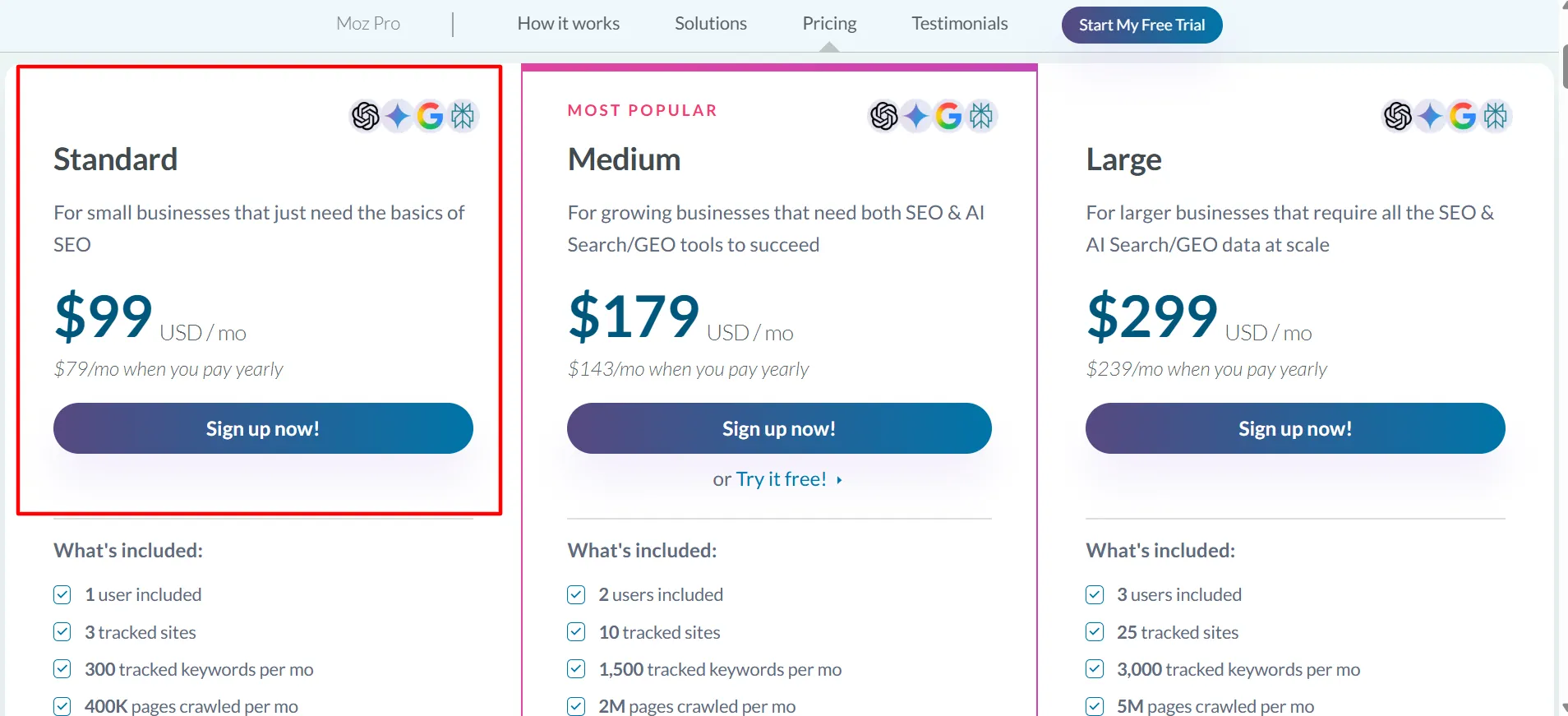
One user, 3 tracked sites, 300 keywords, 400,000 pages crawled per month, unlimited scheduled and branded reports, 1 AI Visibility dashboard, 50 tracked prompts across 4 AI models, and 2 AI content briefs per month. This is the realistic entry point for most small businesses.
Medium
$179 per month, or 143permonthbilledannually(143 per month billed annually (1,719 per year).
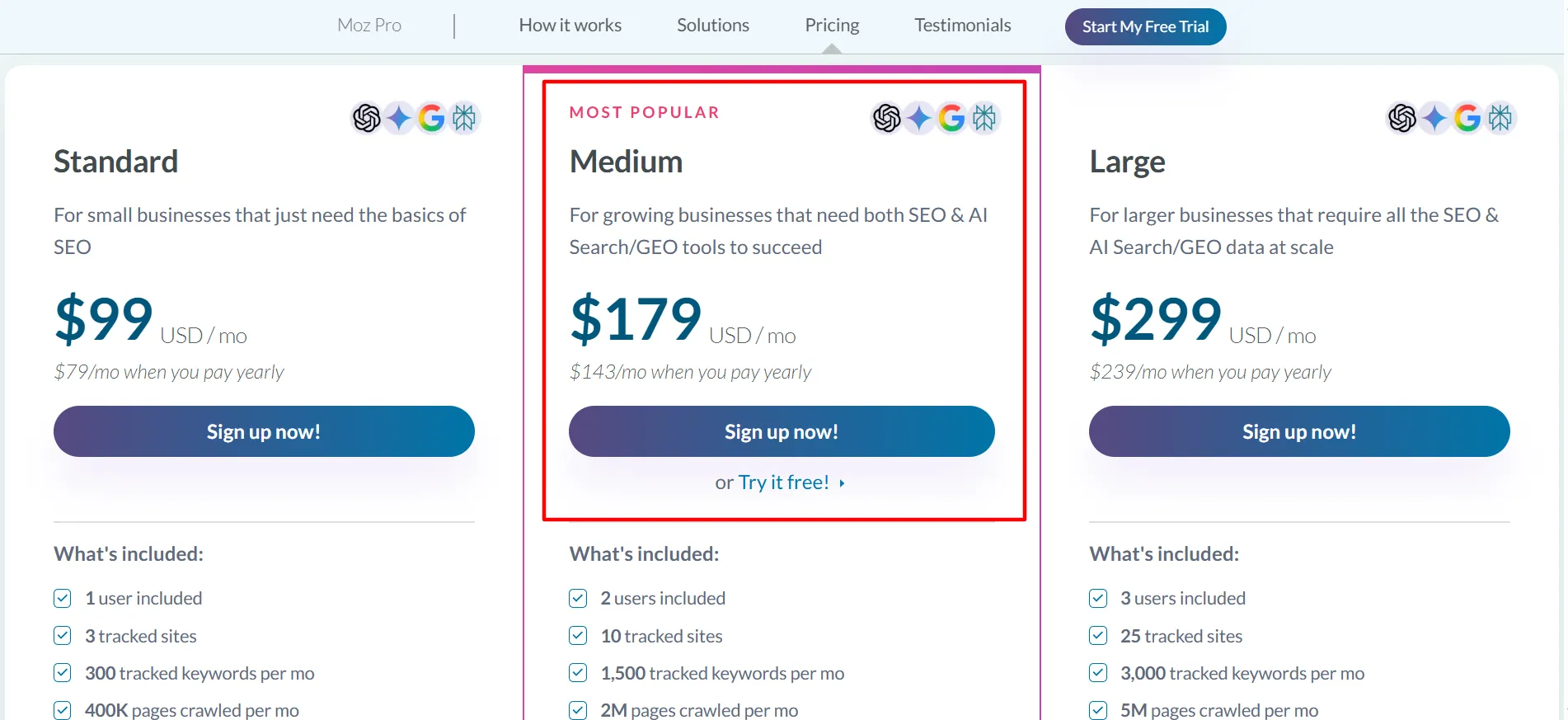
Two users, 10 tracked sites, 1,500 keywords, 2 million pages crawled, 2 AI Visibility dashboards, 100 tracked prompts, 10 AI content briefs per month. Moz calls this its most popular plan, and it is where the tool starts to feel usable for serious work.
Large
$299 per month, or 239permonthbilledannually(239 per month billed annually (2,868 per year).
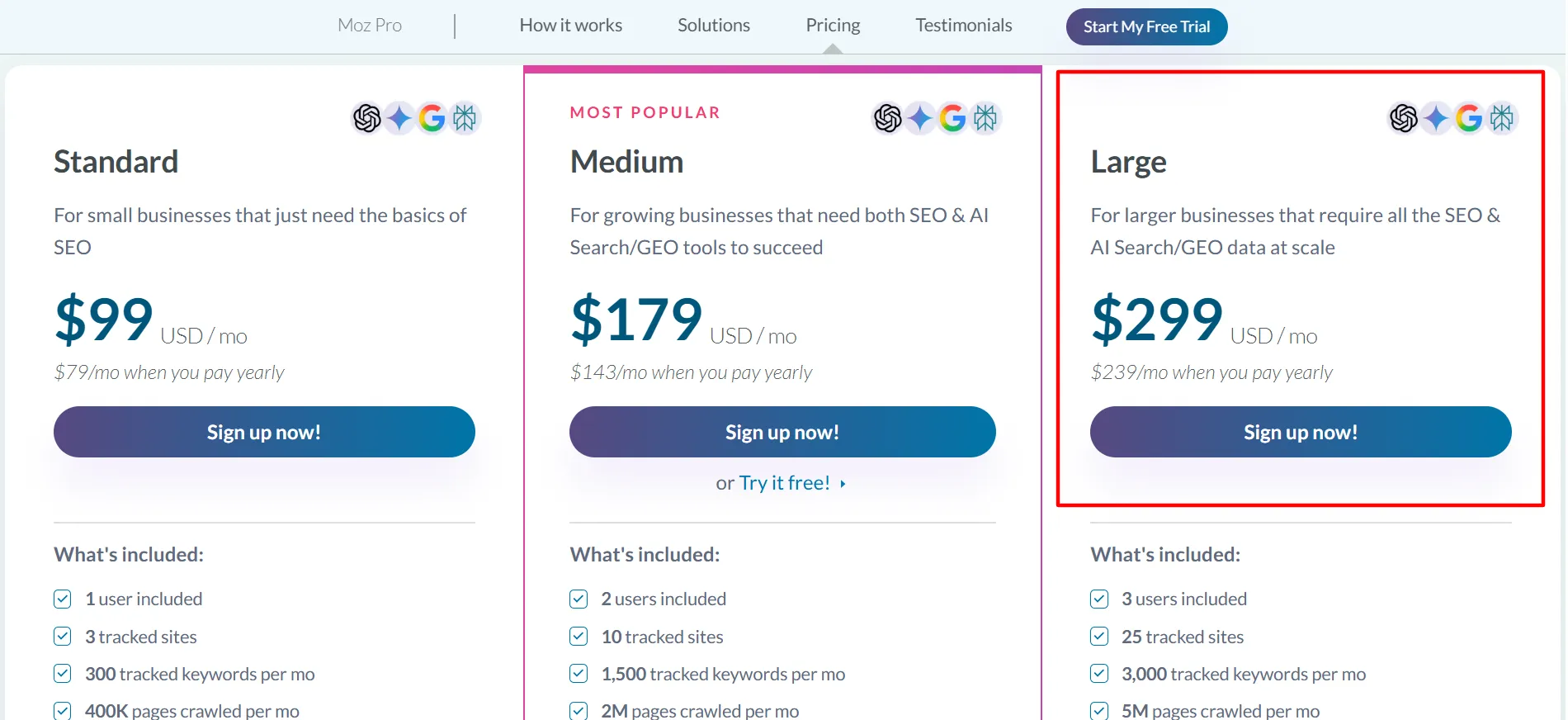
Three users, 25 tracked sites, 3,000 keywords, 5 million pages crawled, 4 AI Visibility dashboards, 200 prompts, 50 AI content briefs per month.
Add Ons and Extras
Extra user seats: purchasable on any plan, priced on top of your subscription.
AI Visibility dashboards: $20 each as an add on.
Extra tracked prompts: $50 per 100 prompts.
Moz Local: a separate product at $20 to $40 per month per location, covering listing distribution, review monitoring, sentiment analysis, and Google Q and A management across the US, UK, and Canada. At $199 to $399 per year, it is decent value for local businesses.
My Read on the Pricing
The structure is fair, but the value is questionable at the low end. Fifty keywords on Starter is barely an SEO hobby.
The jump from Standard (300 keywords) to Medium (1,500 keywords) is steep at $80 more per month, and 300 keywords is what a single active blog post research session can consume.
Factor in the roughly 20 percent annual discount and the 7 day trial, and Medium at $143 per month annually is the only tier I can recommend without caveats.
Moz Pro Features Explained in Detail
Explore every feature included in Moz Pro with detailed breakdowns covering keyword research, rank tracking, site audits, and competitor analysis in this comprehensive Moz review.
1. Keyword Explorer
Moz’s keyword research tool covers the essentials well. You get search volume, keyword difficulty, organic click through rate estimates, and a Priority score that blends opportunity and difficulty into one number. The SERP analysis shows who ranks and with what authority.
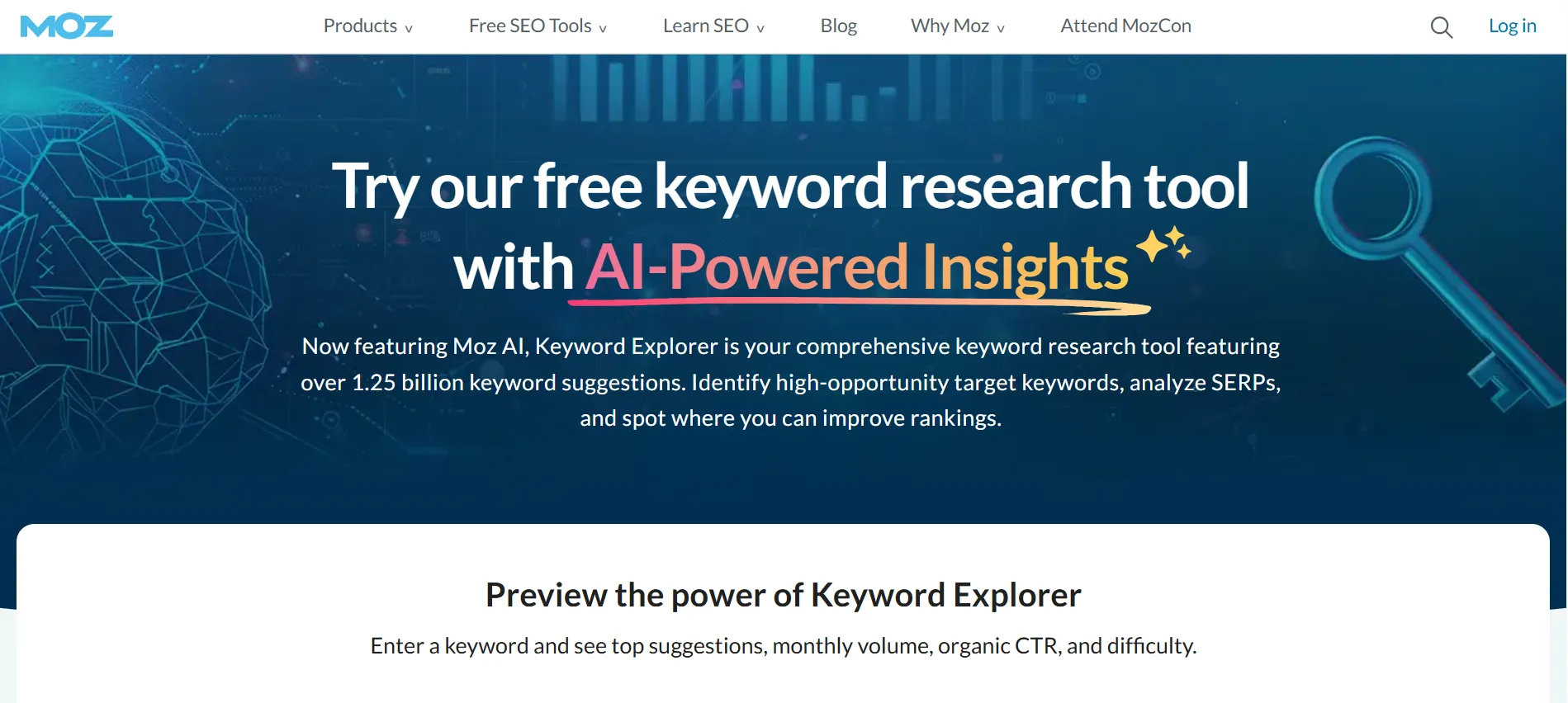
The weakness is depth. With around 1.25 billion keywords in the database, long tail coverage is noticeably thinner than Semrush or Ahrefs. If your niche is competitive or obscure, you will hit walls where competitors keep finding gold.
2. Link Explorer and Domain Authority
This is still Moz’s crown jewel. Domain Authority is the industry standard authority metric, and for good reason. It is simple, stable, and everyone understands it.
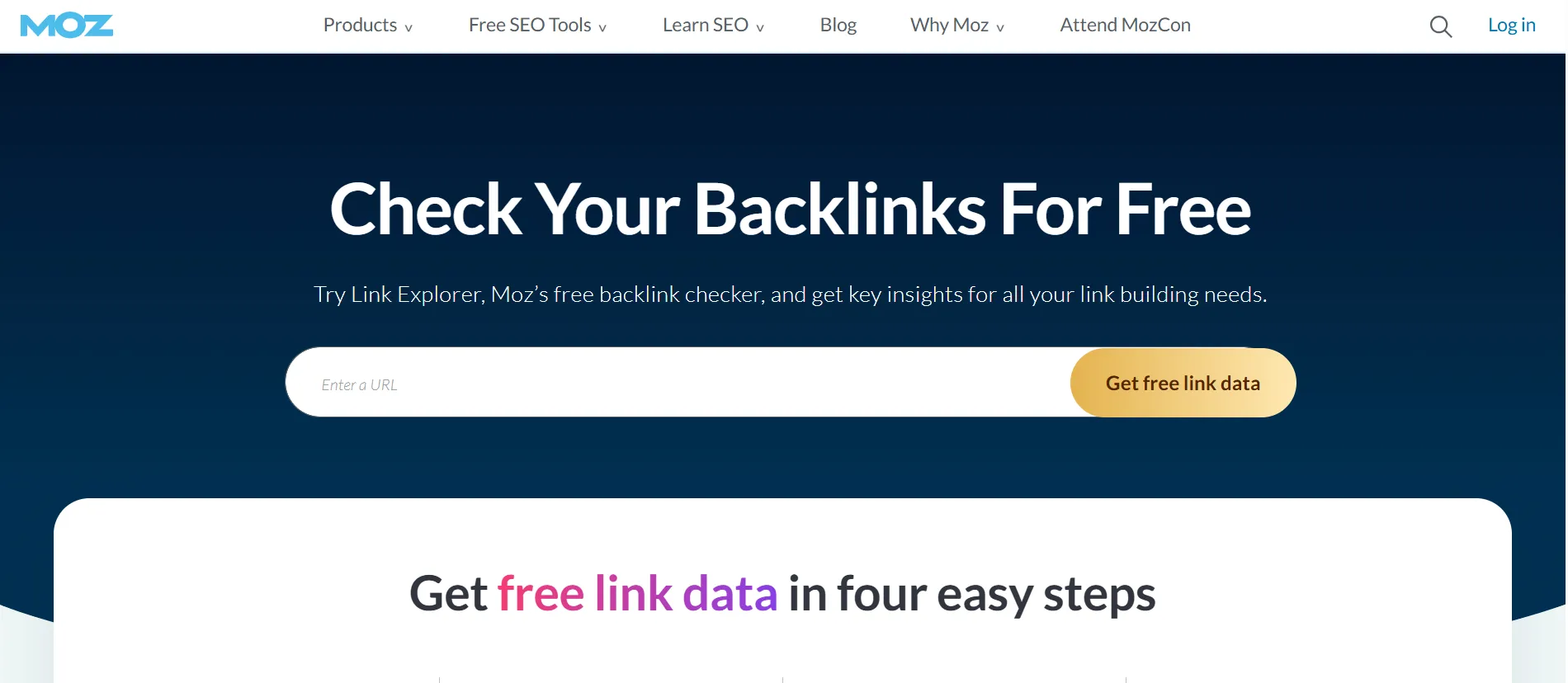
Link Explorer gives you a full backlink profile, anchor text distribution, linking domains, and Spam Score, which is one of the best link quality metrics anywhere.
Real world use: agencies still price link building and evaluate prospects on DA. Journalists and PR teams use it to vet sites. Even if you subscribe to a competitor, you will still end up referencing Moz’s metrics.
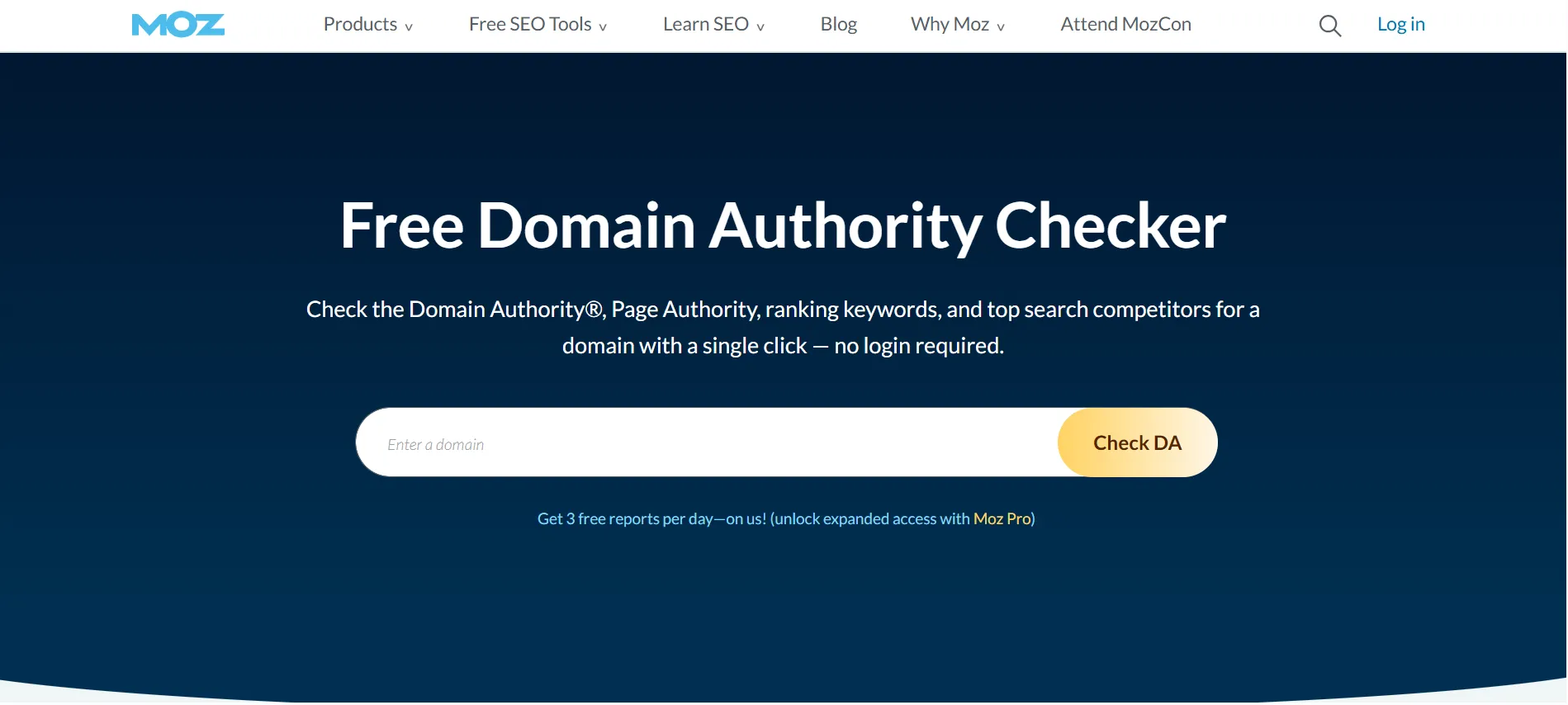
The catch: index freshness. For time sensitive link work like disavow campaigns or rapid competitor response, Ahrefs refreshes faster.
3. Site Crawl
The crawler checks your site for technical issues like broken links, redirect chains, missing metadata, and duplicate content.
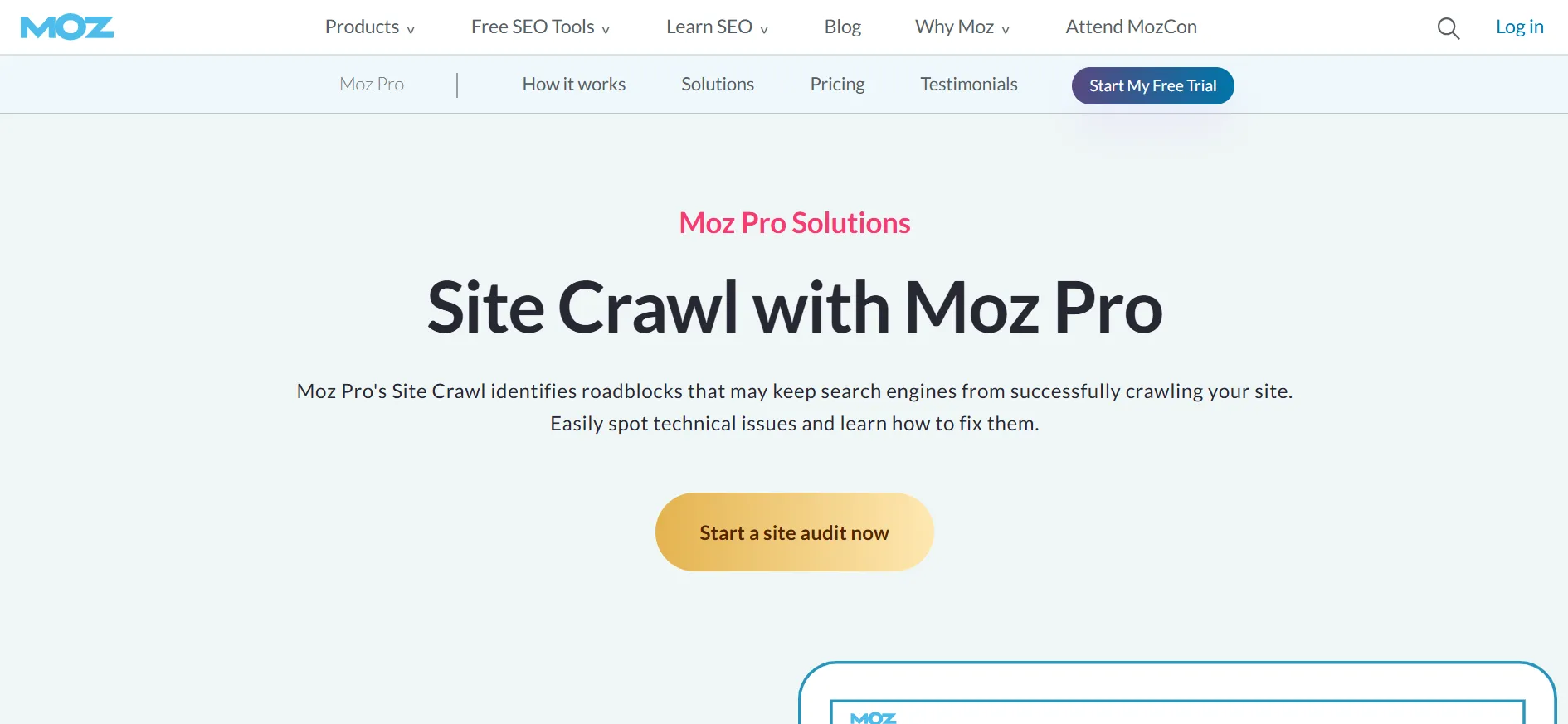
It is straightforward and easy to act on, though the crawl limits on Starter and Standard are tight compared to what Semrush offers at similar prices.
4. Rank Tracker
Tracks your keyword positions across desktop and mobile, by location. It works fine, but it updates weekly.

In 2026, when rankings can shift within hours of an algorithm update or a content change, weekly data feels like reading last week’s newspaper. This is one of the clearest signs of Moz’s legacy architecture.
5. On Page Grader
Paste a URL and a keyword, and Moz grades the page with specific, prioritized recommendations. It is simple and genuinely useful for beginners learning what on page optimization means.
6. MozBar and Free Tools
The MozBar Chrome extension shows DA, PA, and link metrics for any page or SERP you visit.
The free Domain Analysis tool gives limited access to Link Explorer and Keyword Explorer. For anyone not ready to pay, these free tools alone make Moz worth knowing.
7. AI Features (The 2026 Update)
The newer AI suite is Moz’s most important move in years. AI Overviews by keyword show when Google displays AI generated answers for your target terms.
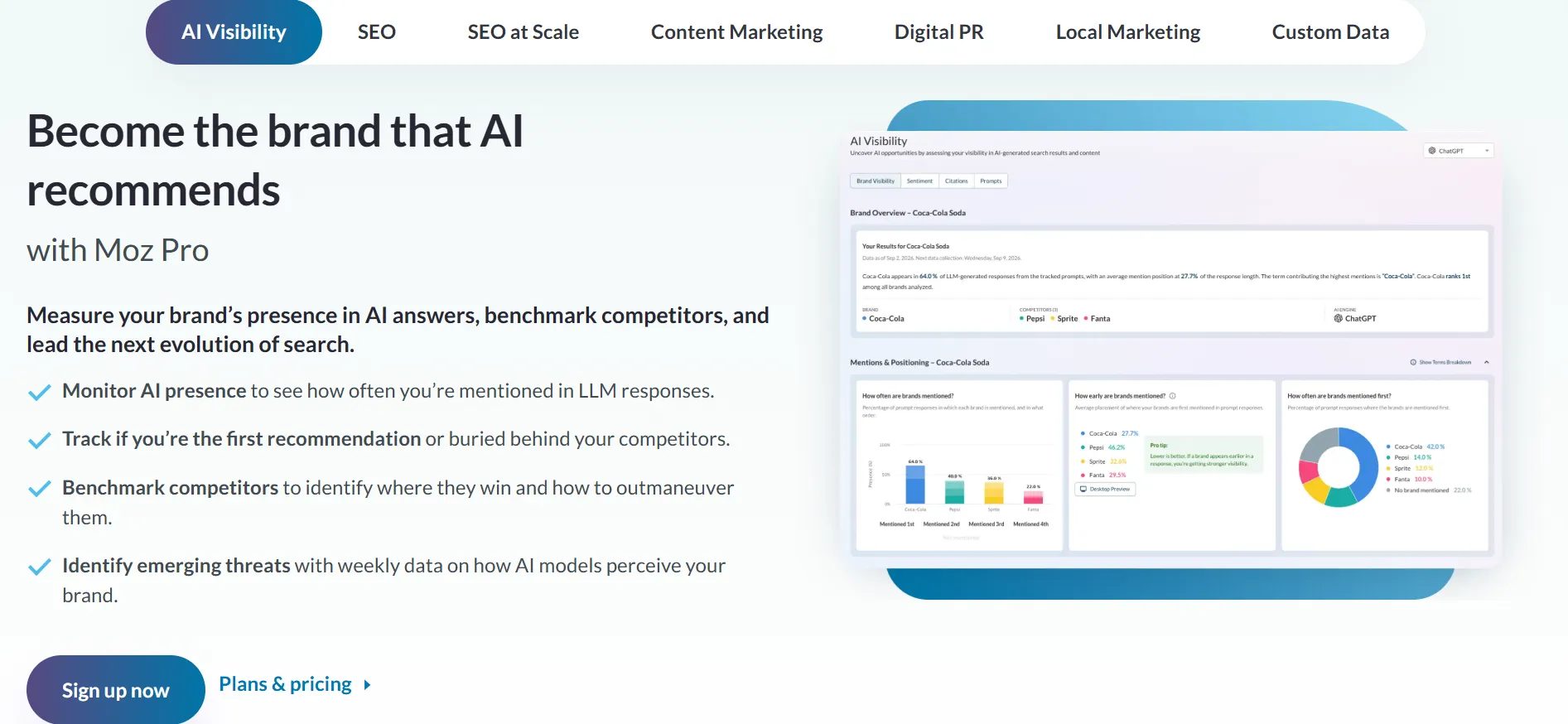
AI Visibility dashboards track how GPT, Gemini, Google AI Mode, and Perplexity describe and cite your brand, with weekly prompt tracking, sentiment analysis, and citation data. AI content briefs generate outlines for your writers.
How good is it? Honest answer: it is a credible start, but it is in beta territory and it is thinner than Semrush’s dedicated AI Visibility toolkit, which covers more platforms and more prompts. Medium plan and above get the dashboards, so budget accordingly.
8. Reporting
Scheduled PDF reports, branded reports from Standard up, and report templates on Medium and Large. Fine for client work, though the design feels dated next to Looker Studio integrations elsewhere.
Pros and Cons: Moz Review
Pros
- The most beginner friendly interface in SEO software. New users are productive within hours.
- Domain Authority and Page Authority remain the industry's most trusted and referenced metrics.
- Spam Score is excellent for link quality analysis.
- Fair pricing structure where every plan unlocks the same features.
- The best educational resources in the industry, including Moz Academy and the legendary blog.
Cons
- Keyword database of around 1.25 billion is many times smaller than Semrush or Ahrefs.
- Starter plan limits, 50 keywords and 1 site, are too tight for real work.
Moz vs Competitors: Complete 2026 Moz Review Comparison
See how Moz stacks up against Ahrefs, Semrush, and other SEO tools in this Moz review, comparing features, pricing, data accuracy, and overall value.
Moz vs Semrush
Semrush is the everything platform. 28.9 billion keywords, 43 trillion backlinks, 55 plus tools covering SEO, PPC, content, social, and now AI visibility, with revenue of $443.6 million in 2025 and ownership by Adobe.
Moz cannot compete on data scale or feature breadth, and reviews consistently show that.
What Moz comparisons by Semrush fans leave out: Semrush is three times the price for the tier most businesses need, has a steep learning curve, and charges per seat and per add on in ways that inflate the real bill.
If you are a beginner or a small business, Moz at $79 to $143 per month is a saner entry point than Semrush at $249 per month for Guru.
Moz vs Ahrefs
Ahrefs owns backlink analysis and has a larger, fresher keyword database than Moz, with a cleaner interface that rivals Moz’s ease of use.
What Ahrefs comparisons leave out: no free plan, no trial at all, weekly crawl limits that frustrate big sites, and pricing that starts around $129 per month. Moz’s 7 day trial and free tools make it the lower risk bet for newcomers.
Moz vs SE Ranking
SE Ranking is the value champion, delivering projects, tracked keywords, and AI features at prices well below Moz, with strong review scores for its audits.
What SE Ranking comparisons leave out: its brand metrics lack the industry recognition of Domain Authority, and its free tool ecosystem is far weaker than Moz’s. For budget buyers, SE Ranking often wins on raw value. For credibility and education, Moz still has an edge.
Moz vs SpyFu
SpyFu starts around $33 per month and specializes in competitor PPC and SEO intelligence.
What SpyFu’s marketing leaves out: it is not a full SEO suite, its site audit and content tools are weak, and data accuracy is questioned more often. It complements Moz rather than replacing it.
Quick Comparison Table: Moz review vs Competitors
Compare Moz against Semrush, Ahrefs, SE Ranking, and SpyFU in this Moz review table showing pricing, features, and key differences at a glance.
Factor | Moz Pro | Semrush | Ahrefs | SE Ranking |
Starting price | $49/mo | $139.95/mo | ~$129/mo | Lower |
Keyword database | 1.25B | 28.9B | 28B+ | Smaller |
Rank tracking | Weekly | Daily | Daily | Daily |
Free tools | Excellent (MozBar) | Limited | None | Limited |
Key metric | Domain Authority | Authority Score | Domain Rating | Proprietary |
Trial | 7 days | 7 to 14 days | None | Trial available |
Best for | Beginners and small businesses | All in one teams | Link focused SEOs | Budget users |
Who Should Use Moz in 2026?
Pros
- You are new to SEO and want the gentlest learning curve in the industry.
- You are a small business with one to three websites and modest keyword needs.
- Your clients or industry measure everything in Domain Authority.
- You want strong free tools without paying anything.
Cons
- You run an agency or enterprise SEO program needing daily data and massive databases.
- Competitive research is your daily bread. Semrush or Ahrefs will serve you better.
Is Moz Pro Worth It? My Final Verdict
Moz in 2026 is a good tool for a specific person: the SEO beginner, the small business owner, or the marketer who wants Domain Authority data and clean simplicity without a $250 per month commitment. For that person, Moz is genuinely one of the best choices available.
But let me be clear about the ceiling. The keyword database is a fraction of the leaders, rank tracking is weekly, and the AI features, while promising, are not best in class. If your SEO program is serious and growing, you will outgrow Moz within a year, and migrating your historical data is painful.
My recommendation: start with Moz’s free tools and the 7 day trial. If the interface clicks and the data covers your niche, Medium at $143 per month annually is a fair deal.
If you find yourself constantly hitting data walls, skip straight to Semrush or Ahrefs and save yourself the double migration.
FAQs: Moz Review
Moz offers genuinely useful free tools, including MozBar, Domain Analysis, and limited Keyword Explorer. Full Moz Pro starts at $49 per month.
Starter 49permonth(49 per month (39 annual), Standard 99(99 (79 annual), Medium 179(179 (143 annual), Large 299(299 (239 annual), plus custom Enterprise.
Yes, 7 days with a credit card required. There is also a 30 day money back guarantee on new subscriptions.
Moz's 0 to 100 score predicting how well a website will rank. It is the most widely cited authority metric in SEO.
iContact Marketing Corp acquired Moz in June 2021.
Yes, arguably the best SEO tool for beginners thanks to its interface, education, and free tools.
Weekly, on all plans. Competitors like Semrush and Ahrefs offer daily tracking.
A Word on Moz Local
Since many searches for a Moz review are actually about local businesses, a quick note on Moz Local.
It is a separate product at $16 to $40 per month per location, handling listing distribution across 90 plus directories, review monitoring, Google Q and A management, and, on higher tiers, review responding, sentiment analysis, and social posting. Annual billing runs $199 to $399 per location.
Compared to dedicated local SEO platforms like BrightLocal or Yext, Moz Local is simpler and cheaper, but it only covers the US, UK, and Canada.
If local search is your entire business, it is a reasonable lightweight option. If it is a side channel, the main Moz Pro suite plus a free Google Business Profile will cover most of your needs.
Quick Links:
The Migration Question
One final practical point. If you are currently on Semrush or Ahrefs and thinking about downgrading to Moz to save money, weigh the migration cost.
You will lose historical rank data, keyword lists, and campaign history, and Moz’s smaller database may not cover keywords your current tool finds easily.
Downgrading tools rarely saves money once you count the productivity loss. Moz makes the most sense as a first serious tool, not as a step down.