If you are thinking about selling an online course, Teachable is probably one of the first names you found. It has been around since 2013, it powers courses for tens of thousands of creators, and it helped define the entire category of course platforms.

Teachable is an all in one platform for creators, coaches, and educators to build, host, and sell online courses, coaching programs, and digital products. Owned by Hotmart Company, Teachable powers 100+ million students across 180 countries with built in payment processing, automatic tax handling, and global payment methods.
Pros
- Easiest to use course builder with drag and drop interface and AI content tools
- Zero transaction fees on Builder, Growth, and Custom plans with Teachable Payments
- Automatic tax calculation and remittance in 45+ countries eliminates compliance headaches
- Global reach with 35+ local payment methods and multi language support across 70+ languages
- Strong student engagement tools including mobile apps, drip content, quizzes, and certificates
Cons
- Starter plan charges 7.5% transaction fees making it expensive for budget conscious creators
- Limited advanced features on lower tiers compared to enterprise competitors
Starting at $39/mo
Get Started with TeachableTeachable at a Glance: Quick Teachable Review Overview
Get a quick snapshot of Teachable’s core features, pricing tiers, and platform strengths in this Teachable review for fast understanding.
Item | Details |
What it is | Hosted platform to create and sell online courses, coaching, and downloads |
Founded | 2013, New York, originally called Fedora |
Founder | Ankur Nagpal |
Owner | Hotmart (acquired 2020, roughly $250 million) |
Starting price | 39permonth(39 per month (29 per month billed annually) |
Free plan | No, removed in June 2025 |
Free trial | 7 days, 30 day money back guarantee |
Transaction fee | 7.5 percent on Starter, 0 percent on higher plans |
Cumulative creator earnings | Over $10 billion (with Hotmart) |
Students reached | Over 30 million enrollments |
Best known for | Simple setup, smooth checkout, tax handling |
G2 rating | 3.8 out of 5 |
What Is Teachable and Who Is It For?
Teachable is a hosted course platform. That means you do not need your own website, hosting, or technical skills.
You sign up, upload your videos, and set your price, and Teachable handles the checkout, payment processing, sales tax, EU VAT, student access, and certificates.
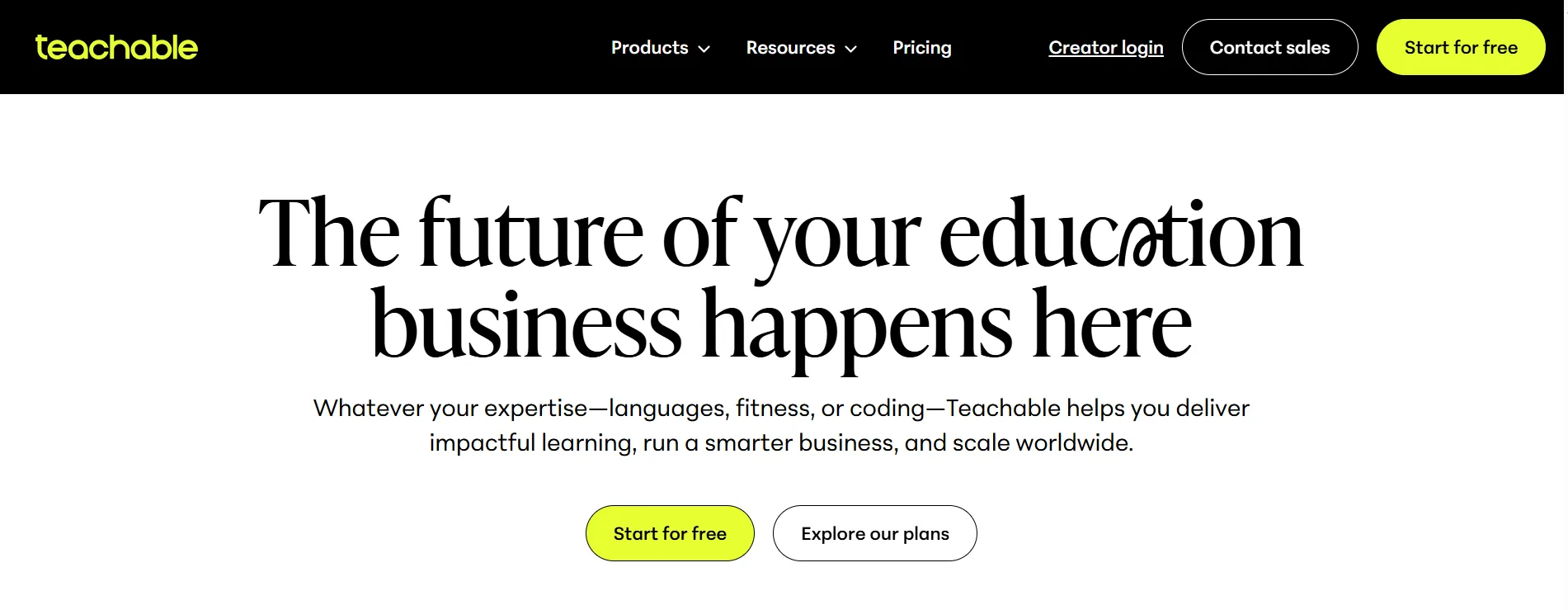
The pitch is simple. You teach, they handle the tech. For a coach, consultant, or expert who wants to sell a course without touching a line of code, that pitch still works well.
Teachable is best for solo creators and small course businesses who want a clean, reliable way to sell courses, coaching, and digital downloads. It is less suited for people who want deep community features, advanced quizzes and assessments, or a full marketing funnel built in.
The Big News: The Hotmart Acquisition and the 2025 Pricing Overhaul
Teachable was founded in 2013 by Ankur Nagpal, originally under the name Fedora. The company raised about $15.2 million across four rounds from investors, including Accomplice, Atlas Venture, and Learn Capital. By 2020, it had roughly $60 million in annual recurring revenue.
In March 2020, Brazilian edtech company Hotmart acquired Teachable for approximately $250 million, well above its last disclosed valuation of $134 million from 2018.
Hotmart wanted a stronger foothold in the US market, and Teachable kept running as its own brand with Nagpal staying on as CEO.
The first couple of years under Hotmart were relatively smooth. Then things changed.
In late 2023, prices went up. Then in June 2025 came the restructure that changed everything. Teachable:
Removed the free plan entirely, including for grandfathered accounts.
Retired the old Basic, Pro, and Pro plus plan names.
Replaced them with Starter, Builder, Growth, and Advanced.
Introduced a 7.5 percent transaction fee on the Starter plan.
Added product limits and student caps where unlimited access had existed before.
Gave legacy customers only 30 days notice before migrating them to new pricing.
The backlash was real. Established creators publicly documented leaving. Kerstin Cable, a language education creator, wrote about migrating more than 30 courses away from Teachable in 2025.
Andrea Jones of OnlineDrea dedicated a podcast episode to explaining why she left after 8 years, citing the platform’s limits as a membership tool.
Here is my honest take. The June 2025 changes made Teachable a worse deal at the low end. The 7.5 percent fee on Starter is steep, and losing the free plan removed the easiest way for new creators to test the platform.
But the product itself is still solid, and for creators on Builder and above with 0 percent fees, the math works fine. The anger is about value at the entry level, not about the core platform being broken.
Teachable by the Numbers: Stats That Matter in 2026
Discover important metrics about Teachable in this Teachable review, including creator earnings, student reach, geographic presence, and platform growth statistics.
Creators have earned over $10 billion cumulatively on platforms under the Hotmart company umbrella, which includes Teachable.
Teachable alone passed $1 billion paid out to creators by 2020 and had processed 43 million student enrollments.
At the time of the Hotmart acquisition, Teachable had over 50,000 creators and 30 million students.
One in five economically active Brazilians has purchased a creator product through Hotmart.
Hotmart’s free AI tool has helped more than 140,000 creators outline digital products, and Hotmart acquired Reshape, an AI transcription and subtitling startup, to expand those capabilities.
Teachable now supports one click course interface translations into Spanish, French, Portuguese, and more languages.
What these numbers tell you is that Teachable sits inside a very large, profitable parent company. It is not going anywhere.
The risk is the opposite, that a large parent optimizes for revenue extraction rather than creator experience, and the 2025 changes showed that risk is real.
Teachable Pricing in 2026: Full Breakdown with Real Math
Pricing is where this Teachable review needs to slow down, because the sticker price is not the real price.
Starter
$39 per month, or 29permonthbilledannually(29 per month billed annually (348 per year upfront). One product, up to 100 students, 7.5 percent transaction fee on every sale, no affiliate program, Teachable branding on your site.
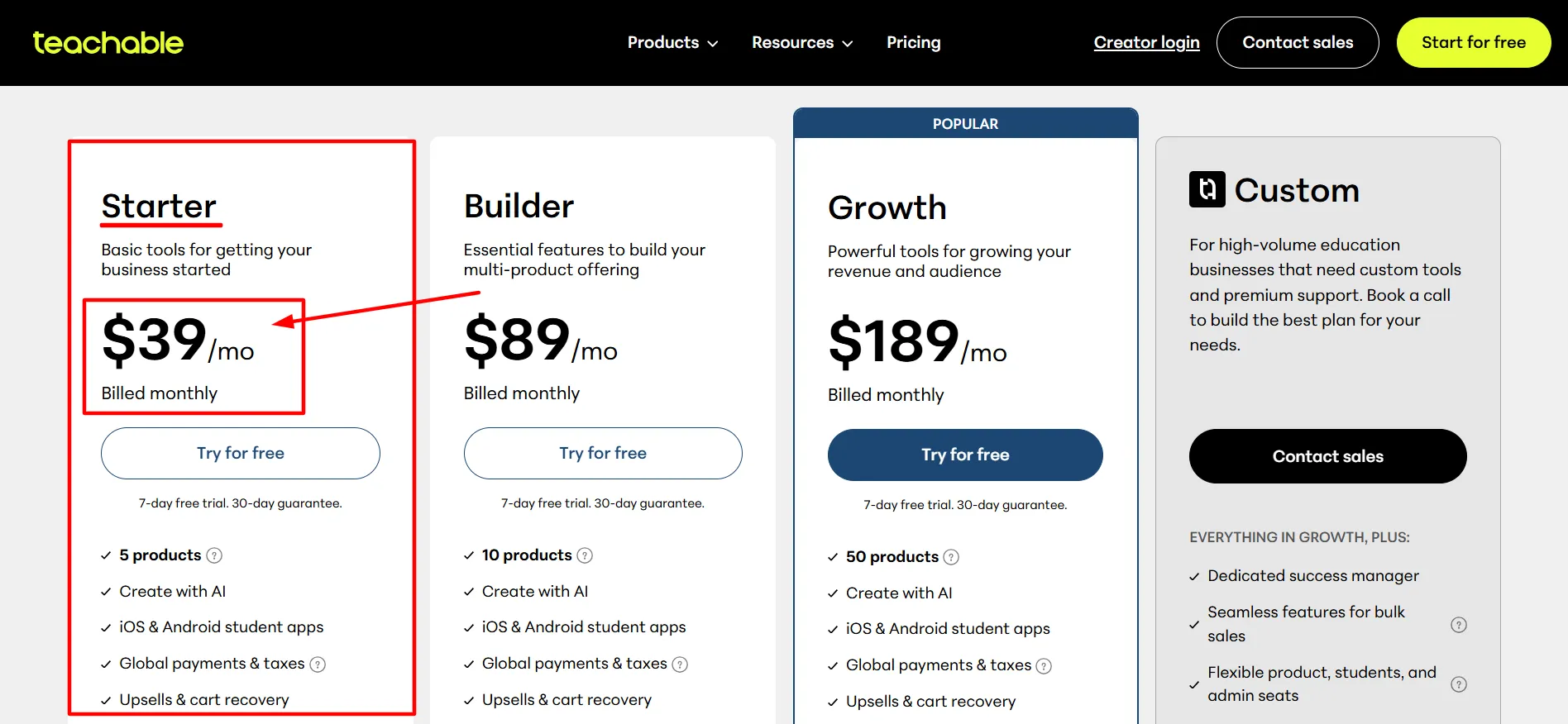
The transaction fee applies on top of standard payment processing of roughly 2.9 percent plus 30 cents.
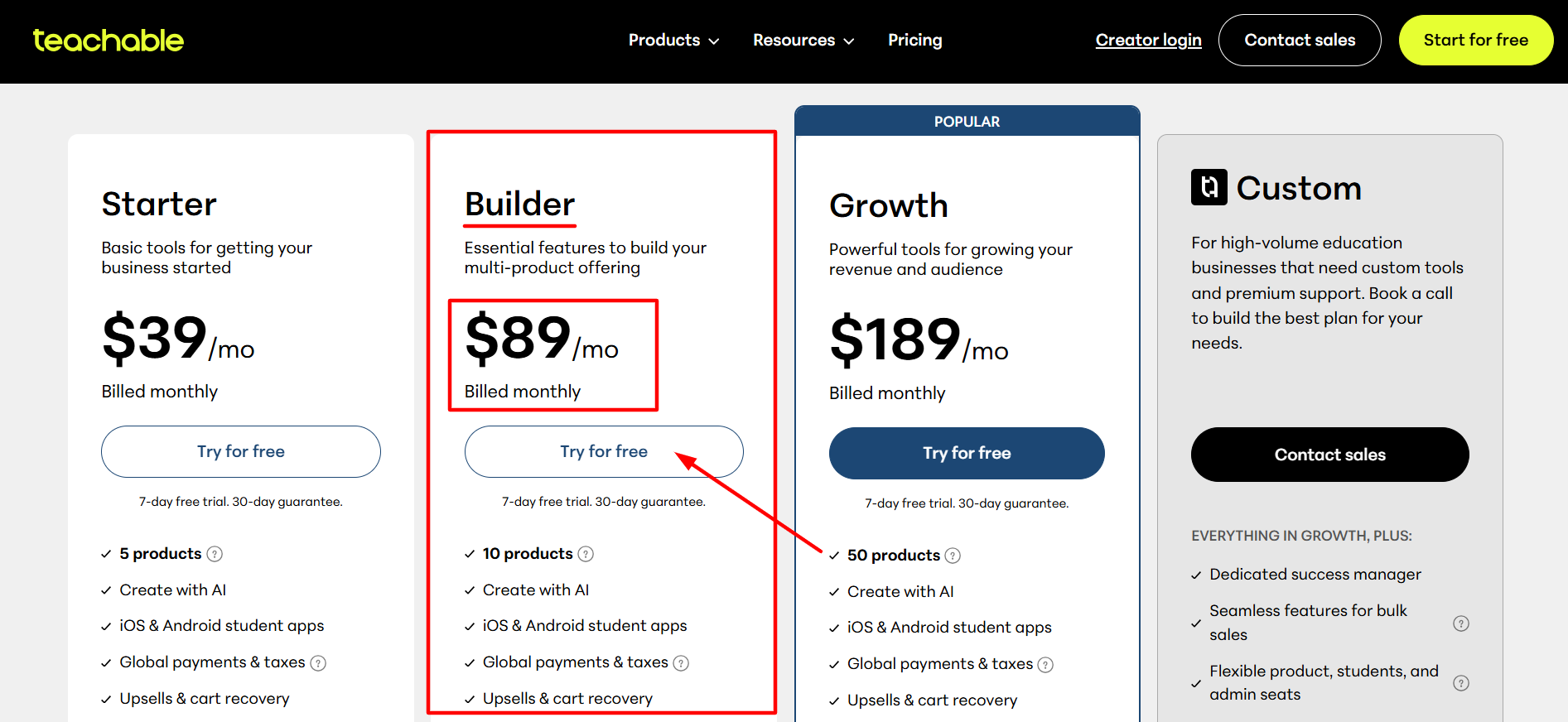
Builder
$89 per month, or $69 per month billed annually. Five products, up to 1,000 students, 0 percent transaction fee, affiliate program included, custom domain, basic email marketing.
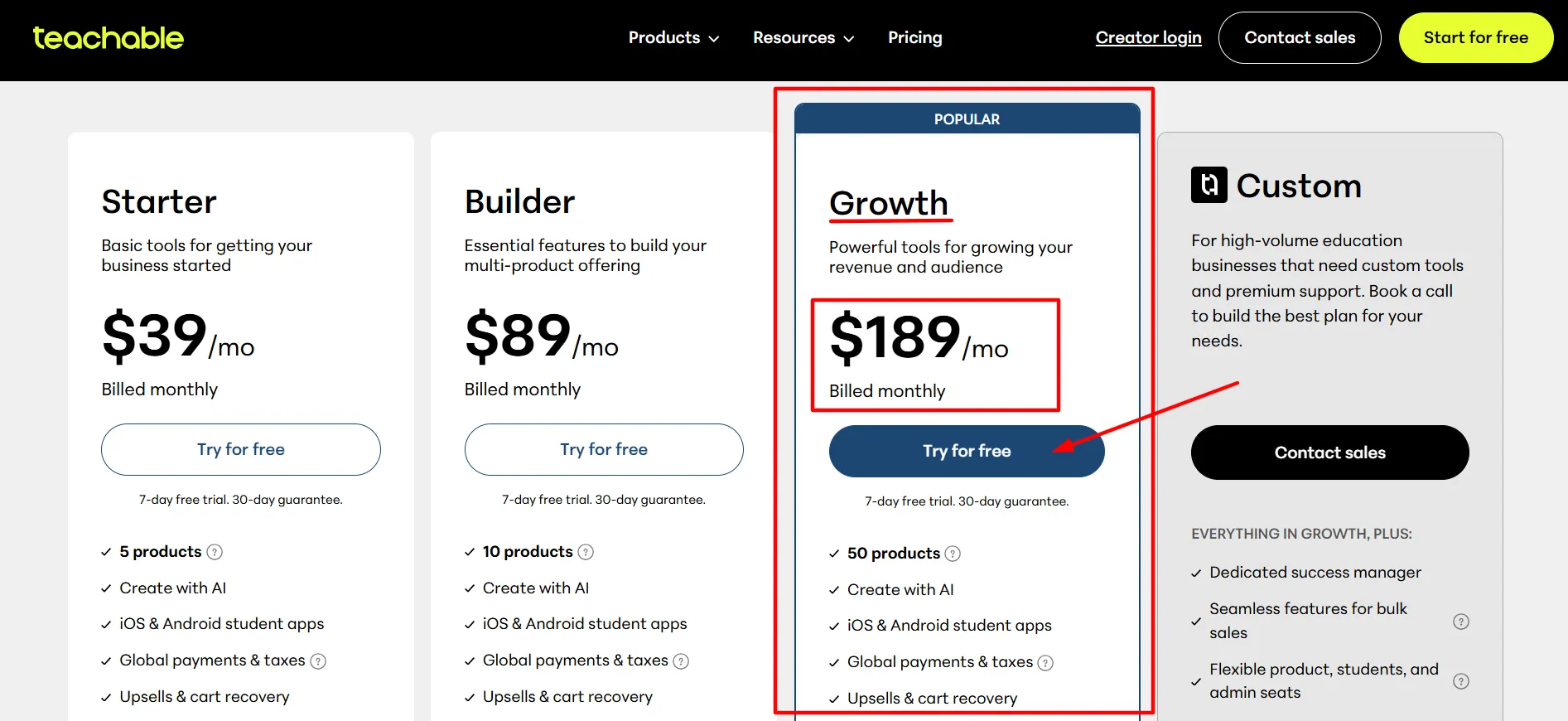
Growth
$189 per month, or $139 per month billed annually. 25 products, unlimited students, 0 percent fees, white glove features, AI captioning, more admin seats.
Advanced
Around $309 per month billed annually. 100 products, unlimited students, advanced admin tools and reporting. Above this sits a custom priced tier for large academies.
Every paid plan includes a 7 day free trial and a 30 day money back guarantee. Partner links sometimes extend the trial.
The Break Even Math Most Reviews Skip
Here is the number that matters. The gap between Starter (29permonthannual)andBuilder(29 per month annual) and Builder (69 per month annual) is $40 per month. Divide $40 by the 7.5 percent fee and you get about $533 per month in revenue.
That means if your course business earns more than $533 per month, staying on Starter costs you more than upgrading to Builder. At $1,000 per month in sales, Starter costs you about $132 total while Builder costs about $98.
At $5,000 per month, Starter costs about $544 while Builder costs about $214. Starter is only the cheap option for very low volume sellers.
Hidden Costs to Budget For
Payment processing: roughly 2.9 percent plus 30 cents per transaction via Stripe or PayPal on every plan.
Third party email marketing: Teachable’s built in email is basic. Most creators add ConvertKit, MailerLite, or ActiveCampaign at $29 to $100 per month.
teachable:pay surcharge: using your own payment gateway instead of Teachable’s native payment system adds an extra fee per sale.
Funnel and landing page tools: if you run webinars or multi step launches, you will likely need an external tool.
Migration costs: if you ever leave, expect 40 to 80 hours of work per course to move content, per industry estimates.
Teachable Features Explained in Detail: Complete Teachable Review Breakdown
Explore every core feature included in Teachable with detailed explanations covering course building, student management, payment processing, and marketing tools in this comprehensive Teachable review.
1. Course Builder
The drag and drop course builder is genuinely one of the fastest on the market. Most creators can have a course live in a single day, including videos, a sales page, and checkout.
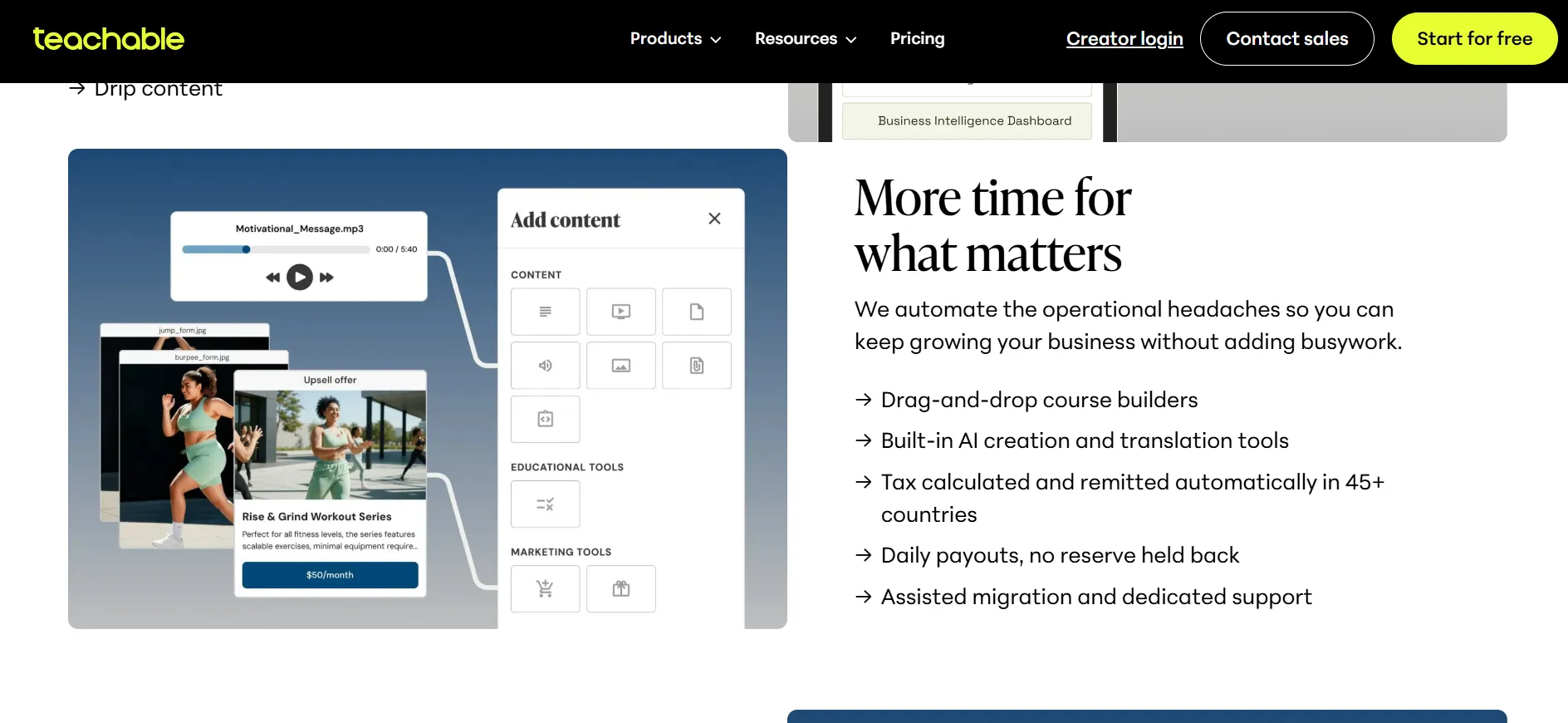
You can structure content into sections and lectures, mix video with PDFs and quizzes, and drip content over time. The interface is clean enough that non technical users rarely get stuck.
2. Checkout and Payments
This is Teachable’s quiet superpower. The checkout converts well in head to head tests, supports order bumps, payment plans, subscriptions, and bundles natively, and handles the boring hard stuff like US sales tax, EU VAT, and global payments automatically.
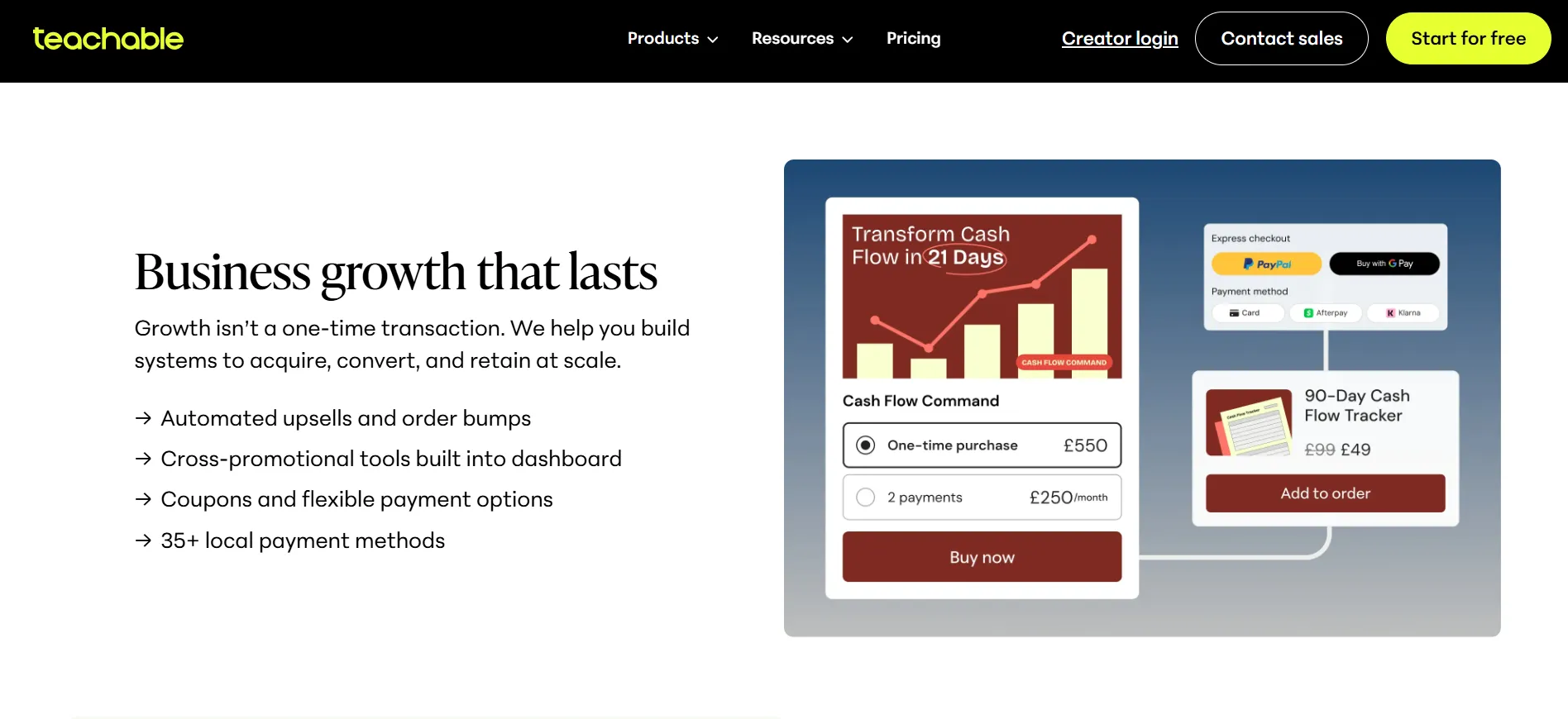
Selling internationally without thinking about tax compliance is a real relief for solo creators.
3. Product Types
Beyond courses, you can sell coaching programs, digital downloads, bundles, and memberships from the same dashboard.
The coaching product includes scheduling integration, which makes it a genuine one stop option for coach creators.
One honest note from user reviews: the membership features exist but are limited, which is exactly why some membership focused creators have left.
4. Affiliate Program
Available on Builder and above, the built in affiliate system lets you recruit partners who promote your course for a commission.
It tracks referrals, manages payouts, and runs inside Teachable instead of requiring a separate platform like Rewardful or FirstPromoter.
5. Certificates and Compliance
Completion certificates and course compliance settings, like required lesson completion, now come on every plan. This used to be a paid upgrade, so it is a genuine improvement from the 2025 restructure.
6. AI Features
Teachable has been adding AI tools steadily. AI captioning is included on Growth and above, and the platform benefits from Hotmart’s AI investments, including the Reshape acquisition for transcription and subtitling.
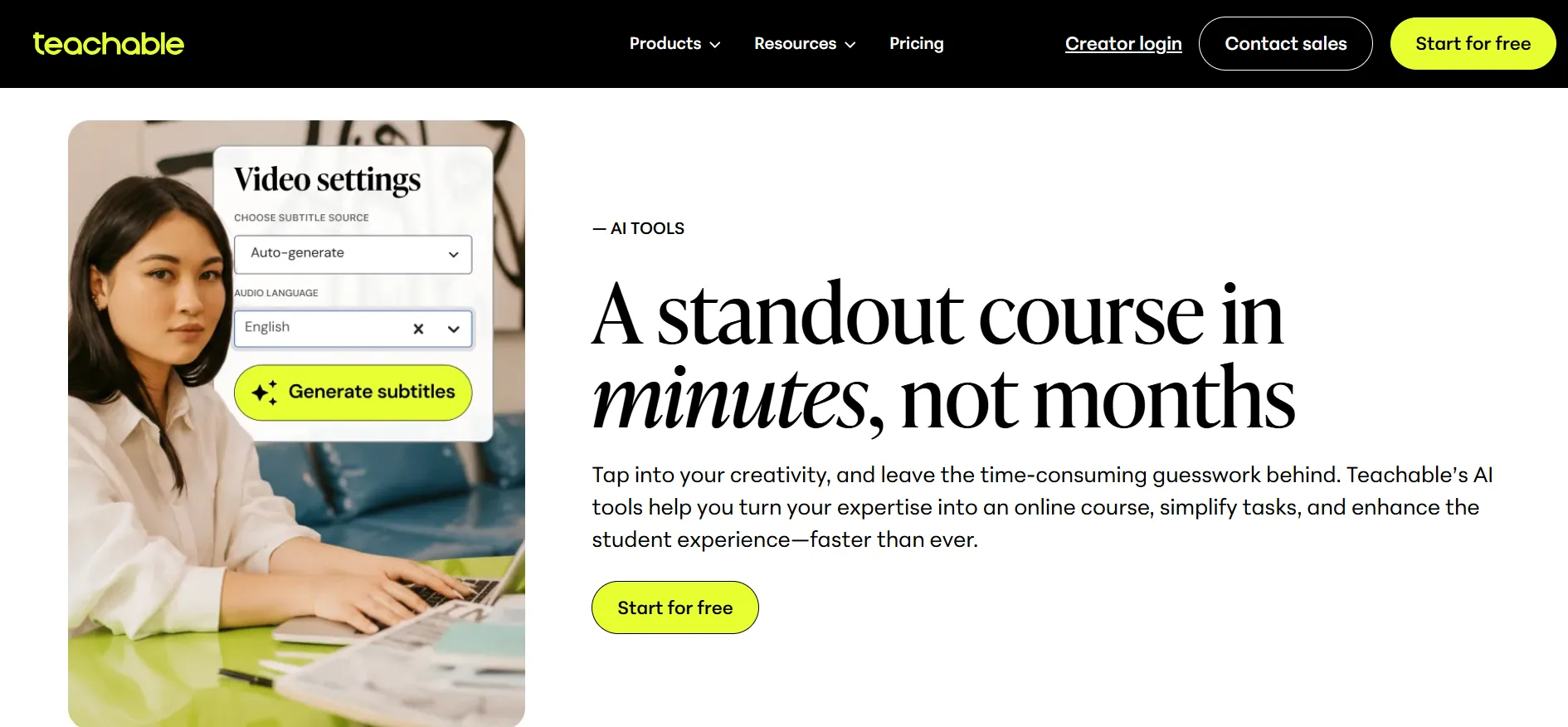
The AI course outline tools are useful for brainstorming, though they will not replace your expertise.
7. Student Experience
The course player is clean, modern, and mobile friendly, with progress tracking and one click translations into Spanish, French, and Portuguese.
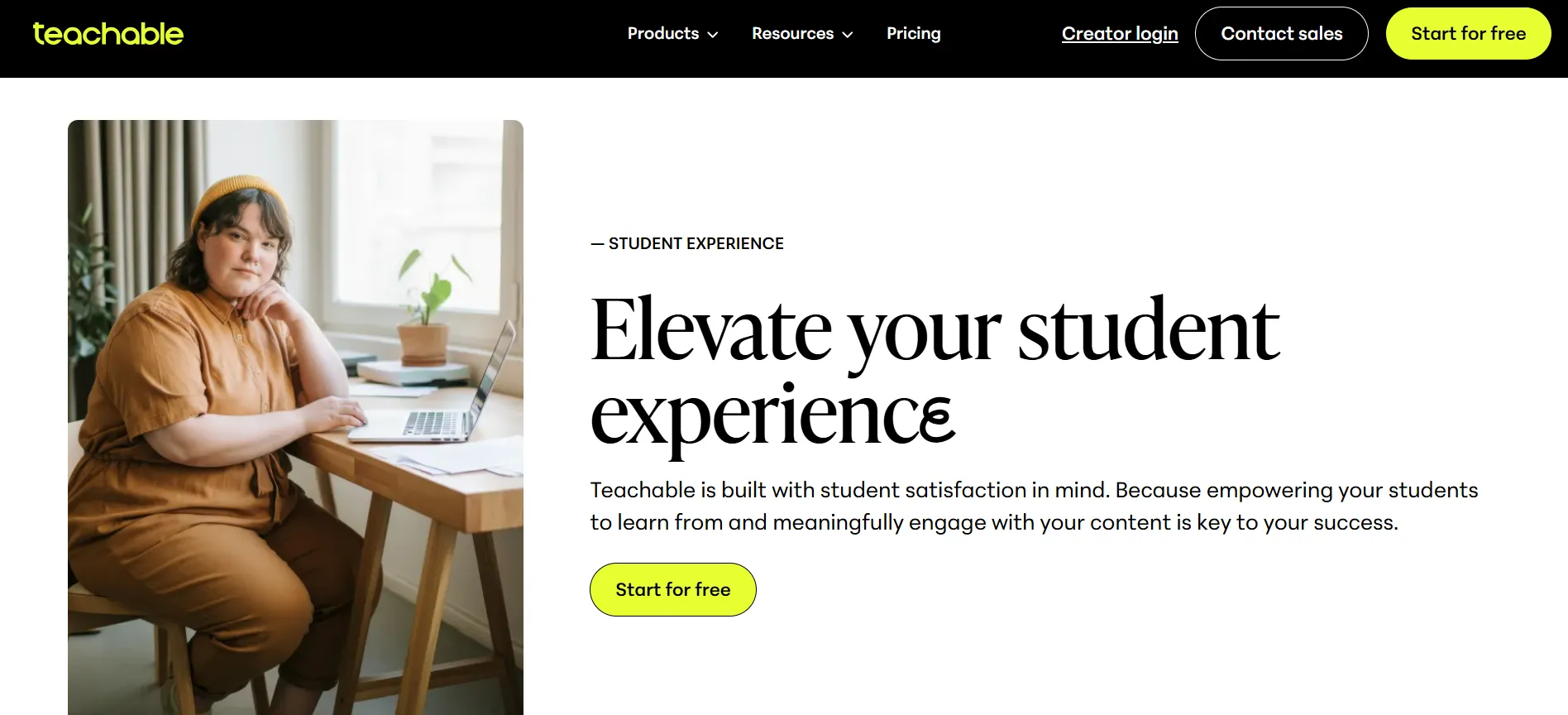
Students consistently rate it among the easiest platforms to navigate. There is a smartphone app for students, which is something self hosted setups struggle to match.
8. What Teachable Does Not Do Well
Community features are minimal. There is no native discussion board or cohort experience, so community focused creators route students to Discord or Circle. Quizzes are simple multiple choice only.
Design flexibility is limited, and you cannot touch the underlying code. Email marketing is basic, and support quality is the most common complaint in user reviews, especially on lower plans.
Pros and Cons: Teachable Review
Pros
- One of the fastest course setups available. A complete course can be live in a day.
- Excellent checkout with order bumps, payment plans, and bundles.
- Automatic tax, VAT, and global payment handling.
- Clean student experience with a mobile app and language translations.
- Backed by Hotmart, a profitable parent company with over $10 billion in cumulative creator earnings.
Cons
- 7.5 percent transaction fee on Starter, plus processing fees.
- Product and student caps on lower plans.
Teachable vs Competitors: Full 2026 Comparison
See how Teachable stacks up against Kajabi, Thinkific, Podia, and other course platforms in this Teachable review, comparing features, pricing, and overall value.
Teachable vs Thinkific
Thinkific is the most direct like for like swap. It charges no transaction fees on any plan, offers 30 day trials, and has stronger quiz logic, communities, and course design flexibility.
What Thinkific’s marketing leaves out: its checkout is less polished than Teachable’s, its payment handling is less seamless, and its plans start higher at around $40 to $54 per month. If fees are your pain point, switch to Thinkific. If checkout conversion matters most, Teachable still has the edge.
Teachable vs Kajabi
Kajabi is the all in one option with email marketing, funnels, CRM, podcasts, and communities built in. Plans run $179 to $499 per month.
What Kajabi comparisons leave out: the total cost of ownership often favors Kajabi once you factor in the email and funnel tools you must add to Teachable anyway. If you earn over $5,000 per month from courses, Kajabi’s consolidation math usually wins. Below that, it is overkill.
Teachable vs Podia
Podia sells courses, downloads, memberships, and webinars from a simple storefront starting around $42 to $49 per month, with no fees on higher plans and generous email marketing included.
What Podia’s marketing leaves out: its learning features are shallower than Teachable’s, and its checkout and tax handling are less mature. For simple digital product businesses, Podia is great. For structured courses, Teachable is stronger.
Teachable vs LearnWorlds
LearnWorlds is the education focused choice with interactive video, assessments, SCORM compliance, and a white label mobile app.
What LearnWorlds comparisons leave out: it costs $5 per enrollment on its Starter plan, and the truly useful interactive features live on its $99 to $299 per month tiers.
If you sell to businesses or need formal assessments, LearnWorlds wins. For standard creator courses, it is more tool than most people need.
Teachable vs Skool
Skool starts at just $9 per month and excels at gamified communities with courses attached.
What Skool comparisons leave out: its course features are bare bones, it takes up to 10 percent in fees on its Hobby plan, and there are no completion certificates or formal learning structure. Skool fits community first businesses, not course first businesses.
Quick Comparison Table: Teachable Review vs Competitors
Compare Teachable against Kajabi, Thinkific, Podia, and other course platforms in this Teachable review table showing pricing, features, and key differences at a glance.
Factor | Teachable | Thinkific | Kajabi | Podia | LearnWorlds |
Starting price | $39/mo | $40 to $54/mo | $179/mo | $42/mo | $29/mo |
Transaction fees | 7.5% Starter, 0% above | 0% | 0% with Kajabi Pay | 5% Mover, 0% above | $5 per sale Starter |
Free plan | No | No, 30 day trial | No, 14 day trial | No, 30 day trial | No, 30 day trial |
Community | Minimal | Growing | Yes | Forum | Forum |
Email marketing | Basic | Via integrations | Full platform | Included | Limited |
Best for | Simple course selling | Course plus community depth | All in one businesses | Digital product variety | Professional education |
Who Should Use Teachable in 2026: Teachable Review Guide
Discover if Teachable fits your needs in this Teachable review, covering ideal users from solo creators and coaches to small agencies and established course businesses.
You are launching your first or second course and want the fastest path to selling.
You sell coaching alongside courses.
You sell internationally and want tax and VAT handled for you.
You expect to earn over $533 per month so Builder’s 0 percent fee makes sense.
Teachable is probably not for you if:
You need a free way to validate an idea. Use a 30 day trial elsewhere instead.
Community and engagement are central to your offer. Look at Circle, Skool, or Thinkific.
You want one tool for courses, email, and funnels. Kajabi or Systeme.io fit better.
You were burned by the 2025 restructure and value pricing stability above everything.
A Note on Support and Reliability
One more thing worth covering, because it shows up in almost every honest Teachable review. Support is the platform’s weakest point. Smaller accounts regularly report slow responses and heavy reliance on self serve documentation.
There is a solid Help Center, but when a billing issue hits mid launch, documentation does not cut it. Larger competitors with 24/7 live chat on every plan have a real edge here.
On reliability, Teachable’s infrastructure is mature. Schools rarely go down, payments process on time, and the platform handles traffic spikes during launches without drama.
Combined with Hotmart’s backing, this is a stable platform you can build on, provided the pricing structure fits your stage.
Teachable Alternatives Summary
If you came here from a search for a Teachable review, there is a decent chance you are also comparing alternatives.
The short version: Thinkific for better fees and course depth, Kajabi for an all in one business, Podia for simple digital products, LearnWorlds for professional education, Skool for community first offers, and Systeme.io if you want funnels and email on a tiny budget.
Every one of them offers a longer trial than Teachable’s 7 days, which tells you something about how confident each is that you will stay.
FAQs: Teachable Review
No. Teachable removed its free plan in June 2025. The cheapest option is Starter at $39 per month, or $29 per month billed annually, with a 7 day trial and 30 day money back guarantee.
7.5 percent on the Starter plan, on top of payment processing fees of roughly 2.9 percent plus 30 cents. Builder, Growth, and Advanced have 0 percent platform fees.
Hotmart acquired Teachable in March 2020 for approximately $250 million. Teachable operates as its own brand under the Hotmart company.
One product on Starter, five on Builder, 25 on Growth, and 100 on Advanced. Student caps apply on Starter and Builder.
Yes. Coaching is a native product type with scheduling integration, alongside courses, downloads, bundles, and memberships.
Yes for setup ease, but the 7 day trial is short and there is no free tier, so budget for at least the Starter plan to get started.
Teachable is a wholly owned subsidiary of Hotmart, a Brazilian edtech company founded in 2011.
Quick Links:
My Final Verdict: Is Teachable Worth It?
Teachable in 2026 is a good product wrapped in a frustrating pricing story. The platform itself is fast, reliable, and excellent at the two things that matter most for course sellers, checkout conversion and payment compliance. Builder at $69 per month is a fair deal for active creators.
But I cannot ignore the context. Removing the free plan, adding a 7.5 percent entry fee, capping products, and forcing legacy users to migrate created real damage, and competitor platforms have happily absorbed the creators who left.
My recommendation: if you sell courses and want simplicity, start your 7 day trial, build one real course, and run actual numbers on the Starter versus Builder break even point.
If community, advanced assessments, or all in one marketing matter to you, take Thinkific or Kajabi for a spin instead. Whatever you choose, export your content regularly so no future pricing change can hold your business hostage.
Rating: 4.0 out of 5. The product earns a 4.5. The pricing history costs it half a point.