
Artificial Intelligence (AI) continues to transform the world in 2025, reshaping industries, enhancing daily life, and creating new opportunities for individuals and businesses.
The global AI market, valued at $391 billion to $757.58 billion, is projected to reach $3.68 trillion by 2034, reflecting a remarkable compound annual growth rate (CAGR) of 19.2% to 31.5%.
Over 55% of Americans regularly engage with AI, and 90% of businesses integrate it to stay competitive. From voice assistants in 77% of devices to generative AI adopted by 65% of organizations, AI’s influence is undeniable.
This comprehensive guide explores the latest AI statistics for 2025, detailing market size, adoption trends, industry applications, and societal impacts.
Whether you’re a professional, student, or business owner, these insights reveal how AI can benefit you. We also address trending questions from Quora and Reddit to provide the most current perspectives on AI’s evolving role.
AI Market Size and Economic Impact
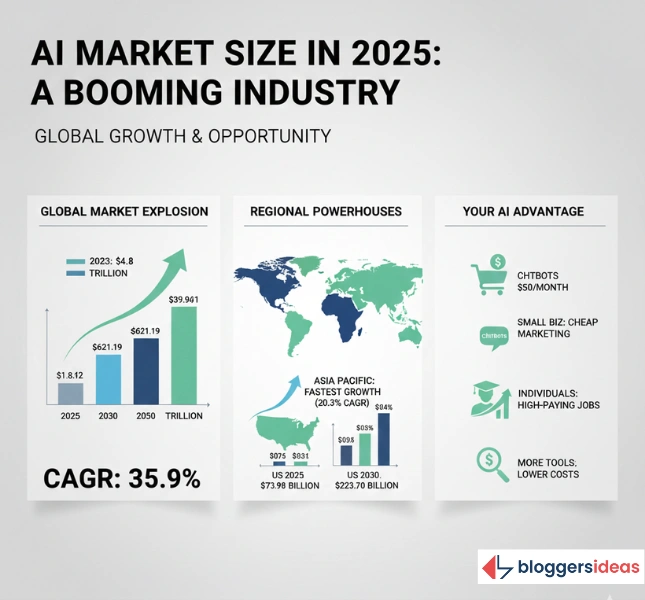
The global AI market thrives in 2025, with estimates ranging from $391 billion to $757.58 billion, driven by innovations in generative AI, machine learning, and autonomous systems.
Projections indicate the market will grow to $2.74 trillion to $3.68 trillion by 2032–2034, with a CAGR of 19.2% to 31.5%. The United States leads with a market size of $46.99 billion to $66.21 billion, expected to reach $223.7 billion by 2030 at a CAGR of 28.3%.
The Asia-Pacific region follows, growing at 20.3% CAGR, fueled by advancements in China and India.
AI’s economic contribution is substantial, with forecasts suggesting it will add $15.7 trillion to the global economy by 2030, boosting GDP by 7% to 26% in countries like China.
| Year | Global AI Market Size ($ Billion) | U.S. AI Market Size ($ Billion) |
| 2023 | 515.31 | – |
| 2024 | 638.23 | 50.16 |
| 2025* | 757.58 | 66.21 |
| 2026* | – | 86.79 |
| 2030* | – | 223.7 |
| 2032* | 2740 | – |
| 2034* | 3680 | – |
*Projected values
The generative AI market alone stands at $63 billion, surpassing the U.S. video gaming industry.
Wearable AI, driven by devices like smartwatches, is valued at $23.56 billion and is expected to reach $180 billion to $303 billion by 2035.
Autonomous vehicles generate $170 billion annually, with potential growth to $400 billion by 2035.
These figures empower individuals to invest in AI-driven fields, such as wearable tech development, and businesses to leverage AI for cost savings and revenue growth.
Also read about: Perplexity AI Statistics
AI Adoption and Usage Trends
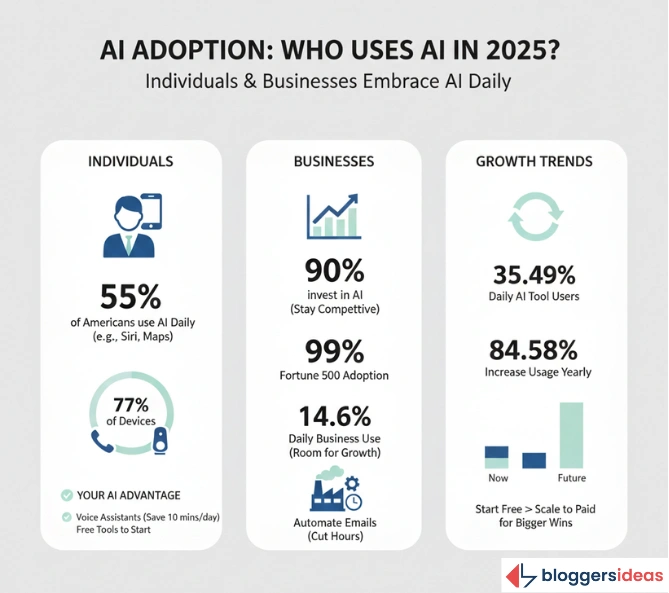
AI adoption accelerates across industries and demographics, with 55% of Americans regularly using AI and 78% to 90% of companies integrating it into operations.
Approximately 35.49% of people use AI tools daily, and 84.58% report increased usage over the past year.
Businesses prioritize AI, with 90% of organizations viewing it as a competitive edge and 63% planning further adoption by 2028.
Notably, 14.6% of businesses use AI daily, and 27% of Americans interact with it several times daily.
| AI Usage Frequency | Percentage of Americans |
| Several Times Daily | 27% |
| Once Daily/Several Times Weekly | 28% |
| Regularly Use | 55% |
| Do Not Regularly Use | 44% |
Machine learning is adopted by 20% of C-suite executives, and generative AI is utilized by 65% of organizations for tasks like content creation and data analysis.
Consumers encounter AI in 77% of devices, from smartphones to smart speakers, with 97% of smartphone users leveraging AI-powered voice assistants.
For individuals, this means seamless access to tools like ChatGPT, which boasts 800 million weekly users, for tasks like research or meal planning.
Also read about: Meta AI Users Statistics
AI in the Workplace
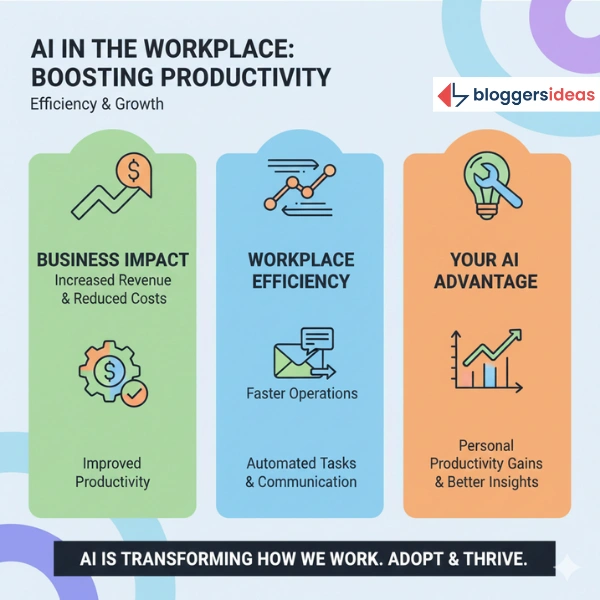
AI transforms workplaces, with 73% of U.S. companies integrating it into workflows, boosting revenue by 6% to 10% and productivity by 1.5% over the next decade.
Over 54% of businesses adopted AI within a year of ChatGPT’s launch, and 80% consider it a top strategy.
Generative AI is used daily by 9% of U.S. workers, particularly in content creation (85.1% of users) and lead generation (55% of B2B marketers).
Employees report 81% improved performance with AI, and 54% of businesses see cost savings and efficiency gains.
| Business Benefit | Percentage of Businesses |
| Increased Productivity | 44% |
| Cost Savings/Efficiency | 54% |
| Improved IT/Network Performance | 52% |
| Revenue Increase (6–10%) | 100% |
Challenges persist, with 35% of businesses citing a lack of technical skills and 40% noting high costs as barriers.
Individuals can overcome these by upskilling in AI through platforms like Coursera, where enterprise sign-ups exceed 200,000, ensuring career relevance.
Also read about: Semrush Statistics
AI Adoption by Industry
AI’s versatility drives adoption across sectors. Retail sees 80% of executives planning AI automation by 2025, with 90% of UK retailers exploring AI agents.
Healthcare leverages AI for diagnostics (38% of professionals use it) and drug development, with over 1,200 AI-enabled medical devices approved by the FDA.
The manufacturing sector anticipates $3.78 trillion in value by 2035, while banking expects $1 billion in revenue by 2027.
Digital marketing relies heavily on AI, with 75.7% of marketers using tools for SEO and content creation.
| Industry | AI Adoption Rate/Impact |
| Retail | 80% plan automation by 2025 |
| Healthcare | 66% of physicians use AI; $461 billion by 2035 |
| Manufacturing | $3.78 trillion by 2035 |
| Banking | $1 billion revenue by 2027 |
| Digital Marketing | 75.7% use AI tools |
| Telecom | 52% use chatbots |
Netflix saves $1 billion annually through AI-driven recommendations, reducing churn, while autonomous vehicles and wearable AI create new revenue streams.
Individuals can explore careers in these sectors, leveraging AI’s growth for job opportunities.
AI in Marketing, Sales, and Customer Service
Marketing and sales lead AI adoption, with 42% of departments regularly using generative AI, rising to 55% in tech companies.
AI enhances lead generation by 50%, reduces manual work by 15%, and improves conversion rates by 25%. Email marketers (51%) find AI more effective than manual efforts, and 55% of B2B marketers use chatbots for lead generation.
Customer service sees 79% of professionals prioritizing AI automation, with 95% of consumer interactions expected to involve AI by 2025.
| AI Use Case in Marketing/Sales | Percentage of Professionals |
| Lead Generation | 55% |
| Better Audience Understanding | 57% |
| Content Creation | 58% |
| Customer Retention | 20% |
Consumers prefer chatbots for simple tasks (80%) and expect improved experiences (80%), benefiting businesses with higher retention and efficiency.
Individuals can use AI tools like ChatGPT for personal branding or content creation, enhancing online presence.
AI in SEO and Content Creation
AI revolutionizes SEO, with 86.07% of professionals integrating AI tools into strategies. Generative AI impacts 47% of Google search queries via AI Overviews, with 87.6% appearing in top positions.
Approximately 63% of marketers report improved organic traffic and rankings post-AI Overviews. Content creators benefit from AI, with 58% using it for blog posts and social media, saving time and boosting visibility.
| SEO Metric | Percentage |
| Professionals Using AI Tools | 86.07% |
| Queries with AI Overviews | 47% |
| Improved Traffic/Rankings | 63% |
Individuals can leverage tools like Jasper or Grammarly to optimize content, while businesses use AI-driven analytics to target high-intent audiences, ensuring cost-effective campaigns.
AI’s Impact on Jobs and Employment
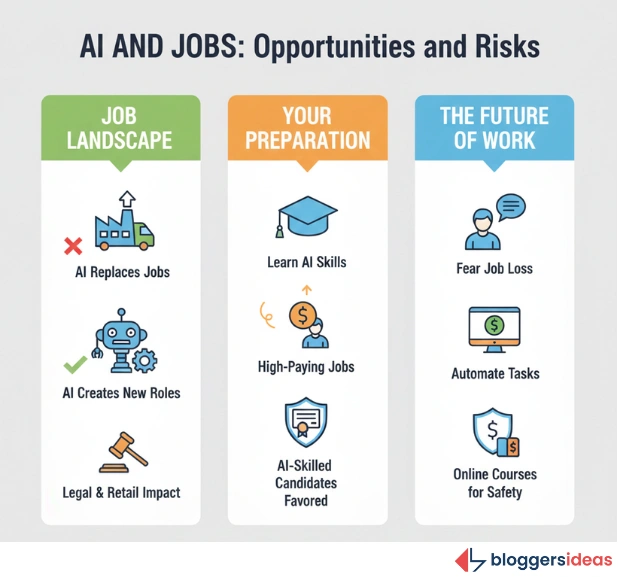
AI’s impact on jobs is dual-edged, with 92 million jobs potentially displaced by 2030 but 170 million new roles created, yielding a net gain of 78 million.
Retail jobs like cashiers face the highest risk, with 12 million losses projected by 2030, while AI specialists and data scientists see the steepest growth.
Approximately 16% of U.S. jobs face automation, affecting 38% of roles in the U.S. and 78% of legal occupations. High earners (55.56% above $200,000) fear job loss most, yet 26% of companies prioritize candidates with AI skills.
| Job Role | Projected Job Loss (2025–2030) |
| Cashiers/Ticket Clerks | 12 million+ |
| Administrative Assistants | 6 million+ |
| Cleaners/Housekeepers | 2.5 million+ |
| Accountants/Bookkeepers | 1.5 million+ |
Upskilling is critical, with Coursera reporting 200,000 enterprise enrollments in AI courses. Individuals can pursue AI certifications to secure roles in growing fields like machine learning.
AI in Cybersecurity
The AI cybersecurity market grows rapidly, reaching $31.56 billion in 2025 and projected to hit $93.75 billion by 2030 at a 24.3% CAGR.
However, 90% of cybersecurity professionals worry about AI-driven cyberattacks, and 78% of U.S. adults fear identity theft via AI.
Only 39% trust AI’s safety, and 52% express concerns about data privacy. Businesses counter this with 33% adopting AI security tools, though 56% cite inaccuracies as a challenge.
| Year | AI Cybersecurity Market Size ($ Billion) |
| 2023 | 20.43 |
| 2024 | 25.39 |
| 2025* | 31.56 |
| 2030* | 93.75 |
*Projected values
Individuals can protect personal data by using AI-enhanced security apps, while businesses invest in AI-driven threat detection to safeguard operations.
Popular AI Functions and Technologies
AI permeates daily life, with 72.97% of households using smart devices like speakers and thermostats. Voice assistants engage 97% of smartphone users, and 36.6% of Americans use them regularly.
ChatGPT leads with 800 million weekly users, followed by Google Gemini (274.7 million visits). AI excels in research (63% of users), cooking/meal planning (45.15%), and content creation (58%).
In healthcare, AI-designed drugs combat resistant bacteria, and 66% of physicians use AI diagnostics.
| AI Function | Usage Rate |
| Research/Question-Answering | 63% |
| Cooking/Meal Planning | 45.15% |
| Content Creation | 58% |
| Voice Assistants | 97% (smartphone users) |
OpenAI, with $12 billion in funding, dominates, with 80% of Fortune 500 companies using ChatGPT, saving $25,000 to $70,000 annually.
Individuals harness these tools for tasks like meal prep or resume writing, while businesses optimize workflows.
Challenges and Ethical Concerns
AI adoption faces hurdles, with 59% citing data science expertise gaps and 40% noting high costs. Privacy concerns top ethical issues (22% of executives), and 63% worry about AI-generated content inaccuracies.
Approximately 77% of businesses rethink strategies due to AI, and 59% hesitate to rely on AI for medical diagnostics. Only 8.5% fully trust Google’s AI Overviews, reflecting skepticism.
Individuals address these by choosing transparent AI tools, while businesses invest in training to mitigate risks.
Trending Questions from Quora and Reddit
Recent discussions on Quora and Reddit highlight AI’s evolving role. On Quora, users ask, “How can AI improve personal productivity in 2025?”
Responses emphasize tools like Notion AI for task automation, with users reporting 20% time savings on repetitive work. Reddit’s r/technology thread, “Is AI overhyped in 2025?” reveals mixed sentiment: 60% praise AI’s efficiency in coding (90% of tech workers use it), but 40% cite inaccuracies in generative AI outputs.
In r/Entrepreneur, users share AI-driven e-commerce success, with chatbots boosting sales by 30% via personalized offers.
Quora queries on “AI’s role in education” highlight platforms like Duolingo, with 25% of students using AI tutors, improving retention by 15%. These insights guide users to practical AI applications.
FAQs About AI Statistics
1. How can individuals use AI for productivity in 2025?
AI tools like ChatGPT, Notion AI, and Grammarly help save time on tasks like research, scheduling, and content creation, boosting personal efficiency by 20%.
2. What benefits do businesses gain from AI adoption in 2025?
AI boosts business revenue by 6–10%, enhances lead generation by 50%, and improves efficiency by 54%, with 65% using generative AI for customer service.
3. How does AI impact job markets in 2025?
AI may displace 92 million jobs by 2030 but creates 170 million new roles, leading to a net gain of 78 million jobs, with AI-skilled candidates in high demand.
4. What role does AI play in cybersecurity in 2025?
The AI cybersecurity market reaches $31.56 billion in 2025, growing to $93.75 billion by 2030, as businesses use AI tools to combat cyber threats.
5. How is AI transforming education in 2025?
AI-powered tutors are improving retention by 15%, with the AI education market projected to reach $88.2 billion by 2032, benefiting students with personalized learning.
Also Read:
- YouTube Creator Statistics
- LinkedIn Statistics
- Grok AI Statistics
- Smartphone Usage Statistics
- Digital PR Statistics
Conclusion
In 2025, AI’s $391–757.58 billion market reshapes industries, with 55% of Americans and 90% of businesses embracing it.
From $3.78 trillion in manufacturing value to 800 million ChatGPT users, AI drives efficiency and innovation.
Individuals leverage tools for learning and productivity, while businesses boost revenue by 6–10%.
Despite challenges like skill gaps (35%) and privacy concerns (52%), AI’s net job creation (78 million) and transformative potential ensure its dominance.
By adopting AI strategically, users unlock unparalleled opportunities for growth and success.
