
In the early 2000s, Apple changed music forever with the iPod and iTunes. This combination let people carry thousands of songs in their pockets and popularized buying single tracks instead of entire albums. For over a decade, Apple led the digital music world.
However, the industry evolved again. Music streaming, where users pay a monthly fee for unlimited access, became the new standard. Apple’s famous CEO, Steve Jobs, was initially against this model. This hesitation allowed a small Swedish company, Spotify, to grow and dominate the new market.
Realizing they were falling behind, Apple made a bold move. They bought Beats Electronics for $3 billion, a company co-founded by music legend Dr. Dre, which had its own streaming service.
Apple shut down Beats Music and launched its own new service, Apple Music, in June 2015. With strong support from artists and big-name radio hosts, Apple Music hit the ground running.
Today, Apple Music is a true giant in the industry. It stands as a powerful competitor to Spotify and has become a vital part of Apple’s business.
This article provides a complete look at Apple Music statistics in 2025, combining the latest data on its subscribers, revenue, user demographics, and its place in the competitive music market.
Apple Music in a Nutshell: Key Statistics for 2026
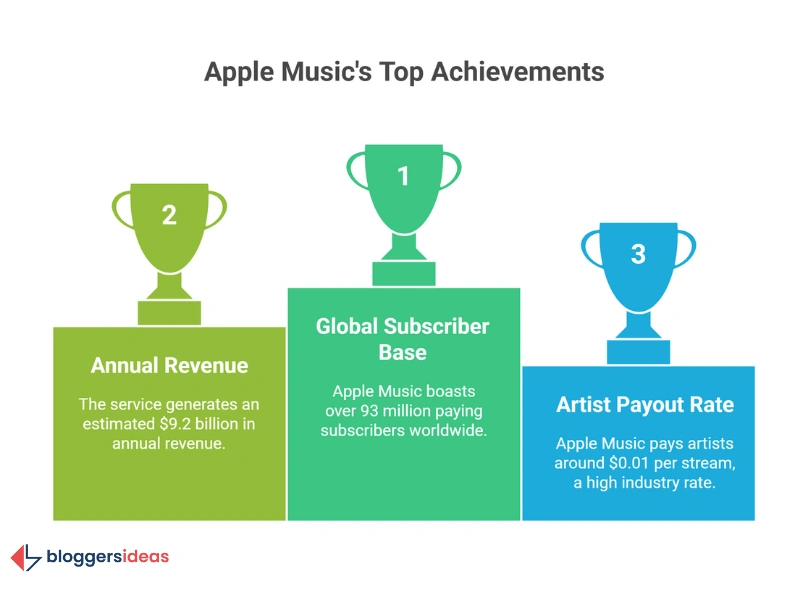
For those who need the facts quickly, here are the most important Apple Music statistics right now.
- Total Subscribers: Apple Music has more than 93 million paying subscribers worldwide.
- Annual Revenue: The service generates an estimated $9.2 billion in annual revenue.
- Artist Payout: Apple Music pays artists around $0.01 per stream, one of the highest rates in the industry.
- US Market Share: It is the second most popular service in the United States, capturing 30.7% of the subscriber market.
- Music Library: Users can access over 100 million songs and 30,000 curated playlists.
- Global Reach: Apple Music is available in 167 countries around the world.
- User Demographics: A majority of its users (56%) are female, and the largest age group is 25-44 years old.
Also read about: iPhone Users Statistics
The User Story: How Many People Subscribe to Apple Music?
The success of any streaming service depends on its subscriber base. Since its launch, Apple Music has shown consistent and impressive growth, building a loyal global audience.
As of 2025, Apple Music has over 93 million paying subscribers. This is a significant milestone, showing an increase of 5.68% from the 88 million subscribers it had the previous year.
The table below tracks Apple Music’s journey from its early days to its current status as a streaming powerhouse.
| Date | Apple Music Subscribers |
| June 2017 | 27 million |
| May 2018 | 50 million |
| June 2019 | 60 million |
| June 2020 | 72 million |
| June 2021 | 78 million |
| June 2022 | 88 million |
| June 2023 | 93 million |
Source: Statista.
Unlike some competitors, Apple Music does not offer a long-term free, ad-supported tier. The vast majority of these users are on a paid plan.
This steady climb in subscribers, even without a “freemium” model, highlights the value users see in its premium features, such as high-quality audio and a seamless experience across Apple devices.
The Money Story: Apple Music’s Impressive Revenue
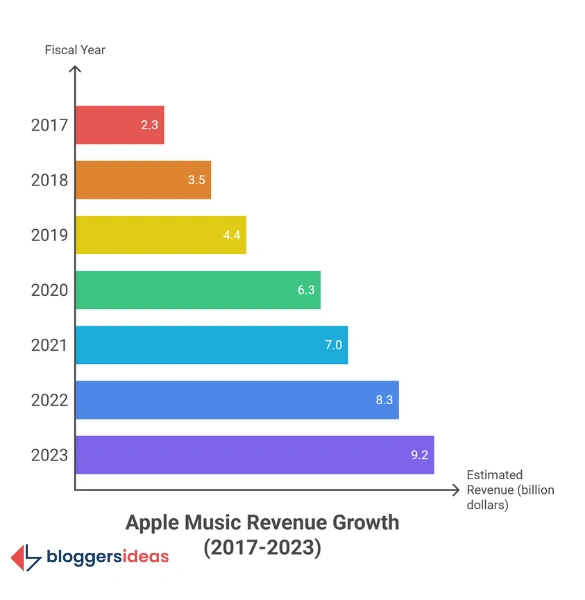
A large subscriber base directly translates into strong revenue. Apple Music has become a financial heavyweight, contributing significantly to Apple’s overall business.
Growing Annual Revenue
Apple Music generated an estimated $9.2 billion in revenue in 2023. This represents a healthy 10.84% increase from the $8.3 billion it earned the previous year. This consistent growth shows the platform’s ability to not only attract new users but also retain existing ones.
| Fiscal Year | Estimated Revenue |
| 2017 | $2.3 billion |
| 2018 | $3.5 billion |
| 2019 | $4.4 billion |
| 2020 | $6.3 billion |
| 2021 | $7.0 billion |
| 2022 | $8.3 billion |
| 2023 | $9.2 billion |
Source: Business of Apps, Statista.
Its Role Within Apple’s Services Division
To understand the full picture, it’s important to see where Apple Music fits within its parent company. Apple does not report the platform’s revenue separately. Instead, it includes it in its “Services” division, which also covers the App Store, iCloud, Apple Pay, and other digital offerings.
Apple’s Services division is the company’s fastest-growing segment, and Apple Music is a key part of that success. It contributes an estimated 6.4% to the Services division’s total revenue, which reached over $85 billion in 2023. This makes Apple Music a strategically important asset for Apple, driving recurring revenue and strengthening the company’s ecosystem.
The Listener Profile: Who Uses Apple Music?
Understanding the audience is crucial for artists, marketers, and the platform itself. Data reveals a clear picture of the typical Apple Music user.
Also read about: Smartwatches Statistics
A Stronger Connection with Female Listeners
Apple Music appeals more to female users. The gender breakdown is as follows:
- Female Users: 56%
- Male Users: 44%
This slight but significant lean towards a female audience can influence everything from playlist curation to artist promotions on the platform.
The Core Age Group: Millennials and Gen X
The majority of Apple Music’s listeners are adults in their prime working and spending years.
- 45% of all users are aged 25 to 44.
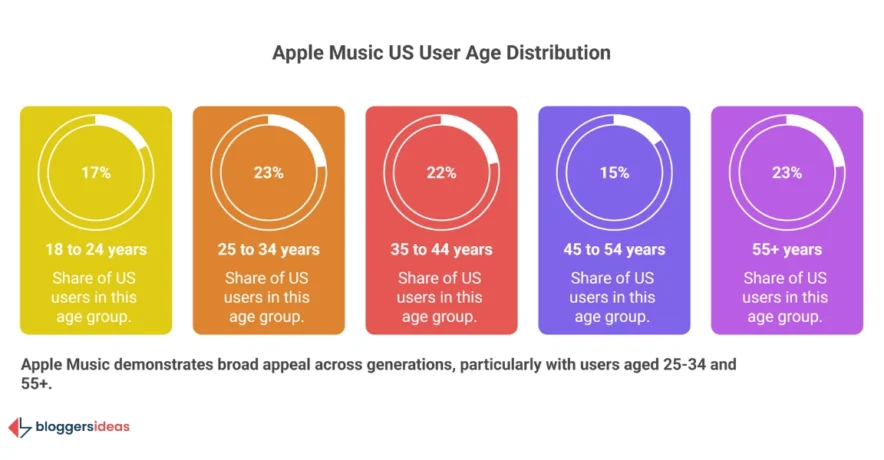
Here is a more detailed breakdown of Apple Music’s users in the United States by age:
| Age Group | Share of US Users |
| 18 to 24 years | 17% |
| 25 to 34 years | 23% |
| 35 to 44 years | 22% |
| 45 to 54 years | 15% |
| 55+ years | 23% |
Interestingly, the service is very popular with both the 25-34 age group and the 55+ age group. This broad appeal across generations is a key strength, allowing Apple to cater to a wide range of musical tastes.
The Market Dominance Story: Apple Music vs. The Competition
The music streaming market is fiercely competitive, but Apple Music has carved out a powerful position.
A Leader in the United States
In the highly valuable U.S. market, Apple Music is the second most popular service, with a 30.7% subscriber market share. It sits comfortably ahead of Amazon Music and YouTube Music. This strong foothold in its home market is a significant advantage.
Here is how the U.S. subscriber market share breaks down:
| Music Streaming Platform | US Subscriber Market Share |
| Spotify | 36.0% |
| Apple Music | 30.7% |
| Amazon Music | 23.8% |
| YouTube Music | 6.8% |
| Pandora Premium | 1.9% |
| Other | <1% |
While Spotify holds the top spot, Apple Music’s share is substantial, making it a two-horse race in the world’s biggest music market.
The Global Landscape
Globally, Spotify remains the undisputed leader in terms of total subscribers. However, Apple Music is firmly in second place and continues to be the primary challenger. Its deep integration with the iPhone, which has over a billion active users, gives it a unique and powerful channel to attract new subscribers worldwide.
The Artist’s Perspective: Payouts and Popularity
For artists, a streaming service is a partner. How much they get paid and how their music is featured are critically important.
One of the Best Payout Rates in the Business
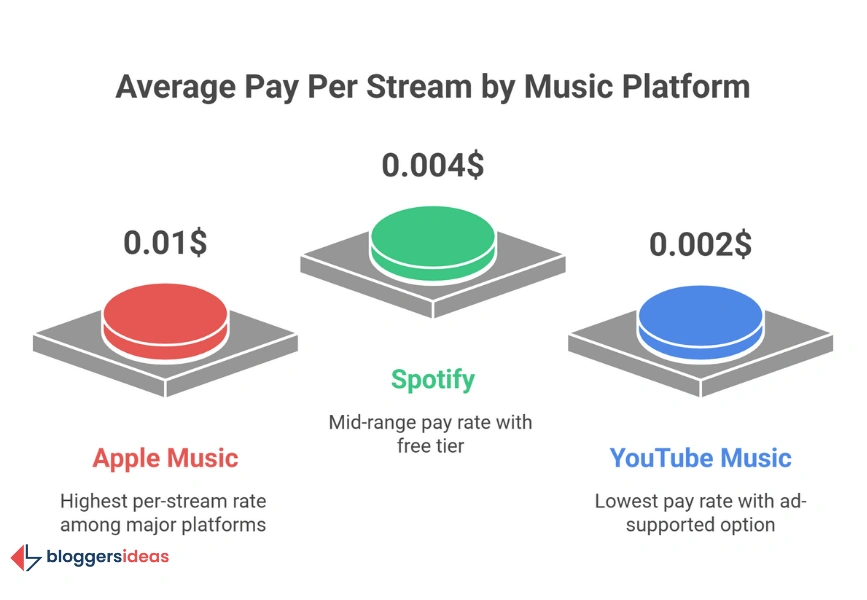
Apple Music pays artists an average of $0.01 per stream. This means for every 100 plays, an artist’s team earns roughly $1. While this sounds small, it is one of the highest per-stream rates among the major platforms.
Here’s how it compares to its main rivals:
| Music Platform | Average Pay Per Stream |
| Apple Music | $0.01 |
| Spotify | $0.003 – $0.005 |
| YouTube Music | $0.002 |
Apple can afford this higher rate because it does not have a free, ad-supported tier. All its listeners are paying subscribers, which creates a larger revenue pool per user to share with artists. This has made Apple Music a preferred platform for many creators who feel it values their work more fairly.
The Most Streamed Artists
Some of the world’s biggest stars dominate the charts on Apple Music.
- Taylor Swift is the most streamed artist on the platform. In 2023, she set a record for the most listeners in a single year and was named Apple Music’s Artist of the Year. Her 65 songs have reached the Global Daily Top 100, more than any other artist.
Here are some of the all-time most streamed artists on the platform:
| Music Artist | Total Streams (in millions) |
| Taylor Swift | 70.2 |
| Ed Sheeran | 61.3 |
| Drake | 47.4 |
| Billie Eilish | 41.7 |
| Post Malone | 36.7 |
[Something Extra] How to Use These Apple Music Statistics
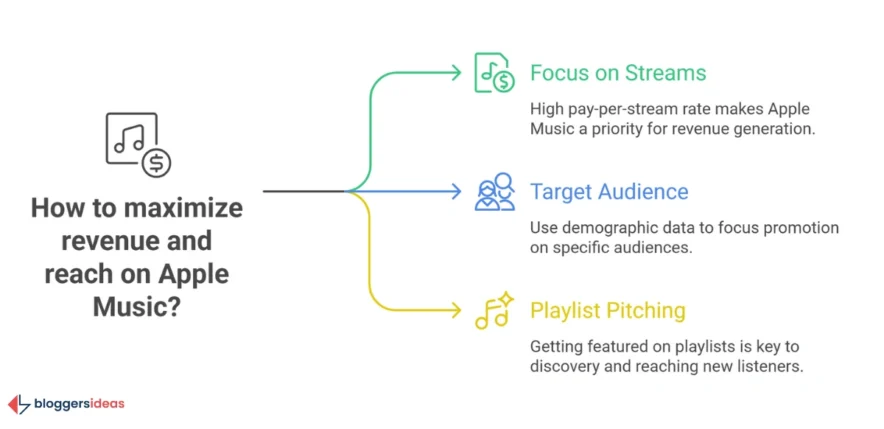
This data provides valuable insights for different groups. Here’s how you can use it to make better decisions.
For Artists, Managers, and Labels:
- Platform Strategy: The high pay-per-stream rate ($0.01) makes getting your music on Apple Music a priority. Focus on driving streams here, as they generate more revenue than on other major platforms.
- Targeting Your Audience: Use the demographic data. If your music appeals to women aged 25-44, Apple Music is a perfect place to focus your promotion. Pitch your tracks to playlists that are popular with this audience.
- Playlist Pitching: With 30,000 official playlists, getting featured is key to discovery. Knowing the platform’s user demographics can help you tailor your pitch to specific curators, explaining why your song is a good fit for their listeners.
For Marketers and Advertisers:
- Brand Partnerships: The user base is premium (all paying subscribers) and leans towards an adult, female audience. Brands in fashion, wellness, technology, and lifestyle can find a highly engaged and valuable audience here for potential partnerships with artists or playlist sponsorships.
- Content Creation: Since Apple Music is deeply integrated with the Apple ecosystem, marketing campaigns can be designed around this. For example, a fitness brand could create workout playlists on Apple Music and promote them to iPhone and Apple Watch users.
For Investors and Financial Analysts:
- Company Health: Track Apple Music’s subscriber growth as a key performance indicator (KPI) for Apple’s Services division. Steady growth here signals a healthy, recurring revenue stream that diversifies Apple’s income beyond hardware sales.
- Competitive Landscape: While Spotify has more users, Apple Music’s revenue-per-user is higher due to the lack of a free tier. Analyze its subscriber growth relative to competitors to gauge its market position and long-term potential. The platform’s ability to hold a ~30% market share in the US against a bundled competitor like Spotify is a sign of immense brand loyalty.
For Everyday Music Fans:
- Ethical Listening: If you care about supporting artists financially, the data shows that your streams on Apple Music provide more money to your favorite musicians than on almost any other platform.
- Making a Choice: When deciding between services, consider this: Apple Music offers a massive library (100 million songs), high-quality audio, and deep integration if you own Apple products. It’s built for a premium, uninterrupted experience.
FAQs About Apple Music Statistics
1. How many people subscribe to Apple Music?
As of 2025, Apple Music has over 93 million paying subscribers globally. It has grown steadily every year since its launch in 2015.
2. Who is Apple Music's biggest competitor?
Spotify is Apple Music’s main competitor. Globally, Spotify has more subscribers. However, in the valuable United States market, the two are much closer, with Spotify holding 36% of subscribers and Apple Music holding 30.7%.
3. How much does Apple Music pay artists per stream?
Apple Music pays artists an average of $0.01 per stream. This is one of the highest payout rates in the music streaming industry, largely because the service does not have a free, ad-supported version.
4. Is Apple Music bigger than Spotify?
It depends on how you measure it. Spotify is bigger in terms of total global subscribers. However, Apple Music generates more revenue per user and holds a very strong second-place position, especially in the United States. In terms of music library size, both platforms offer over 100 million songs.
5. What kind of music and content is on Apple Music?
Apple Music has a massive and diverse library of over 100 million songs, covering every genre imaginable. It also features over 30,000 expertly curated playlists, live radio stations (like Apple Music 1), and exclusive content, including artist interviews, live performances, and music videos.
Also Read:
Conclusion: A Streaming Giant with a Bright Future
Apple Music has successfully overcome its late start to become a dominant force in the music industry. With over 93 million subscribers, $9.2 billion in annual revenue, and a powerful position in the critical U.S. market, it is far more than just a secondary player. It is a true powerhouse.
The platform’s commitment to a premium, ad-free experience, its high payout rates for artists, and its seamless integration into the Apple ecosystem have created a loyal and growing user base. As a key pillar of Apple’s thriving Services division, Apple Music is not just shaping how we listen to music—it is also securing its own place as an essential part of one of the world’s most valuable companies for years to come.
