
Canva has become a global design powerhouse, reshaping how people and businesses create visual content.
What started as a simple drag and drop tool is now used by 95 percent of Fortune 500 companies, including FedEx, L’Oréal, Salesforce, and Starbucks.
Its appeal spans entrepreneurs, students, marketers, and executives who rely on Canva to save time, cut costs, and produce polished visuals without needing professional design skills.
Heading into 2025, Canva’s growth shows no signs of slowing. Its user base, revenue, and market influence continue to climb, making it one of the most important platforms in the visual marketing world.
This overview highlights the key statistics behind Canva’s rise and what they mean for creators and organizations looking to elevate their design workflows.
Canva Statistics 2026: A Snapshot of Dominance
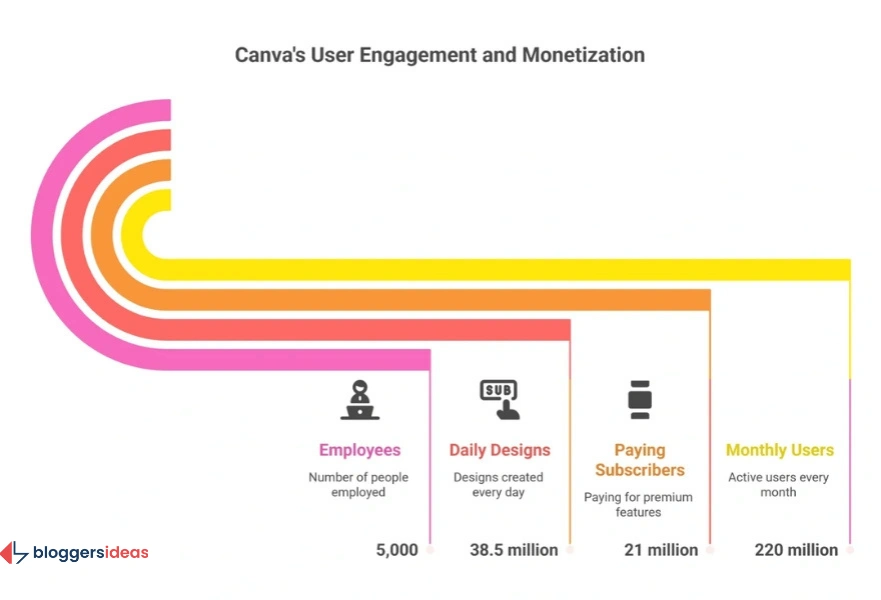
Canva’s meteoric rise is underscored by a series of compelling statistics that highlight its pervasive influence across the global design ecosystem. These figures reflect not just a tool’s popularity but a fundamental shift in how visual content is created and consumed.
Top Picks: Key Canva Statistics 2026
| Statistic | Impact |
| Active Monthly Users (AMU) | 220 million active monthly users |
| Fortune 500 Company Usage | 95% of Fortune 500 companies utilize Canva |
| Company Valuation | Valued at $42 billion (or $26 billion by another source) |
| Global Employee Count | Over 4,500 employees worldwide (or 5000 by another source) |
| Annual Revenue (2024/2025 projection) | $2.7 billion (2024) or $3 billion annualized (2025) |
| Market Share (Graphics Market) | 12.47% in the Graphics market |
| Canva for Education Users | Over 60 million students and teachers use ‘Canva for Education’ |
| Total Designs Created | Over 30 billion designs created to date |
These statistics collectively paint a picture of a platform that is not merely popular but fundamentally integrated into the workflows of millions of creators, educators, and businesses, demonstrating its crucial role in the modern visual landscape.
About Canva: Foundation and Global Reach
Canva’s journey began in 2013, founded by Melanie Perkins, Cliff Obrecht, and Cameron Adams, with a clear vision to simplify design. Headquartered in Sydney, Australia, it has rapidly expanded its footprint, becoming a global phenomenon.
| Aspect | Detail |
| Founded In | 2013 |
| Founders | Cliff Obrecht, Melanie Perkins, and Cameron Adams |
| Headquarter | Sydney, Australia |
| Active Monthly Users (AMU) | 220 million |
| Available In | 190 countries |
| Revenue (2024/2025) | $2.7 billion (2024) / $3 billion annualized (2025) |
| Valuation | $42 billion (or $26 billion) |
| Market Share | 12.47% (Graphics Market) |
- Also read about: Pinterest Statistics
How Many People Use Canva? A User Base That Explodes
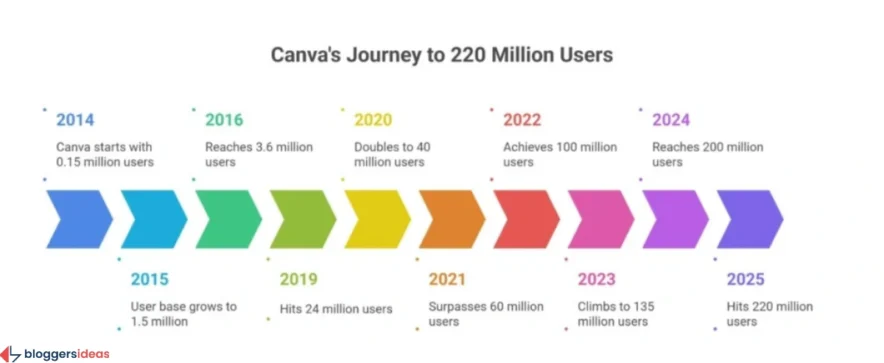
Canva’s growth trajectory has been nothing short of phenomenal, reflecting its intuitive design and widespread utility. The platform has successfully cultivated a massive and engaged user base across the globe.
- Massive Active Monthly Users: Canva proudly serves 220 million active monthly users (AMU). This staggering number showcases its pervasive presence in the daily lives of creators and professionals.
- Growing Subscriber Base: Out of these 220 million active users, a significant 21 million are paying subscribers, indicating a strong value proposition that encourages users to invest in premium features. This is up from 16 million paying users in September 2023.
- Rapid User Growth Trajectory: The number of Canva users has surged dramatically over the past few years. Between 2019 and 2021, the application gained an impressive 80 million users. The most substantial annual increase occurred in 2022, with a growth of 50 million users. In 2024, the user base expanded by an additional 35 million, demonstrating sustained momentum.
Canva User Growth Over the Years:
| Year | Number Of Canva Users (Millions) |
| 2014 | 0.15 (January) to 0.6 (July) |
| 2015 | 1.5 |
| 2016 | 3.6 |
| 2019 | 30 (or 24 in October) |
| 2020 | 40 (or 40 in October) |
| 2021 | 60 (or 60 in September, 75 in December) |
| 2022 | 110 (or 100 in October) |
| 2023 | 135 |
| 2024 | 220 (or 170 by another source) |
- Also read about: Digital Marketing Statistics
Canva Users By Country: A Global Phenomenon
Canva’s reach extends across continents, fostering a vibrant global community of creators. Its availability in nearly every nation underscores its universal appeal.
- Global Presence: Canva is actively used in 190 countries worldwide, which accounts for an astounding 97.4% of all nations. This demonstrates its profound global penetration.
- Top Contributing Countries: The United States leads in traffic to Canva, contributing 14.38% of its total traffic. Brazil and Indonesia also represent significant user bases.
Countries Sending the Highest Traffic to Canva:
| Country | Share of Canva Use (%) |
| The United States | 14.38 |
| Brazil | 11.92 |
| Indonesia | 5.9 (or 5.98) |
| Mexico | 5.57 |
| India | 5.26 |
| Others | 56.96 |
Demographics Of Canva Users: Diverse Creators
Canva’s popularity transcends traditional demographic boundaries, attracting a diverse audience that spans various age groups and genders.
- Gender Distribution: Women constitute the majority of Canva’s user base, with 60.17% being female compared to 39.83% male users. The proportion of female users has steadily increased, from 55% in 2022 to 60% in 2023.
- Age Distribution: The platform resonates most strongly with younger professionals and adults. The largest segment of Canva users, approximately 31%, falls within the 25 to 34 age bracket. Conversely, individuals aged 65 and above represent the smallest user group. Overall, a significant majority of Canva users are between 18 and 44 years old.
Canva Users by Age Group:
| Age Group | Canva Users Share (%) |
| 18 to 24 years | 21.77 |
| 25 to 34 years | 31 |
| 35 to 44 years | 20.22 |
| 45 to 54 years | 13.32 |
| 55 to 64 years | 8.56 |
| More than 65 years | 5.13 |
Canva Users & Usage By Industry:
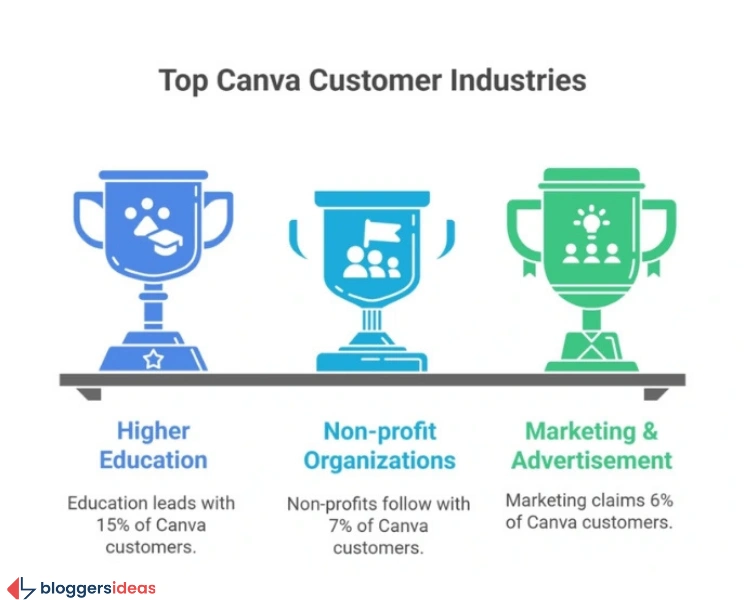
Canva’s versatility makes it invaluable across a multitude of industries, with specific sectors benefiting from its tailored plans and extensive feature set.
- Education Sector Dominance: The education industry represents the largest segment of Canva customers, accounting for 15%. This high adoption rate is largely due to Canva’s dedicated “Canva for Education” plan, which offers free or low-cost access, making it highly attractive to educators and students.
- Non-Profit Engagement: Non-profit organizations closely follow, comprising 7% of Canva’s customer base, also benefiting from specialized plans.
- Marketing and Advertisement Sector: The marketing industry is a significant user, making up 6% of Canva customers, reflecting its essential role in creating compelling advertising and promotional materials.
- Widespread Corporate Adoption: Canva is utilized by over 83,000 companies, spanning from small businesses to large enterprise-level organizations, demonstrating its broad applicability and scalability.
Number Of Canva Customers In Different Industries:
| Industry | Canva Customers (%) |
| Higher Education | 15 |
| Non-profit Organizations | 7 |
| Marketing & Advertisement | 6 |
| Information Technology | 5 |
| Education Management | 4.5 |
| Computer Software | 4 |
| Retail | 3 |
| Internet | 3 |
| Real Estate | 3 |
| Others | 51.5 |
Fortune 500 Company Usage: Canva’s Enterprise Footprint
Canva’s enterprise-level adoption underscores its robust capabilities for large organizations, enabling them to achieve significant design efficiencies and measurable return on investment.
- Near-Universal Fortune 500 Adoption: An astounding 95% of Fortune 500 companies have integrated Canva into their operations. This widespread adoption by top-tier global businesses speaks volumes about Canva’s reliability, scalability, and value.
- Examples of Enterprise Users: Prominent Fortune 500 companies leveraging Canva include FedEx, L’Oréal, Salesforce, Zoom, and Starbucks.
- Key Reasons for Enterprise Preference: Major factors contributing to Fortune 500 companies’ preference for Canva include its unparalleled ease of use, powerful collaboration features that facilitate team workflows, extensive functionality, and the ability to maintain brand consistency across vast organizations.
- Tangible ROI for Enterprises: Companies like Salesforce have reported remarkable results, achieving a 66% reduction in the cost per design and a 63% increase in design production, demonstrating the tangible positive ROI from using Canva.
Canva Financials: A Billion-Dollar Design Powerhouse
Canva’s financial performance reflects its immense success and strategic positioning as a leading design platform, boasting impressive revenue figures and a high valuation.
- Robust Revenue Growth: Canva generated a substantial revenue of $2.7 billion in 2024, showcasing a remarkable year-over-year growth of 35%. This figure is projected to reach $3 billion in annualized revenue for 2025. The platform experienced a significant revenue surge between 2019 and 2021, with revenue growing by $395 million in 2020 and an additional $500 million in 2021, reaching $1 billion in 2021.
Canva Revenue Generated Over the Years:
| Year | Revenue Generated By Canva (Millions USD) |
| 2017 | $60 |
| 2018 | $84 |
| 2019 | $105 |
| 2020 | $500 |
| 2021 | $1,000 (1 billion) |
| 2023 | $2,000 (2 billion) |
| 2024 | $2,700 (2.7 billion) |
| 2025 | $3,000 (3 billion annualized) |
Company Valuation: Canva is currently valued at $42 billion. While this represents a 14.28% decrease compared to its $49 billion valuation recorded last year (and down from its peak of $54.5 billion in 2021), it remains an exceptionally high valuation for a private technology company. Another source indicates a more recent valuation of $26 billion.
Canva Valuation Over the Years:
| Year | Canva Valuation (Billion USD) |
| 2021 | $54.5 |
| 2023 | $38.5 |
| 2024 | $49 |
| 2025 | $42 (or $26) |
Significant Funding Rounds: Canva has successfully raised a total funding of $969 million through Q2 2025 (or $562.6 million in disclosed funding including its latest $200 million Series F funding in 2021). These substantial investments underscore investor confidence in its growth trajectory and market potential.
Details of Canva Funding Rounds:
| Month, Year | Amount (Millions USD) | Round |
| 2014 | $6.6 | Seed |
| 2015 | $15 | Series A |
| 2016 | $15 | Series B |
| 2018 | $40 | Series C |
| May 2019 | $70 | Series D |
| Oct 2019 | $85 | Series D |
| Jun 2020 | $60 | Late VC / Series D |
| Apr 2021 | $71 | Late VC / Series E |
| Sep 2021 | $200 | Late VC / Series F |
| Sep 2023 | $569 | Late VC |
| May 2024 | $400 | Growth Equity VC |
| Aug 2025 | $969 (total) | Secondary |
Canva Market Share
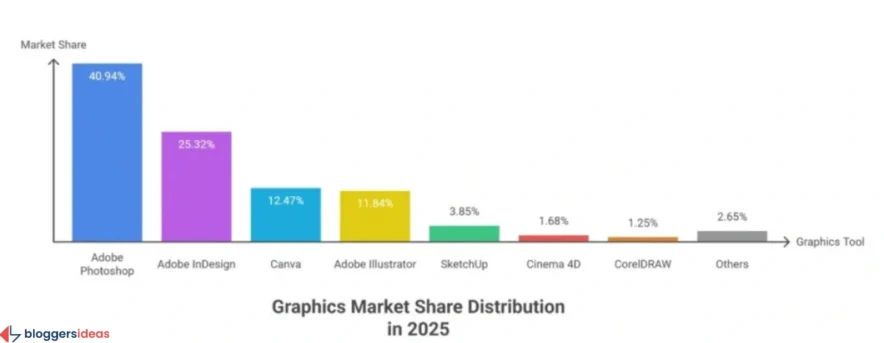
Canva has established itself as a formidable contender in the competitive graphics software market, capturing a significant share through its user-friendly interface and comprehensive features.
- Significant Market Share: Canva commands a substantial 12.47% market share in the overall graphics market. While Adobe Photoshop leads with 40.94%, Canva stands impressively as the third-largest player, surpassing other established tools like Adobe Illustrator.
Breakdown Of The Graphics Market Share:
| Graphics Tool | Market Share (%) |
| Adobe Photoshop | 40.94 |
| Adobe InDesign | 25.32 |
| Canva | 12.47 |
| Adobe Illustrator | 11.84 |
| SketchUp | 3.85 |
| Cinema 4D | 1.68 |
| CorelDRAW | 1.25 |
| Others | 2.65 |
Canva Usage Statistics: A Hub of Creativity
Millions of designs are created on Canva every day, showcasing its unparalleled role as a hub for visual content creation across diverse formats.
- Billions of Designs Created: Users have collectively created more than 30 billion designs using Canva to date, with an astonishing 10 billion of these designs produced in just the last two years.
- Rapid Design Production: This translates to an average of 200 designs being created with Canva every second, or 8.6 million designs each day. In 2021 alone, Canva reported the creation of 3.5 billion designs.
- Diverse Content Creation: Over 1 billion presentations and slideshows have been crafted on Canva, along with 160 million infographics, 200 million business cards, and more than 15 million charts, highlighting the platform’s versatility.
- Extensive Font Library: Canva offers a vast selection of over 6,056 fonts, comprising 985 English fonts and 5,071 in other languages. “Amiro” stands out as the most popular font, having been used in over 13.5 billion designs.
- Rich Asset Library: The platform provides access to a colossal stock library of over 100 million images, graphics, and video elements, with 75 million of these being premium assets. Additionally, Canva features 610,000 templates (350,000 premium) and 160 million infographics.
Canva Traffic Share: A Highly Engaged Audience
Canva.com consistently attracts a massive audience, driven by its user-friendly experience and comprehensive design capabilities.
- High Monthly Visits: Canva.com records approximately 681 million monthly visits, indicating a highly engaged and active user base.
- Website Engagement Metrics: The website maintains a healthy bounce rate of 27.16% and visitors typically navigate through 6.69 pages per visit. The average duration of a visit on Canva.com is 8 minutes and 17 seconds, reflecting deep user engagement.
- Dominant Direct Traffic: An impressive 71.15% of the traffic received on Canva.com is direct traffic, underscoring strong brand recognition and intentional user visits. Organic search contributes over 25.32% of traffic, while referrals account for 2.13%.
- Social Media Traffic Sources: YouTube is the leading social media platform driving traffic to Canva, accounting for 33.63% of all social media-driven visits. Facebook and WhatsApp Web follow with 23.88% and 16.1% respectively.
Canva Traffic Share from Social Media Platforms:
| Social Media Platforms | Percentage Of Traffic |
| YouTube | 33.63 |
| 23.88 | |
| Whatsapp Web | 16.1 |
| 6.78 | |
| Facebook Messenger | 6.48 |
| Others | 13.13 |
Canva For Education: Empowering Learning Through Design
Canva for Education has emerged as a truly transformative tool, providing educators and students with the means to create engaging and visually appealing content, fostering collaboration, and enriching the overall educational experience.
- Massive Educational User Base: Over 60 million students and teachers actively use Canva for Education. This number has doubled compared to the previous year, with 25 million users recorded in 2022.
- Free Access and Resources: Launched in 2020, Canva for Education offers free services to K-12 teachers and students, providing access to thousands of educational templates and a wide array of design tools.
Growth of Canva for Education Users:
| Year | Number of Canva for Education Users (Millions) |
| 2020 | 8 |
| 2022 | 25 |
| 2023 | 50 |
| 2024 | 60 |
Canva Acquisitions: Strategic Expansion for Enhanced Capabilities
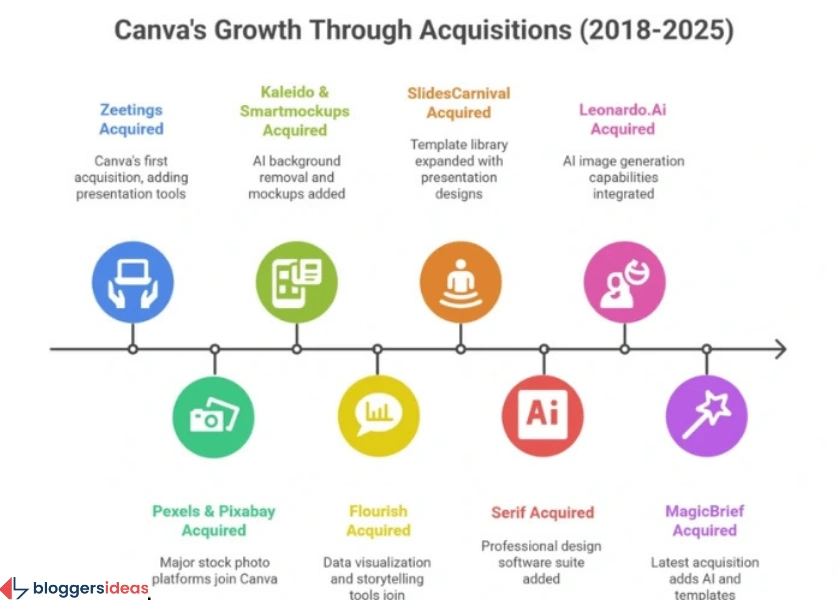
Canva has strategically expanded its ecosystem through a series of well-timed acquisitions, bolstering its offerings and enhancing its position as a comprehensive design solution.
- Growth Through Acquisition: Canva has made 7 acquisitions in the last six years (or 10 based on the extended list provided). Its most recent acquisitions include SlidesCarnival, Flourish, Kaleido, Serif, Leonardo.Ai, and MagicBrief.
- Diverse Acquired Sectors: These acquisitions span various sectors, including Enterprise Tech, Consumer Digital, and AI-driven creative tools, originating from countries like the United Kingdom, Germany, Australia, Spain, Austria, and the Czech Republic.
- Strategic Feature Enhancement: In 2021, Canva notably acquired Kaleido and Smartmockups, directly integrating advanced capabilities for background removal and realistic product mockups, respectively.
Canva Acquisitions Over the Years:
| Acquisition Date | Company Name | Location |
| Apr 24, 2018 | Zeetings | Australia |
| May 17, 2019 | Pexels | Germany |
| May 17, 2019 | Pixabay | Germany |
| Feb 23, 2021 | Kaleido | Austria |
| Feb 23, 2021 | Smartmockups | Czech Republic |
| Feb 02, 2022 | Flourish | United Kingdom |
| Mar 11, 2023 | SlidesCarnival | Spain |
| Mar 25, 2024 | Serif | United Kingdom |
| Jul 30, 2024 | Leonardo.Ai | Australia |
| Jun 18, 2025 | MagicBrief | Australia |
Case Studies On Canva: Real-World Impact and Success Stories
Numerous case studies provide compelling evidence of Canva’s transformative impact, illustrating how individuals and businesses across diverse industries harness its power to upscale their marketing and design efforts.
- Case Study 1: COBS Bread – Slicing Design Costs by 50% with Canva for Teams
COBS Bread, a growing franchise, sought a design tool that could ensure brand consistency and ease of use across its many franchisees. By implementing Canva for Teams, they revolutionized their marketing workflow, resulting in decreased design time, lower operating costs, and significantly improved brand consistency. This strategic adoption led to a remarkable 30% reduction in design costs and a 50% saving on subscription fees compared to their previous platform. Alina Pejkovic, their local marketing specialist, emphatically stated, “As a growing franchise, Canva is the easiest, most intuitive platform you can adopt and introduce that can scale your brand and support your franchise partners.” - Case Study 2: Zoom – Saving Over 230 Hours of Design Time in Three Months
Zoom, a global communication leader, experienced substantial efficiency gains by integrating Canva into its design processes. In just Q4 2022, Zoom saved over 230 hours of design time by using Canva. Canva for Teams empowered even non-designers within their organization to create professional-quality visuals, effectively scaling their design capabilities. The Creative Manager at Zoom highlighted the profound impact, advising other business leaders, “If I were to talk to a business leader, I would let them know how much time they’re going to save by switching to Canva. It will allow your team the time they need to focus on the projects that matter.”
These case studies powerfully demonstrate Canva’s ability to deliver tangible benefits—from cost reduction and time savings to enhanced brand consistency and empowerment for non-designers—across varied business contexts.
What Users Are Asking on Quora and Reddit: The Latest Canva Insights
Beyond the published statistics, online communities like Quora and Reddit offer a real-time pulse on what users are actively discussing and seeking regarding Canva. These conversations reveal emerging trends, challenges, and aspirations:
- “How can I integrate Canva with AI tools for automated content creation?” This question frequently appears, reflecting a strong user interest in leveraging AI to generate design elements, content suggestions, or even full design layouts within Canva, streamlining the creative process further.
- “What are the best practices for maintaining brand consistency across large teams using Canva for Teams?” As more enterprises adopt Canva, managing brand guidelines, ensuring template adherence, and controlling design permissions for numerous users become critical. Users are seeking advanced tips for brand kit utilization and team governance.
- “Can Canva replace professional design software like Adobe for advanced tasks?” This ongoing debate highlights the continuous evolution of Canva’s capabilities. While it excels in ease of use, users want to understand its limits for complex tasks like intricate photo manipulation, vector graphics, or specialized print design, and when a traditional professional tool might still be necessary.
- “Are there specific accessibility features in Canva for designers creating content for visually impaired users?” With an increasing focus on digital inclusivity, designers are asking about Canva’s tools for ensuring color contrast, providing alt-text functionality, and generating accessible PDF outputs to meet WCAG standards.
- “How can I leverage Canva’s new features (e.g., Magic Write, Magic Eraser, AI-generated images) to create truly unique and engaging content?” Users are keen to explore and master Canva’s latest AI-powered tools, seeking tutorials, creative prompts, and innovative ways to push the boundaries of design without extensive design experience, tapping into generative AI capabilities.
These questions illustrate that Canva users are not only embracing its current power but are also actively looking towards its future, particularly concerning AI integration, enterprise-level brand management, advanced design capabilities, and digital accessibility.
Also Read:
- Slack Statistics
- Android Usage Statistics
- Mobile Internet Traffic Statistics
- Quick Commerce Statistics
- Reddit Statistics
Conclusion:
Canva’s rise shows no signs of slowing. By 2025, it has reached 220 million monthly active users, generated $2.7 billion in 2024 revenue, and is on track for $3 billion in 2025.
Holding 12.47 percent of the graphics market, Canva now operates in 190 countries and supports more than 60 million students and teachers through Canva for Education.
Its influence extends across major industries, with 95 percent of Fortune 500 companies using it daily.
Strategic acquisitions like Leonardo.Ai and MagicBrief continue to strengthen its AI capabilities, while its ease of use, templates, and collaboration tools keep it the go to platform for creators, educators, and businesses worldwide.
