
In an increasingly digitized world where personal data often fuels the engines of major tech giants, DuckDuckGo stands as a formidable alternative, championing user privacy above all else.
This privacy-focused search engine has steadily cultivated a dedicated following since its inception in September 2008, evolving from a niche player to a significant contender in the global search market.
As we approach 2025, understanding DuckDuckGo’s trajectory, its impact on user behavior, and its potential for future growth becomes crucial for individuals, marketers, and tech enthusiasts alike.
This comprehensive article delves into the latest DuckDuckGo statistics, exploring its impressive search volume, growing user base, and the profound reasons behind its increasing relevance.
The Rise of Privacy
DuckDuckGo’s core promise—no tracking, no profiling, and no targeted ads—resonates deeply with a global audience increasingly concerned about their digital footprints.
This commitment to privacy is not merely a slogan but a foundational principle that has fueled a remarkable surge in its search volume and overall user engagement.
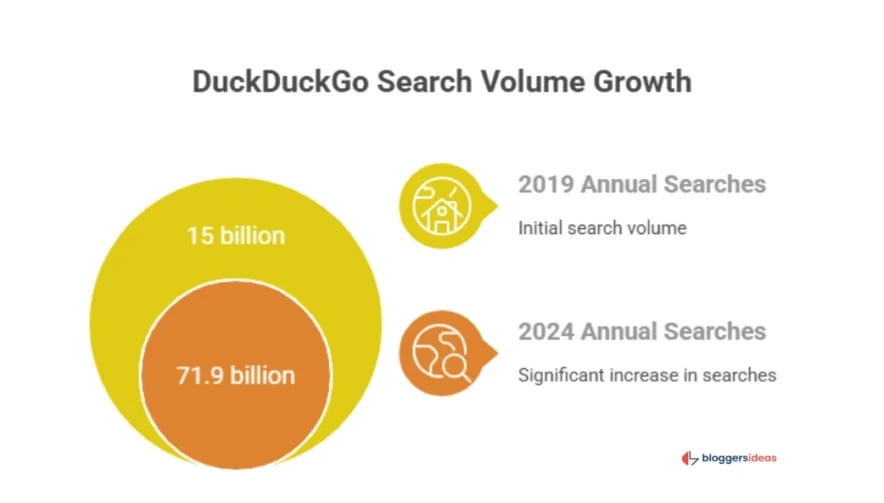
By 2024, DuckDuckGo recorded an astounding 71.9 billion annual searches, marking an incredible 379% increase since 2019 when it processed a comparatively modest 15 billion queries.
This exponential growth unequivocally demonstrates a significant shift in user preferences towards a more secure and private internet experience.
The platform’s momentum also becomes evident in its consistent monthly traffic. During the first quarter of 2024, DuckDuckGo observed approximately 2.292 billion visits.
January alone registered 783.5 million visits, February saw a slight dip to 740.9 million, and March rebounded strongly to 767.4 million.
These figures paint a clear picture of sustained user interest and trust in DuckDuckGo’s privacy-centric approach.
Looking ahead to 2025, projections suggest that DuckDuckGo will continue to solidify its position, building upon the strong foundation of user trust it has diligently established.
Examining the daily search queries further illuminates DuckDuckGo’s sustained activity. The platform now averages around 98.79 million searches every day.
In January 2023, this figure surpassed 110 million, with an all-time high of 111.7 million recorded on January 17, 2022.
While there was a temporary dip in daily searches below 100 million in spring 2022 due to reports concerning Microsoft trackers within its mobile browser—a situation that DuckDuckGo quickly addressed and resolved—the subsequent rebound, with a 1.2 million increase by August, powerfully underscores the resilience of its user base and their unwavering commitment to privacy.
| Metric | 2019 (Billion) | 2020 (Billion) | 2021 (Billion) | 2022 (Billion) | 2023 (Billion Est.) | 2024 (Billion) |
| Annual Search Queries | 15.08 | 23.65 | 35.3 | 31.21 | 30+ | 71.9 |
| Average Monthly Visits Q1 | N/A | N/A | N/A | N/A | N/A | 2.292 |
| Average Daily Searches | 34.37 Million | 51.96 Million | 95.28 Million | 100 Million | 98.79 Million | 98.79 Million |
Also read about: Google Chrome Statistics
Demographics, Behavior, and Income Insights
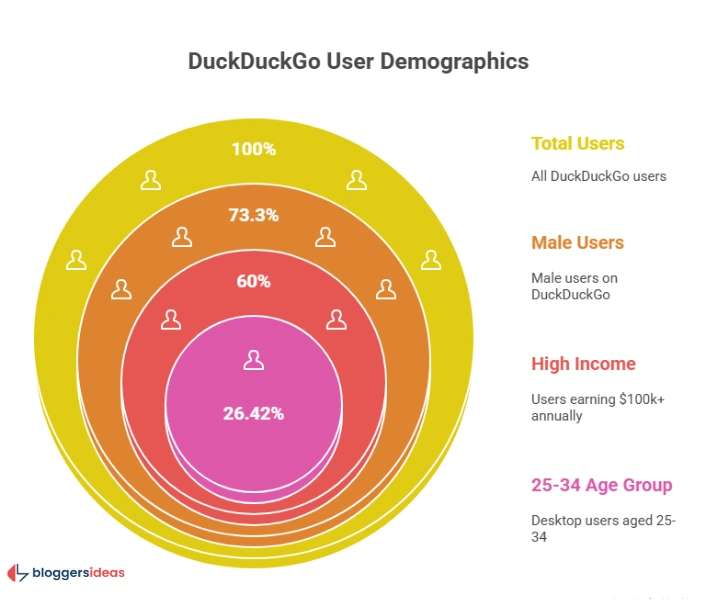
Understanding the demographics of DuckDuckGo users provides valuable insights for marketers and those interested in the evolving landscape of online behavior.
DuckDuckGo primarily attracts a male audience, with 73.3% of users identifying as male and 26.7% as female. This contrasts sharply with major search engines like Google or Bing, which exhibit a more balanced gender distribution.
Approximately 60% of DuckDuckGo’s overall traffic originates from male users, indicating a distinct demographic preference.
The 25-34 age group represents the largest segment of DuckDuckGo’s desktop users, accounting for 26.42%.
While interest from younger users, specifically those aged 18-24, is gradually increasing, older users, aged 65 and above, constitute a smaller portion of the total user base at just 8.93%.
Interestingly, income data reveals that a substantial 60% of DuckDuckGo users earn at least $100,000 annually. This makes the platform particularly attractive to advertisers seeking to engage with higher-earning, privacy-conscious consumers.
Even with its strict no-tracking model, DuckDuckGo offers compelling contextual advertising opportunities, as ads are based on keywords rather than intrusive personal data, leading to potentially higher engagement and return on investment for advertisers.
The preference for DuckDuckGo among this demographic underscores a correlation between higher income and a stronger inclination towards digital privacy.
Also read about: Bing Statistics
The Core Appeal: Why Privacy Preferences Drive DuckDuckGo’s Growth
DuckDuckGo’s continued expansion is not merely a consequence of passive adoption; it is a result of users actively choosing a search engine that aligns with their privacy values.
Unlike search engines that come pre-installed or are set as default, DuckDuckGo requires users to consciously change their settings, a significant action that highlights a deliberate commitment to privacy.
These individuals prioritize privacy enough to invest the effort required to make a switch.
The search engine’s fundamental promise of “no tracking” forms the bedrock of its appeal. DuckDuckGo abstains from storing search history, associating searches with individual users, or creating personalized profiles.
This fundamental difference sets it apart from competitors that largely rely on user data for their business models.
Beyond its core no-tracking policy, DuckDuckGo offers a suite of robust privacy tools designed to empower users:
- Advanced Tracker Blocking: This feature actively prevents hidden trackers from loading on websites, enhancing user anonymity.
- Smarter Encryption: DuckDuckGo automatically redirects users to encrypted (HTTPS) versions of websites whenever possible, ensuring secure communication.
- Email Protection: Users can create a unique “@duck.com” email address, which acts as a protective shield, forwarding emails to their real inbox while stripping away trackers, thus maintaining the privacy of their primary email address.
- App Tracking Protection (Android): This innovative feature extends DuckDuckGo’s privacy benefits beyond its browser, blocking trackers across other applications installed on Android devices.
Collectively, these comprehensive tools create a far more secure and private online experience, which continually encourages users to return to the platform.
The transparent and proactive approach to user privacy is a key differentiator in a market saturated with data-hungry services.
Also read about: Google Ads Statistics
Market Share in 2026: Global and Regional Growth Analysis
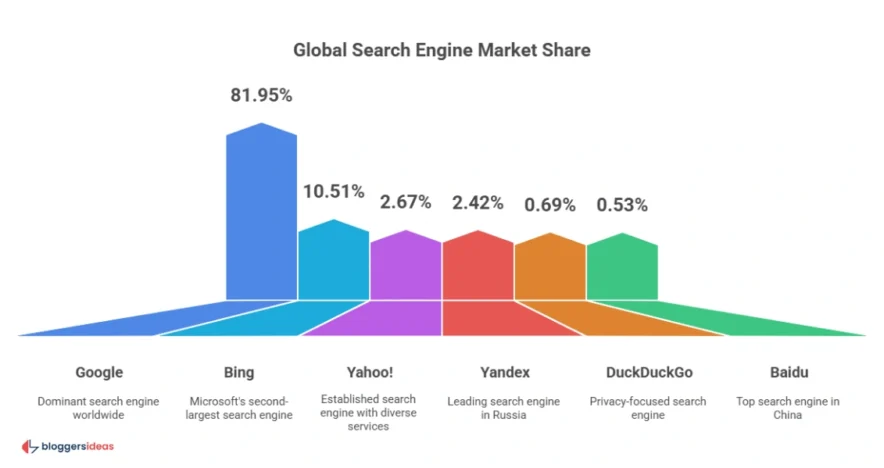
In 2025, DuckDuckGo continues to carve out a respectable, albeit smaller, share of the global search engine market.
Across all devices worldwide, it maintains approximately 0.6–0.8% of the total search market, positioning it as the fifth most popular search engine globally, trailing behind Google, Bing, Yahoo, and Yandex, but ahead of Baidu.
| Search Engine | Global Market Share (as of January 2024) |
| 81.95% | |
| Bing | 10.51% |
| Yahoo! | 2.67% |
| Yandex | 2.42% |
| DuckDuckGo | 0.69% |
| Baidu | 0.53% |
The global market share has seen fluctuations, peaking around 0.65% in 2022 before settling at 0.54% in 2023 and 2024. Despite these variations, the overall trend since 2012 has been one of consistent, albeit gradual, growth.
DuckDuckGo’s Regional Strongholds
While its global market share may seem modest compared to giants like Google, DuckDuckGo demonstrates significant strength in specific regions, particularly the United States and parts of Europe.
- United States: DuckDuckGo claims a notable 37.6–38% of all its users globally are located in the U.S. In terms of overall US market share, it secures a 1.96% stake across all device types, making it the fourth most used search engine in the country, just behind Google, Bing, and Yahoo. Intriguingly, Yahoo, its closest competitor in the US, holds only a slightly larger share at 2.44%.
- Germany: This privacy-conscious nation accounts for 18% of DuckDuckGo’s user base.
- France & U.K.: Both countries each contribute 12% to DuckDuckGo’s user demographics.
This regional distribution highlights DuckDuckGo’s particular resonance in countries with more stringent privacy regulations and a higher public awareness of data protection issues.
Also read about: Social Media Usage Statistics
DuckDuckGo by Device: Desktop, Mobile, and Tablet Market Shares
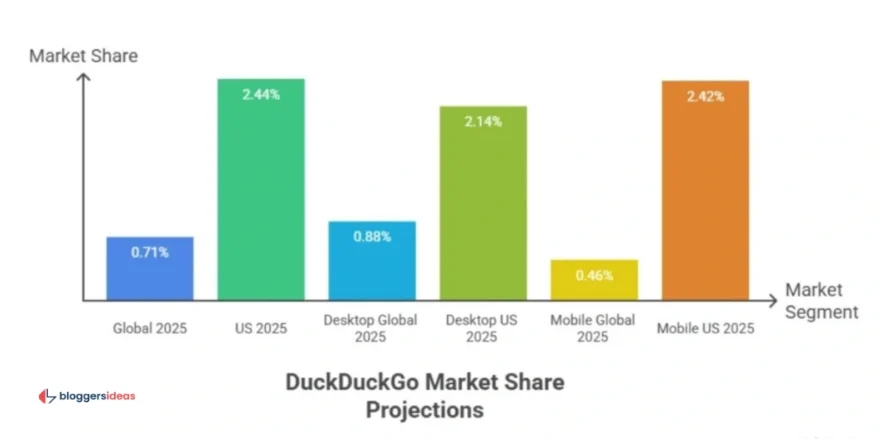
DuckDuckGo’s market share also varies across different device categories, reflecting diverse user habits and preferences.
| Device Type | Global Market Share (2022) | Global Market Share (2023) | Global Market Share (2024) | US Market Share (2022) | US Market Share (2023) | US Market Share (2024) |
| Desktop | 0.94% | 0.72% | 0.71% | 2.63% | 2.13% | 2.14% |
| Tablet | 1.07% | 0.85% | N/A | N/A | 2.83% | N/A |
| Mobile | 0.51% | 0.46% | 0.46% | 2.22% | 1.76% | 1.81% |
Note: Tablet data for 2024 and global for 2024 were not explicitly provided in the source but are inferred to be stable or slightly adjusted based on the provided trends.
On a global scale, DuckDuckGo’s desktop market share stands at 0.71% in 2024, positioning it as the fourth most popular search engine among desktop users, after Google, Bing, and Yahoo.
While its desktop share experienced a slight decline from 0.99% in July 2022 to 0.73% in September 2023, it shows stability in 2024.
The mobile market has historically been more challenging for DuckDuckGo to penetrate globally, holding a 0.46% share in 2024, placing it sixth behind several other major players.
However, the picture changes significantly when we focus on the United States. Here, DuckDuckGo exhibits a robust presence across all device types:
- US Desktop Market Share: DuckDuckGo commands a 2.14% search engine market share among desktop users in the US. It achieved the milestone of a 1% market share in 2019 and has since more than doubled its presence, demonstrating consistent growth in this segment.
- US Mobile Market Share: In the US, DuckDuckGo has achieved remarkable success in the mobile segment, holding a 1.81% share of the US mobile search market. This makes it the second most popular mobile search engine in the US, with only Google’s near-monopolizing 95.06% market share ahead of it. This impressive performance in the US mobile market contrasts sharply with its global mobile market share and highlights a successful strategy to appeal to privacy-conscious mobile users domestically.
- US Tablet Market Share: DuckDuckGo has also seen a rise in the tablet segment in the US, reaching 2.83% in 2023.
The success in the US mobile and tablet markets underscores a significant trend: American users are increasingly seeking privacy solutions on their portable devices, and DuckDuckGo is effectively meeting that demand.
DuckDuckGo’s Ecosystem: Apps, Extensions, Funding, and Philanthropy
Beyond its search engine, DuckDuckGo extends its privacy-first philosophy through a suite of products and initiatives.
Mobile App Performance and Downloads
DuckDuckGo offers highly-rated mobile browsing apps for both iOS and Android platforms, which are instrumental in its growth.
The DuckDuckGo Privacy Browser for iPhone users saw approximately 500,000 downloads in April 2024 alone. The Android app experiences even greater traction, with 1,000,000 installations in April 2024, and its cumulative all-time downloads exceeding 50 million.
These apps boast excellent reviews, maintaining a cross-platform average of 4.5/5 stars, reflecting high user satisfaction with their privacy features and browsing experience.
On the App Store, it ranks 18th in the Utility category with a 4.9 average from 1.2 million ratings, while on Google Play, it consistently ranks among the top 200 apps with a 4.8-star rating.
DuckDuckGo is the second most-used mobile search engine in North America, boasting 6 million monthly downloads, with 800,000 downloads worldwide in March 2024 alone.
Chrome Extension Usage
For users who prefer the Chrome browser but desire enhanced privacy, DuckDuckGo provides a powerful Chrome extension.
This tool actively blocks hidden trackers and assigns privacy grades to websites, empowering users to make informed decisions about their online activity.
The Chrome extension currently boasts over 5 million active users, demonstrating a significant demand for privacy tools even within a dominant browser ecosystem.
Funding and Valuation
DuckDuckGo has successfully attracted substantial investment, securing $113 million across three funding rounds. This includes a significant secondary investment of $100 million completed at the end of 2020.
With 29 investors backing its mission, DuckDuckGo’s financial stability reinforces its capacity for continued innovation and expansion.
As of its last funding round, DuckDuckGo was valued at an estimated $236-354 million, a substantial increase from its 2011 valuation of $19.82 million.
This robust valuation reflects investor confidence in its long-term potential within the privacy-focused tech landscape.
| Date | Funding Amount |
| October 2011 | $3 million |
| August 2018 | $10 million |
| 2020 | $100 million |
Philanthropic Endeavors: DuckDuckGo Donations
Beyond its commercial operations, DuckDuckGo actively contributes to the broader internet privacy community through significant philanthropic donations.
The company regularly supports organizations dedicated to upholding and advancing internet privacy.
In 2023, DuckDuckGo donated a total of $1,100,000 to 25 organizations, with its largest donations of $125,000 each allocated to the Electronic Frontier Foundation (EFF), The Markup, and Public Knowledge.
Since 2011, DuckDuckGo has contributed a cumulative total of $5,873,549 to various privacy-focused initiatives, underscoring its deep commitment to its core values and supporting the ecosystem it operates within.
| Year | Amount (Number of Organizations) |
| 2011 | $1,909 (6) |
| 2012 | $11,640 (7) |
| 2013 | $20,000 (7) |
| 2014 | $40,000 (6) |
| 2015 | $125,000 (5) |
| 2016 | $225,000 (9) |
| 2017 | $400,000 (16) |
| 2018 | $500,000 (21) |
| 2019 | $600,000 (11) |
| 2020 | $750,000 (15) |
| 2021 | $1,000,000 (20) |
| 2022 | $1,100,000 (24) |
| 2023 | $1,100,000 (25) |
DuckDuckGo’s Workforce: A Global, Remote Team
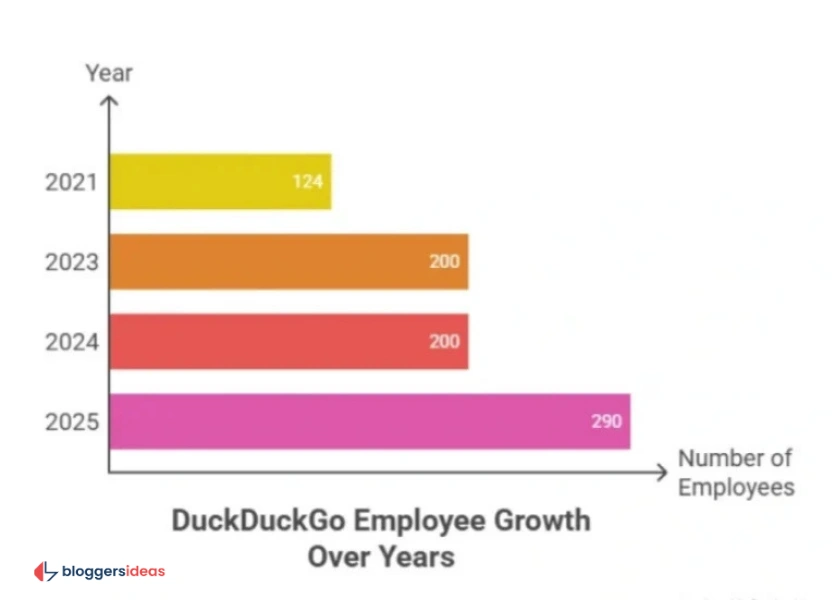
DuckDuckGo operates with a lean yet effective team of 200 employees, who work remotely from over 15 countries worldwide.
This distributed workforce model allows the company to tap into a diverse talent pool while maintaining its operational flexibility.
The headcount has remained stable over the past year, indicating a mature and well-structured organization capable of managing its impressive growth with its current team size.
This remote-first approach also aligns with the company’s emphasis on digital freedom and autonomy.
| Date | Employees |
| March 2018 | 45 |
| March 2019 | 59 |
| March 2020 | 83 |
| March 2021 | 124 |
| March 2022 | 172 |
| March 2023 | 200 |
| March 2024 | 200 |
What’s Driving the Growth and What’s New?
Beyond the statistics, real-world user conversations on platforms like Quora and Reddit offer invaluable insights into what people are asking and appreciating about DuckDuckGo.
Users frequently inquire about DuckDuckGo’s effectiveness in blocking trackers, its search result quality compared to Google, and its commitment to privacy post-controversies.
Recent discussions highlight a continued focus on “Privacy Basics” and “Smarter Encryption,” indicating that users are actively seeking clear, actionable ways to protect their data.
The Email Protection service consistently receives positive feedback as a simple yet powerful tool for reducing spam and enhancing inbox privacy.
Furthermore, many users are exploring how DuckDuckGo’s App Tracking Protection on Android can extend privacy benefits across their entire mobile experience, a feature that distinguishes it from browser-only privacy solutions.
A common theme emerging from online communities revolves around the desire for even more comprehensive privacy features and clearer communication during any privacy-related controversies.
Users appreciate DuckDuckGo’s responsiveness to feedback, such as its quick action to clarify and rectify the Microsoft tracker issue, which helped to rebuild trust.
The continued support from privacy advocacy groups like the Electronic Frontier Foundation (EFF) and European Digital Rights (EDRi) also plays a crucial role in validating DuckDuckGo’s mission and reassuring its user base.
Users are also expressing interest in the quality of DuckDuckGo’s search results, often comparing them to Google’s.
While some acknowledge that Google’s personalized results can sometimes be more relevant for certain queries, many prioritize the unadulterated, unbiased results offered by DuckDuckGo, free from manipulative personalization bubbles.
This reflects a growing understanding among users that personalized results come at the cost of privacy.
Product Updates and Milestones
DuckDuckGo has continuously refined its product offerings and achieved significant milestones that contribute to its growing appeal and user base.
- Language Support: The search engine now supports an impressive 64 languages, a substantial increase from its initial 10. This expansion makes DuckDuckGo accessible to a much broader global audience, fostering inclusivity and widening its reach.
- Interface Redesign: A streamlined and intuitive new interface design has enhanced the search experience, making it smoother and easier for users to navigate and find information efficiently.
- Mobile App Improvements: Continuous improvements to its mobile applications for Android and iOS ensure that DuckDuckGo keeps pace with the rapidly evolving demands for privacy on the go, offering a seamless and secure browsing experience.
- Homepage “Privacy Basics”: The homepage now features “Privacy Basics,” a valuable resource that provides users with easy-to-understand tips and guidance on protecting their personal information, further educating and empowering its community.
- Search Traffic Increase: Since 2015, DuckDuckGo has witnessed an astonishing ninefold increase in search traffic, a testament to its compelling value proposition.
- Rapid User Acquisition: Between July 2020 and January 2021 alone, DuckDuckGo added 35 million new searches, signaling a period of accelerated interest and adoption.
- Financial Success: In 2020, DuckDuckGo achieved a remarkable $100 million in revenue, demonstrating that prioritizing user privacy can indeed coexist with a successful and profitable business model.
- Growing User Base: With over 30 million users in the U.S. and more than 100 million globally, DuckDuckGo continues its rapid expansion. It effectively appeals to individuals who prioritize digital safety and transparency, simultaneously providing advertisers with a strategic and ethical channel to connect with this valuable audience. Daily visits have reached 16.12 million, with daily queries exceeding 15 million and projections to hit 25 million in 2025.
FAQs About DuckDuckGo
1. What is the primary appeal of DuckDuckGo for users in 2025?
DuckDuckGo’s appeal lies in its privacy-first approach, with no tracking, personal data collection, or personalized ads.
2. How has DuckDuckGo’s search volume changed?
DuckDuckGo’s searches grew 379% since 2019, reaching 71.9 billion annual searches in 2024, showing strong demand for privacy.
3. Does DuckDuckGo have a significant market share?
DuckDuckGo holds a 0.6–0.8% global share, with stronger regional performance, especially in the US (1.96% overall market share).
4. What unique privacy features does DuckDuckGo offer?
DuckDuckGo offers tracker blocking, smarter encryption, email protection, and app tracking protection on Android.
5. How can advertisers use DuckDuckGo while respecting privacy?
Advertisers can run keyword-based campaigns on Microsoft Advertising Network, reaching privacy-conscious users without compromising their data.
Also Read:
- Android Usage Statistics
- Coupon Statistics
- Email Marketing Statistics
- Online Advertising Statistics
- Podcast Statistics
Conclusion
As we navigate through 2025, DuckDuckGo firmly establishes itself as much more than just an alternative search engine; it represents a movement towards a more private and secure internet.
Its record-breaking 71.9 billion searches in 2024, coupled with a growing U.S. market share and impressive performance in the mobile sector, underscore a clear and accelerating trend: more people are consciously prioritizing their digital privacy.
Despite the formidable dominance of Google, DuckDuckGo has successfully carved out a significant niche by offering a compelling value proposition that resonates with privacy-conscious users worldwide.
The continuous product enhancements, strong financial backing, philanthropic efforts, and active engagement with user concerns further solidify its position.
As conversations around digital safety and data ethics intensify, DuckDuckGo is exceptionally well-positioned to sustain its momentum and continue expanding its influence, consistently proving that earning and maintaining user trust is a powerful and profitable strategy in the evolving digital landscape.
