
Online learning, or eLearning, has completely changed the world. It’s not just for university students anymore. It’s for workers learning new skills, kids in school, and anyone who wants to learn a new hobby. The way we learn has moved from the classroom to our computer screens, tablets, and phones.
But how big is this change, really? Is online learning just a popular trend, or is it here to stay? And most importantly, does it actually work better than old-school learning?
This guide will answer all of those questions and more. We have gathered over 70 of the most important eLearning statistics for 2025 from trusted sources. But we won’t just give you a boring list of numbers.
We will explain what these numbers mean in very simple language. We will show you the facts in a way that is easy to understand, using clear headings, short sentences, bullets, and tables.
And to make it even more useful, we have a special section that explains what these statistics mean for YOU, whether you are a student trying to decide on a course, a business owner looking to train your team, or a teacher trying to help your students succeed.
Let’s dive into the fascinating world of online learning.
The “Big Picture”: 10 Shocking Facts About eLearning in 2026
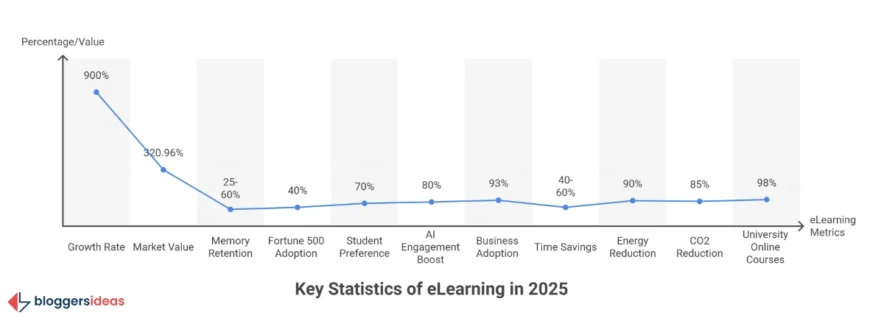
Before we get into the details, let’s look at some of the most surprising facts that show just how huge online learning has become.
- Incredible Growth: The online learning market has grown by a mind-blowing 900% since the year 2000. It is the fastest-growing part of the entire education industry.
- A Giant Market: The global eLearning market is expected to be worth $320.96 billion in 2025. That’s more than the entire economy of some countries.
- You Remember More: Studies show that students remember 25% to 60% more information when they learn online, compared to only 8-10% in a traditional classroom.
- Big Companies Use It: 4 out of 10 Fortune 500 companies (the biggest companies in the US) use eLearning to train their employees.
- Students Prefer It: A huge majority of students (70%) say that online learning is better than learning in a traditional classroom.
- AI is a Game-Changer: Using Artificial Intelligence (AI) in eLearning has boosted student engagement by an amazing 80%.
- Almost All Businesses are On Board: 93% of businesses around the world plan to use eLearning methods for their teams.
- It Saves a Ton of Time: Online learning can reduce the time needed to learn a subject by 40% to 60%.
- It’s Eco-Friendly: Online courses use 90% less energy and produce 85% less CO2 per student than in-person learning.
- Most Universities Have Moved Online: An incredible 98% of universities now offer at least some of their courses online.
Source: Statista
What Do These Numbers Mean for YOU? (A Simple Guide for Everyone)
Statistics are just numbers until you understand how they affect you. Let’s break down what this data means for different people.
If You Are a STUDENT:
Online learning is probably a big part of your life. Here’s what the stats say you can expect:
- You Will Learn More Effectively: The fact that students retain 25-60% more information online is a huge deal. This means the time you spend studying is more valuable. You are more likely to remember what you learn for your exams and for your future career.
- You Have Total Flexibility: The #1 reason students choose online learning is for its flexibility. 63% of students pick online programs because they can fit them around their jobs, families, and personal lives. You can learn late at night, early in the morning, or on the weekends.
- You Can Improve Your Grades: 81% of students (that’s 8 out of 10) say that using digital learning tools helped them get better grades.
- You Are Not Alone: With 98% of universities offering online courses, you are part of a massive global community. More than 200 million people signed up for online courses last year.
- You Will Learn More Than Just Facts: 60% of online students reported that they improved important “soft skills” like communication, teamwork, and time management.
Also read about: Udemy Vs LinkedIn Learning (Lynda)
If You Are a BUSINESS LEADER or MANAGER:
If you are thinking about training your employees, the numbers show that eLearning is one of the smartest investments you can make.
- It Makes Your Company More Money: This is not an opinion; it’s a fact. Companies that have strong online training programs generate 218% higher revenue per employee. That’s a massive return on investment.
- Your Employees Will Be Happier and More Engaged: Happy employees do better work. Online learning boosts employee engagement by 18%. It shows you are investing in their growth, which makes them more loyal to the company.
- It Saves Time and Money: Employee training can be expensive and time-consuming. Online learning requires 40% to 60% less time from your employees to learn the same material. IBM famously found that for every $1 they invested in online training, they got $30 back in productivity.
- It Keeps You Competitive: 72% of companies say that using online learning helps them stay competitive in their industry. It allows your team to learn new skills quickly and adapt to changes in the market.
If You Are a TEACHER or EDUCATOR:
The shift to online learning has changed your job more than anyone’s. The statistics show both opportunities and challenges.
- The Tools Are on Your Side: You are not alone in using technology. 85% of teachers use digital learning tools to help their students. And 7 out of 10 teachers agree that these tools are very helpful.
- You Can Personalize Learning: 35% of school administrators believe that eLearning helps them personalize instruction for each student’s skill level. You can give advanced students extra challenges and provide extra help to those who are struggling.
- But You Must Be Aware of the Challenges: The biggest concern for K-12 educators is the amount of screen time students have (36% are worried). Another major issue is the “digital divide”—not all students have reliable internet or a good computer at home.
Also read about: Xperiencify Vs Teachable
The Money Story: How Big is the eLearning Market?
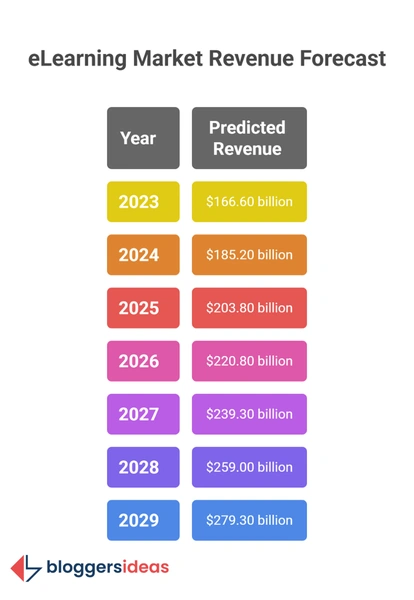
The growth of online learning is best seen in the money it generates. The market is huge and expanding every single year.
The global eLearning market is projected to reach $320.96 billion in 2025.
To put that in perspective, that is more than the entire Gross Domestic Product (GDP) of countries like New Zealand or Portugal. And it’s not stopping there. By 2028, the market is expected to grow to an incredible $539.88 billion.
This shows a strong Compound Annual Growth Rate (CAGR) of 14.1%, which simply means the market is growing by an average of over 14% every single year.
Predicted Market Growth (Year by Year)
This table shows just how fast the market is growing, in billions of U.S. dollars.
| Year | Predicted Online Learning Revenue |
| 2023 | $166.60 billion |
| 2024 | $185.20 billion |
| 2025 | $203.80 billion |
| 2026 | $220.80 billion |
| 2027 | $239.30 billion |
| 2028 | $259.00 billion |
| 2029 | $279.30 billion |
Source: The Business Research Company
Where Does the Money Come From?
The eLearning market comprises several parts. Here’s a breakdown of where the revenue comes from.
- Online University Education: This is the biggest piece of the pie. It includes everything from full online degrees to single college courses. This sector is expected to generate $120.70 billion.
- Online Learning Platforms: These include Coursera, Udemy, and Skillshare, where you can learn almost anything. This sector is expected to generate $58.45 billion.
- Professional Certificates: These include online courses that award a certificate for a specific job skill, such as digital marketing or data science. This sector is expected to contribute $6.04 billion.
The People Story: Who is Learning Online and Where?
Online learning is for everyone, from young students to older adults looking for a career change.
- The average age of an online student is 32 years old.
- It’s almost an even split between genders. On Coursera, for example, 53% of students are male and 47% are female.
- More than 220 million people signed up for Massive Open Online Courses (MOOCs) in 2022.
Online Learning Around the Globe
While online learning is a global phenomenon, some countries have more learners than others.
| Top Countries by Number of Learners (on Coursera) |
| 1. United States (17.3 million) |
| 2. India (13.6 million) |
| 3. Mexico (4.8 million) |
| 4. Brazil (3.7 million) |
| 5. China (3.3 million) |
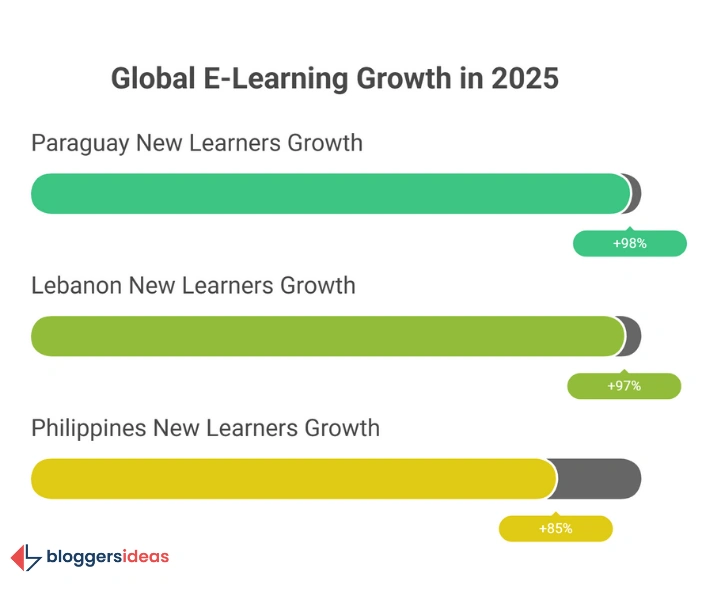
While the US has the most learners, other countries are catching up incredibly fast. Here are the countries with the fastest growth in new online learners.
| Countries with the Fastest Growth of New Learners |
| 1. Paraguay (98% growth) |
| 2. Lebanon (97% growth) |
| 3. Philippines (85% growth) |
| 4. Guyana (74% growth) |
| 5. Indonesia (74% growth) |
The Reality Check: What Are the Problems with Online Learning?
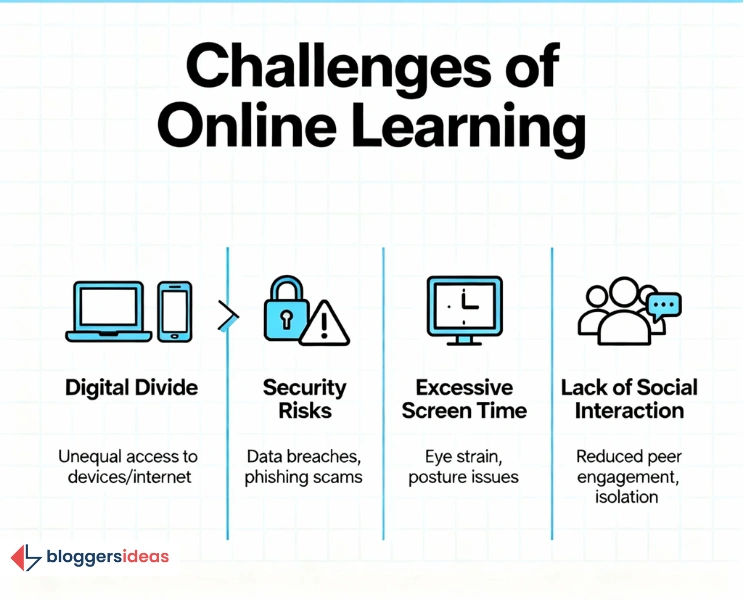
As great as online learning is, it is not perfect. There are some serious challenges that schools, companies, and governments need to solve.
- The Digital Divide: This is the biggest and most serious problem. Not everyone has access to the tools needed for online learning. In the United States, 25% of low-income students have limited access to a reliable computer or high-speed internet. This puts them at a major disadvantage compared to their peers.
- Security and Safety: When students, especially K-12 students, are online all day, safety becomes a big concern. School devices often have low antivirus compliance rates, which opens them up to security risks. Furthermore, it is a challenge to keep students away from inappropriate content online. Studies have found that students can spend up to an hour per day on distracting or inappropriate sites.
- Too Much Screen Time: Both parents and teachers worry about the health effects of students staring at screens for many hours a day. 36% of K-12 educators see this as a major challenge of digital learning. It can lead to eye strain, poor posture, and less physical activity.
- Lack of Social Interaction: While online forums can be helpful, nothing can fully replace face-to-face interaction with teachers and classmates. Some students can feel isolated or miss out on the social aspects of learning that happen in a physical classroom.
FAQs About eLearning Statistics
1. What is the projected size of the eLearning market in 2025?
The global eLearning market is expected to reach $320.96 billion in 2025, with steady growth projected through 2028.
2. How does online learning compare to traditional classroom learning?
Studies show students remember 25% to 60% more information with online learning, compared to 8-10% in traditional classrooms.
3. Which countries are leading in online learning growth?
The U.S., India, and Mexico are the top countries for online learning, with Paraguay and Lebanon showing the fastest growth.
4. What are the biggest challenges facing online learning?
The digital divide, security concerns, too much screen time, and lack of social interaction are key issues affecting online learning.
5. How does eLearning benefit businesses?
Companies that implement eLearning see 218% higher revenue per employee and save 40%-60% in training time, boosting productivity and engagement.
Also Read:
- Instagram Statistics
- WhatsApp Statistics
- Email Marketing Statistics
- Zoom Statistics
- Smartwatches Statistics
Conclusion: The Future is Online, and It’s Happening Now
The evidence is overwhelming. Online learning is not a temporary trend that will fade away. It is a fundamental shift in how we gain knowledge and skills, and it is here to stay.
The numbers tell a clear story: the eLearning market is a global powerhouse, worth hundreds of billions of dollars and growing at an incredible rate. For students, it offers a more effective, flexible, and engaging way to learn. For businesses, it is a proven tool to increase profits, boost productivity, and keep employees happy.
Of course, the journey is not without its bumps. We must work to close the digital divide, ensure the safety and well-being of our students, and find a healthy balance between online and in-person interaction.
But the direction is clear. With advancements in AI, virtual reality, and personalized learning, the online education experience will only get better. The statistics of 2025 show that eLearning is no longer just an alternative; it is an essential part of our modern world.
