
In the world of modern dating, one app stands above the rest as a true cultural phenomenon: Tinder. For over a decade, it has completely revolutionized how people meet, connect, and interact.
The simple act of “swiping right” has become a part of our global vocabulary, and the app itself has become an irreducible element of the modern dating landscape.
But behind the millions of daily swipes and late-night chats lies a massive business fueled by incredible numbers. How many people are actually using Tinder in 2025? Who are they? And how does a “free” dating app generate nearly $2 billion in revenue?
This is your ultimate guide to the state of Tinder today. We’re going to pull back the curtain and look at the real data driving the world’s most famous dating app.
From its user numbers and revenue streams to the fascinating psychology of how people swipe, let’s dive into the tinder statistics that tell the true story of Tinder.
The Big Picture: How Many People Use Tinder in 2026?
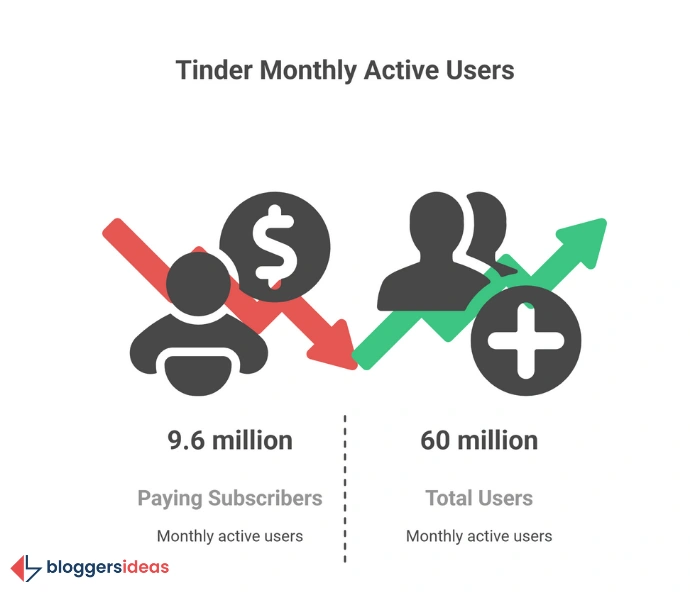
First, let’s start with the headline numbers. Tinder’s user base is enormous, making it one of the most popular social apps on the planet.
- As of 2025, Tinder has around 60 million monthly active users (MAU) worldwide.
- Of those millions of users, 9.6 million are paying subscribers.
These paying subscribers are the core of Tinder’s business model. They pay for premium features that give them an edge in the dating game. However, the number of subscribers has seen a slight dip in recent years.
Tinder Subscribers by Year (2015-2025)
This table shows Tinder’s incredible journey from a small startup to a global giant, as well as the recent challenges it has faced.
| Year | Number of Subscribers (in millions) | What This Shows |
| 2015 | 0.7 | The very beginning of its growth. |
| 2018 | 4.3 | Rapid adoption and the start of its monetization success. |
| 2020 | 8.9 | The pandemic likely boosted online dating, pushing numbers higher. |
| 2022 | 10.8 (Peak) | The absolute peak of Tinder’s subscriber count. |
| 2023 | 9.9 | The first significant drop, showing market maturation. |
| 2024 | 9.6 | The trend continues as competition from apps like Hinge and Bumble heats up. |
Source: World Population Review, Statista
[Image: A line graph showing the number of Tinder subscribers from 2015 to 2025, peaking in 2022 and then slightly declining.]
While the number of paying users has slightly decreased, 60 million monthly users is still a massive audience, keeping Tinder firmly at the top of the dating app world.
The Money Machine: How Does Tinder Make Billions?
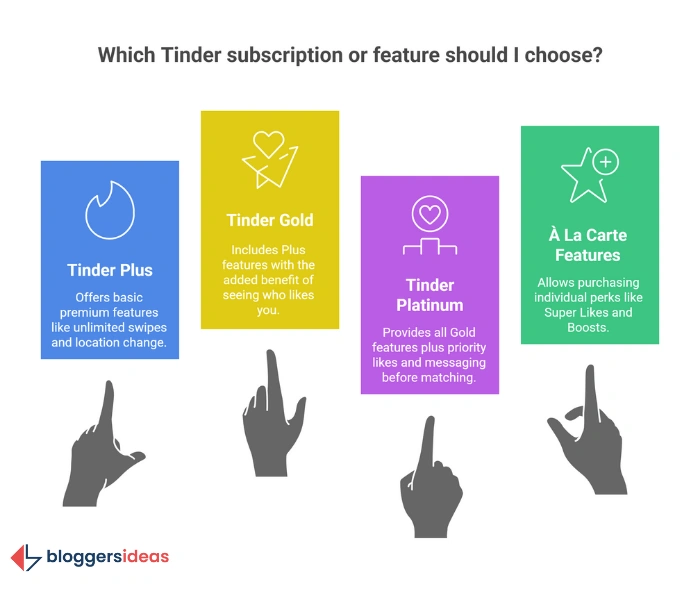
This is the question on everyone’s mind: if the app is free to use, how did Tinder make $1.94 billion in 2024? The answer lies in its clever “freemium” model and a tiered subscription system that offers powerful features to those willing to pay.
Here’s a simple breakdown of how Tinder generates its revenue:
- Tinder Plus: This was the first premium tier. It offers features like Unlimited Swipes, Rewind (to undo an accidental left swipe), and Passport (to change your location and swipe in other cities).
- Tinder Gold: This includes all the features of Plus, but adds the most popular premium feature: “Likes You.” This allows you to see a list of everyone who has already swiped right on you, so you can get an instant match.
- Tinder Platinum: The highest tier. It includes all the features of Gold, plus Priority Likes (your profile gets shown to people you like before non-subscribers) and the ability to Message Before Matching by attaching a message to your Super Like.
- À La Carte Features: Users can also buy individual perks, like Super Likes (to show someone you’re very interested) and Boosts (to temporarily make your profile one of the top profiles in your area).
This multi-layered strategy means there is a price point for everyone, from the casual user who just wants unlimited swipes to the serious dater who wants every possible advantage.
Tinder’s Revenue Growth Over the Years
| Year | Annual Revenue (in millions) | Key Insight |
| 2015 | $47 | Just getting started with its premium model. |
| 2018 | $805 | Explosive growth as Tinder Gold becomes a massive hit. |
| 2021 | $1,649 | Continued dominance and maturity in the market. |
| 2024 | $1,940 | Slower growth, but still an incredibly profitable business. |
[Image: A bar chart showing Tinder’s steady revenue growth from a small bar in 2015 to a massive bar in 2024.]
Who Is Swiping? A Deep Dive into Tinder Demographics
Understanding who uses Tinder is key to understanding the platform’s culture and dynamics. The data reveals a user base that is overwhelmingly young, predominantly male, and spread across various income levels.
1. Age Demographics: A Young Person’s Game
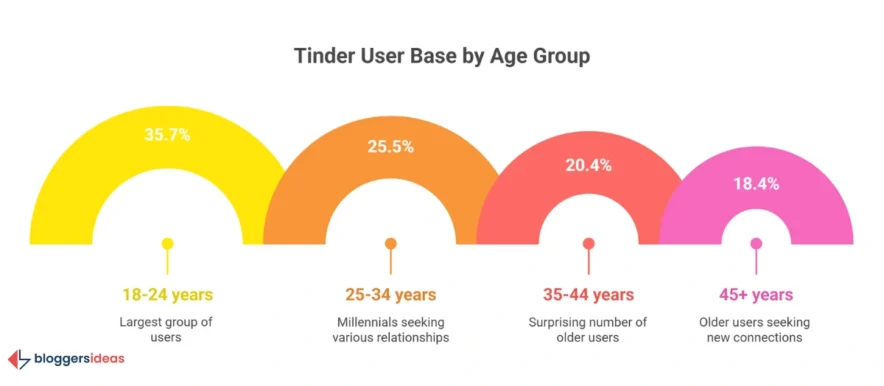
Tinder is, without a doubt, most popular with younger generations.
- An incredible 61.2% of all Tinder users are between the ages of 18 and 34.
Here is a full breakdown of the user base by age:
| Age Group | Percentage of Tinder Users | Who They Are |
| 18-24 years | 35.7% (The largest group) | Gen Z users, including college students and young professionals, who are digital natives and comfortable with online dating. |
| 25-34 years | 25.5% | Millennials who are using the app for everything from casual dating to finding serious relationships. |
| 35-44 years | 20.4% | A surprisingly large group, showing that Tinder is not just for people in their twenties. |
| 45+ years | 18.4% | A growing demographic of older users who are turning to online dating to meet new people. |
While Tinder is a young person’s world, the fact that nearly 40% of its users are over 35 shows that its appeal is broadening.
2. Gender Demographics: The Big Imbalance
This is one of the most talked-about statistics when it comes to Tinder. The platform has a significant gender imbalance.
- Male Users: 75.8%
- Female Users: 24.2%
[Image: A simple pie chart clearly showing a 76% male slice and a 24% female slice.]
This means that for every one female user on Tinder, there are roughly three male users. This has a profound impact on the user experience:
- For Men: The competition is incredibly high. Men have to work harder to stand out and are likely to get far fewer matches.
- For Women: They are likely to receive a very high volume of likes and messages, which can be both flattering and overwhelming.
It’s interesting to note that this gender ratio changes by region. In countries like India, the male user base is even larger. However, in Europe, the ratio is much closer to an even 50/50 split.
Where in the World is Tinder Most Popular?
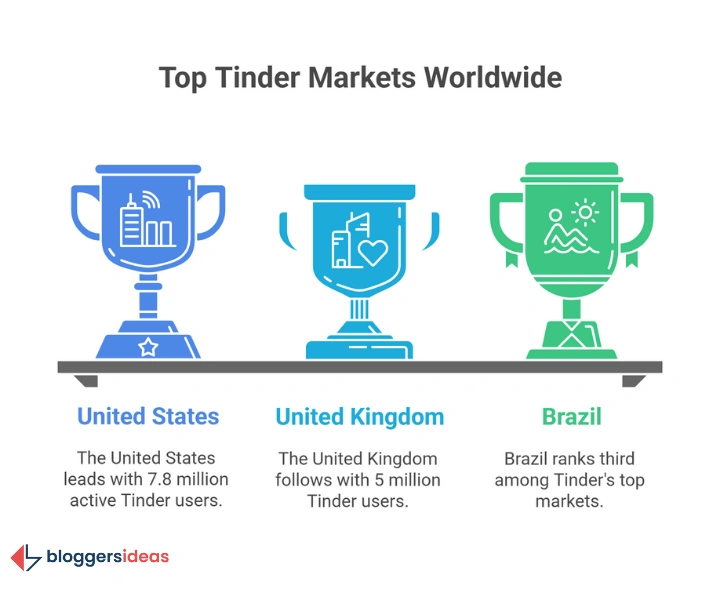
While Tinder is available in 190 countries, a few key markets dominate its user base.
- The United States is by far the biggest market, with 7.8 million active Tinder users.
- The United Kingdom comes in second with 5 million users.
- Other top countries include Brazil, Canada, France, Australia, and Germany.
This shows that while Tinder has a massive global footprint, its core strength lies in Western countries.
How People Actually Use the App: Behavior and Swipe Secrets
Beyond the basic demographics, the way people behave on Tinder is fascinating. These statistics reveal the psychology behind the swipes.
1. Men Swipe Right More Often Than Women
This is a well-known phenomenon backed by data. Men and women approach swiping with very different strategies.
- Men swipe right on approximately 46% of the profiles they see. They tend to use a “casting a wide net” approach, swiping right on many profiles and then deciding who to talk to from their matches.
- Women swipe right on approximately 14% of the profiles they see. They are far more selective, carefully evaluating profiles before deciding to like someone.
This difference in behavior directly contributes to the gender imbalance in matches.
2. What Makes a Successful Profile?
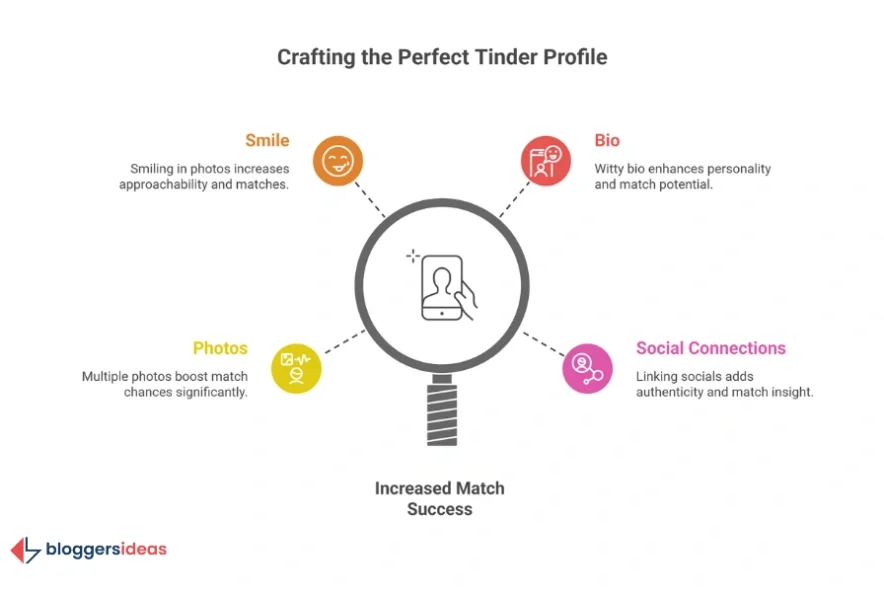
What actually convinces someone to swipe right? The data gives us some clear clues.
- Photos are Everything: Having at least 3-4 photos dramatically increases your chances of getting a match compared to having just one. Profiles with only one photo are often seen as fake or low-effort.
- Smile! Profiles where the person is smiling in their main photo receive significantly more right swipes. It makes you seem more approachable and friendly.
- Don’t Skip the Bio: While photos are crucial, a bio is your chance to show some personality. A witty or interesting bio can be the deciding factor. In fact, profiles with a bio get far more matches than those without one.
- Connect Your Socials: Linking your Instagram or Spotify account adds a layer of authenticity and gives potential matches more insight into your life and tastes.
3. The “Hookup App” Reputation: Is It True?
Tinder has long had a reputation for being a “hookup app” for casual encounters. While that is certainly a part of its culture, it’s not the whole story.
- According to surveys, only about 22% of users say they use Tinder primarily for hookups.
- A much larger group—around 44%—say they are looking for long-term relationship potential.
- The rest are there for a mix of reasons, including making friends, boosting their confidence, or simply out of curiosity.
This shows that while the “hookup app” label has stuck, a huge portion of the user base is looking for something more meaningful.
Tinder vs. The World: How it Stacks Up Against Competitors
Tinder is no longer the only player in the game. Fierce competition has emerged, primarily from Bumble and Hinge.
- Bumble: Known as the “feminist” dating app, where women have to make the first move. This feature has made it incredibly popular with women who are tired of being bombarded with messages.
- Hinge: Marketed as the app that’s “designed to be deleted.” It focuses on creating deeper connections through detailed profiles and ice-breaker prompts, attracting users who are serious about finding a relationship.
While Tinder still has the most market share in the US, Bumble is not far behind. This competition is the primary reason for Tinder’s recent dip in subscribers, as users now have high-quality alternatives to choose from.
FAQs About Tinder Statistics
1. How many active users does Tinder have in 2025?
Tinder has around 60 million monthly active users worldwide in 2025.
2. What is Tinder's revenue model?
Tinder generates revenue through a freemium model, offering premium subscriptions like Tinder Plus, Gold, and Platinum, along with a la carte features like Super Likes and Boosts.
3. What is the gender distribution of Tinder users in 2025?
Tinder’s user base is predominantly male, with 75.8% male users and 24.2% female users.
4. What age group uses Tinder the most?
The largest group of Tinder users are between the ages of 18-24, making up 35.7% of the user base.
5. How does Tinder compare to its competitors like Bumble and Hinge?
While Tinder remains the most popular dating app in the U.S., Bumble and Hinge are growing rapidly, offering features that appeal to users seeking more meaningful connections.
Also Read:
- Instagram Statistics
- WhatsApp Statistics
- Smartwatches Statistics
- Meta AI Statistics
- Google Gemini Statistics
Conclusion
The statistics for 2025 paint a clear picture of Tinder. It remains a titan of the online dating world, with a massive and engaged user base that generates billions of dollars in revenue. It is a young person’s platform, dominated by a large male audience, and it has successfully integrated itself into the fabric of modern social life.
However, the giant is no longer untouchable. The slowdown in revenue growth and the slight decline in subscribers show that the market is maturing. Fierce competitors like Bumble and Hinge are capturing the hearts and minds of users who are looking for a different kind of experience.
Tinder’s future will depend on its ability to innovate and adapt. It needs to find ways to address the gender imbalance, keep its platform safe and engaging, and convince users that it is more than just a “hookup app.” But with 60 million people still swiping every month, it’s clear that the Tinder flame is far from burning out. It’s simply facing a new, more competitive world.
