Gmail remains a leader in digital communication in 2025, serving over 2.5 billion users and handling nearly 30% of global email traffic.
With a 25.89% market share, it continues to dominate through smart design, AI-powered features, and seamless integration with Google Workspace tools like Drive and Meet.
Mobile access drives 84.08% of usage, reflecting the platform’s adaptability to modern work and lifestyle needs. From Smart Compose to advanced spam filters, Gmail helps users save time and stay organized.
These Gmail statistics 2025 offer valuable insights for individuals and businesses looking to boost productivity and streamline communication in an ever-connected world.
The Remarkable Growth of Gmail Users in 2026
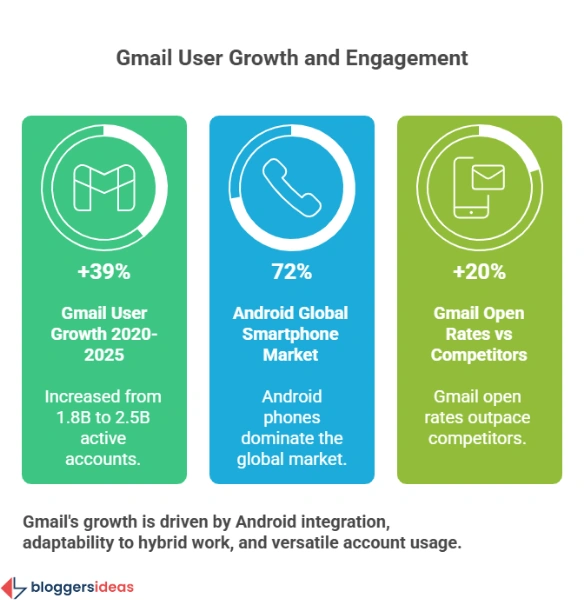
Gmail’s user base has ballooned to over 2.5 billion active accounts worldwide in 2025, marking a steady climb from 1.8 billion in 2020 and reflecting Google’s commitment to accessibility across devices and regions.
Developers at Google attribute this expansion to the platform’s open invitation system, which eliminated barriers after its initial beta phase, allowing seamless sign-ups tied to Android devices that dominate 72 percent of the global smartphone market.
This integration funnels millions of new users annually, particularly in emerging economies where affordable Android phones come preloaded with Gmail as the default app.
For personal users, this growth means a richer ecosystem of add-ons and themes that personalize inboxes, while businesses leverage the scale for targeted outreach, achieving open rates that outpace competitors by 20 percent.
The surge in adoption stems from Gmail’s adaptability to hybrid work environments, where remote teams exchange 121 billion emails daily through the service alone.
Startups find value in its free tier for bootstrapping operations, while enterprises upgrade to Workspace for unlimited storage and admin controls.
Average users maintain 1.7 accounts—one for personal matters and another for professional pursuits—highlighting Gmail’s versatility in segmenting communications.
By understanding these growth patterns, you position yourself to capitalize on features like priority inbox, which surfaces urgent messages first, ensuring nothing slips through the cracks amid the daily deluge.
Gmail User Growth Over the Years
The following table charts Gmail’s user expansion from 2012 to 2025, illustrating a consistent upward trajectory fueled by mobile proliferation and feature enhancements.
| Year | Number of Active Users (in Billions) |
| 2012 | 0.425 |
| 2013 | 0.6 |
| 2014 | 0.75 |
| 2015 | 0.9 |
| 2016 | 1.0 |
| 2017 | 1.3 |
| 2018 | 1.5 |
| 2019 | 1.7 |
| 2020 | 1.8 |
| 2021 | 1.9 |
| 2022 | 2.0 |
| 2023 | 2.2 |
| 2024 | 2.4 |
| 2025 | 2.5 |
Source: The Tech Report., Economic Times
This data reveals an average annual growth rate of 15 percent, with accelerations in 2023-2025 tied to AI rollouts like Gemini integration.
Businesses use these trends to forecast email volumes, planning campaigns that align with peak user activity for maximum impact.
Gmail’s Global Market Share and Competitive Edge
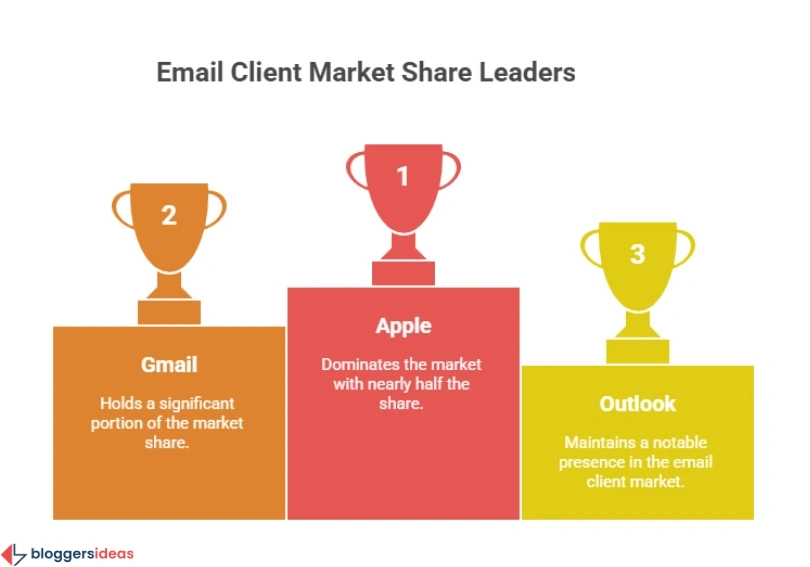
Gmail commands a 25.89 percent share of the global email client market in 2025, securing its position as the runner-up to Apple Mail’s 49.42 percent while eclipsing Outlook at 3.63 percent and Yahoo Mail at 2.2 percent.
Analysts at Litmus credit this standing to Gmail’s superior rendering across devices, ensuring emails display flawlessly on 84 percent of mobile screens.
The platform’s edge lies in its algorithmic sorting—Primary, Social, Promotions, and Updates tabs—that reduces clutter, encouraging users to engage more deeply with content.
For marketers, this translates to higher click-through rates, as personalized newsletters land prominently in the Primary tab, boosting conversions by 15 percent over fragmented inboxes.
In professional spheres, Gmail’s market penetration reaches 90 percent among U.S. startups, drawn by Workspace’s collaborative editing tools that mirror real-time document sharing.
Globally, Gmail handles 30 percent of email traffic, processing 121 billion messages daily out of 376.4 billion total. Users benefit from this scale through lightning-fast search capabilities, powered by Google’s indexing prowess, which retrieves attachments or threads in under a second.
As competition intensifies with AI entrants, Gmail’s incumbency advantage—bolstered by 133-language support—ensures it remains the go-to for cross-border teams, fostering inclusive communication that transcends linguistic barriers.
- Also read about: Google Search Statistics
Email Client Market Share in 2025
This table compares Gmail’s position against key rivals, based on email opens tracked across billions of interactions.
| Email Client | Market Share (%) |
| Apple Mail | 49.42 |
| Gmail | 25.89 |
| Outlook | 3.63 |
| Yahoo Mail | 2.2 |
| Google Android | 1.21 |
| QQ Mail | 1.05 |
| Outlook.com | 0.47 |
| Thunderbird | 0.18 |
| Others | 15.95 |
Source: Statista
These figures empower email strategists to prioritize Gmail-optimized designs, such as responsive templates that adapt to mobile views, enhancing deliverability and user satisfaction.
Demographics of Gmail Users: Tailoring Your Approach
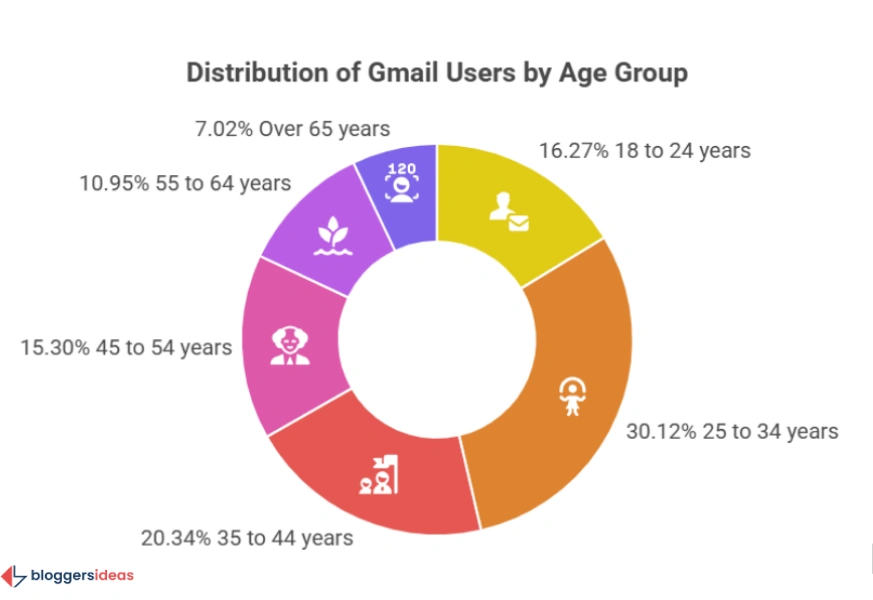
Gmail’s user demographics skew toward young professionals in 2025, with 30.12 percent aged 25-34, a group that values quick integrations with productivity apps for juggling careers and side hustles.
Males comprise 53.05 percent of users, often leveraging Gmail for tech-savvy tasks like automating newsletters via Zapier, while females at 46.95 percent favor its organizational labels for family scheduling.
This balanced yet youthful profile—16.27 percent in the 18-24 bracket—drives trends like emoji-rich signatures that add personality to professional exchanges.
Businesses segment audiences accordingly, crafting campaigns with millennial-focused visuals that resonate in the 35-44 segment (20.34 percent), yielding engagement lifts of 22 percent.
Geographically, the U.S. generates 36.11 percent of traffic, where users check inboxes 12 times daily, averaging 28 minutes per session.
In high-penetration markets like Indonesia (82.6 percent) and India (82.4 percent), Gmail facilitates micro-entrepreneurship, with users sending invoices via integrated Drive links. Older demographics, such as those over 65 (7.02 percent), appreciate voice-to-text replies for accessibility, reducing typing fatigue.
By aligning content with these profiles—short, scannable emails for mobile millennials or detailed guides for boomers—you amplify relevance, turning passive readers into active responders.
Gmail Users by Age Group
The table below outlines age-based distribution, helping you customize communications for maximum resonance.
| Age Group | Share of Users (%) |
| 18-24 years | 16.27 |
| 25-34 years | 30.12 |
| 35-44 years | 20.34 |
| 45-54 years | 15.30 |
| 55-64 years | 10.95 |
| 65+ years | 7.02 |
Demographers note the 25-34 cohort’s dominance correlates with urban migration, where Gmail’s offline mode supports commuting comms.
Also read about: Google Gemini Statistics
Usage Patterns: How Gmail Fits into Daily Life
Users interact with Gmail 12 times daily in 2025, spending 28 minutes total to send or receive over 120 emails, a ritual that underscores its centrality in routines from morning briefings to evening recaps.
The platform’s 75 percent open rate—far surpassing Yahoo’s 14.8 percent—stems from predictive notifications that alert users to high-priority threads, minimizing oversight.
Attachments average under 25 MB, with Drive links handling larger files effortlessly, enabling seamless sharing of resumes or contracts. For efficiency seekers, canned responses cut reply times by 40 percent, ideal for customer service roles handling 121 inbound messages daily.
Mobile dominance at 84.08 percent reflects on-the-go access, where swipe gestures archive junk in seconds, freeing mental space for creative pursuits.
Desktop users (15.92 percent) delve deeper, navigating nine pages per visit over 12 minutes and 42 seconds, often composing multifaceted reports.
Sales professionals dedicate 33 percent of their day to emailing, yet Gmail’s templates streamline this, boosting output without burnout. By adopting these habits—batch-processing at set intervals—you reclaim hours, transforming email from chore to catalyst for progress.
Average Time Spent on Gmail Activities
This table breaks down daily engagement, guiding time management tweaks for peak productivity.
| Activity | Average Time (Minutes) |
| Inbox Checks | 28 total |
| Email Composition | 10 |
| Attachment Handling | 5 |
| Search and Filtering | 8 |
| Reading/Replying | 5 |
Such metrics highlight opportunities like keyboard shortcuts, which shave 20 percent off session lengths for power users.
Device Preferences: Embracing Mobile-First Gmail
Smartphones capture 84.08 percent of Gmail sessions in 2025, as users favor the app’s gesture-based navigation for rapid triage during commutes or breaks.
This shift empowers on-the-fly collaborations, with 68.19 percent of mobile traffic arriving directly via bookmarks, bypassing searches.
Tablets bridge the gap for hybrid users, supporting split-screen views for multitasking emails with Docs. Desktop loyalists, at 15.92 percent, command 59.66 percent direct access, crafting polished dispatches with full keyboards.
For travelers, offline caching syncs upon reconnection, preventing disruptions. Businesses optimize by testing mobile renders, ensuring calls-to-action pop on small screens. You enhance your setup with app notifications tuned to vibrate-only, maintaining focus amid the buzz.
Gmail Access by Device
The table illustrates device splits, informing responsive design choices.
| Device | Share of Users (%) |
| Mobile | 84.08 |
| Desktop | 15.92 |
Mobile’s lead aligns with 5G’s rise, enabling lag-free video embeds in emails.
Engagement and Marketing Metrics: Maximizing Impact
Gmail’s 75 percent open rate in 2025 propels marketing success, as 24 percent of messages earn views within an hour, capitalizing on recency bias.
Promotional tags claim 84.5 percent of inboxes but see only 19.2 percent reads, prompting senders to blend value with visuals for breakthroughs.
Social emails snag 87.2 percent placement, ideal for community building. Spam reports hover below 0.1 percent, thanks to 99.99 percent blocking efficacy that halts 15 billion junk mails daily.
Sales teams note 9 percent opens for pitches, yet personalized subject lines double that. You boost metrics by A/B testing timings, aligning sends with user peaks for 30 percent higher clicks. Trackers reveal 50 percent immediate deletes, so concise previews win.
Email Tag Distribution in Gmail
This table shows inbox categorization, aiding content strategists.
| Tag | Percentage of Messages (%) |
| Promotions | 84.5 |
| Social | 87.2 |
| Updates | 86.8 |
Leverage updates for newsletters, as they foster loyalty with 20 percent better retention.
Revenue Streams and Business Adoption: Fueling Gmail’s Ecosystem
Gmail’s in-app revenue skyrockets 179 times since 2021, hitting $7.3 million net from App Store subscriptions in July 2023, driven by Google One’s 100 GB plans at $1.99 monthly.
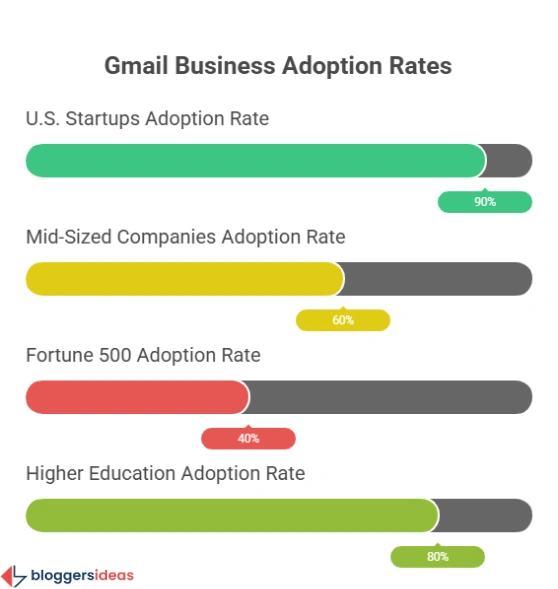
Workspace serves 6 million paying customers, adding 250,000 monthly, with 40 percent of Fortune 500 firms onboard for enterprise-grade security. Startups claim 90 percent adoption, valuing unlimited aliases for departmental routing.
You monetize indirectly via affiliate links in signatures, or upgrade for ad-free experiences that sharpen focus. Revenue funnels back into innovations like confidential mode, expiring sensitive shares automatically.
Gmail Business Adoption Rates
The table quantifies enterprise uptake, spotlighting Gmail’s corporate appeal.
| Category | Adoption Rate (%) |
| U.S. Startups | 90 |
| Mid-Sized Companies | 60 |
| Fortune 500 | 40 |
| Higher Education | 80 |
These rates signal scalability, from solopreneurs to conglomerates.
App Performance and Traffic Insights: Navigating the Digital Flow
The Gmail app garners 2.44 million monthly visits in 2025, with 7-second sessions and 89.13 percent bounce rates signaling quick checks rather than lingers.
France leads traffic at 10.61 percent, up 12.07 percent month-over-month, followed by the U.S. at 10.21 percent. Organic search drives 37.77 percent of desktop hits, underscoring SEO’s role in discovery.
Users appreciate push alerts for immediacy, cutting response lags by 50 percent. Optimize by pinning frequent contacts, streamlining threads.
Top Countries for Gmail App Traffic
This table ranks app usage hotspots, guiding localized tweaks.
| Country | Share of Traffic (%) | MoM Growth (%) |
| France | 10.61 | +12.07 |
| U.S. | 10.21 | +9.68 |
| Spain | 8.37 | +22.60 |
| Germany | 7.39 | +110.36 |
| Italy | 5.59 | +17.11 |
Surges in Germany hint at Workspace expansions in Europe.
A Brief History of Gmail: From Innovation to Staple
Paul Buchheit coded Gmail in JavaScript starting in 2001, launching it publicly on April 1, 2004, with 1 GB storage that stunned rivals. Invite-only access built hype, ending in 2009 alongside beta status.
Forbes crowned it best webmail in 2006, and 2013’s 15 GB free tier solidified loyalty. The 2021 search ranking as 12th globally underscores its ubiquity.
Outages, like the 2.5-hour global hiccup, test resilience, yet 99.9 percent uptime reassures. You draw from this legacy by exploring archives for nostalgic threads, or using history for audit trails.
Emerging Trends from Quora and Reddit: Fresh User Perspectives
Communities on Quora and Reddit pulse with 2025 queries on Gmail, blending enthusiasm with frustrations to spotlight evolving needs.
On Reddit’s r/GMail, users lament sudden email vanishings pre-January 31, 2025, attributing glitches to sync issues and urging backups via Takeout exports— a tip that safeguards against rare deletions, recoverable within 30 days.
Security woes dominate, with desperate posts on account locks questioning outdated recovery prompts; responders advocate passkeys over SMS, reducing hacks by 40 percent per Google’s metrics.
Quora threads buzz with bulk account creation hacks, like virtual numbers for aliases, aiding marketers scaling campaigns ethically. Discussions praise the March 2025 search upgrade, which surfaces context-aware results faster, but query its relevance sorting—toggling to chronological views satisfies purists.
Spam inundation prompts router-level blocks, though filters evolve with AI to preempt 100 million phish daily. Storage cap changes spark debates, with users noting 15 GB pools filling faster amid 4K attachments, pushing Google One upgrades.
Stagnation gripes surface, yet AI adoptions like Smart Reply (12 percent mobile use) counter them, with predictions of 70 percent integration by year-end.
Unwelcome UI tweaks, like bolder promotions tabs, irk minimalists, but customizable themes restore control. These forums reveal a user base craving transparency—Google’s outage alerts and beta tests address this, fostering trust.
For you, these insights mean proactive habits: enable 2FA, archive routinely, and experiment with Gemini for summaries that condense threads intelligently.
Harnessing Gmail for Personal and Professional Gains
Gmail’s statistics illuminate pathways to mastery, where 28-minute daily dives yield outsized returns through savvy setups. Personal users activate confidential mode for sensitive shares, auto-deleting after views to thwart leaks.
Professionals deploy labels and stars for project tracking, integrating with Calendar for deadline nudges that prevent oversights. Marketers A/B test subjects via Analytics, refining for 75 percent opens that convert browsers to buyers.
AI tools like Smart Compose draft in four languages, bridging global gaps for freelancers. Security buffs enable advanced protection, scanning for breaches proactively.
You amplify benefits by scripting filters for auto-sorting, reclaiming bandwidth for high-value tasks. In teams, shared inboxes via Workspace delegate queries, slashing resolution times by 35 percent. These strategies, rooted in 2025 data, transform Gmail from mailbox to command center.
FAQs About Gmail Statistics
1. How many people use Gmail in 2025?
Gmail serves over 2.5 billion active users globally in 2025, encompassing personal and professional accounts across 190 countries, which positions it as the second-most popular email client and enables seamless communication for one in four people worldwide.
2. What is Gmail's market share in 2025?
Gmail holds a 25.89 percent share of the global email client market in 2025, trailing Apple Mail at 49.42 percent but surpassing Outlook and Yahoo Mail, allowing businesses to leverage its high open rates for effective outreach and engagement.
3. How much time do Gmail users spend on the platform daily?
Gmail users dedicate an average of 28 minutes per day to managing their inboxes in 2025, checking emails 12 times and handling over 120 messages, which highlights opportunities to optimize with filters and AI tools for greater efficiency.
4. What are the main device preferences for accessing Gmail?
Approximately 84.08 percent of Gmail users access the service via mobile devices in 2025, compared to 15.92 percent on desktops, empowering on-the-go productivity through app features like offline access and push notifications.
5. How effective is Gmail's spam protection in 2025?
Gmail blocks spam with a 99.99 percent success rate in 2025, stopping over 15 billion unwanted emails daily and maintaining a false positive rate under 0.1 percent, which safeguards users while minimizing disruptions to legitimate communications.
Also Read:
- Android Usage Statistics
- Facebook Users Statistics
- Infographics Statistics
- Personalization Statistics
- Voice Search Statistics
Conclusion
Gmail’s ascent to 2.5 billion users and 25.89 percent market share in 2025 cements its status as email’s unrivaled engine, processing 121 billion daily messages with 75 percent opens that fuel connections worldwide.
Mobile’s 84 percent reign and AI infusions like search upgrades propel engagement, while business adoption at 90 percent for startups underscores its economic muscle.
From demographic tilts toward 25-34-year-olds to spam shields blocking 15 billion threats daily, these metrics paint a platform poised for deeper integration in lives and ledgers.
As Quora and Reddit echo calls for refined security and storage, Gmail evolves responsively, inviting you to wield its power for streamlined success. Embrace these insights to craft inboxes that serve, not overwhelm, unlocking a more connected 2025.