Artificial Intelligence (AI) is no longer a futuristic concept but a present-day reality profoundly reshaping the global talent acquisition landscape.
As we approach AI recruitment statistics 2025, it becomes clear that organizations across all sectors are embracing AI-driven tools to enhance efficiency, reduce costs, and improve the quality of hires.
This comprehensive article delves into the transformative impact of AI in recruitment, providing detailed insights for recruiters, HR professionals, and job seekers alike, enabling them to leverage AI’s benefits while navigating its challenges.
Market Growth and Adoption
The AI recruitment industry is experiencing robust growth, signaling a fundamental shift in how companies identify, attract, and onboard talent.
This technological revolution is driven by AI’s proven ability to streamline processes and deliver measurable results.
Market Size and Projections: A Billion-Dollar Industry
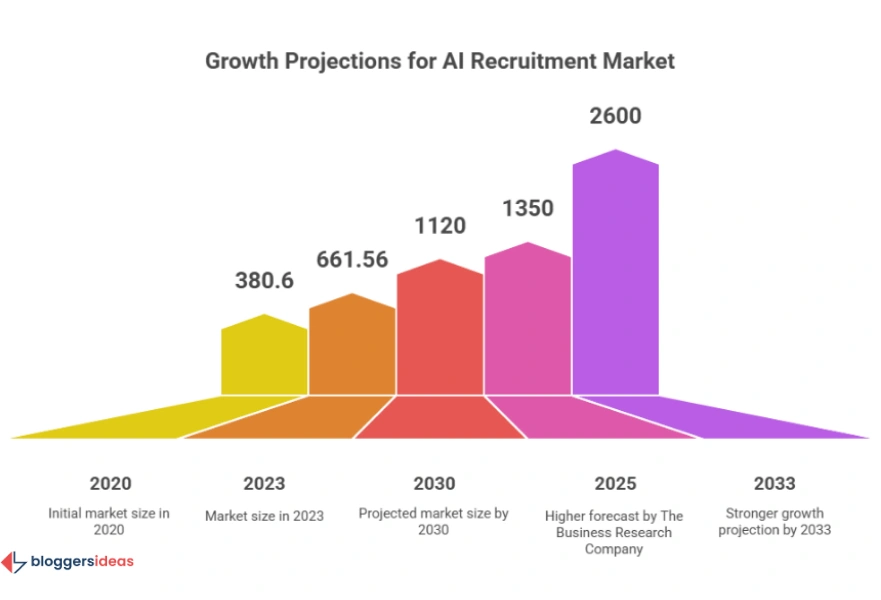
The global AI recruitment market demonstrates significant expansion. Valued at $661.56 million in 2023, the industry is projected to reach an impressive $1.12 billion by 2030, growing at a Compound Annual Growth Rate (CAGR) of 6.78%.
Other estimates place the market at $596.16 million in 2025, reaching $860.96 million by 2030 with a CAGR of 7.63%. These projections underscore a consistent and healthy expansion, indicating AI’s increasing indispensable role in talent acquisition.
The following table illustrates the projected market size of the AI recruitment industry, highlighting its trajectory towards becoming a multi-billion dollar sector.
| Year | Market Size of The AI Recruitment Industry (Millions USD) |
| 2020 | $380.6 |
| 2021 | $470.3 |
| 2022 | $540.4 |
| 2023 | $661.56 |
| 2025 (Estimated) | $596.16 – $661.56 |
| 2030 | $1,119.8 – $860.96 |
Also read about: Meta AI Statistics
Regional Leadership and Cost Savings: North America at the Forefront
North America currently leads the charge in AI adoption for HR processes, achieving a remarkable 40% cost reduction in 2022.
This region generated $206.4 million in revenue for the global AI recruitment industry in 2022 and is projected to contribute $323.2 billion by the end of 2030.
Europe closely follows, with a 36% cost reduction attributed to AI implementation in HR. The Asia-Pacific region also shows significant growth, expected to double its market share to $250 million by 2030.
These regional statistics highlight the widespread recognition of AI’s economic benefits across the globe.
| Region | Cost Cutting (2022) | 2023 Market Share (Millions USD) | 2030 Projection (Millions USD) |
| North America | 40% | $280 | $475 |
| Europe | 36% | $150 | $230 |
| Asia-Pacific | 25% | $120 | $250 |
| Rest of the World | 20% | N/A | N/A |
Source: Market Research Future.
The Recruiter’s Perspective: Benefits, Concerns, and Adoption Rates
Recruiters are increasingly embracing AI tools, recognizing their potential to transform the hiring process.
However, this adoption also comes with a nuanced understanding of AI’s limitations and potential pitfalls.
Widespread Adoption: AI as a Standard Practice
The integration of AI into recruitment processes has become a standard practice for a vast majority of organizations.
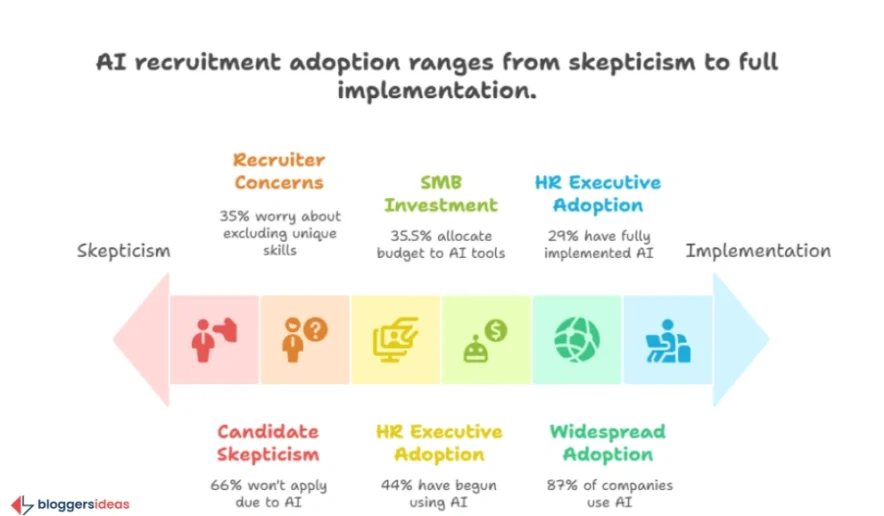
Around 87% of companies currently utilize AI for their recruitment process, with more than 65% of recruiters already employing AI tools to hire talent.
This widespread adoption is particularly evident among large corporations, with 99% of Fortune 500 companies leveraging AI-driven recruitment methods.
The trend indicates that AI is no longer a competitive advantage but a foundational element of modern talent acquisition strategies.
| Metric | AI Usage |
| Companies using AI for recruitment | 87% |
| Recruiters using AI for hiring | 65% |
| Fortune 500 companies using AI recruitment | 99% |
| Companies to invest in recruitment automation (by 2025) | >73% |
| Organizations actively using AI in HR | 45% |
| Organizations preparing to integrate AI in HR | 38% |
| Global AI adoption rate in HRM | 21% |
| Organizations expected to integrate AI in HR by 2025 | 80% |
| Annual growth of AI adoption | 35% |
Source: Statista.
Key Benefits: Efficiency, Objectivity, and Quality of Hire
Recruiters cite numerous compelling reasons for integrating AI into their workflows. The primary driver is time-saving, with 44% of recruiters highlighting it as a main benefit and 67% of hiring decision-makers agreeing that AI significantly reduces hiring timelines.
This efficiency is further bolstered by AI’s ability to process large volumes of data much faster than humans, thereby accelerating the screening process.
Beyond speed, AI also contributes to a more objective and higher-quality hiring process. 68% of recruiters believe AI can effectively remove biases from hiring, a critical improvement given that 48% of hiring managers admit to harboring some form of bias.
Furthermore, AI-picked candidates are 14% more likely to pass interviews and 18% more likely to accept job offers, indicating that AI enhances the quality of matches between candidates and roles.
| Benefits of AI in Recruitment | Share of Respondents |
| Saves Time | 67% |
| Removes Human Bias | 43% |
| Delivers Best Candidate Matches | 31% |
| Saves Money | 30% |
| Makes the hiring process faster | 86.1% |
| Most useful for candidate sourcing (recruiters) | 58% |
| Most advantageous in screening candidates (recruiters) | 56% |
| Most beneficial in nurturing candidates (recruiters) | 55% |
| Improves hiring accuracy (AI-driven interview analytics) | 40% |
| Improves talent matching (predictive analytics) | 67% |
| Improves workforce diversity (predictive analytics) | 35% |
Emerging Concerns: Bias, Exclusivity, and the Human Element
Despite the clear advantages, recruiters also express genuine concerns regarding AI’s role in recruitment. A significant 35% of recruiters worry that AI may inadvertently exclude candidates with unique skills and experiences that do not fit predefined algorithms.
There is also a fear that algorithmic bias, though intended to be removed, could manifest in new forms (18% of respondents). Furthermore, 26% of recruiters believe AI recruitment could potentially damage the HR industry by dehumanizing the process.
These concerns highlight the need for careful implementation and continuous oversight to ensure AI tools augment, rather than replace, human judgment and empathy in hiring.
| Dangers of AI In The Recruitment Process | Share Of Respondents |
| Overlooking atypical qualities and experiences | 21% |
| Algorithmic bias | 18% |
| Candidates manipulating technology to get the job | 16% |
| Aspects overlooked by AI software developers | 16% |
| Applicants drop out of the process because they are uncomfortable with the technology | 14% |
Also read about: Microsoft AI Model Unveiled: Challenges Google and OpenAI
The Job Seeker’s Perspective: A Mixed Bag of Hope and Skepticism
While companies are rapidly adopting AI, job seekers hold a more cautious and at times, skeptical view of its involvement in hiring decisions.
Their perspectives are crucial for organizations aiming to build fair, transparent, and candidate-friendly recruitment processes.
Hesitation and Mistrust: The Desire for Human Touch
A striking 66% of U.S. adults indicate they would avoid applying for jobs that use AI to make hiring decisions.
This sentiment stems from a perception that AI lacks the personal touch, may not fully understand nuanced situations, and could still harbor biases.
Furthermore, 71% of U.S. adults actively oppose AI making final hiring decisions, while 7% favor it, and 22% remain unsure. This strong opposition underscores a fundamental desire for human involvement in critical career decisions.
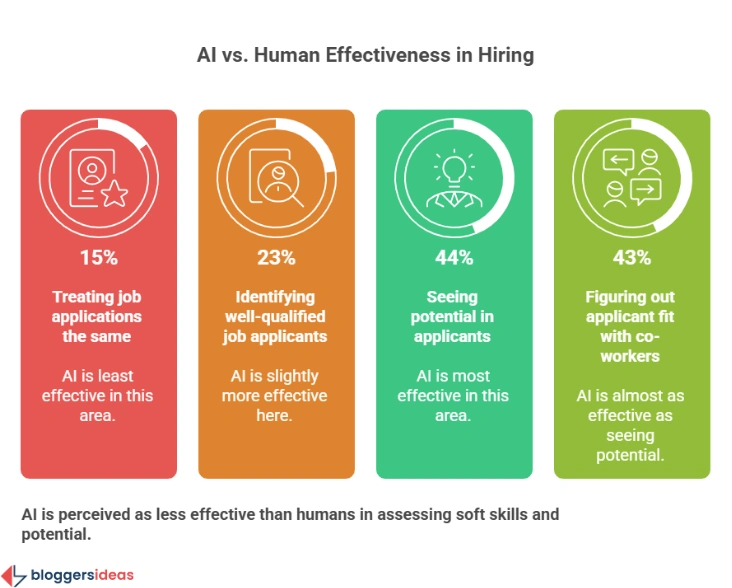
Job seekers also express concerns about potential unfairness. 15% of U.S. adults believe AI cannot treat all job applications in the same way as humans, and 23% think AI may be less effective in identifying well-qualified candidates.
A significant 44% worry that AI might overlook the potential of applicants who do not perfectly fit a job description.
The issue of racial or ethnic bias is also prominent, with 37% of American adults believing it is a significant problem in hiring, and 13% thinking AI could exacerbate it.
| Part Of The Hiring Processes (AI’s Effectiveness Compared to Humans) | Share of Respondents (US Adults) |
| Treating job applications in the same way | 15% |
| Identifying job applicants who are well-qualified | 23% |
| To see potential in the job applicant who may not fit the job description | 44% |
| To figure out which job applicant would work well with their co-workers | 43% |
| Ethnicity (Believing AI Will Worsen Racial Bias) | Share of Respondents |
| Black | 20% |
| Asian | 12% |
| Hispanic | 13% |
| White | 12% |
| Overall | 13% |
Hope for Fairness and Efficiency: Faster Feedback and Bias Reduction
Despite the skepticism, job seekers also see potential benefits in AI-driven recruitment. A notable 70% believe AI can improve response times and enhance their overall experience, while 75% express a preference for AI-driven recruitment tools if it leads to faster feedback and a more personalized journey.
The hope for reduced discrimination is also present, with 44% of job seekers reporting personal experiences of discrimination and believing AI could help mitigate such biases.
This dual perspective highlights the need for transparent communication from employers regarding AI’s role in their hiring processes, with almost 90% of job seekers wanting companies to be forthright about their AI usage.
The Future of AI in Recruitment: Trends and Investments
The trajectory of AI in recruitment points towards deeper integration and more sophisticated applications. Organizations are not just adopting AI; they are strategically investing in its future capabilities.
Increased Investments and Broader Applications
Investments in AI-powered recruitment software are surging, with leading tech companies intending to allocate 60% of their budget towards these tools worldwide.
Small and medium businesses are also joining this trend, with 35.5% allocating their budget toward AI or machine learning recruitment tools.
Enterprises plan to allocate the highest budget for AI-powered recruitment tools, reflecting a strategic shift across all business sizes.
Beyond core recruitment, AI is expanding its footprint across various HR functions. 60% of organizations now use AI to manage talent, and 44% of HR executives have already implemented AI for payroll processing and benefits administration.
This broad application signifies AI’s evolution from a niche tool to a comprehensive HR solution.
| HR Executives Using AI In | Not Using AI At All | Starting To Use AI | Fully Implemented One Or More AI Solutions |
| Employee record management | 22% | 41% | 37% |
| Payroll processing and benefits administration | 23% | 33% | 44% |
| Recruitment and hiring | 27% | 44% | 29% |
| Performance management | 28% | 38% | 34% |
| Onboarding new employees | 31% | 42% | 27% |
| Retaining current employees | 33% | 40% | 27% |
| Cross-skilling and reskilling employees | 33% | 36% | 30% |
| Company culture and rewards management | 36% | 32% | 32% |
| Managing Talent mobility | 35% | 40% | 24% |
The Evolution of AI’s Role: Augmentation, Not Replacement
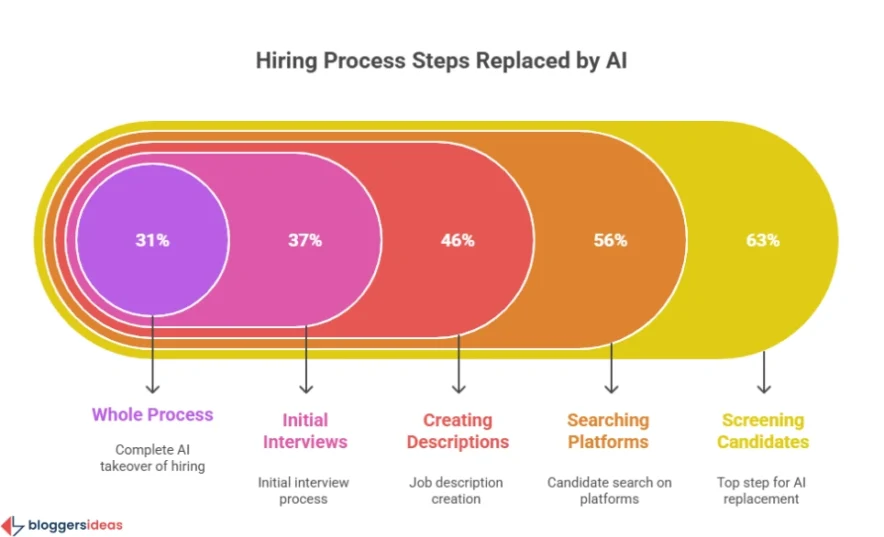
While concerns about AI replacing human recruiters exist (31% of recruiters believe AI will ultimately take over the whole hiring process), the dominant trend suggests AI will augment, rather than entirely replace, human roles.
63% of recruiters believe AI will replace candidate screening, and 56% expect it to replace candidate searching across platforms.
However, only 31% of recruiters believe AI will completely take over the entire hiring process, and 15% firmly believe AI will never replace the human side of recruitment.
| Which Part Of The Hiring Process Can Be Replaced | Share Of Respondents (Recruiters) |
| Screening Candidates | 63% |
| Searching for a candidate on different platforms | 56% |
| Creating job descriptions | 46% |
| Conducting initial interviews | 37% |
| The whole process of hiring AI will take over | 31% |
Looking ahead to AI recruitment statistics 2025 and beyond, AI is forecast to augment 90% of HR functions and transform HR into a strategic function in 80% of organizations.
58% of organizations believe AI will boost employee productivity, and 55% expect it to enhance the overall employee experience within the next five years.
This indicates a future where AI empowers HR professionals to focus on strategic initiatives, leaving repetitive and data-intensive tasks to intelligent automation.
Insights from Quora and Reddit
Beyond official statistics, online forums like Quora and Reddit provide a pulse on real-world concerns and emerging discussions regarding AI in recruitment.
Many users frequently ask about the explainability of AI’s hiring decisions, seeking transparency on why a particular candidate was chosen or rejected by an algorithm. This reflects a growing demand for “black box” AI models to be more transparent and auditable.
Another recurring theme involves the ethical implications of AI evaluating soft skills or personality traits, with users questioning the fairness and accuracy of such assessments.
There’s also significant discussion around how job seekers can “optimize” their applications for AI screeners without compromising authenticity.
These discussions highlight a collective desire for fairness, transparency, and a balanced approach as AI becomes more prevalent in critical life decisions like employment.
FAQs About AI Recruitment Statistics
1. How common is AI use in recruitment, and what are its main benefits?
About 87% of companies now use AI in hiring. It saves time for 67% of recruiters, reduces bias by 43%, and improves candidate quality by 14%.
2. What are job seekers’ main concerns about AI hiring?
Around 66% of U.S. adults hesitate to apply for jobs using AI, citing lack of personal touch, missed potential, and algorithmic bias as key worries.
3. What is the value and growth outlook of the AI recruitment market?
Valued at $661.56 million in 2023, the AI recruitment market is projected to hit $1.12 billion by 2030, growing at a 6.78% CAGR.
4. How else is AI used in HR beyond recruitment?
AI now supports payroll, benefits, and performance management, with 60% of firms using it across HR and 44% fully adopting it for admin tasks.
5. Will AI replace human recruiters?
Unlikely. While 63% expect AI to automate screening, only 31% believe it could replace recruiters. Most agree it will assist, not replace, humans.
Also Read:
- Android Usage Statistics
- Most Google Searched Things Statistics
- Personalization Statistics
- Voice Search Statistics
- Google Gemini Statistics
Conclusion:
The landscape of talent acquisition is irrevocably transformed by AI, and AI recruitment statistics 2025 paint a clear picture of its increasing dominance. With over 87% of companies already leveraging AI in their recruitment processes, and the global market projected to reach over a billion dollars by 2030, AI is undeniably a cornerstone of modern hiring strategies.
While benefits such as significant time savings (67%), bias reduction (43%), and improved candidate quality (14% higher interview success rates for AI-selected candidates) are compelling, critical challenges persist.
Concerns around AI potentially overlooking unique talent (35% of recruiters) and a notable reluctance from job seekers (66% of U.S. adults) to apply for AI-screened roles necessitate a thoughtful and ethical approach.
The future of AI in recruitment lies in striking a delicate balance: maximizing automation for efficiency while ensuring human oversight, transparency, and empathy remain at the core of every hiring decision.
This blend will allow organizations to fully harness AI’s power, building diverse, skilled, and engaged workforces for the future.
Here is an image illustrating the current state and future of AI in recruitment, showcasing the blend of technology and human interaction.