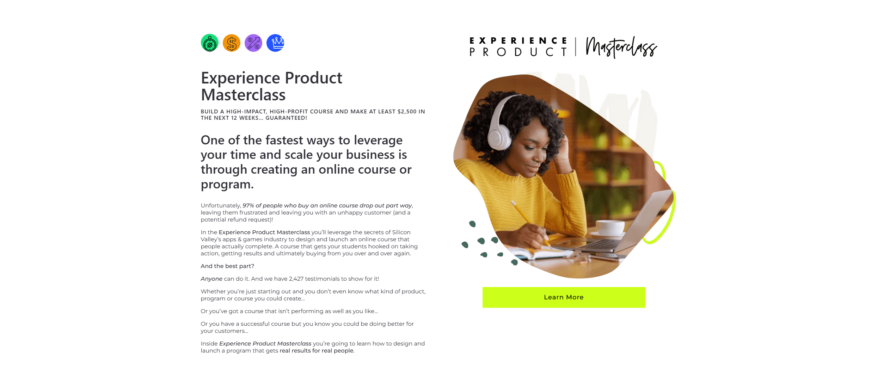
I’ve bought a lot of “how to create an online course” programs over the years, and most of them teach the same three things: pick a niche, record some videos, sell it on a webinar. Experience Product Masterclass is one of the few that starts from a different question entirely: why do students buy courses and then never finish them?
That question is the whole program. Marisa Murgatroyd built EPM around fixing course completion, not just course creation, and after going through the material and reading through years of student feedback, that focus is what actually sets it apart from the crowded “sell your knowledge online” space.
If you’re building or fixing a course right now, the fastest way to see current terms is to join the waitlist directly, since enrollment isn’t open year-round:
https://liveyourmessage.com/epmev/waitlist/
Here’s the full breakdown before you do.
The Problem EPM Was Built to Solve
Most online courses have a completion rate somewhere around 3 percent. That number gets thrown around a lot in the course-creation world, and it’s not an exaggeration; it’s close to the industry norm. Students buy, watch the first two modules, and vanish. No results, no testimonials, no referrals, no repeat sales.
Murgatroyd’s answer is what she calls the Experience Formula: designing a course the way a good video game is designed, with clear milestones, unlocks, points, and a defined “win” state instead of an open-ended pile of lessons. It’s not a new idea in game design circles, but applying it deliberately to online education is where EPM carved out its space.
Inside the Program
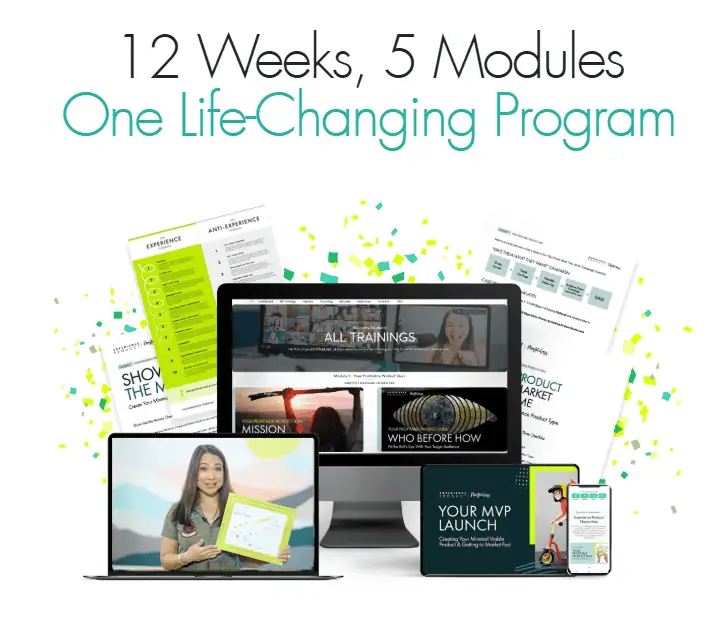
EPM runs 10 to 12 weeks, delivered live, and covers five modules:
Module 1: Profitable Idea Unlock. You don’t start recording anything yet. You validate the idea, define what “finishing” your course actually means for a student, and build the outcome you’re promising before you build a single lesson.
Module 2: Experience Design. This is the core of the method. You take your content and restructure it into a journey: checkpoints, quick wins early on, and a path that keeps students moving instead of stalling out.
Module 3: Content Creation. Now you build the actual training, using templates so you’re not staring at a blank page trying to figure out lesson structure from scratch.
Module 4: Marketing and Launch. Swipe files and launch sequences for filling the course, built from patterns across past cohorts rather than generic copywriting advice.
Module 5: Scale and Delivery. Setting up the coaching cadence, tech stack, and support systems so the course keeps running after launch week ends.
Every student also gets Xperiencify, Murgatroyd’s own delivery platform, built around the same XP-and-unlock mechanics taught in the course. You’re not just learning the theory; you’re using the tool inside the program while you build your own version of it.
Why the Guarantee Matters More Than It Looks Like It Should
A lot of course-creation programs promise vague things like “lifetime access” or “money-back if unsatisfied.” EPM’s guarantee is different: complete the coursework, launch your product, follow the marketing steps, and if you haven’t made at least $2,000 within 12 weeks, Murgatroyd personally covers the gap.
That’s a real number tied to a real outcome, not a satisfaction survey. It also changes the incentive on the other side. A program that has to pay you if you don’t hit a number has a reason to actually make sure you launch, not just hand you videos and wish you luck.
What Students Actually Say
Reading through independent reviews rather than the program’s own marketing gives a more useful picture. The recurring theme isn’t “I got rich.” It’s “I finally finished something.” Several long-time course shoppers describe EPM as the first program, out of dozens purchased, that they completed start to finish with something real to show for it.
The weekly coaching calls and personal success coach come up more often than the video content itself. That tracks with the program’s whole premise: the structure is what gets people to act, not just the information.
Financial outcomes vary widely, which makes sense given the guarantee only sets a $2,000 floor. Some students report launches well into five figures. Others land close to the guarantee threshold. Review aggregators show an average in the 4-star range across well over a hundred reviews, with a small cluster of 1-star reviews mostly citing price or a mismatch between expectations and the amount of independent work the program requires.
How the Coaching Actually Works
The word “coaching” gets used loosely across the course-creation space, so it’s worth being specific about what EPM includes. Students get a personal success coach assigned to them, not a shared inbox that routes to whoever’s available. That coach tracks your milestones through the program and follows up when you fall behind, rather than waiting for you to ask for help.
On top of the one-on-one piece, there are group coaching calls where Murgatroyd or her senior coaches answer questions live and walk through common sticking points across the cohort. Students who’ve been through more than one round mention that hearing other people’s problems solved in real time often answers a question they hadn’t even thought to ask yet.
This structure is really the answer to the completion-rate problem the whole program is built around. A course can teach the best gamification method in the world, but if nobody checks in when a student goes quiet in week four, the same 3 percent completion problem shows up inside EPM itself. The coaching layer is what keeps that from happening.
What Happens After the Program Ends
A detail that gets skipped in a lot of course-creation reviews: what happens once the 10 to 12 weeks are over. EPM includes lifetime access to the training material, so the modules don’t disappear once the live cohort wraps. Students who need to revisit Module 2 a year later while relaunching a product can go back through it without paying again.
Xperiencify access also continues past the program itself, since it’s the platform meant to run whatever course or membership you built during EPM. That matters for anyone treating this as infrastructure for an ongoing business rather than a one-time project.
Who This Actually Fits
EPM makes the most sense for:
Coaches or consultants with real expertise but no packaged product yet
Anyone with an existing course that people buy but don’t finish
Service providers ready to turn one-on-one work into something scalable
It’s a rougher fit for someone with zero niche and zero audience. The program assumes you’re refining an idea, not discovering one cold. If you’re starting from nothing, spend a few weeks getting basic clarity first so you’re not paying premium tuition to answer a question the course assumes you’ve already worked out.
Common Hesitations, Addressed Directly
“What if I don’t have a fully formed idea yet?” The first module is built for exactly this. It’s not assumed you’re walking in with a finished concept, just enough direction to validate against. If you have zero sense of what you’d teach at all, that’s the one gap the program doesn’t fully solve for you.
“What if I fall behind during the 10 to 12 weeks?” This is the entire reason the coaching layer exists. Milestone tracking means someone notices before week eight rolls around and you’ve quietly checked out. That said, a coach checking in can’t force you to do the work; it can only make it harder to disappear unnoticed.
“Is $2,500 really justified compared to a $200 alternative?” Only if you’d actually use what the $2,300 difference buys: a delivery platform, a personal coach, and group calls. If you’re disciplined enough to launch on your own with cheaper tools, EPM is solving a problem you don’t have. If accountability and structure are genuinely what’s been missing, that gap is exactly what the price covers.
Pros and Cons
Pros
- Early access secures your spot before enrollment fills up
- Waitlist members often get exclusive discounts or bonuses
- No commitment required until course officially opens enrollment
- You'll receive valuable free content while waiting
Cons
- No guaranteed start date creates uncertain planning timeline
- Course quality and outcomes remain unverified before purchase decision
Final Verdict
EPM isn’t a course about making a course. It’s a course about making sure the one you already have an idea for gets finished by the people who buy it. The gamified structure, the included software, and the outcome guarantee are what separate it from cheaper, more generic alternatives.
The real barrier is timing, not doubt about whether the method works. Enrollment isn’t open right now, so the only move that actually matters today is getting on the waitlist so you’re first in line the moment the next cohort opens:
https://liveyourmessage.com/epmev/waitlist/
If you’ve got something worth teaching and an audience that isn’t finishing what you’ve already built, that’s the one action worth taking before this page closes another tab.
Frequently Asked Questions
Not at this moment. Enrollment runs in cohorts and is currently closed, but you can join the waitlist at liveyourmessage.com/epmev/waitlist to get notified when it reopens.
The last confirmed cohort charged $2,497 paid in full, or split into six installments. Pricing can shift year to year, so confirm current cost once the next cohort opens.
No. It requires completing the coursework, launching your product, and applying the marketing steps taught in the program. It's tied to doing the work, not simply enrolling.
The program runs 10 to 12 weeks depending on the cohort, including live calls and milestone check-ins throughout.
No, there's no connection despite the similar name. EPM is sold entirely through Live Your Message's own website.