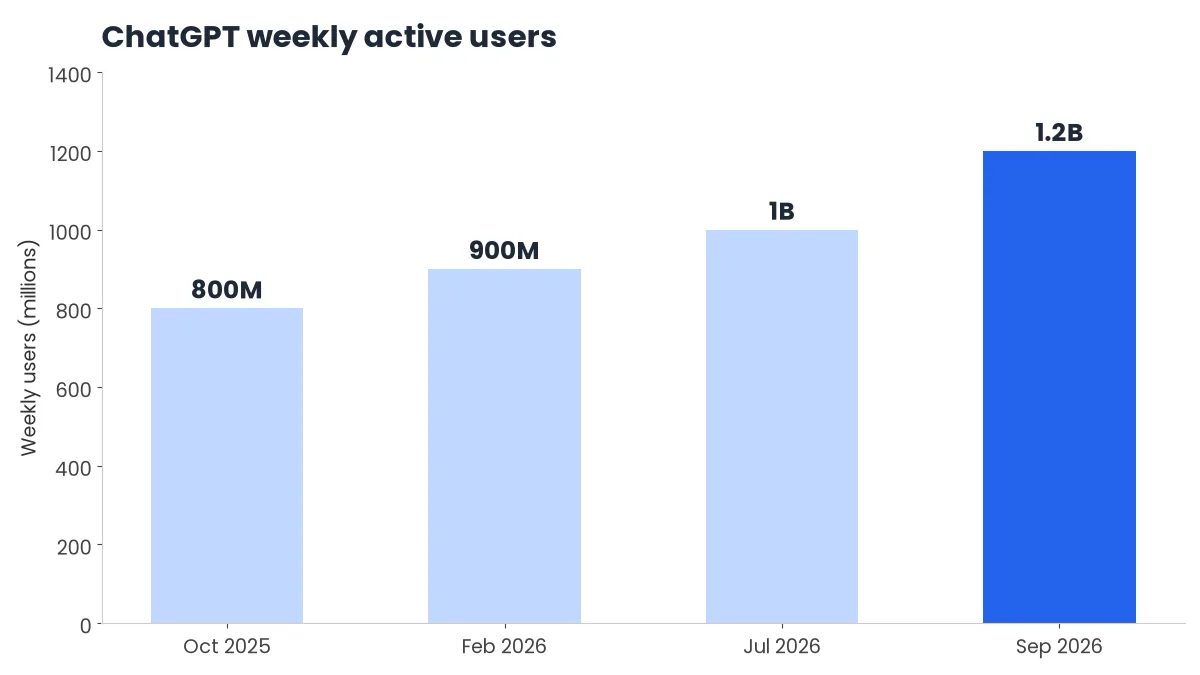
AI chatbot statistics this year start with one figure: ChatGPT has a weekly audience of 1.2 billion.
Adoption is broad as well. Nearly half of American adults use a chatbot, and close to one in four opens one every day.
This page covers users, market size, industries, revenue, benefits, costs, age groups, countries, challenges and the outlook ahead.
Key Highlights: AI Chatbot Statistics 2026
- ChatGPT counts 1.2 billion users each week, versus 800 million a year earlier.
- Gemini has passed the 1 billion mark for monthly users.
- Nearly half of American adults (49%) chat with AI, and 24% do it daily.
- The chatbot market is valued at $10.42 billion to $13.28 billion in 2026.
- Close to half of all companies (47%) are rolling chatbots out enterprise wide.
- Shoppers sent by AI tools convert 90% better than other online visitors.
- A brand’s own bot handled the latest support request for just 7% of customers.
- Nearly half (45%) of AI replies on news topics contained a serious flaw.
How Many Users Do AI Chatbots Have in 2026?
With 1.2 billion weekly users, ChatGPT has the largest audience of any chatbot. Our AI chatbot statistics track its weekly base rising from 800 million a year ago to 1.2 billion now. Gemini climbed from 650 million monthly users to past 1 billion over that same stretch. Our ChatGPT statistics break down that growth by feature and country.
| AI chatbot | Latest user count | Measured |
|---|---|---|
| ChatGPT | 1.2 billion | Weekly |
| Gemini app | Over 1 billion | Monthly |
| Meta AI | Over 1 billion (last shared late last year) | Monthly |
| Copilot family | Over 150 million (last shared late last year) | Monthly |
What this means: most of your readers have likely opened a chatbot this week, so skip the beginner explanations.
Which AI Chatbot Gets the Most Website Traffic?
ChatGPT captures 56.4% of visits across AI chatbot websites. Across these AI chatbot statistics on traffic, Gemini follows with 25%, nearly double its share a year ago, while Claude grew fourfold to 9.6%. For the fastest climber, see our Claude statistics.
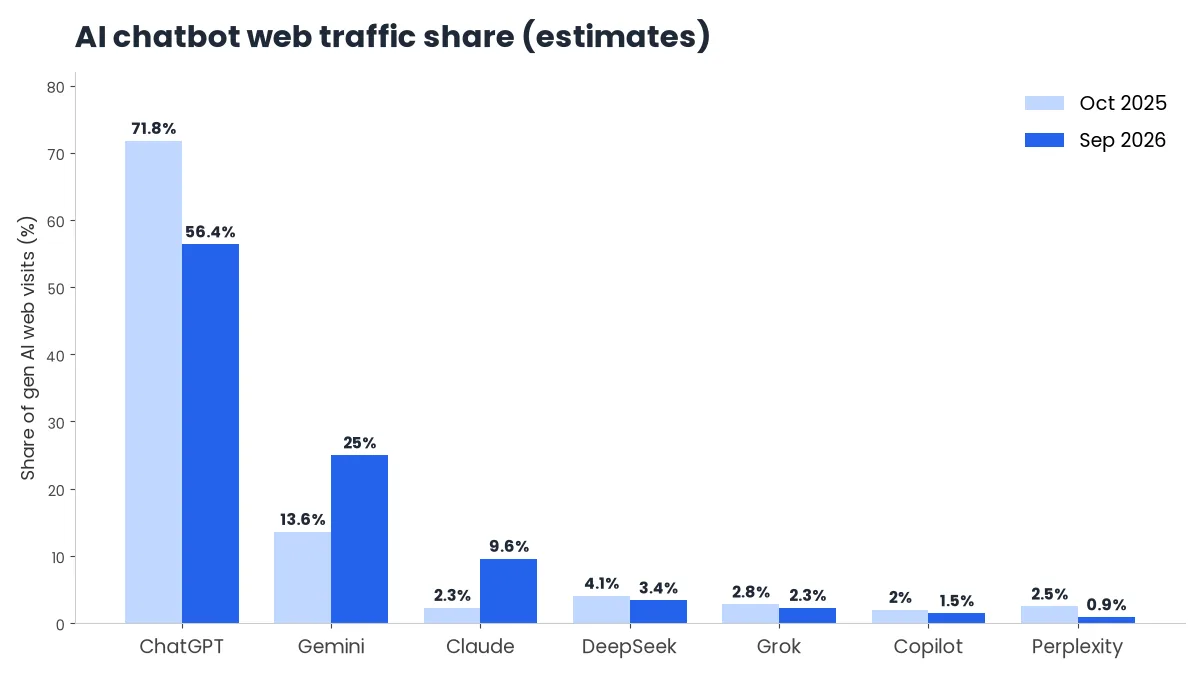
| AI chatbot | Web traffic share now | A year ago |
|---|---|---|
| ChatGPT | 56.4% | 71.8% |
| Gemini | 25.0% | 13.6% |
| Claude | 9.6% | 2.3% |
| DeepSeek | 3.4% | 4.1% |
| Grok | 2.3% | 2.8% |
| Copilot | 1.5% | 2.0% |
| Perplexity | 0.9% | 2.5% |
What this means: ChatGPT still leads in our AI chatbot statistics, yet it lost about 15 points of share in a year, so no single chatbot owns your audience.
How Much Is the Chatbot Market Worth in 2026?
Chatbot software and services bring in between $10.42 billion and $13.28 billion in 2026. These AI chatbot statistics come from four market estimates that count chatbot software and services in different ways. All of them show growth of roughly 20% to 30% a year, with North America the largest region.
| Market estimate | 2026 value | Long range forecast |
|---|---|---|
| Estimate 1 | $13.28 billion | $37.53 billion by 2030 |
| Estimate 2 | $11.8 billion | $41.2 billion by 2033 |
| Estimate 3 | $11.45 billion | $32.45 billion by 2031 |
| Estimate 4 | $10.42 billion | $60.21 billion by 2034 |
What this means: even the most cautious forecast expects the market to nearly triple within five years, so there is room for new tools and niche players.
How Many Americans Use a Chatbot Every Day?
Roughly one in four American adults (24%) opens an AI chatbot daily. Our AI chatbot statistics on adoption show 49% of American adults now use chatbots, up from 33% two years ago. By brand, 44% of adults use ChatGPT, 24% use Gemini and 17% use Copilot.
| Chatbot use among American adults | Share |
|---|---|
| Never | 51% |
| Weekly or less often | 25% |
| Several times a day | 12% |
| About once a day | 8% |
| Almost constantly | 4% |
What this means: with 51% of adults never touching a chatbot, search and social stay important for reach.
What Are AI Chatbots Mostly Used For?
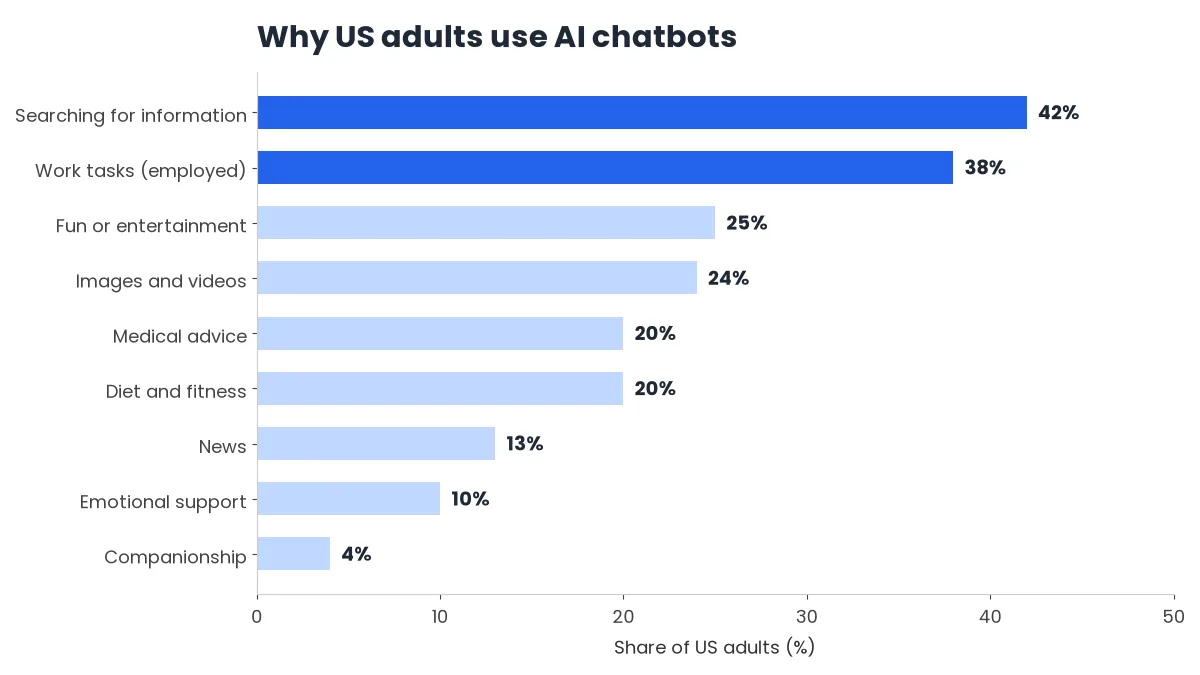
Looking up information is the top use, at 42% of US adults. These AI chatbot statistics put work second, with 38% of employed adults using chatbots for job tasks. Only 4% turn to one for companionship.
| Reason for using a chatbot | Share of US adults |
|---|---|
| Finding information | 42% |
| Work tasks (employed adults) | 38% |
| Fun or entertainment | 25% |
| Creating or editing images and video | 24% |
| Medical questions | 20% |
| Diet and fitness guidance | 20% |
| Following the news | 13% |
| Emotional support | 10% |
| Companionship | 4% |
What this means: people use chatbots in place of a search engine, so pages with direct answers have a better chance of being quoted.
Which Industries Use AI Chatbots the Most?
Retail and ecommerce account for about 30.1% of AI chatbot spending. By sector, our AI chatbot statistics place banking, finance and insurance second at 25.3%, ahead of IT and telecom at 19.7% and healthcare at 15%.
| Industry | Share of AI chatbot spending |
|---|---|
| Retail and ecommerce | 30.1% |
| Banking, finance and insurance | 25.3% |
| IT and telecom | 19.7% |
| Healthcare | 15.0% |
| All other industries | 9.9% |
What this means: retail and finance teams have the clearest case for testing a chatbot first.
How Widely Do Companies Use AI Chatbots?
Chatbots are being rolled out enterprise wide at 47% of organizations. Our AI chatbot statistics show no other AI tool scaled as widely, with AI agents near 20%. Roughly 89% of companies apply AI somewhere in their operations, and 44% now scale it company wide, up from 38% a year earlier.
What this means: smaller companies can read these AI chatbot statistics as a signal to launch a focused chatbot now and keep pace with larger rivals.
How Much Revenue Do AI Chatbot Makers Earn?
ChatGPT’s maker earned about $10 billion in a single recent quarter. On revenue, these AI chatbot statistics put its yearly run rate near $50 billion, with more than 100 million paid ChatGPT subscriptions. Claude’s maker shows an $81 billion run rate and booked $33.2 billion between January and September. The two firms count run rate differently, so compare them with care.
| Revenue metric | Figure |
|---|---|
| Claude maker, annual run rate | $81 billion |
| ChatGPT maker, annual run rate | About $50 billion |
| Claude maker, revenue January to September | $33.2 billion |
| ChatGPT maker, latest quarterly revenue | About $10 billion |
What this means: buyers are paying serious money for chatbots, so expect more paid tiers and business plans.
What Benefits Do AI Chatbots Bring to Online Stores?
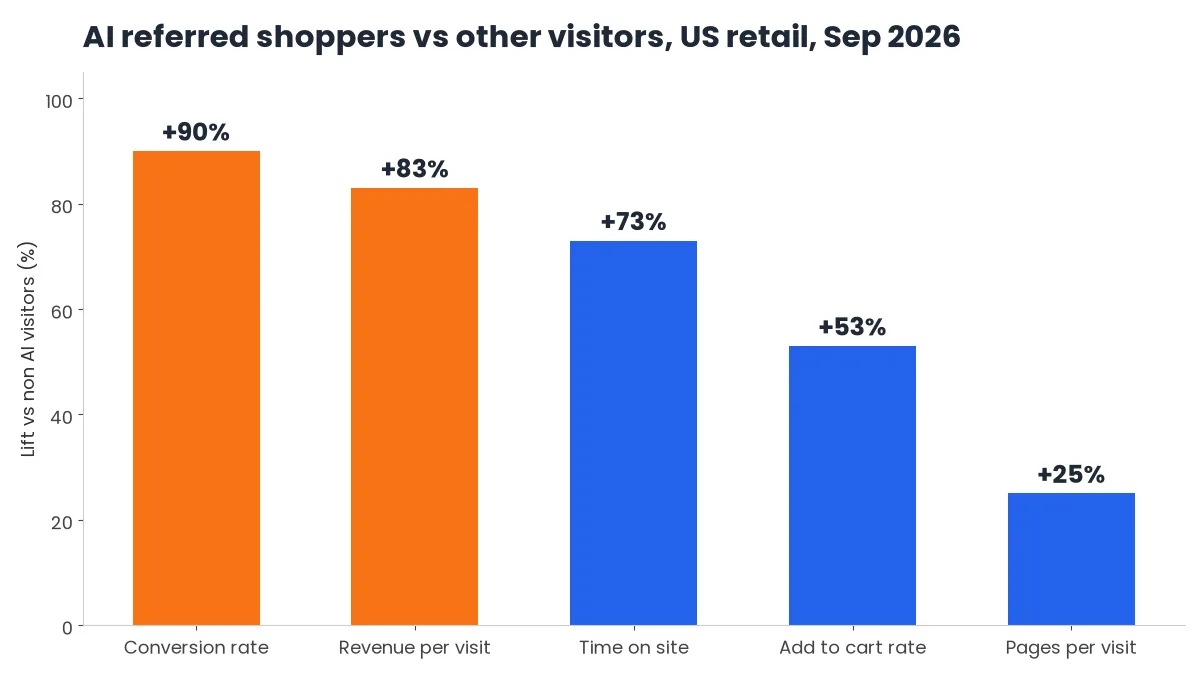
Visitors who arrive from AI tools convert 90% better on US retail sites. Our AI chatbot statistics for retail also show these buyers spending 83% more on each visit and staying 73% longer. Our digital marketing statistics show how this fits wider channel trends.
| AI visitors vs other visitors | Difference |
|---|---|
| Conversion rate | 90% higher |
| Revenue per visit | 83% higher |
| Time on site | 73% higher |
| Add to cart rate | 53% higher |
| Pages per visit | 25% higher |
What this means: visitors from chatbots are now among the most valuable on the web, so track AI referrals as a separate line in your own AI chatbot statistics.
Can AI Chatbots Cut Business Costs?
Support departments gave AI a median 12% of the previous year’s budget, the highest share of any function. On costs, the AI chatbot statistics show returns lag behind, because just 24% of support leaders report a positive payback. About one in ten organizations say running costs limit their chatbot use, yet autonomous agents could lower support spending by 30% by 2029.
What this means: savings come from volume, so automate your most repeated questions before anything else.
Which Age Group Uses AI Chatbots Most?
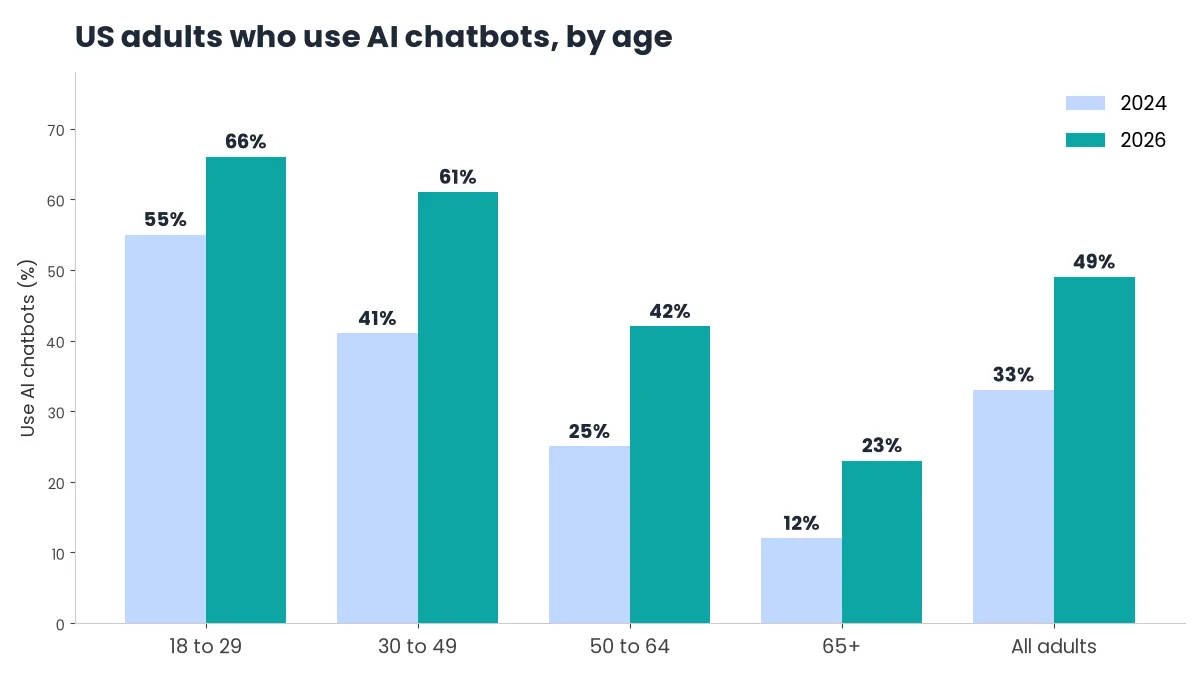
Two in three Americans aged 18 to 29 (66%) use AI chatbots. Broken out by age, our AI chatbot statistics show people aged 30 to 49 posting the biggest jump, from 41% to 61% in two years. Teens are active too, with 64% using chatbots, and our Character AI statistics show how younger users lean toward companion apps.
| Age group | Use AI chatbots now | Two years ago |
|---|---|---|
| 18 to 29 | 66% | 55% |
| 30 to 49 | 61% | 41% |
| 50 to 64 | 42% | 25% |
| 65 and older | 23% | 12% |
What this means: if you sell to people under 50, being visible inside chatbot answers is no longer optional.
Which Countries Use ChatGPT the Most?
Americans account for 21.7% of ChatGPT web traffic. By region, these AI chatbot statistics rank India second with 9.2%, while Brazil and Japan each add about 5%.
| Country | Share of ChatGPT web visits |
|---|---|
| United States | 21.7% |
| India | 9.2% |
| Brazil | 5.0% |
| Japan | 5.0% |
| South Korea | 3.3% |
What this means: English content reaches the most chatbot users, while India and Brazil reward local language pages.
Did you know?
About 250 million people now use voice with ChatGPT every week, either by dictating or by talking to it. Our voice search statistics show how spoken queries are changing the way people search.
Do Customers Like Customer Service Chatbots?
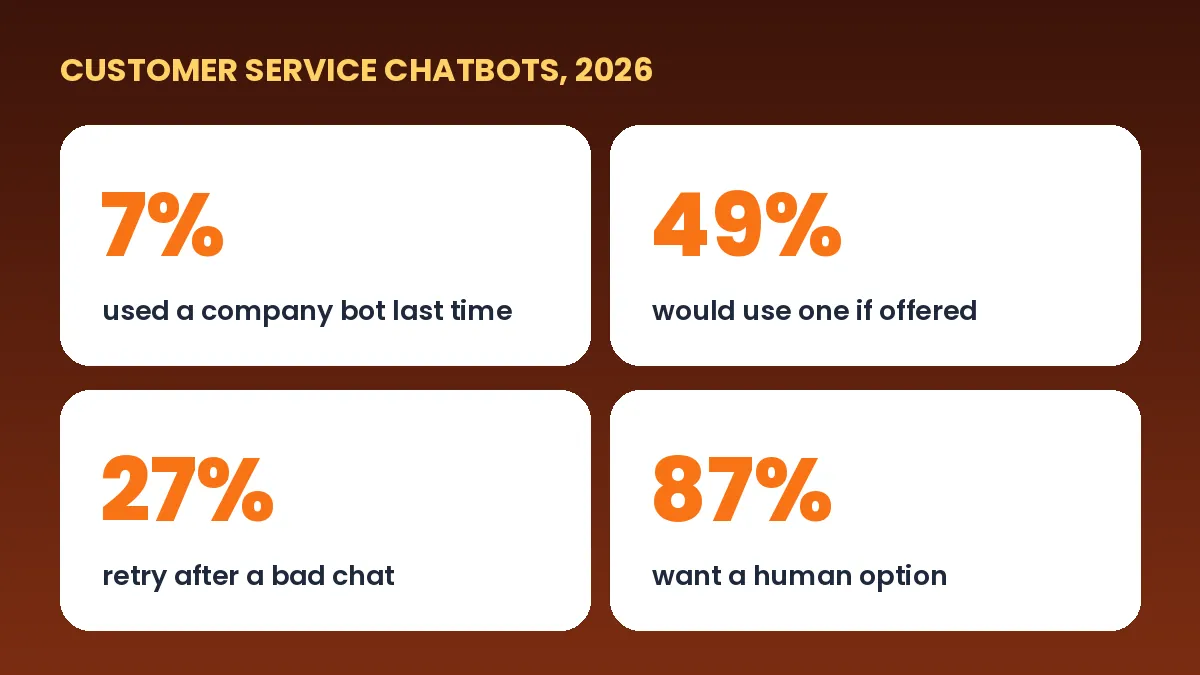
Just 7% of customers relied on a brand’s own bot during their most recent support request. Our AI chatbot statistics on service show 49% would have tried one if it had been offered. Customers use outside AI tools about three times as often, and 87% want a clear path to a human.
| Customer service metric | Share of customers |
|---|---|
| Want a guaranteed route to a person | 87% |
| AI users who let it finish a task | 58% |
| Open to a brand chatbot if available | 49% |
| Willing to retry a bot after a bad chat | 27% |
| Used a brand chatbot last time | 7% |
What this means: build a narrow bot that reliably solves a few problems instead of one that attempts everything.
How Accurate Are AI Chatbots?
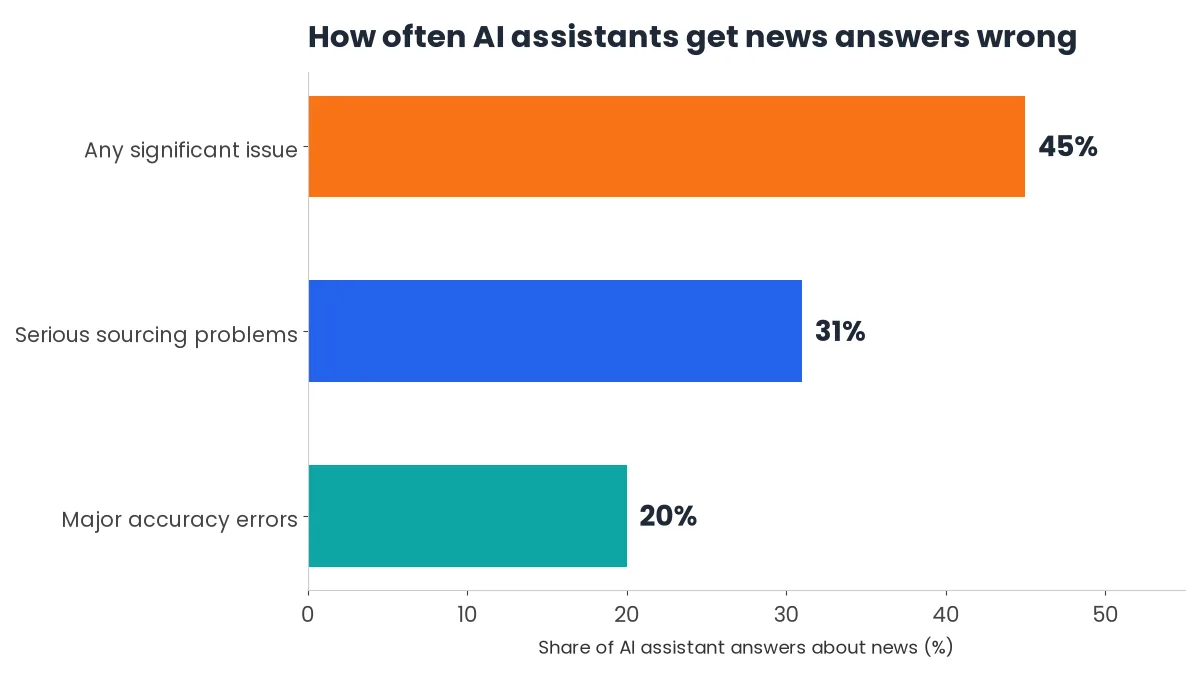
Close to half (45%) of AI replies to news questions contained a serious flaw. This part of our AI chatbot statistics rests on a review in which journalists from 22 public broadcasters graded more than three thousand replies in 14 languages. Almost a third had serious sourcing problems, and one in five had major factual mistakes.
| Problem found in AI news answers | Share of answers |
|---|---|
| Any significant issue (all assistants) | 45% |
| Serious sourcing problems | 31% |
| Major factual errors | 20% |
What this means: fact check every chatbot that speaks for your brand before it goes live, since accuracy remains the weakest area in AI chatbot statistics.
What Is the Future of AI Chatbots?
By 2029, autonomous agents may settle 80% of routine support requests with no human involved. Looking further out, our AI chatbot statistics suggest AI agents will be opening half of all support requests by 2030. For the bigger picture, our generative AI statistics track the models that power these tools.
What this means: get your site and help desk ready for software that shops and files requests for people.
AI Chatbots in 2026: Pros and Cons
Pros
- 1.2 billion people use ChatGPT weekly
- 24% of US adults already use a chatbot daily
- AI referred shoppers convert 90% better on retail sites
- AI referred visitors spend 83% more per visit
- Nearly half of companies (47%) scale chatbots enterprise wide
- The market is growing roughly 20% to 30% a year
Cons
- 45% of AI replies on news carried a serious flaw
- Brand bots handled just 7% of recent support requests
- Just 27% will retry a bot after a bad experience
Taken together, the AI chatbot statistics above reveal wide reach and real revenue, while accuracy and customer trust still trail behind. Lean on chatbots for routine questions and new visitors, and keep people in charge of complex or sensitive cases.
Quick Links
- GTA 6 Statistics 2026
- ChatGPT Statistics 2026
- Claude Statistics 2026
- Generative AI Statistics 2026
- AI Statistics 2026
- Character AI Statistics 2026
- Voice Search Statistics 2026
- Digital Marketing Statistics 2026
AI Chatbot Statistics: Frequently Asked Questions
ChatGPT alone serves about 1.2 billion people every week, and Gemini has crossed the 1 billion mark for monthly users. Plenty of people switch between assistants, so the totals overlap. In the United States, 49% of adults use chatbots, and close to one in four uses one every day.
ChatGPT leads on every measure in current AI chatbot statistics. It has about 1.2 billion weekly users, holds 56.4% of visits to AI chatbot websites and is used by 44% of American adults. Gemini ranks second with a 25% traffic share, while Claude is a distant third at 9.6% but is growing faster than most rivals.
Market estimates for this year range from $10.42 billion to $13.28 billion. Each estimate defines the market a little differently, but all expect growth of roughly 20% to 30% a year, with long range forecasts between $32.45 billion by 2031 and $60.21 billion by 2034.
About 24% of US adults open a chatbot daily; that group includes 12% who check in more than once a day plus 4% who say they use one almost constantly. Another 25% use chatbots a few times a week or less. The remaining 51% never use them, which leaves plenty of room for growth.
Finding information is the most common use, cited by 42% of US adults. Among people with jobs, 38% use chatbots for work tasks. About a quarter use them for fun or to create images and videos, while far fewer rely on them for emotional support or companionship.
Trust is still low. Just 7% of customers relied on a brand's own bot during their latest support request, even though 49% say they would have tried one. Only 27% give a bot a second chance once it fails them, and 87% want a clear route to a person.
Not always. In a large review of news replies, 45% of AI responses carried a serious flaw. Almost a third showed serious sourcing problems and one in five contained major factual errors. Always check an important answer before you act on it or publish it.
Chatbots are shifting from answering questions to taking action. By 2029, autonomous agents may settle 80% of routine support issues without people, which could lower support costs by 30%. By 2030, AI agents may start half of all customer service requests.
Conclusion: AI Chatbot Statistics 2026 in Numbers
This year’s AI chatbot statistics describe a technology that has settled firmly into daily life. ChatGPT serves 1.2 billion people every week, 49% of American adults use chatbots, and the market is worth up to $13.28 billion this year. Visitors sent by AI tools already convert 90% better than other shoppers, while accuracy and trust remain the main weak spots. Over the next few years, look for chatbots to move from answering questions to completing purchases and support tasks for their users.