If you are looking for an honest Semrush review, you probably have one big question in mind. Is Semrush still worth the money in 2026?

Semrush is a comprehensive digital marketing platform offering SEO, PPC, content marketing, social media management, local SEO, PR, and competitive intelligence tools. Now owned by Adobe, Semrush features 28 billion keywords, 43 trillion backlinks, and AI visibility tracking across traditional and AI search channels.
Pros
- Massive keyword database (around 28 billion) with superior AI search tracking capabilities
- All in one platform covering SEO, PPC, content, social, local, and PR management
- Largest backlink database (43 trillion) with detailed competitive intelligence
- Daily rank tracking updates across 142 global databases and 808 million domain profiles
- AI Visibility toolkit monitors LLM responses and AI answer positioning
Cons
- Premium pricing starts higher than competitors at $120/month entry level
- Steep learning curve with overwhelming features for beginners
starting with $117.33/mo
Get Started with SemrushAffiliate disclosure: some of the links in this Semrush review are affiliate links. If you buy through them, we may earn a commission at no extra cost to you.
I have used Semrush on and off for years, and a lot has changed recently. Adobe bought the company. The pricing plans got a full makeover.
And the tool now pushes something called AI visibility, which tracks how your brand shows up inside ChatGPT and other AI search engines.
So in this Semrush review, I will walk you through everything. The new pricing, the features that matter, the hidden costs, the pros and cons, and how it stacks up against Ahrefs.
By the end, you will know exactly which plan fits you, or whether you should skip it completely.
Here is a quick scorecard before we get into the details.
| Category | Rating |
| Features | 9.5 / 10 |
| Ease of use | 7 / 10 |
| Data quality | 9 / 10 |
| Pricing value | 7 / 10 |
| Support and learning resources | 9 / 10 |
| Overall | 8.7 / 10 |
What Is Semrush?
Semrush is an online visibility platform. In plain English, it helps you answer questions like these:
- What keywords should my website target?
- What is wrong with my website technically?
- Who links to my competitors, and how do I get those links?
- What ads are my competitors running?
- How does my brand appear inside ChatGPT and Google AI Overviews?
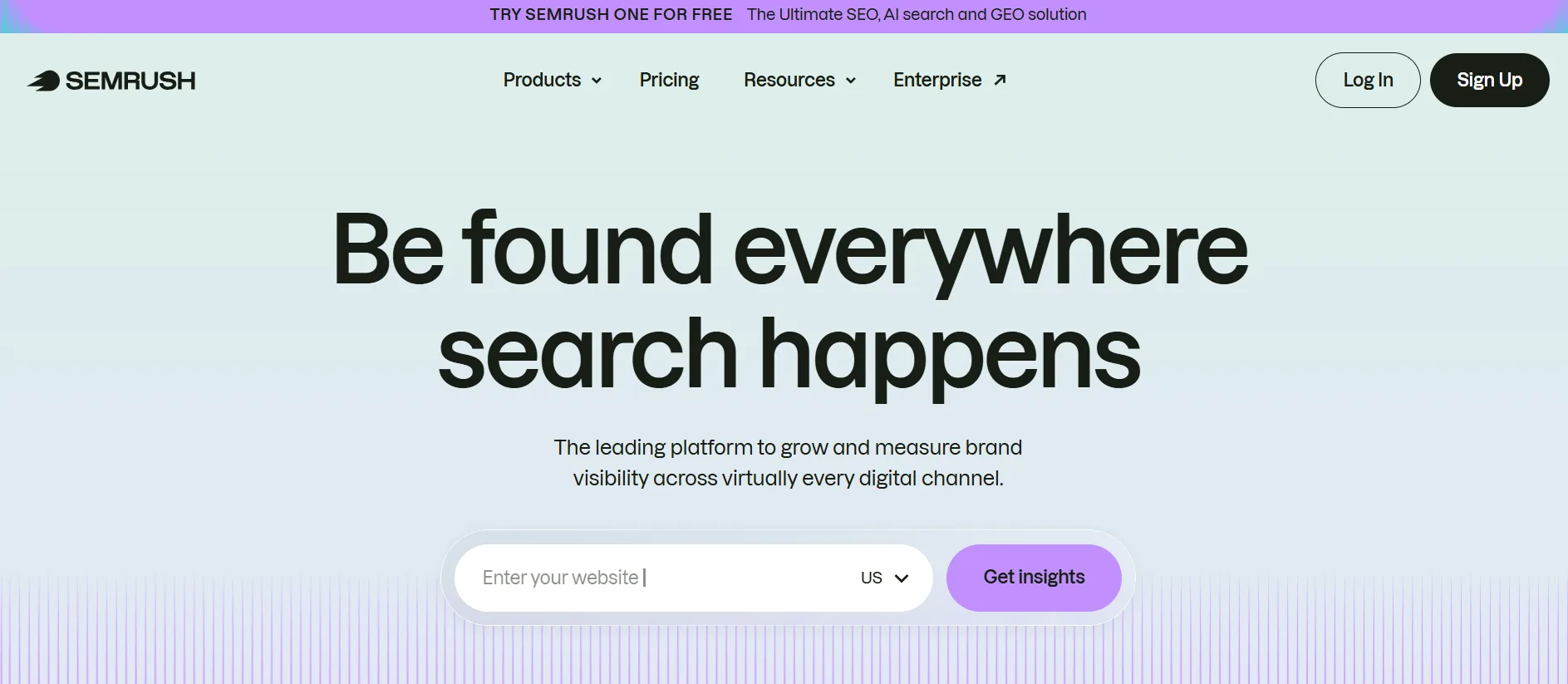
The company started in 2008 and has grown into one of the biggest names in digital marketing. Semrush has over 112,000 paying customers, and its tools cover SEO, paid advertising, content marketing, social media, and competitive research.
But the biggest story of 2026 is not a feature. It is the Adobe acquisition, and you need to understand it before you buy anything.
The Adobe Acquisition: What Actually Happened
On November 19, 2025, Adobe announced it would buy Semrush for $12 per share in an all-cash deal worth about $1.9 billion. Semrush stock jumped 74% on the news.
So what does this mean for you as a customer?
The good news first. Adobe serves 99% of the Fortune 100, and Semrush now gets access to that scale. Adobe’s own analytics data showed that traffic from generative AI sources to US retail sites grew 1,200% year over year. That is exactly why Adobe wanted Semrush.
Adobe makes content tools like Photoshop and Firefly. Semrush tells you how that content performs in search and AI engines. Put together, the two companies want to own the whole chain of creating content and measuring its visibility.
Semrush’s own numbers back up the move. In its last financial report before the deal closed, the company said customers paying over $10,000 a year grew 31% year over year, and customers paying over $50,000 a year grew more than 74%.
Big companies are clearly buying in. Semrush also launched an official app inside ChatGPT, so marketers can pull live Semrush data directly inside ChatGPT conversations.
Now the cautious news. Pricing changed after the acquisition. Semrush introduced a new plan structure called Semrush One, and the entry prices moved up compared to what longtime users remember.
More on that below, because it changes the math for small teams.
My honest take: in the short term, nothing dramatic changed for everyday users. The tool works the same, support is the same, and the brand still operates independently.
The long-term bet is that Semrush becomes the AI search visibility layer inside Adobe’s marketing stack. If that works, the tool gets stronger. If you are a small user, the risk is slow price creep, which is worth watching.
Semrush at a Glance: Quick Semrush Review Overview
Get a quick snapshot of Semrush’s core capabilities, pricing tiers, and platform strengths in this Semrush review for fast understanding.
| Item | Detail |
| Founded | 2008 |
| Paying customers | 112,000+ |
| Keyword database | 25 to 28 billion keywords (estimates vary by source) |
| Backlink database | One of the largest in the industry, tens of trillions of links |
| Free trial | 7 days standard, 14 days via official partners |
| Free plan | Yes, very limited |
| Cheapest paid plan | $139 per month (or $117.33 on annual billing) |
| Money-back policy | 7-day refund on your first annual purchase |
| Best for | Agencies, in-house SEO teams, serious content marketers |
| Not ideal for | Total beginners and one-person blogs on a tight budget |
Semrush Pricing in 2026: The Part Most Reviews Get Wrong
Here is where this Semrush review gets practical. Semrush now sells two separate product tracks, and most older reviews only mention one.
Track 1: Semrush One (the new flagship)
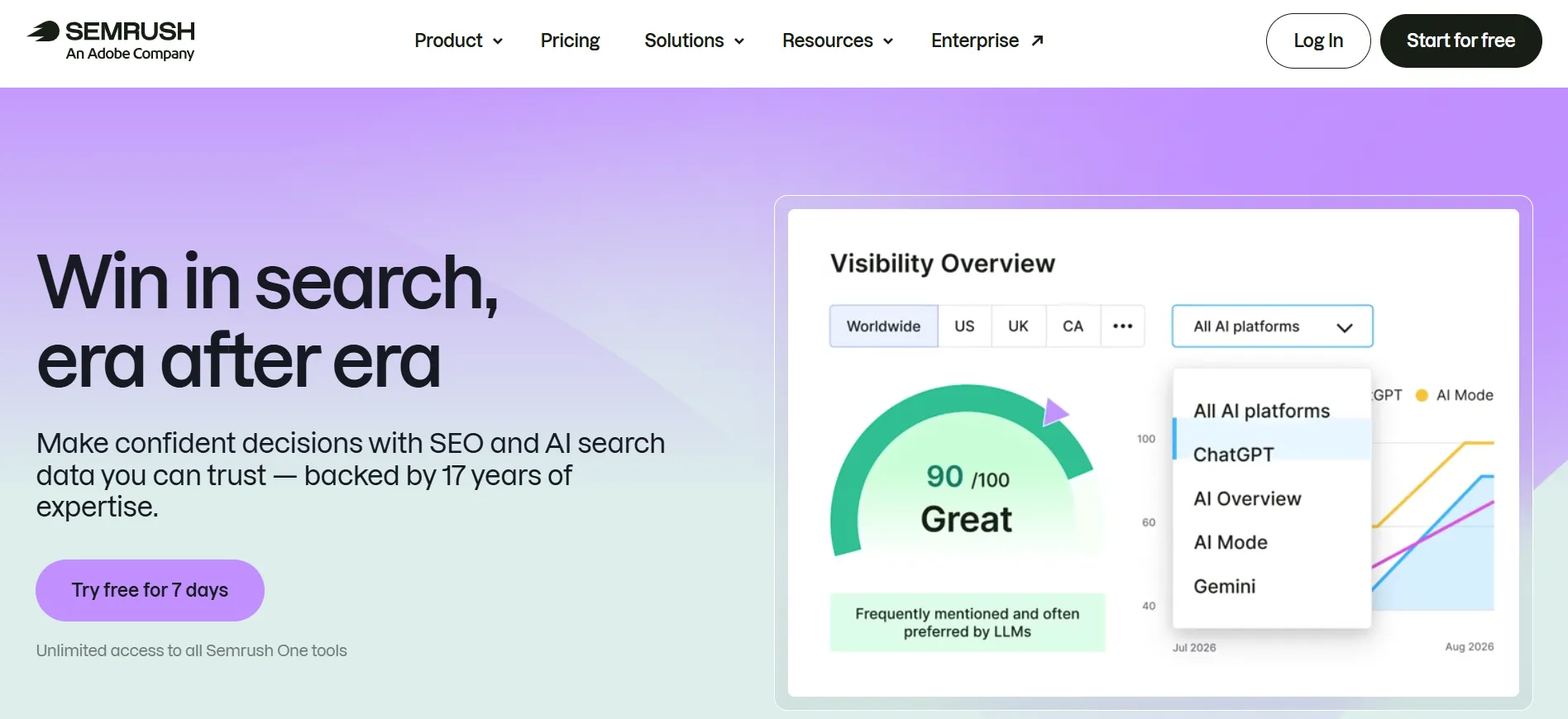
Semrush One bundles the classic SEO toolkit with the new AI visibility features.
| Plan | Monthly Price | Annual Price (per month) | Websites | Keywords | AI Prompts |
| SEO (entry) | $139 | $117.33 | 5 | 500 | Included |
| Starter | $199 | $165.17 | 5 | 500 | 50 tracked daily |
| Pro+ | $299 | $248.17 | 15 | 1,500 | 100 tracked daily |
| Advanced | $549 | $455.67 | 40 | 5,000 | 200 tracked daily |
Track 2: Semrush SEO Classic (the legacy plans)
The old plans still exist for people who only want SEO tools without AI visibility.
| Plan | Monthly Price | Annual Price (per month) |
| Pro | $139.95 | $117.33 |
| Guru | $249.95 | $208.33 |
| Business | $499.95 | $416.66 |
There is also an Enterprise tier with custom pricing, API access at scale, SSO, and a dedicated account manager.
Which track should you pick? If tracking your brand inside AI search matters to you, go with Semrush One. If you only care about traditional SEO and want to save money, Classic Pro at $117.33 a month billed annually is the best value entry point.
Note that the One SEO tier and Classic Pro cost the same on annual billing, so the One entry tier is the better deal unless you specifically want the older workflow.
The Hidden costs nobody advertises
This is the section that will save you money, so read it twice.
Every plan includes only one user seat. Extra seats cost $45 per month on the lower plans, $80 on the mid plans, and $100 on the top plans. Run a three-person agency on Pro+ and your real bill is $299 plus two seats at $80 each, which comes to $459 a month. That number never appears on the pricing page.
Add-ons stack up fast. The AI Visibility toolkit costs $99 per month per extra domain. The Local toolkit starts at $30 per month per location.
The Advertising toolkit runs $99 to $220 per month. ContentShake is $60 per month. Traffic and Market Analytics costs $289 per month per user. Reports cost $10 to $20 per month extra.
Annual billing saves 17%, and the refund policy only gives you 7 days on a first-time annual purchase. So do not buy annual on day one. Use the free trial first, test everything, then commit.
Semrush Review: Core Features Explained in Detail
Explore every core feature Semrush delivers in this Semrush review, from SEO tools and PPC management to content marketing and competitor intelligence capabilities.
1. Keyword research
The Keyword Magic Tool is still one of the best in the business. You type in a seed keyword and get thousands of related keywords with volume, difficulty, intent, and cost-per-click data.
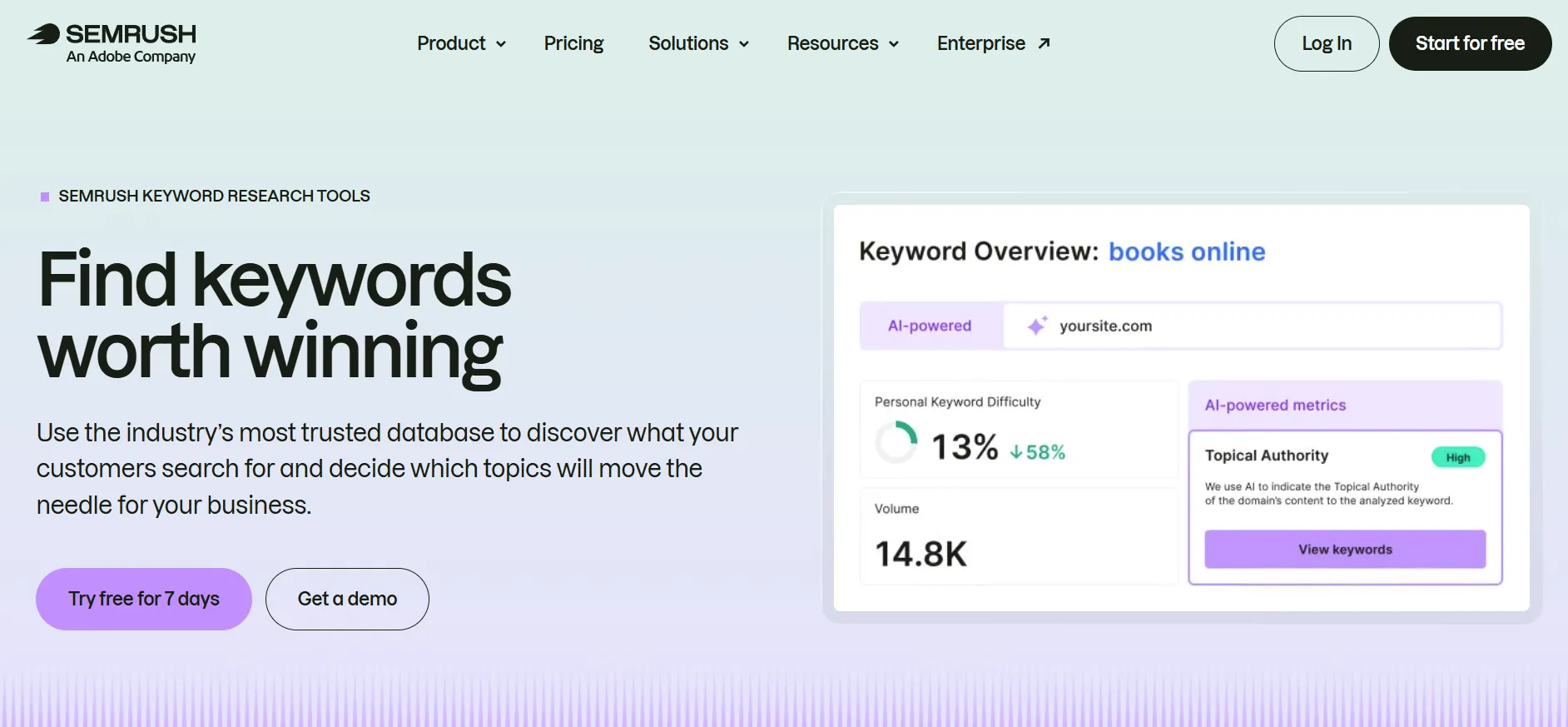
The Keyword Gap tool lets you compare your keyword profile against up to five competitors at once and instantly shows you keywords they rank for that you do not. For content planning, this alone justifies the subscription for many teams.
2. Site audit
The Site Audit tool crawls your website and flags technical problems: broken links, slow pages, missing tags, duplicate content, and more.
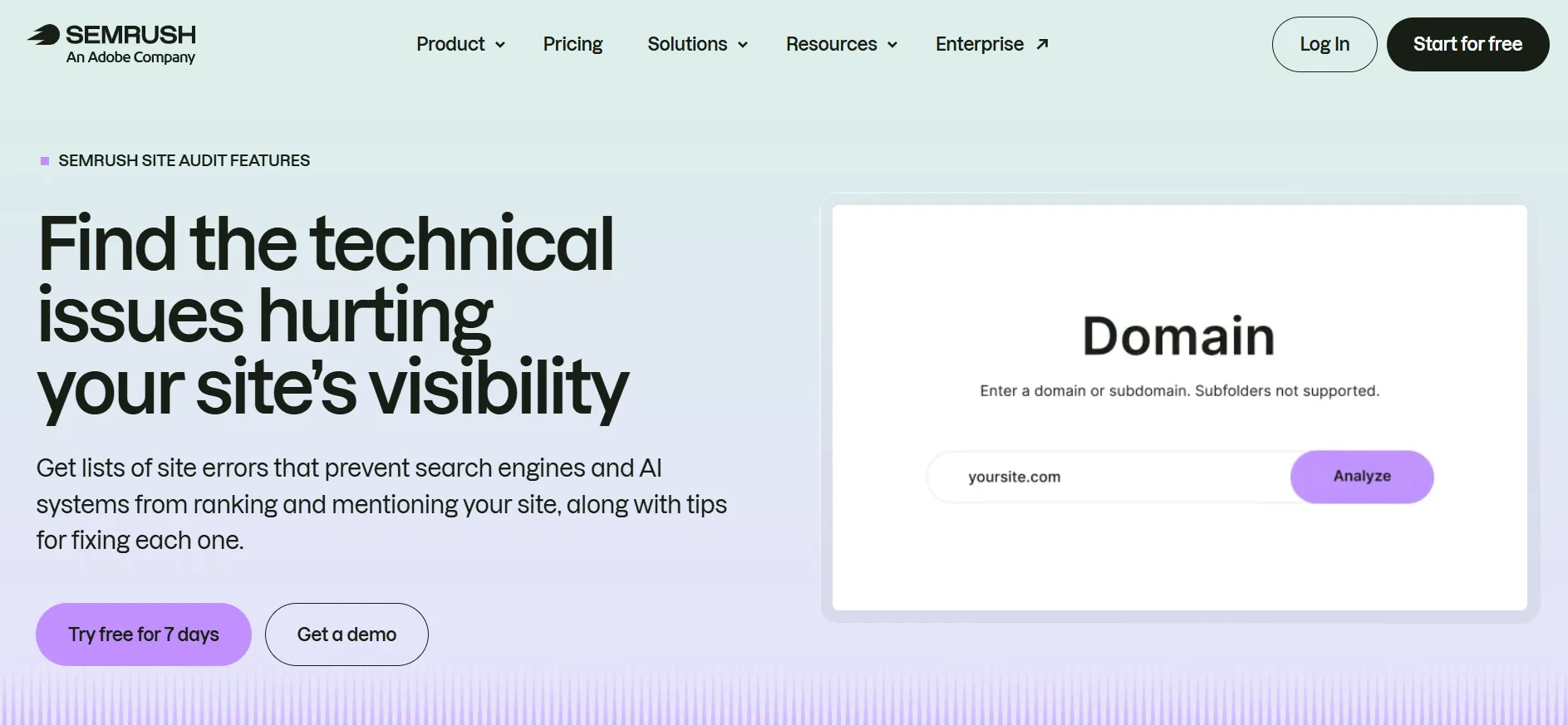
It runs over 140 checks and gives you an AI-powered health score so you can track progress over time. You can crawl up to 100,000 pages per month on Starter, 300,000 on Pro+, and a million on Advanced. For most sites, that is more than enough.
3. Backlink analysis
Semrush’s backlink database is one of the largest available, with tens of trillions of links indexed.
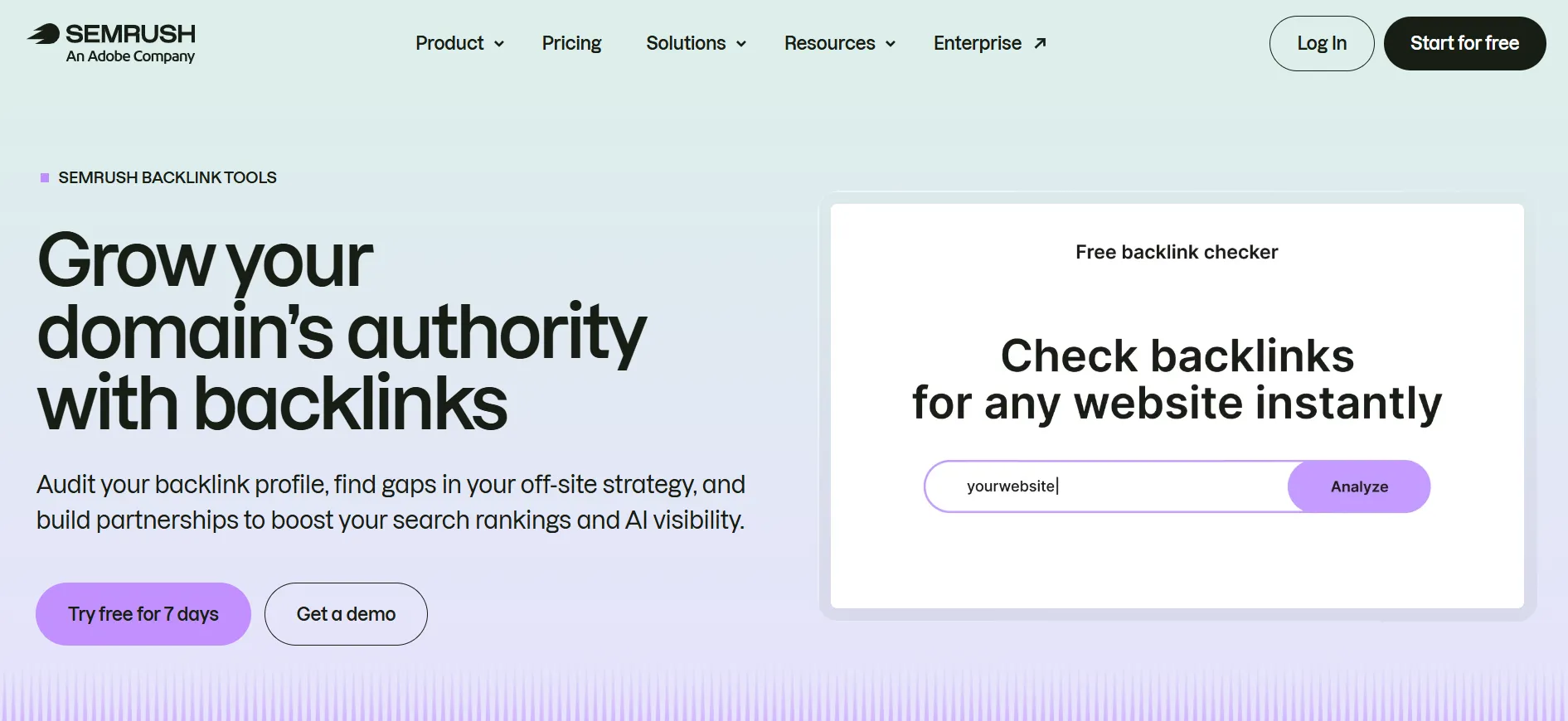
The Backlink Audit tool helps you spot toxic links that could hurt your rankings, and the Link Building Tool works like a light CRM for outreach campaigns. Is Ahrefs slightly fresher with link data? Often, yes. But for most workflows, Semrush is close enough, and you get everything in one dashboard.
4. Position tracking
Daily rank tracking is included by default on all plans. You can track rankings by location, device, and SERP features, and get alerted when big changes happen.
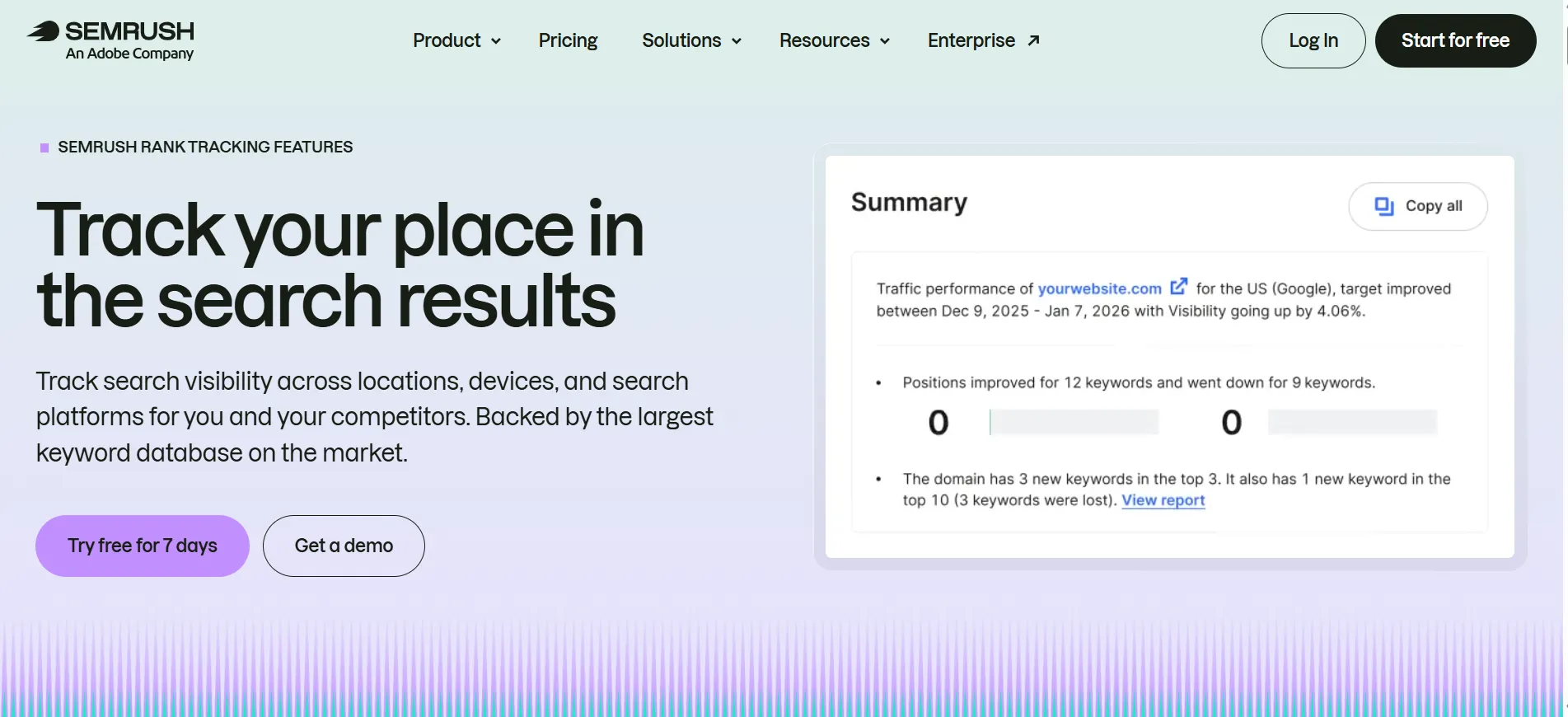
Several competitors charge extra for daily updates or only offer weekly tracking at lower tiers, so this is a genuine value point.
5. Competitive intelligence
This is where Semrush truly separates itself. Traffic Analytics estimates any competitor’s traffic sources and visitor behavior.
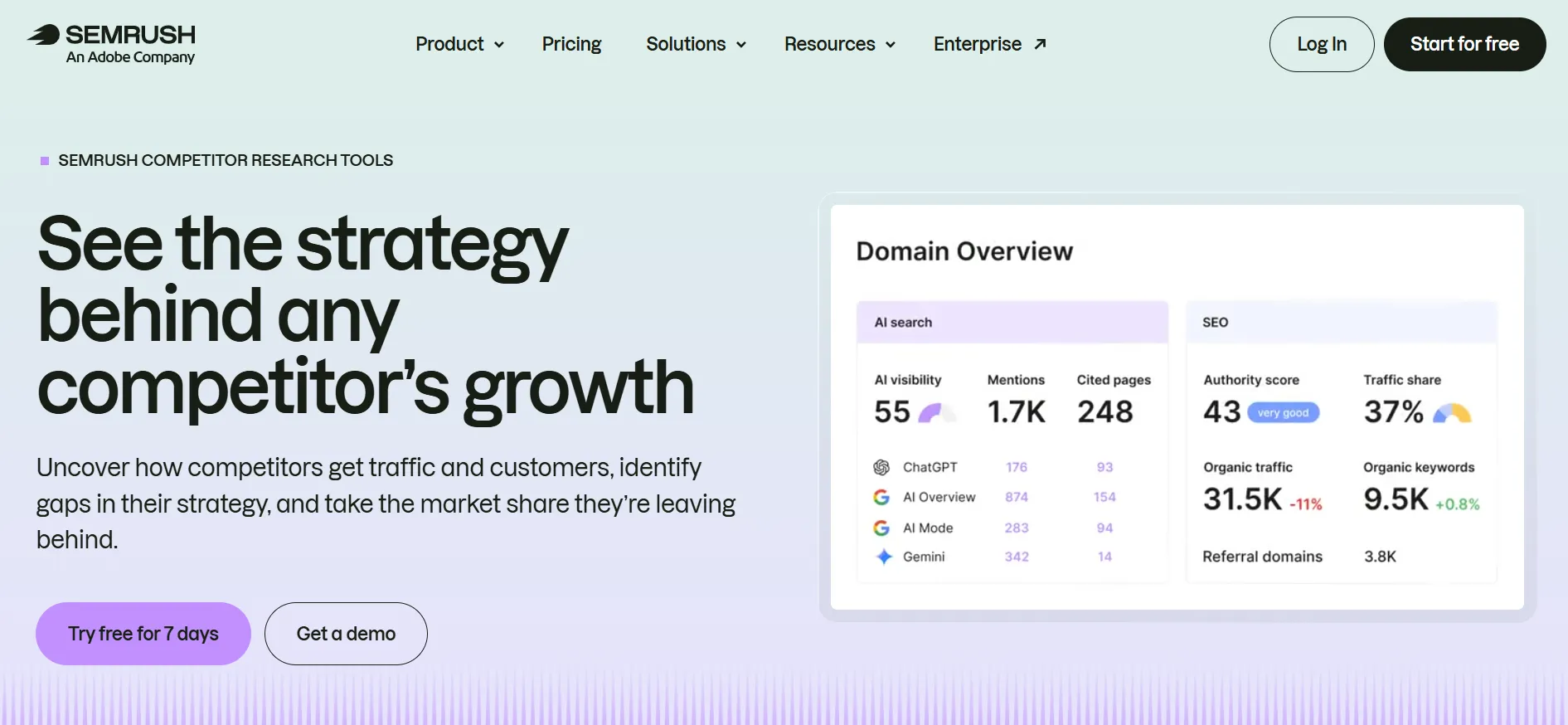
The advertising research tools show you exactly what ads a competitor runs on Google, what they pay, and what their landing pages look like. Ahrefs has nothing comparable for paid search. If you run PPC alongside SEO, this feature alone can pay for the subscription.
6. Content marketing tools
From the Pro+ plan up, you get the full content platform: topic research, SEO content briefs, a writing assistant, plagiarism checks, and performance tracking.
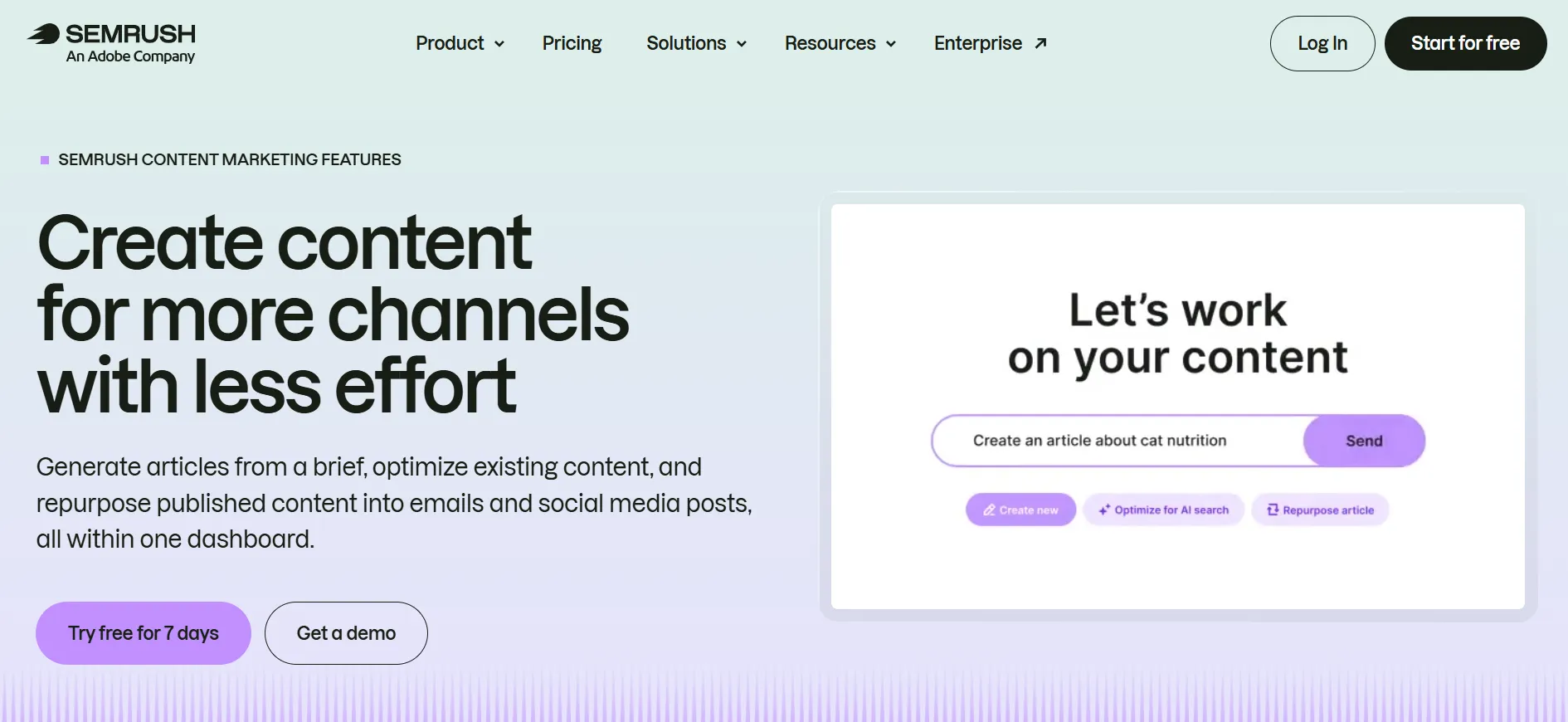
It is not going to replace a human writer, but it keeps your content process organized and data-driven.
7. AI visibility and GEO (the big new thing)
This is Semrush’s bet on the future, and after the Adobe deal, it is clearly the company’s main direction. The AI visibility tools track how your brand appears inside ChatGPT, Perplexity, Gemini, and Google’s AI Overviews.
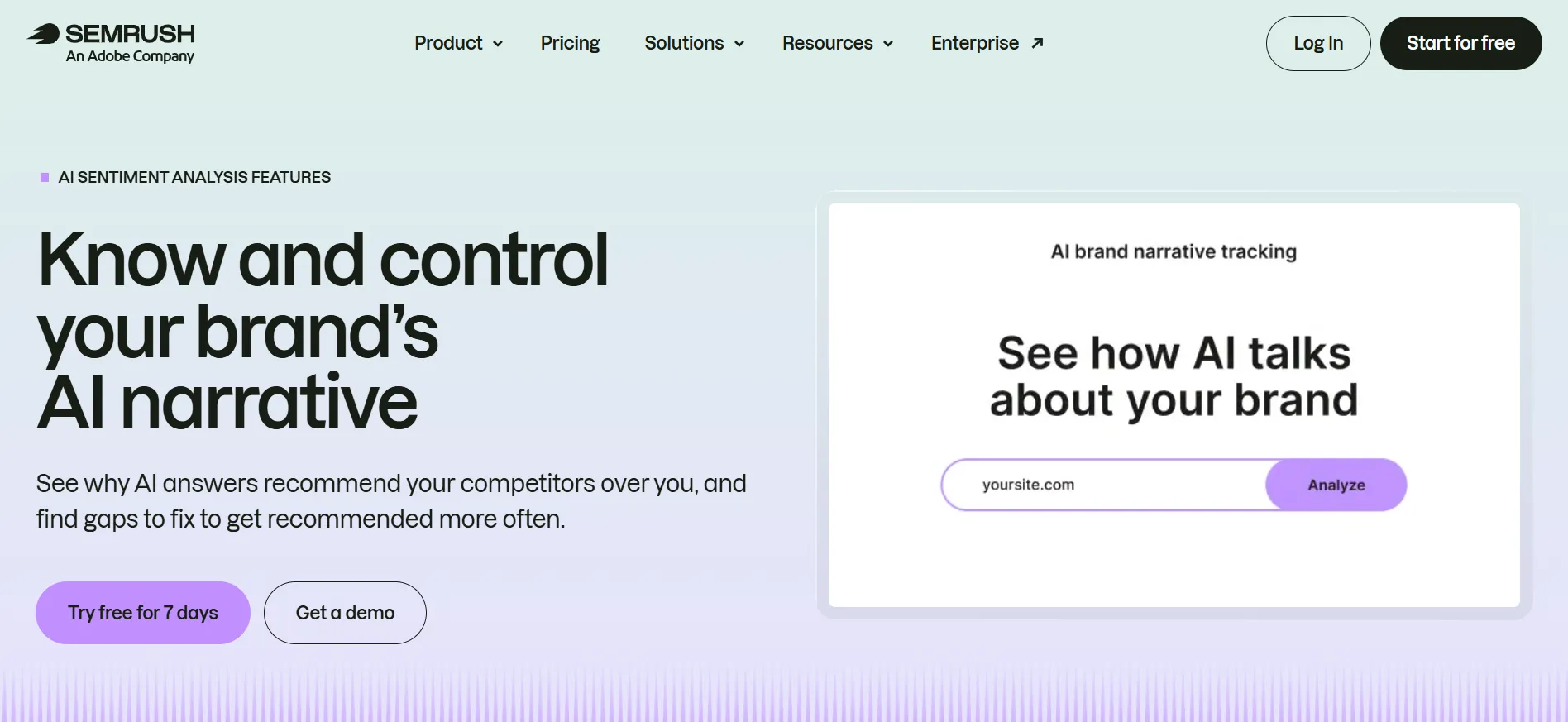
You can monitor custom prompts daily, check AI sentiment toward your brand, and get AI-readiness audits of your website. The company even opened MCP access, which lets AI tools query Semrush data directly.
If your customers increasingly ask ChatGPT for product recommendations instead of Google, this is the feature that tells you whether you exist in those answers. Few competitors go this deep right now.
8. Local SEO
The Local toolkit (a paid add-on) manages your Google Business Profile, listings, reviews, and map rankings.
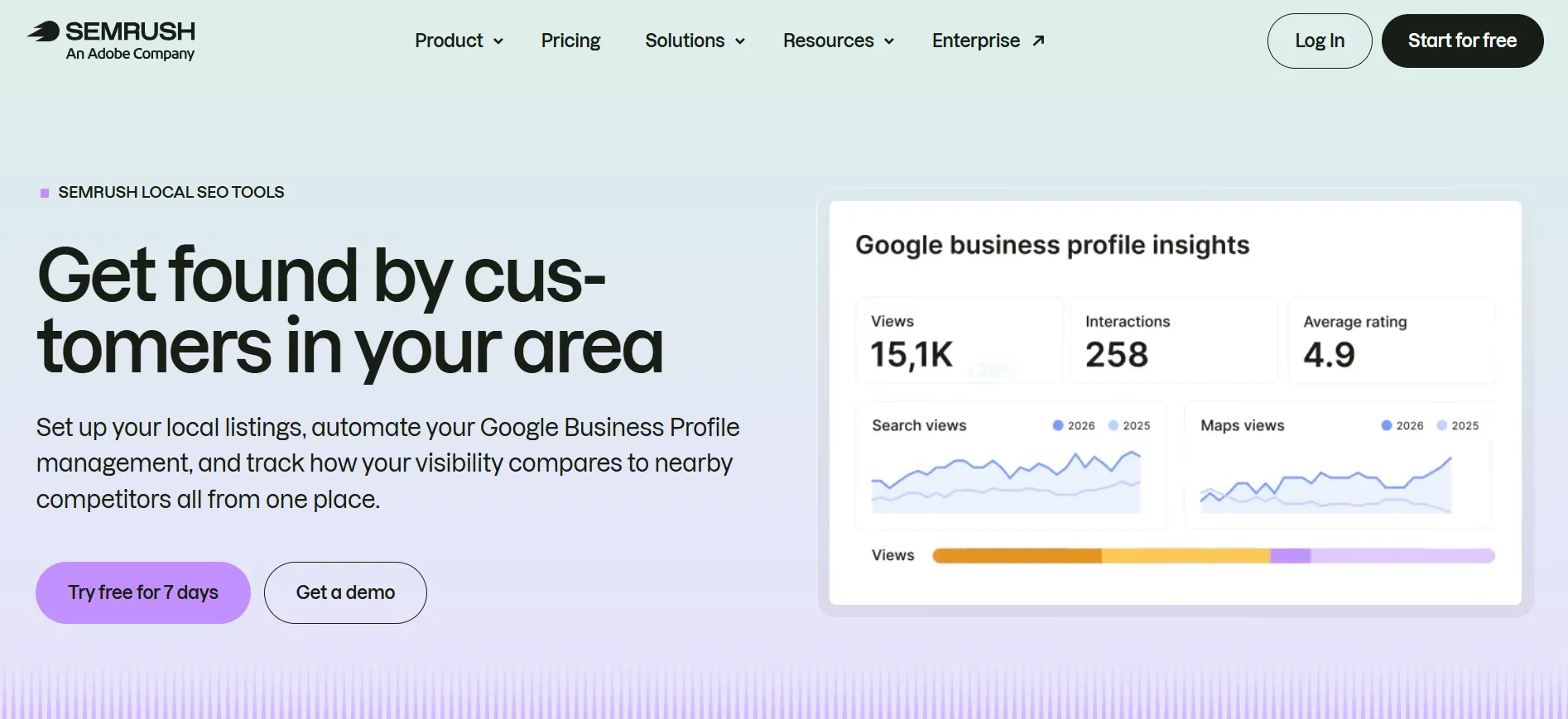
It starts at $30 per month per location. Solid for local businesses, but budget for it separately.
9. Reporting
Reporting is deep but costs extra for the good stuff. Base Report is $10 a month, Pro Report is $20 a month with white labeling and external integrations.
Agencies will end up needing one of these.
Ease of Use: Honest Assessment
Semrush is powerful, but nobody calls it simple. The dashboard throws a lot at you on day one, and it takes a week or two of real use before the layout clicks.
The saving grace is Semrush Academy. It is completely free, even for non-customers, and it includes structured courses with certifications in SEO, PPC, and content marketing. If you are new to SEO, the learning curve is manageable because the training material is genuinely good. Phone support is also available on paid plans, which several competitors do not offer.
My advice: during your free trial, pick one real task, like auditing your own website or researching ten target keywords. Learn by doing. Do not try to explore every tool in week one.
Semrush vs Ahrefs: The Comparison Everyone Wants
No Semrush review is complete without this matchup. Both tools are excellent, and they now cost about the same at the mid tier. Here is the honest breakdown.
| Category | Semrush | Ahrefs | Winner |
| Starting price (annual) | $117.33/mo | $108/mo | Ahrefs, slightly |
| Free trial | 7 to 14 days | None | Semrush |
| Backlink index | Very large | Largest and freshest | Ahrefs |
| Site audit | Best in class | Good | Semrush |
| PPC and ad research | Full suite | None | Semrush |
| Content marketing tools | Full platform | Content Explorer only | Semrush |
| AI visibility tracking | Comprehensive | Basic | Semrush |
| Rank tracking | Daily, included | Daily can cost extra | Semrush |
| Interface | Dense | Cleaner | Ahrefs |
| Learning resources | Academy, courses | Strong blog and YouTube | Semrush |
The verdict in one line: pick Semrush if you want one tool for SEO, PPC, content, and AI visibility. Pick Ahrefs if link building is your main job and you want the freshest backlink data.
Many agencies eventually pay for both. If you can only afford one, the 14-day Semrush trial makes it the easier tool to evaluate first.
Cheaper alternatives exist too. SE Ranking covers the core features at a lower price. Mangools is friendlier for beginners at under $30 a month. Neither matches Semrush’s depth, but they might be the smarter buy if you are just starting out.
Pros and Cons: Semrush Review
Pros
- One of the most complete feature sets among SEO platforms
- AI visibility tracking that few competitors match yet
- Strong PPC and advertising research tools
- Daily rank tracking included on all plans
- Excellent free training through Semrush Academy
Cons
- Expensive, especially once you add seats and add-ons
- Steep learning curve for beginners
Who Should Buy Semrush?
Buy it if you are:
- An SEO agency managing multiple client sites
- An in-house marketer who runs SEO and PPC together
- A content team that plans content around keyword data
- A brand that wants to track its visibility inside AI search engines
- A business that can actually use the daily limits on your tier
Skip it if you are:
- A total beginner with one small blog and no budget
- A freelancer who only needs keyword research and nothing else (Mangools or a cheaper tool will do)
- A team of three or more on a tight budget, because the per-seat fees will sting
- Someone who hates dashboards with lots of options
5 Tips to Save Money on Semrush
- Never buy without the trial. Standard trial is 7 days, but official partners offer 14 days on the same plans. Test everything first.
- Use annual billing only after the trial. The 17% annual discount is real, but the refund window is only 7 days on a first annual purchase, so commit only once you are sure.
- Audit your seat count. One seat per plan. If two people need access, compare the $80 seat fee against upgrading plans; sometimes the math favors a higher tier.
- Do not buy add-ons on day one. Start with the base plan, and only add Local, Advertising, or AI Visibility toolkits when you hit a real need.
- Compare One vs Classic before paying. The One SEO tier and Classic Pro cost the same annually, but include different features. Pick based on whether you want AI visibility tools.
FAQ: Semrush Review
Yes, if you use more than just keyword research. Agencies, in-house teams, and anyone running SEO plus PPC will get their money's worth. Solo beginners on a budget should start with cheaper tools first.
The Semrush One SEO tier and the Classic Pro plan both cost $117.33 per month when billed annually, or $139 per month on monthly billing. A limited free plan with daily search caps also exists.
Yes. The standard trial is 7 days on the One plans. Official partners frequently offer an extended 14-day trial on the same plans. No credit card is required to start.
Semrush offers a 7-day money-back guarantee on your first annual purchase only. Monthly plans do not qualify. Test thoroughly during the trial instead of relying on the refund.
Semrush wins for all-in-one use: SEO, PPC, content, and AI visibility in one place. Ahrefs wins for backlink analysis and a cleaner interface. Semrush also offers a free trial while Ahrefs offers none.
Semrush One is the new plan lineup that bundles SEO tools with AI visibility features. Classic is the legacy SEO-only toolkit sold alongside it. Both are active in 2026, which confuses many buyers.
It is powerful but not beginner-friendly. The learning curve is real. However, Semrush Academy's free courses make it easier to learn than most competitors.
Yes. Its AI visibility tools track how your brand appears in ChatGPT, Perplexity, Gemini, and Google AI Overviews, including daily monitoring of custom prompts and AI sentiment analysis.
Quick Links:
Final Verdict: Should You Buy Semrush in 2026?
Here is my bottom line after this full Semrush review.
Semrush is still one of the most complete visibility platforms you can buy. The keyword data is deep, the site audit is best in class, the competitive intelligence is hard to match, and the new AI visibility tools put it ahead of where search is actually going.
The single-seat policy and paid add-ons push the true cost above the sticker price. And beginners will feel lost for the first couple of weeks.
My recommendation: start with the 14-day trial through an official partner link. Work on a real project. If you find yourself opening it daily by day ten, buy annual billing on the plan that fits your limits, not the one with the longest feature list.
If it feels like overkill by day five, save your money and look at SE Ranking or Mangools instead.
Semrush earns its price when you use its breadth. If you only need one slice of it, cheaper tools will serve you better.