Organic search drives more than half of all website traffic and delivers a lower cost per lead than almost every other digital marketing channel. Those two facts alone justify SEO investment for most businesses. But the research data in 2026 goes much further — quantifying specific ROI figures, payback periods, and comparative returns that make the business case for SEO concrete rather than vague.
The challenge in 2026 is that the AI Overview landscape has changed the traditional SEO value proposition. Traffic from organic search is down for informational queries. But the businesses still winning from SEO are the ones who adapted early — building the kind of authority, brand recognition, and citation credibility that AI-era search rewards.
Fun Fact: Organic search generates 53.3% of all website traffic according to BrightEdge research — more than paid search, social, email, and direct traffic combined. Social media, by comparison, drives approximately 5% of all website traffic. The channel most marketers talk about is generating one tenth the traffic of the channel that gets one tenth the attention.
SEO ROI Statistics 2026: Top Picks
Organic search generates 53.3% of all website traffic. (BrightEdge)
SEO leads close at a 14.6% rate compared to 1.7% for outbound marketing leads. (HubSpot)
The average cost per lead from SEO is $31 compared to $61 for paid search. (HubSpot)
Businesses that blog generate 55% more website visitors. (HubSpot)
SEO has an average ROI of 22:1 — for every $1 invested, businesses earn $22 on average. (Backlinko)
Companies that invest in SEO are 13 times more likely to achieve a positive ROI. (HubSpot)
70% of marketers say SEO is more effective than PPC for generating sales. (Databox)
The top organic result gets 27.6% of all clicks compared to 2.4% for position 10. (Backlinko)
It takes 6 to 12 months on average to see measurable SEO results from a new campaign. (Ahrefs survey)
Compounding SEO content generates 6x more organic traffic after 12 months than at launch. (HubSpot)
SEO vs Other Marketing Channels — The ROI Comparison
The most common question from anyone allocating a marketing budget is: how does SEO compare to the alternatives? The data in 2026 gives clear, specific answers.
Channel | Average Cost Per Lead | Average Close Rate | Long-Term Value |
SEO / Organic | $31 | 14.6% | Compounds over time |
Paid Search (PPC) | $61 | 10–12% | Stops when budget stops |
Social Media Ads | $58 | 3–5% | Stops when budget stops |
Email Marketing | $23 | 8–12% | Requires list building |
Content Marketing | $88 (short-term) | 14%+ | Compounds over time |
Outbound / Cold | $61+ | 1.7% | Linear returns |
The 14.6% close rate for SEO leads versus 1.7% for outbound leads is the most striking data point in this comparison. The reason is intent — someone who found your business by searching for what you offer is already in the buying mindset. Someone who received an unsolicited cold call is not.
What this means for you: If you are allocating marketing budget and you are choosing between SEO and paid search, the cost-per-lead differential alone justifies SEO investment. But the compounding nature of SEO is the bigger advantage — a paid search campaign that stops spending stops generating leads immediately. A well-executed SEO campaign continues earning traffic and leads for years after the initial investment.
How Long Does SEO Actually Take to Show ROI?
The most honest criticism of SEO as a marketing channel is the time to results. This is real, and the data is worth understanding clearly rather than glossing over.
Time Period | What to Expect |
Month 1–2 | Technical fixes, content published, indexing begins |
Month 3–4 | First rankings for low-competition keywords |
Month 6 | Measurable organic traffic increase begins |
Month 9–12 | Significant traffic growth and lead generation |
Month 12+ | Compounding returns — content continues growing |
Month 24+ | Established authority, strong competitive position |
The 6 to 12-month timeline is the honest answer to when SEO starts paying back. Businesses that expect results in 60 days are going to be disappointed. Businesses that commit to a 12-month runway and measure at 6-month intervals consistently find positive ROI by the end of their first year.
The compounding dynamic is what makes SEO’s long-term ROI superior to paid channels. A blog post published today may rank position 20 in month one. Position 10 in month three. Position four in month six. Position one in month twelve. And it continues earning traffic at position one in month 24, 36, and beyond — with no additional budget spent. That compounding is why the 22:1 ROI figure, while it seems high, is consistently validated by long-term measurement studies.
SEO Traffic Value — The Search Channel That Outperforms Everything
Organic search’s dominance of web traffic is something every marketer knows in theory and very few act on sufficiently in practice.
Traffic Source | Share of All Website Traffic |
Organic Search | 53.3% |
Direct | ~15% |
Paid Search | ~12% |
Social Media | ~5% |
Referral | ~7% |
~4% | |
Other | ~4% |
The social media figure deserves attention. Social is where most marketing conversation, budget, and attention focuses in 2026 — and it drives approximately 5% of website traffic. Organic search drives 53.3%. The channel receiving one tenth the marketing budget and attention is driving ten times the traffic. This imbalance is arguably the most significant misallocation in digital marketing budgeting.
What this means for you: If your marketing budget is weighted more heavily toward social than SEO, the traffic data says you have your priorities backwards. Social is valuable for brand awareness and community building. SEO is valuable for generating website visits that lead to conversions. They are not competing channels — but the traffic data is unambiguous about which one delivers more website visits per dollar invested.
Content Marketing and SEO ROI
Content and SEO are inseparable. The businesses generating the strongest SEO ROI are doing so through systematic content investment.
Content Investment | ROI Impact |
Companies that blog | 55% more visitors |
Businesses with 16+ blogs/month | 4.5x more leads |
Long-form content (1,500+ words) | Gets 3x more backlinks |
Original research content | Earns links naturally |
Updated / refreshed content | 2.7x more traffic after update |
Compounding content at 12 months | 6x more traffic than at launch |
The compounding content figure is one of the most powerful arguments for consistent, long-term content investment. A piece of content published today is not at its peak performance. It typically takes 6 to 12 months for a piece of content to reach its ranking ceiling. If you keep publishing consistently, your content library compounds — older posts continue growing in authority and traffic while newer posts begin their trajectory.
The practical implication: a business that published 50 articles two years ago and stopped is leaving significant compounding value on the table. A business that has published 50 articles and continues publishing 4 to 8 articles per month will see exponential traffic growth over a 24-month period.
SEO ROI by Business Type
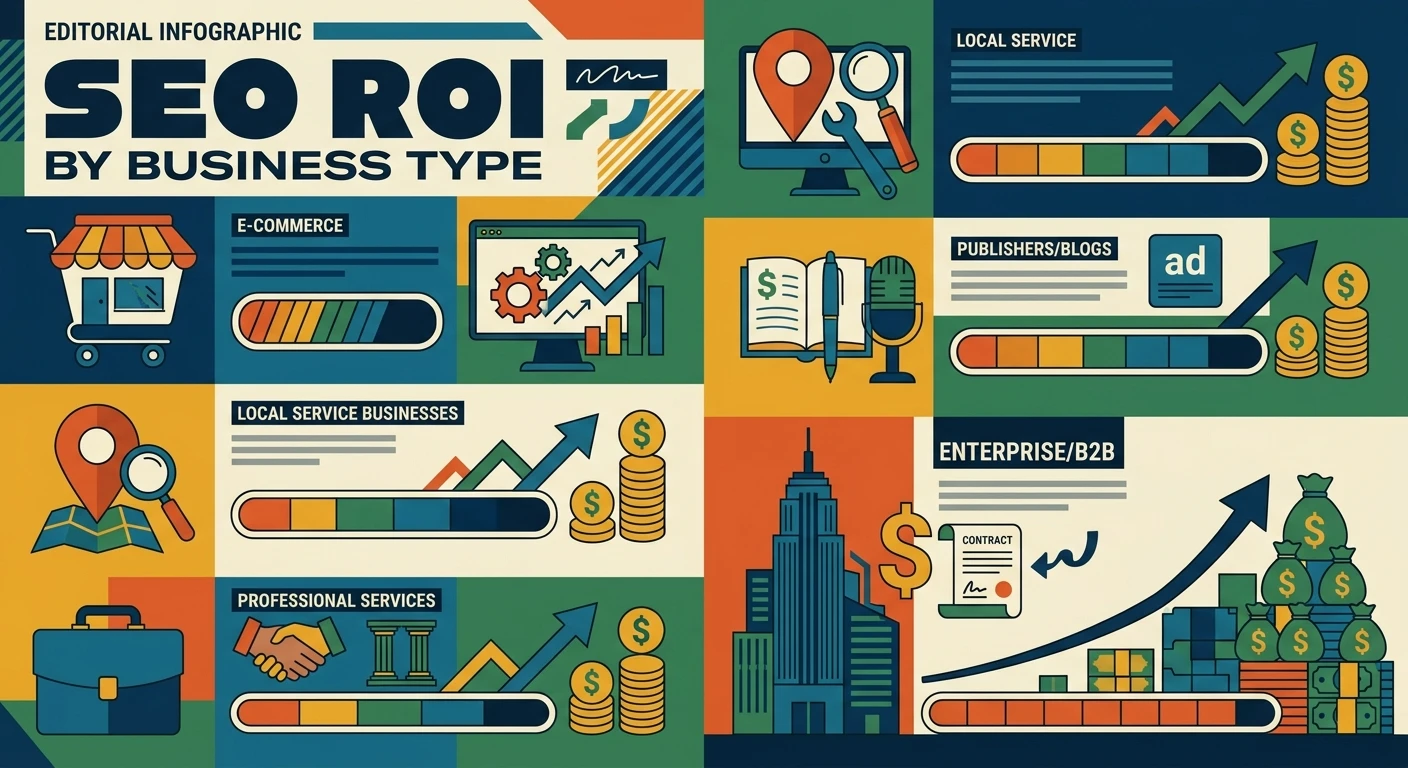
Not all businesses experience SEO ROI equally. The data shows meaningful differences based on business model, industry, and query intent.
Business Type | Typical SEO ROI Timeline | ROI Potential |
E-commerce | 6–12 months | Very high (transactional queries) |
B2B SaaS | 9–18 months | High (long sales cycle but high value) |
Local service businesses | 3–6 months | High (local intent is click-heavy) |
Publishers / blogs | 6–12 months | Medium (ad or affiliate dependent) |
Professional services | 9–12 months | High (trust-based, research-heavy buyers) |
Enterprise / B2B | 12–24 months | Very high (long-term, high-value contracts) |
B2B businesses tend to see longer ROI timelines but higher absolute returns because their average deal values are larger. A single enterprise customer acquired through organic search can represent $50,000 to $500,000 in contract value — making the ROI calculation on a $5,000 per month SEO investment straightforward even with an 18-month payback period.
The Impact of AI Search on SEO ROI — 2026 Update
The AI Overview landscape has genuinely changed some of the traditional SEO ROI calculations, and honesty about this is important.
Traffic from informational queries has declined for sites that have not adapted to AI citation. The click-through rates that underpinned traditional SEO traffic projections have compressed significantly for informational keyword categories. Content that used to drive 1,000 monthly visits may now drive 400 if an AI Overview answers the query directly.
However, the businesses adapting their SEO strategy are finding that the AI era actually improves ROI per visitor rather than destroying it overall.
Being cited inside an AI Overview earns 35% more organic clicks and 91% more paid clicks than ranking below it. Clicks that survive zero-click trends convert 23% better because they are higher-intent visitors. SEO investment that builds the brand authority and referring domain count needed for AI citation is producing compounding returns across both traditional rankings and AI visibility simultaneously.
The conclusion from the data: SEO ROI in 2026 is not dead. It is restructuring. The businesses that built their SEO ROI on high-volume informational content need to rebalance toward commercial intent and brand authority. The businesses that built on genuine expertise, original data, and deep niche authority are seeing stronger relative performance than ever because AI search is systematically removing their weaker competitors from the visible results.
SEO ROI Benchmark Table
Metric | Industry Average | Top Quartile |
Cost per lead (SEO) | $31 | Under $15 |
Organic close rate | 14.6% | 18–22% |
Monthly traffic growth (year 1) | 5–10% | 15–25% |
ROI at 12 months | 10:1 | 20:1+ |
ROI at 24 months | 20:1 | 40:1+ |
Content investment required | $2,000–$5,000/month | $5,000–$15,000/month |
FAQs
Research from Backlinko and multiple agency studies shows average SEO ROI of 22:1 over a 24-month period with consistent investment and quality execution. Early returns in the first 12 months typically range from 5:1 to 10:1, improving significantly as content compounds over time.
Most businesses see meaningful traffic and lead generation results within 6 to 12 months of starting SEO. Local SEO for established businesses can show results in 3 to 6 months, while new domains in competitive industries may need 12 to 18 months to generate significant ROI.
Yes — SEO produces a lower average cost-per-lead at $31 compared to $61 for PPC, along with higher close rates of 14.6% versus 10 to 12% for paid ads. Unlike paid advertising, SEO builds a compounding asset that continues generating returns after the initial investment is made.
Companies that blog consistently generate 55% more website visitors, and businesses publishing 16 or more posts per month earn 4.5 times more leads than those publishing 0 to 4 posts. A growing content library compounds in value over time, making it one of the highest-return activities within an SEO strategy.
Research consistently shows that a minimum investment of $1,500 to $2,000 per month sustained for at least 12 months is the threshold at which most businesses begin seeing clearly positive SEO ROI. Below this level, output quality and consistency are typically insufficient to build the topical authority and backlink profile required for meaningful ranking improvements.