The SEO versus PPC debate never fully ends because the honest answer is that both channels have genuine strengths. But the data in 2026 tells a clear story about which channel delivers superior economics over time — and it is not the one that gets the most attention in most marketing budget conversations.
SEO generates more traffic, at lower cost per lead, with higher close rates, and builds compounding assets that continue earning after the investment stops. PPC delivers faster results, better short-term control, and superior performance for specific high-commercial-intent queries. The question is not which channel is better in absolute terms — it is which channel is better for your specific situation, timeline, and budget.
Fun Fact: The top organic result on Google gets 27.6% of all clicks. The top paid result gets 2.1%. Organic search clicks outperform paid by more than 13 to 1 in click share — yet paid advertising typically consumes a larger share of most digital marketing budgets than SEO. The misallocation is one of the most persistent patterns in marketing.
SEO vs PPC Statistics 2026: Top Picks
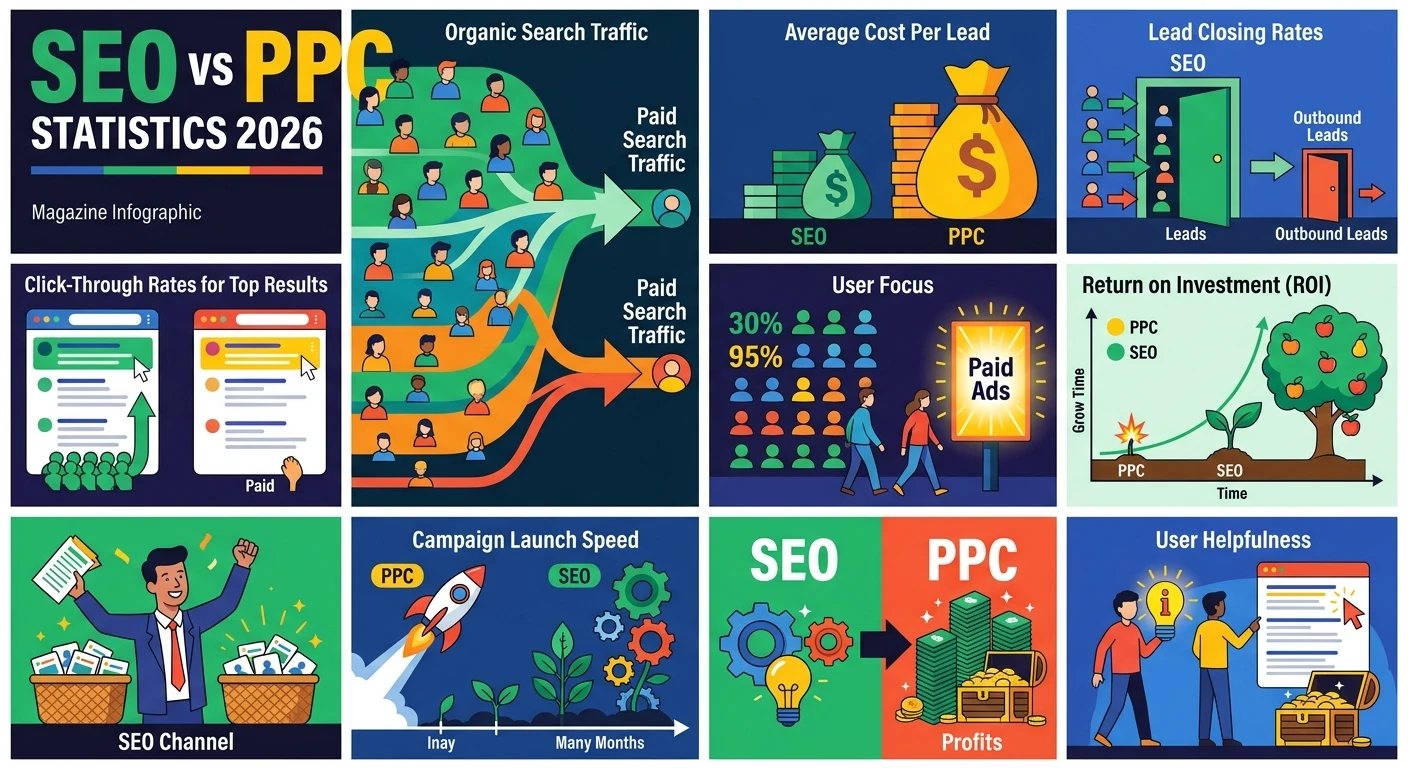
Organic search drives 53.3% of all website traffic vs 15% for paid search. (BrightEdge)
The average cost per lead from SEO is $31 vs $61 for paid search — a 2x difference. (HubSpot)
SEO leads close at 14.6% vs 1.7% for outbound leads. (HubSpot)
The top organic result gets 27.6% of clicks vs 2.1% for the top paid result. (Backlinko)
70–80% of users skip paid ads and focus on organic results. (MarTech)
SEO ROI averages 22:1 over 24 months vs PPC ROI at approximately 2:1. (Backlinko / WordStream)
61% of B2B marketers say SEO generates more leads than any other marketing channel. (HubSpot)
PPC campaigns see ROI immediately on day one vs SEO which takes 6–12 months.
Businesses combining SEO and PPC see 25% more clicks and 27% more profits vs using either alone. (Google)
75% of users say paid search ads help them find the information they are searching for. (Search Engine Land)
Traffic Volume — Where the Numbers Are Clear
Organic search generates 53.3% of all website traffic. Paid search drives approximately 15%. Social media drives about 5%. mediapost
The fundamental traffic numbers have been consistent for years and they consistently tell the same story. Organic search is the dominant traffic source by a margin that is not close. The channel that generates 53% of all website traffic receives less marketing budget and strategic attention than the channel generating 15%.
Traffic Source | Share of Total Web Traffic |
Organic Search | 53.3% |
Direct | ~15% |
Paid Search | ~15% |
Referral | ~7% |
Social Media | ~5% |
~4% |
What this means for you: If your traffic strategy is weighted more heavily toward paid search than organic, you are investing proportionally more in the channel delivering proportionally less traffic. This is not to say paid search has no value — it clearly does. It is to say that the marginal return on additional SEO investment is often higher than the marginal return on additional PPC spend, particularly at budget levels where both channels are already active.
Click-Through Rates — Organic vs Paid
The organic versus paid CTR data is one of the most cited and most misunderstood statistics in search marketing. The headline — top organic result gets 27.6% of clicks vs 2.1% for top paid result — requires context to interpret correctly.
Position | Organic CTR | Paid CTR |
#1 | 27.6% | 2.1% |
#2 | 15.8% | 1.3% |
#3 | 11.0% | 0.9% |
#4–7 | 3–8% | 0.5–0.8% |
#8–10 | 1–3% | Under 0.5% |
The context that matters: paid ads occupy different SERP real estate and target different query types. High-commercial-intent queries — “buy running shoes size 10” — have significantly higher paid ad click rates because the ad matches the intent precisely and appears before organic results. Informational queries have the inverse pattern.
70 to 80% of users skip paid ads and focus on organic results. This is the macro pattern. At the query level, it varies significantly — some purchase-intent queries see paid CTR exceeding organic CTR for the same total page.
Cost Per Lead — The Economic Comparison
This is where SEO builds its strongest long-term economic case.
Channel | Average Cost Per Lead | Average Close Rate |
SEO / Organic | $31 | 14.6% |
Paid Search (PPC) | $61 | 10–12% |
Social Media Ads | $58 | 3–5% |
Email Marketing | $23 | 8–12% |
Content Marketing | $88 (upfront) | 14%+ |
Outbound / Cold | $61+ | 1.7% |
The combination of lower cost per lead AND higher close rate makes organic search the economically dominant lead generation channel in this comparison. A lead from organic search costs half what a paid search lead costs, and converts at 14.6% versus 10 to 12% for paid.
The reason for the higher organic close rate is intent quality. Someone who found your business by searching a relevant keyword without any paid advertising intervention is making a genuine discovery choice. Someone clicking on a paid ad may be less far along in the decision process.
What this means for you: If you track cost per lead and close rates by channel in your CRM, compare organic versus paid on these two metrics specifically. The differential almost always favours organic for the same budget level — which is the core financial argument for investing in SEO.
The Time Dimension — PPC Wins Short-Term, SEO Wins Long-Term
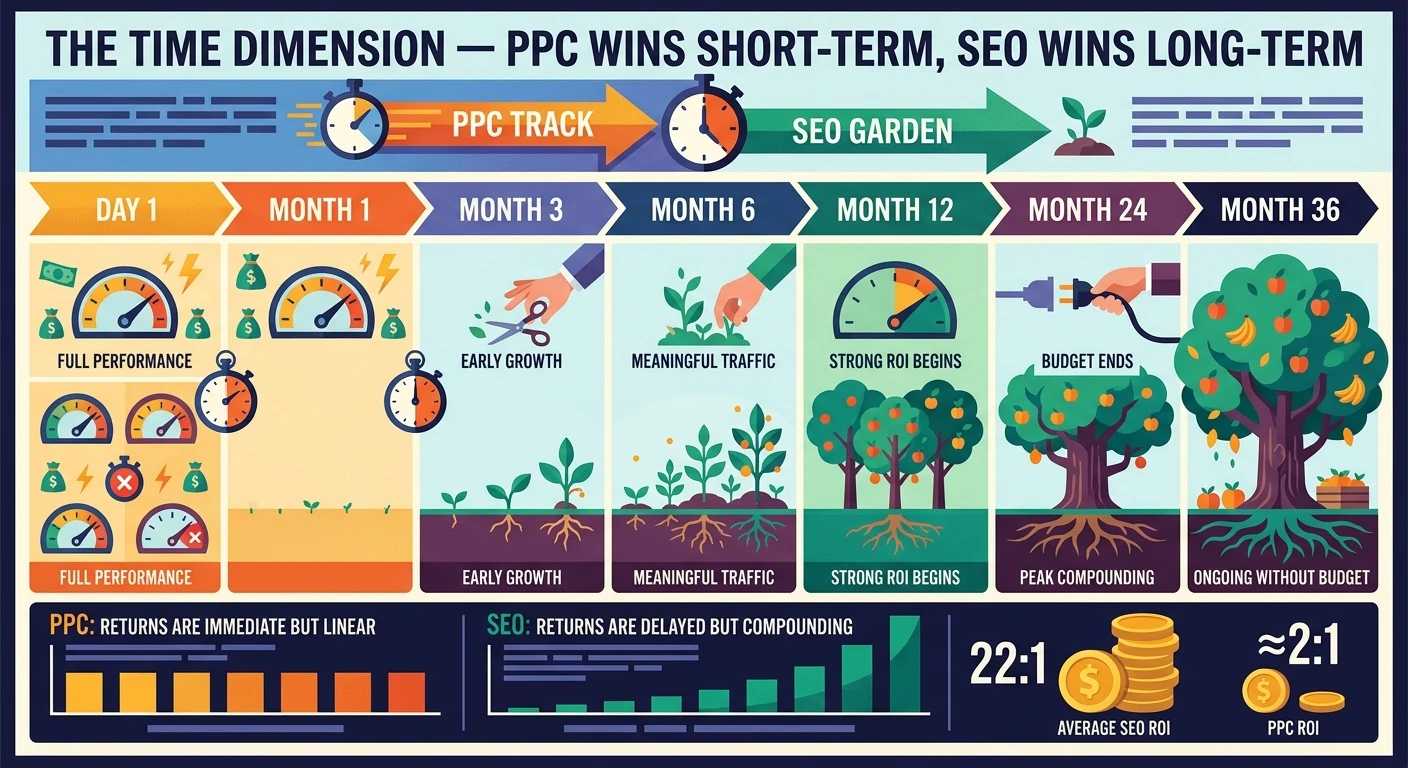
The honest characterisation of the SEO vs PPC trade-off is temporal. PPC wins on speed. SEO wins on economics over time.
Timeframe | PPC Performance | SEO Performance |
Day 1 | Full performance | Near zero |
Month 1 | Full performance | Minimal |
Month 3 | Full performance | Early growth |
Month 6 | Full performance | Meaningful traffic |
Month 12 | Full performance | Strong ROI begins |
Month 24 | Ends when budget ends | Peak compounding |
Month 36 | No residual value | Ongoing without budget |
This table illustrates the fundamental structural difference. PPC generates returns proportional to spend for exactly as long as you spend. The moment you stop the campaign, the traffic and leads stop. SEO generates returns that grow over time and persist after the active investment stops. The content published in year one continues earning traffic in year three.
The 22:1 average SEO ROI over 24 months versus approximately 2:1 for PPC reflects this temporal difference. PPC’s returns are immediate but linear. SEO’s returns are delayed but compounding.
When PPC Beats SEO — The Honest Assessment
The research does not argue that SEO always wins. There are specific situations where PPC is the clearly superior choice.
PPC is better when:
You need results in days or weeks, not months
You are testing a new product or market with uncertain demand
You are targeting extremely competitive terms where ranking organically would take years
You need precise control over targeting by geography, time of day, or audience segment
You are running a time-limited promotion or event
Your product or service has very high per-transaction value that justifies high per-click costs
SEO is better when:
You have a 12+ month time horizon
You are targeting informational and research queries that precede purchase decisions
You want to build a long-term traffic asset that compounds in value
Your cost per lead needs to decline over time rather than remain constant
You are building a brand that benefits from organic visibility and credibility signals
Both together is better than either alone:
Businesses combining SEO and PPC see 25% more clicks and 27% more profits versus using either channel in isolation. The reason is the reinforcing effect — PPC data informs the highest-converting keyword targets for SEO investment. SEO organic rankings provide credibility that improves PPC ad quality scores and click-through rates. Users who see a brand both organically and in paid results convert at higher rates than those who see either alone.
B2B vs B2C — Different Channel Dynamics
Business Type | Best Channel | Reason |
B2B SaaS | SEO-dominant | Long research cycles, information-heavy purchase decisions |
B2C E-commerce | PPC + SEO | Both shopping and research queries important |
Local services | Local SEO | Near-me intent, high-urgency queries |
Enterprise software | SEO + ABM | High deal values justify organic content investment |
Flash sales / promotions | PPC | Time-sensitive, cannot wait for SEO |
SaaS content marketing | SEO | Informational content drives trial sign-ups |
61% of B2B marketers say SEO generates more leads than any other marketing channel. This figure is particularly strong in B2B because the research-heavy, long-cycle nature of B2B purchase decisions aligns perfectly with SEO’s strengths — being present and credible when buyers are in their research phase.
SEO vs PPC Benchmark Table
Metric | SEO | PPC |
Time to first results | 6–12 months | Immediate |
Cost per lead | $31 average | $61 average |
Close rate | 14.6% | 10–12% |
24-month ROI | 22:1 | ~2:1 |
Traffic share | 53.3% of web traffic | ~15% of web traffic |
Residual value | High (compounds) | Zero (stops with budget) |
Best query types | Informational, research | Commercial, transactional |
Brand credibility signal | High | Moderate |
Targeting precision | Low | Very high |
Budget flexibility | High (long-term) | High (immediate) |
Frequently Asked Questions
SEO delivers approximately 22:1 ROI compared to approximately 2:1 for PPC over a 24-month horizon according to Backlinko and WordStream data. However, PPC generates returns immediately while SEO typically takes 6 to 12 months to gain traction.
New businesses with immediate revenue needs should start PPC for fast traffic while simultaneously building SEO for long-term growth. Once organic rankings begin generating traffic around months 6 to 12, PPC budget can gradually shift toward expanding SEO investment.
Yes — organic leads close at 14.6% compared to 10 to 12% for paid leads, reflecting the higher intent of users who found a business through genuine search. This difference significantly affects true cost per acquisition when evaluating channel performance.
No — Google has repeatedly confirmed that running PPC campaigns has no direct impact on organic rankings. PPC can indirectly support SEO by increasing branded search volume, revealing high-performing keywords, and testing content before committing to organic creation.
Research shows 70 to 80% of users skip paid ads and scroll directly to organic results during general web searches. Paid ad engagement is considerably higher for high-commercial-intent queries like product searches compared to informational research queries.